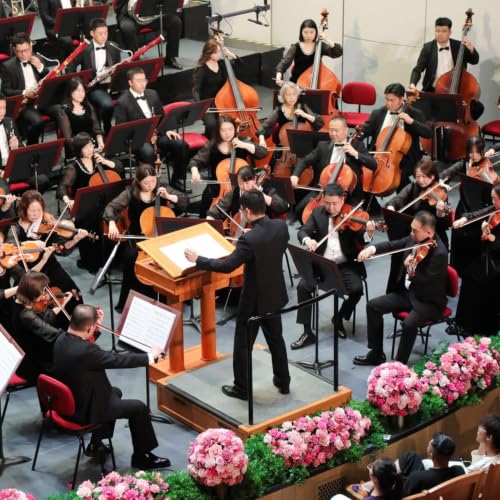
Symphonic Poem "Qinqiang Crossing Time": Where Ancient Melody Meets Symphony The symphonic poem " Qinqiang Crossing Time" is a bold and passionate work of musical exploration. It takes Qin Opera, one of China's oldest and most impassioned operatic forms, as its core material, and constructs a cross-temporal cultural dialogue through the universal language of symphony. The piece employs an original and innovative approach that blends Chinese and Western music and combines classical and modern styles. Within a scientific compositional framework, the composer draws inspiration from the "top-down view" concept in engineering drawing, overlaying contrasting elements such as Qin Opera and symphony, classical and modern, to create a unique musical structure. Additionally, the piece achieves a significant breakthrough in performance technique: the glissando playing on brass and woodwinds is a first in Chinese musical works, greatly enriching the expressive capabilities of the orchestra. It precisely captures and amplifies the desolate timbre of the Qin Opera banhu, the unique charm of the free rhythm (sanban), and the heroic spirit of the Qin Opera artist's "roaring" vocal style. This is not only an ode to ancient China but also a bold declaration for the future. It proves that China's cultural treasures can undoubtedly bloom with unprecedented radiance within the artistic paradigm of modern science, allowing the world to hear a Chinese voice that is both ancient and contemporary. 交响诗《秦腔穿越》:当古老秦腔与交响相遇 交响诗《秦腔穿越》是一部大胆而深情的音乐探索之作。它以中国最古老、最富激情的戏曲声腔 —— 秦腔为核心素材,通过交响乐这一世界性的音乐语言,构建了一场跨越时空的文化对话。 作品采用了原创的中西融合、古典与现代结合的全新方法。在科学的作曲框架下,作曲家借鉴工程制图中的 “俯视图” 思维,将秦腔与交响乐、古典与现代等对比元素进行交叉叠置,创造出独特的音乐结构。同时,乐曲在演奏技法上也实现了重大突破,铜管与木管的滑音演奏在中国音乐作品中尚属首次,极大地丰富了管弦乐队的表现力,精准捕捉并放大了秦腔板胡的苍凉、散板的独特韵味、以及秦腔艺人 “吼” 腔的豪迈气魄。 这不仅是一部献给古老中国的颂歌,更是一次面向未来的大胆宣言。它证明了中国的文化瑰宝,完全可以在现代科学的艺术范式中,绽放出前所未有的光彩,让世界听到一个既古老又现代的中国声音。
続きを読む
一部表示


 2026/07/2013 分
 2026/07/2013 分
 3 分
3 分 14 分
14 分