『Regulatory Ramblings』のカバーアート

Regulatory Ramblings

Regulatory Ramblings

著者: Reg/Tech Lab - HKU-SCF FinTech Academy - Asia Global Institute - HKU-edX Professional Certificate in FinTech
無料で聴く

このコンテンツについて

Welcome to Regulatory Ramblings, a podcast from the HKU FinTech team at The University of Hong Kong on the intersection of all things pertaining to finance, technology, law and regulation. Hosted by The Reg/Tech Lab, HKU-Standard Chartered FinTech Academy, Asia Global Institute and the HKU-edX Professional Certificate in FinTech, with support from the HKU Faculty of Law. Join us as we hear from luminaries across multiple fields and professions as they share their candid thoughts in a stress-free environment - rather than the soundbites one typically hears from the mainstream press.

© 2025 HKU FinTech
政治・政府 政治学 経済学
エピソード
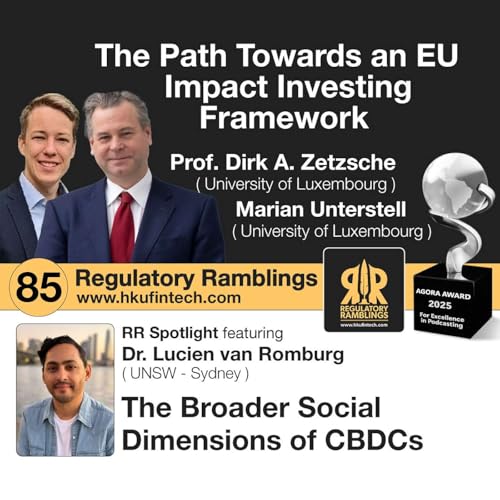
  • Ep 85 - Advancing the Impact Investing Framework + The Social Dimension of CBDCs
    2025/12/24

    Featuring Professor Dirk Zetzsche, Marian Unterstell, and Dr. Lucien van Romburg 🎧

    In this episode, Regulatory Ramblings explores two major themes shaping the future of financial regulation: retail CBDCs and their social dimensions, and the EU’s evolving impact investing landscape.

    The conversation begins with Dr. Lucien van Romburg, who unpacks his latest co‑authored research on why central banks must look beyond monetary policy when evaluating retail CBDCs. He explains how social needs, public engagement, and broader policy goals - from financial inclusion to technological innovation - must shape CBDC design. The discussion also examines international case studies, contrasting Australia, Europe, the US, and China, while highlighting why cash, education, and public trust remain central to any CBDC rollout.

    Later, Professor Dirk Zetzsche and Marian Unterstell discuss their proposal for a more effective EU impact investing framework. They explain why Europe’s current sustainability rules overemphasize compliance and input‑based metrics instead of incentivizing proven impact. The segment highlights the need for materiality, simplified reporting, proportionality for smaller managers, and a shift from exclusionary ESG strategies toward outcome‑driven investment models that genuinely improve environmental and social conditions.

    Topics discussed include:

    • Why CBDC decisions must consider societal impacts, not just monetary policy
    • Global contrasts: US prohibitions, EU digital euro, China’s digital currency strategy
    • Cash usage, public engagement, and the limits of existing payment systems
    • Why exclusionary ESG investing achieves little in practice
    • The case for shifting EU sustainable finance rules toward verified impact
    • The operational realities and costs of impact investing
    • Materiality, data burdens, and smarter regulatory design

    About Our Guests:

    Professor Dirk Zetzsche is a professor of financial law, the ADA Chair in Financial Law (Inclusive Finance), and co-lead at the University of Luxembourg’s National Centre of Excellence in Financial Technology Research & Innovation. He is also coordinator of the House of Sustainable Governance & Markets, and a member of the University’s Faculty of Law, Economics and Finance, as well as head of its Law Department.

    Marian Unterstell is a doctoral researcher, ADA Chair in Financial Law (Inclusive Finance), and a member of the University of Luxembourg’s Faculty of Law, Economics and Finance.

    Dr. Lucien van Romburg is a postdoctoral research fellow at the School of Private and Commercial Law and a member of the Faculty of Law & Justice at UNSW-Sydney.

    Regulatory Ramblings is brought to you by The University of Hong Kong’s Reg/Tech Lab, HKU‑SCF FinTech Academy, Asia Global Institute, and the HKU‑edX Professional Certificate in FinTech, with support from HKU Faculty of Law. The program is led by Douglas Arner and hosted by Ajay Shamdasani.

    Learn more at hkufintech.com/rr.


    HKU FinTech is the leading fintech research and education in Asia. Learn more at www.hkufintech.com.

    続きを読む 一部表示
    1 時間 11 分
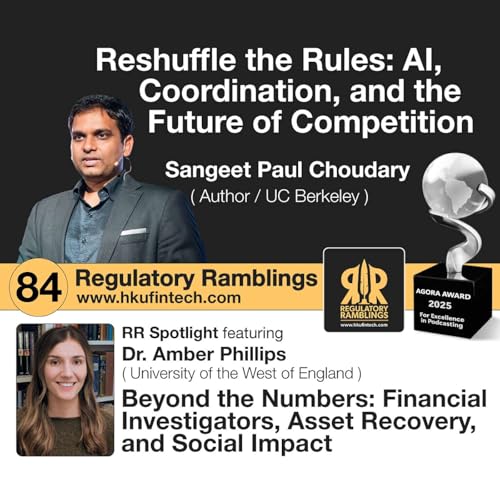
  • RR 84 - From Asset Recovery to AI Revolution: Risk, Coordination, and the Future
    2025/12/10

    Episode 83 with Sangeet Paul Choudary and Amber Phillips 🎧

    We explore two critical frontiers shaping the future of compliance, risk, and governance - from the fight against financial crime to the systemic impact of artificial intelligence.

    Spotlight: Amber Phillips on Asset Recovery and Financial Investigators

    We begin with Dr. Amber Phillips, Senior Lecturer in Criminology at UWE Bristol, who shines a spotlight on the often-overlooked heroes of financial crime enforcement: accredited financial investigators (AFIs). Amber explains why AFIs are indispensable under the UK Proceeds of Crime Act and how their work extends beyond financial crime into everyday policing. She challenges the misconception that technology will replace human expertise, arguing instead for integration between investigative skills and emerging tech.

    Amber also introduces her concept of the “Fifth D” - Destination - in asset recovery, emphasizing that success isn’t just about disruption or deterrence, but about where confiscated money ultimately goes. We discuss why stripping criminals of assets can be a more effective deterrent than custodial sentences, and why measuring success requires moving beyond headline figures to consider social impact and community reinvestment. For Amber, asset recovery is a story - not a statistic - and its ethical dimension matters as much as its financial one.

    Sangeet Paul Choudary on AI as a Technology of Coordination

    In the second half, we turn to Sangeet Paul Choudary, Thinkers50 Strategy Award winner and author of Reshuffle: Who Wins When AI Reshapes the Knowledge Economy. Sangeet reframes the AI debate, arguing that its true power lies not in intelligence but in coordination - acting as the “glue” that binds fragmented systems and redefines economic architecture.

    He dismantles common myths about AI as mere automation or efficiency, showing how it changes the logic of competition, governance, and value creation. From financial services to global platforms, Sangeet explains why legacy integration is a coordination challenge, why efficiency metrics mislead, and why firms must rethink workflows and business models rather than bolt AI onto old structures.

    We explore concepts like coordination without consensus, the coordination paradox, and the migration of value from execution to orchestration - where “above-the-algorithm” work becomes the new premium. Sangeet also highlights the enduring human advantage: judgment, curiosity, and narrative - the ability to frame questions and curate meaning in a machine-mediated world.

    Why This Episode Matters

    Whether you’re a compliance professional, a financial investigator, or a business leader navigating AI adoption, this episode offers practical insights and strategic foresight. From turning “bad money into good” to re-architecting workflows for an AI-driven economy, Episode 84 is a deep dive into the forces reshaping risk, regulation, and relevance.


    The Regulatory Ramblings is an award-winning podcast, honored with the Agora Award for Excellence in Podcasting, bestowed by the Compliance Podcasting Network for its outstanding contribution to thought leadership in compliance and fintech.

    The podcast is brought to you by The University of Hong Kong’s Reg/Tech Lab (Building Better Financial Systems), HKU-SCF FinTech Academy, Asia Global Institute, and HKU-edX Professional Certificate in FinTech, with support from HKU Faculty of Law. The program is led by Douglas Arner and hosted by Ajay Shamdasani.

    For more details and resources, visit: hkufintech.com/rr


    HKU FinTech is the leading fintech research and education in Asia. Learn more at www.hkufintech.com.

    続きを読む 一部表示
    1 時間 19 分
  • Ep 83 - Hong Kong’s New Protection of Critical Infrastructures (Computer Systems) Ordinance
    2025/11/26

    Episode 83 with Wendy Chow, Nicky Au, and Pierre Malgorn 🎧

    Hong Kong is stepping into a new era of cybersecurity regulation with the Protection of Critical Infrastructure Computer Systems Ordinance, set to take effect on January 1, 2026. What does this mean for businesses, and how will it reshape the city’s role as a global hub? In this episode of Regulatory Ramblings, host Ajay Shamdasani explores the ordinance’s implications, from compliance challenges to talent strategies and emerging threats like AI-powered attacks.

    The conversation begins with Wendy Chow, Head of Digital Technologies and Data Infrastructure at Invest Hong Kong, who explains why the ordinance is a proactive measure to strengthen Hong Kong’s position as an international financial, shipping, and trading hub. Wendy outlines the eight designated sectors - banking, energy, healthcare, transport, IT, telecommunications, and broadcasting - and stresses that the law moves beyond voluntary best practices to a robust legal framework. She also shares how InvestHK is providing hands-on support and guidance to help businesses adapt, attract cybersecurity firms, and build local talent pipelines.

    Later, Ajay is joined by Nicky Au, General Manager, Greater Bay Area at Ensign InfoSecurity, and Pierre Malgorn, APAC Director at I-TRACING Cybersecurity, for a deep dive into implementation strategies and board-level priorities. They discuss why risk-based approaches are essential, how to prepare for incident response and crisis communication, and why financial penalties alone won’t drive cultural change. Both experts emphasize that cybersecurity must be treated as a strategic business risk, requiring top-down commitment and continuous awareness training.

    The segment also looks ahead to AI-driven threats and the evolving compliance landscape. Nicky and Pierre explain why mere regulatory box-ticking is no longer enough and how attackers are leveraging AI to scale breaches - while defenders must use AI for detection and response. They argue that real security demands agility, visibility, and proactive threat hunting, not just adherence to minimum standards.

    About Our Guests:

    Wendy Chow is Head of Digital Technologies and Data Infrastructure at InvestHK, with over two decades of experience helping global tech firms establish and grow in Hong Kong.

    Nicky Au serves as General Manager, Greater Bay Area at Ensign InfoSecurity, specializing in cyber defense strategies and talent development.

    Pierre Malgorn is APAC Director at I-TRACING Cybersecurity, bringing deep expertise in governance, risk, and compliance advisory for critical infrastructure operators across Europe and Asia.

    The Regulatory Ramblings is an award-winning podcast, honored with the Agora Award for Excellence in Podcasting, bestowed by the Compliance Podcasting Network for its outstanding contribution to thought leadership in compliance and fintech.

    The podcast is brought to you by The University of Hong Kong’s Reg/Tech Lab (Building Better Financial Systems), HKU-SCF FinTech Academy, Asia Global Institute, and HKU-edX Professional Certificate in FinTech, with support from HKU Faculty of Law. The program is led by Douglas Arner and hosted by Ajay Shamdasani.

    For more details and resources, visit: hkufintech.com/rr


    HKU FinTech is the leading fintech research and education in Asia. Learn more at www.hkufintech.com.

    続きを読む 一部表示
    54 分
まだレビューはありません