エピソード

  • The Unfiltered Truth About Indie Publishing with Mark Leslie
    2026/03/08
    Mark is a writer, an editor, a professional speaker, and a book nerd with a passion for craft beer.He’s also an ambassador for the Canadian publishing industry and my mentor.Prefer video? Watch this interview on YOUTUBE. It’s worth your while… I include a clip where I failed to hit record on our 1st attempt at this interview. My expression and shock might be priceless. I met Mark Leslie several years ago when we took the same short story webinar. When he found out about my short story blog, he invited me onto his podcast.Here is my first chat ever with Mr. Leslie:Since then, we’ve become fast friends, and I bump into him all over the continent at writing conferences.All sorts of goodies in this podcast…You can learn more about Mark over at markleslie.caAngelique: You’ve said failure is just a data point and writers shouldn’t be afraid of it. What do you mean by that in publishing?Mark: I’ve been in this industry for a long time, and I’ve failed thousands of times. I’ve screwed up, done the wrong thing, and made mistakes constantly. But if it weren’t for those mistakes, I wouldn’t have learned. Sometimes, if something works accidentally, you think you knew what you were doing, and that can actually teach you the wrong lesson. Failure gives you information. It shows you what didn’t work, and that helps you adjust.Angelique: A lot of writers look for the magic formula. Is there one?Mark: No. There’s no magic bullet. There are good strategies, yes, but every single book is different, even for the same author. Every platform is different. Every reader is different. You can’t just copy what someone else did and expect the same result. You have to learn and adjust it according to what you’re writing, who you’re serving, and how you’re releasing it. A hundred authors can do all the so-called right things, and only a tiny percentage may still hit that perfect timing where everything aligns.Angelique: So writers shouldn’t just chase whatever seems to be working for everyone else?Mark: Exactly. Too many indie authors act like a bunch of ten-year-olds playing soccer, all chasing the ball around. They’re following the latest trend without thinking strategically. You have to think more like Wayne Gretzky, skating to where the puck is going to be. You have to figure out where your puck is, and your puck is going to be different from someone else’s. Most of the time it still won’t work, but every once in a while you’ll get a hit. That’s part of the game.Angelique: Is publishing really that unstable, even when something works?Mark: Absolutely. You can have a good year and still be broke the next year. There’s no guarantee in writing. You have to be able to pivot. I put out maybe three books a year on average, and they don’t all make money. Some books are successful, some do okay, and some are complete duds. So I’m playing the odds. I’m not waiting ten years and hoping one book becomes a blockbuster. I’m producing the books that are meaningful to me and releasing them with passion.Angelique: How important is talent compared to persistence?Mark: Talent matters, but it’s only one part of the equation. Persistence is huge. The writers who don’t quit are the ones who win. You’re going to get bad reviews, rejection, disappointing sales, and things that make you want to stop. But if you quit, that’s the end. You have to keep going.Angelique: How should writers handle negative reviews and readers who don’t connect with the work?Mark: You have to remember that not every reader is your reader. My mother never liked my writing because she was a romance reader and I didn’t write romance. That didn’t mean my books were bad. It just meant she wasn’t the ideal reader for me. The same is true with reviews. Some people are simply not the right audience. That’s okay. What matters is finding the people who do love what you write.Angelique: Why does having a body of work matter so much in publishing?Mark: Because one book rarely gives you enough leverage. When you spend money marketing one book, the math is tough. Maybe people click, maybe a few buy, but the return can be small. When you have more books, even if they’re not all in the same series, a reader who likes one can go looking for the others. That’s where the value of a backlist comes in. If someone discovers you and enjoys your writing, they may go buy more of your books. That’s one of the best reasons to keep building a body of work.Angelique: Does the backlist only matter if you write in series?Mark: Series make it easier, but no, it’s not only about series. If a reader connects with your voice or your storytelling, they may want more from you regardless. I’ve done that myself as a reader. I’ve read one book by an author and immediately gone out and bought everything else they wrote. That’s the power of a body of work.Angelique: For writers with anthologies or story collections, should ...
    続きを読む 一部表示
    32 分
  • Indie Book Selling Strategies with Cindy Gunderson
    2026/03/01
    Okay, my fellow writers and readers,You are in for a treat. This remarkable woman is one of a kind. She’s authentic, friendly, and gave me so much actionable advice.And inspiration.And hope.Cindy has managed to create a thriving business without losing her sense of humor or fun. Her latest a-ah moment? She’s giving away her audiobooks for free on YouTube.FOR FREE. (Check it out)Though it’s completely counterintuitive, this is driving more sales for her. (Listen to learn more.) If you like YouTube, here is our interview in video form.And can you believe she initially grew her business to gangbuster numbers by using free social media marketing?Yup.I was lucky to meet Cindy at Superstars last year. (If you wonder about the benefits of cons, the connections and people you meet are worth every penny.)Here’s her official bio:Cindy Gunderson is a voice actress, content creator, and award-winning author. Since she has commitment issues, she writes sci-fi and fantasy, plus contemporary romance and women’s fiction under the pen name Cynthia Gunderson.After 25+ years of performing, voiceover and commercial work, instructing piano and vocal performance, and directing children’s theater, she turned to audiobook narration and production. She’s narrated, mastered, and produced over fifty-five audiobooks since 2020 in her home studio and has created a massive audio listener following/community on TikTok, YouTube, and other various audiobook platforms.Cindy’s first novel, Tier 1, was awarded First Place in Science Fiction at the 2021 CIPPA EVVY Awards, and her women’s fiction novel, Yes, And, was honored with the Indie Author Award’s first place prize for best adult novel in the state of Colorado, 2023.Let’s get real here. All we have to do is look at her titles and cover art to be drawn in.How clever is that title? You can listen to it here.Or this one:(Listen to it here)Okay, I could do this all day. So go ahead and click play on the podcast (link at top) or our YouTube interview. Here are some highlights below.If you want to learn more about Cindy,Her website is here: https://cindygundersonaudio.comMost of my content is free, but there is another tier for those who want to take their short story writing to the next level. AF: How many books did it take until you started to see some traction in your career?CG: It took me until I had 12 books out before I was making some money, and over 40 before I hit six figures. AF: Let’s talk about the day-to-day. Writing full-time is hard. What’s your routine—CG: I’m still figuring it out. Life variables change—kids’ schedules, my husband’s schedule—so what works one year doesn’t work the next. I’ve leaned into curiosity. My favorite phrase is, “I don’t have to do it forever.” I’ll try a routine, and if I hate it, I change it.AF: So what are your productivity goals?CG: What got me to six figures isn’t what will get me to the next level. I maxed out what I could do alone, so now I have two assistants, and we’re moving toward expanding the business. AF: What are they doing for you?CG: One is international—she helps with audio editing and content creation. The other does formatting, promo submissions, admin, Shopify tasks, and she’ll be helping more with book maintenance and my YouTube channel. Delegation is a whole skill set.AF: I heard you say it took five years to get to six figures—was that right?CG: Almost four years.AF: And is that gross or net?CG: Gross. Net depends on ad spend. The first year I hit six figures, I barely spent on ads because social media drove sales. That changed in the last 6–8 months—TikTok slowed down, platforms shifted—so I leaned harder into paid ads.AF: I love your social media posts where you pretend to be thinking like one of your main characters. Do those actually drive sales?CG: Yep. They used to drive more on TikTok than they do now, but they still work. My strategy shifted: social media used to be my sales strategy; now it’s connection, reader retention, superfans. Paid ads are more of a straight sales engine. And honestly, all the pieces work together—social, ads, Amazon, Meta, YouTube—you don’t always know which one “caused” the sale. Once I stopped trying to control it perfectly, it worked better.AF: When you say paid ads, what do you mean?CG: Mostly Facebook and Amazon right now. I also do promos by discounting—Chirp deals, Barnes & Noble promos. BookBub deals were okay for me, but expensive and stressful, so I don’t submit much anymore. Audio promos have been huge for me.AF: Where do most of your sales come from? Are you in KU?CG: I was wide for ebooks and doing Draft2Digital, but when social sales slowed, I talked to others and tried going back into KU. It was a huge boost. My audio is still wide, though. AF: Which audio platforms?CG: Audible, Chirp, Nook, Kobo, audiobooks.com—everywhere. And also free on YouTube.AF: Doesn’t free hurt paid?CG: Not in my ...
    続きを読む 一部表示
    31 分
  • From Expertise to Authority
    2026/02/15
    Learn more about Matty at The Indy AuthorPrefer to watch? I really enjoyed this conversation with Matty and though her new ventures focuses on helping entrepreneurs and those approaching retirement establish the next phase of their career, her advice works perfectly for authors hoping to grow their platforms.Like me! When I find an author who has managed to make this a full-time gig, I am all ears!!!If you’d rather focus on short stories— which is the main thrust of this platform, and where I am BUILDING authority — check out this podcast with my mentor, Mark Leslie Lefebvre and Matty Dalrymple where we talk about short story strategies.Now back to building authority from expertise!Here are some of the highlights from my chat with Matty:Angelique: Your project is called From Expertise to Authority. What’s the difference between those two?Matty: Expertise is what you know. Authority is when other people recognize you as someone to listen to on that topic. A lot of people—especially later-career professionals—have deep expertise, but they haven’t built the visibility, relationships, and platforms that turn that into authority. Authority isn’t just knowledge. It’s knowledge plus reach plus trust.Angelique: You work with a lot of experienced professionals, not just new writers. What are they usually trying to figure out?Matty: Many of them already have a book out. They’re retired or transitioning careers and want to stay engaged, share what they know, and be seen as leaders in a new or adjacent field. Their question isn’t “How do I publish?” It’s “How do I become known as a go-to voice in this space?” That’s the shift from simply having written something to building authority around a topic.Angelique: You emphasize starting simply. Why is that so important?Matty: Because it’s much easier to add than to take away. If you launch with a complicated system—paid tools, elaborate production, lots of deliverables—you can trap yourself in work that isn’t sustainable. I learned this with transcripts for my podcast. I started offering heavily edited transcripts, and when I had to stop for time reasons, it felt like I was taking something away from my audience. If I’d never offered them, no one would have missed them. Start lean. Build only what proves useful.Angelique: You talk about the three steps to building authority. Can you walk us through them?Matty: Sure.* Showing Expertise– This is where you share what you know. Written content is powerful here: newsletters, articles, posts that demonstrate your knowledge. You’re showing people your thinking.* Growing Connections and Trust – Now people get to know you. Your voice. Your perspective. This often happens through podcasts, interviews, and conversations where your human presence comes through.* Being an Authority – This is where people pay for access to your expertise. Courses, consulting, editorial services, coaching, client work. You’re not just sharing knowledge—you’re applying mastery to help others directly.Angelique: For someone with a strong niche—like mine in paid, no-fee short fiction markets—how do they grow without going broader?Matty: You don’t necessarily have to widen the niche. Instead, deepen your relationship layers. You’re already doing expertise-based work through written guidance. You’re building personality-based connections through conversations like this. The next step is exploring authority-based offerings—paid newsletters, consulting, editorial feedback, submission strategy help. That lets you be deeply meaningful to a specific audience rather than vaguely useful to a huge one.Angelique: You’re big on repurposing content. How does that fit into building authority?Matty: It’s essential. Every piece of content should do multiple jobs. An article can also be a podcast episode if you read it aloud. That article might become a chapter in a future book. An interview becomes both relationship-building and source material for your ideas. When you think holistically, you’re not creating ten separate things—you’re creating one idea that moves through multiple formats. That’s how you grow authority without burning out.Angelique: Let’s talk platforms. Why do you like newsletter ecosystems like Substack for this stage?Matty: Because you own the relationship. You have the email addresses. If a social platform changes or disappears, you can take your audience with you. It’s also low-cost, which matters when you’re in the building phase and not expecting immediate profit. It lets you experiment without heavy financial pressure.Angelique: How do in-person events factor into authority building?Matty: They’re powerful for two reasons. First, you observe your audience—what resonates, what doesn’t, what problems people actually talk about. Second, you build real relationships. You meet peers, speakers, organizers. Those connections lead to invitations, collaborations...
    続きを読む 一部表示
    31 分
  • Selling your Novel with Cherry Weiner
    2026/02/08
    Join my chat with Cherry Weiner as we go over…📝 How our editing process works📖 What the big publishers are looking for🧭 How long it REALLY takes to go from book deal → bookstore shelf💡 Smart moves that help authors build lasting careersI finished my first novel, City Lights to Country Nights, last February and signed with Cherry Weiner at Superstars 2025 last year. (This year’s con starts Feb 4 in Colorado, but I am missing it this year.)The only way to query Cherry is to meet her in person, and she signed a few of us from last year’s convention! It’s been a year of trying to sell my book, and here’s your chance to eavesdrop on our conversation as Cherry talks about me through the realities of the publishing world and the best way forward to success for an author.Join the next tier and read my cold email to Cherry before the con and the winning query letter!AF: A lot of writers imagine you write a book, get an agent, sell it, and a few months later it’s in stores. What’s the real timeline from book sale to publication?CW: Much longer than people think. First, editors can take months just to read submissions — three, six, sometimes nine months. If they love it, they still have to take it to an acquisitions meeting where sales, legal, and other editors weigh in. If it passes, we negotiate the deal, which can take a week or even months. Then, contracts take weeks to process. After the manuscript is accepted, publication is often scheduled up to 24 months later because publishers buy books years in advance.AF: I didn’t know about the acquisitions meeting. Does this mean an editor can love your book and still reject it?CW: Absolutely. An editor can be passionate about a book, but if the acquisitions committee says no, the deal is dead. Publishing decisions are business decisions as much as creative ones.AF: How has publishing changed since you started?CW: It’s much harder now. I used to be able to sell a book on three chapters and an outline. Today, especially for new authors, I need a complete, polished manuscript before submitting. Publishers are taking fewer risks.AF: How many major publishers are we really talking about now?CW: Very few. There are about four or five major houses left, plus some big independents. And many imprints under the same umbrella consult together, so if one says no, that often closes doors within that house.AF: What does a manuscript need today for you to say yes?CW: I have to feel like I’m not reading — I’m there in the story. If I can put it down easily, it’s a no. It has to pull me in completely and make me want to turn the page.AF: What’s a common character mistake you see?CW: Weak protagonists. Today’s readers and editors want strong, capable main characters — especially women. Not “wet noodles.” Growth is great, but they need strength from the start. (Authorial note: Cherry originally thought the main character in my cowboy romance was a “wet noodle” and was going to say no. But I convinced her to let me take another crack at it. And hired Bruce McAllister to help me. DM me if you want to learn more about hiring Bruce.)AF: Do editors still buy series from new authors?CW: Not the way they used to. I try to pitch series, but most editors will buy one book first and wait to see how it performs before committing to more.AF: How long will you keep submitting a book before giving up?CW: I keep going as long as I believe in the author and we have options. Sometimes we pause and try another project. I once worked with an author for six years before selling the right book — but it was in the genre she truly loved writing.(Authorial note: This eased my mind greatly. I was panicking about my book not being sold after a year of being pitched to editors. Cherry won’t give up on me if I don’t give up on writing. I am considering creating book #2 in this world. After I complete a million other projects, of course. Squirrel anyone?)AF: How important is an author’s platform now?CW: Very. One of the first things editors ask is about social media and audience. Discoverability is a huge issue, and having a following helps prove there’s a readership.AF: When does it make sense to use a pen name?CW: If you’re switching genres and don’t want to confuse readers, or if previous sales were weak. Editors can see sales history, so sometimes a fresh start with a new name helps.AF: What makes a great agent–author relationship?CW: Trust, honesty, and communication. It’s like a business marriage. You’re trusting me with your work, so transparency is essential.AF: What’s your best advice for writers pitching agents or editors?CW: Be natural. Don’t read a script. Put your best foot forward — and ideally, have a complete manuscript ready.Curious how I found my agent? Read my cold email and the winning query letter.Cherry Weiner only takes queries from authors she meets in person. I knew she was going to be attending Superstars ...
    続きを読む 一部表示
    37 分
  • Writing for TV & Film with Chris Goldberg
    2026/01/22
    Don’t miss this raw and authentic interview with Chris Goldberg. He tells the honest truth about optioning IP for film and the current state of the industry.He’s rarely interviewed, so I am so grateful he’s chosen to share his story with us.Prefer to watch your interviews? See it on YouTube.Chris Goldberg is veteran in the film industry and is heavily involved the book-to-film world. He’s the founder and force behind Winterlight Pictures and is working on over 25 projects at places like A24, Netflix, Sony, Plan B, 87Eleven, and Lionsgate to name a few. He’s been been involved in huge hits like The Martian, and The Fault in Our Stars. Some of his projects currently in development include The Maid with Universal Pictures, and Biter staring Zöe Kravitz.Here is a notice in deadline.com about one of his projects which involves Patrick Hoffman’s The White Van.Black Label Media’s Molly Smith, Rachel Smith, Thad Luckinbill and Trent Luckinbill will produce alongside Chris Goldberg at Winterlight Pictures, who brought the project to Singer and Black Label Media, with Black Label also financing. Seth Spector will executive produce.Here are some of the highlights from the interview:AF: Can you tell people a bit about who you are?CG: You were one of the very first people I met on Substack when I started, so it’s really great to be here talking with you. I’m a producer and a writer. I started my career in New York as a literary scout, finding books to turn into movies for Fox. I did that for about ten years, reading constantly and reporting back to executives on what might work as film or television. After that, I moved to Los Angeles and worked as a development executive.About five years ago, I started my own production company, Winterlight Pictures, and at the same time I began writing again for the first time in about twenty years. Substack has been a completely unexpected experience for me. I didn’t go there with a big plan, but it’s turned into a creative home and a place where I’ve met people—like you—who share similar interests in storytelling, film, and the business behind it all.AF: What is Winterlight Pictures, and how does it fit into your work as both an executive and a creator?CG: Winterlight Pictures is my production company, and it really allows me to combine all the different parts of my background. When I was coming up in the industry, there was very much an attitude that being an executive and being a creative had to be separate. If you were a producer or development executive, you weren’t supposed to be a writer.For a long time, that separation shaped my life. I always wanted to write, but I was deeply immersed in developing other people’s work. Now, having my own company gives me the freedom to wear multiple hats. I can develop projects, produce them, and also create my own material. That balance works for me in a way that it never could when I was under a studio contract.AF: You’ve mentioned before that you stopped writing for a long time. Why did that happen?CG: When I was coming out of NYU, I was very focused on being a writer. I met director Whit Stillman when I was about twenty-one, and I asked him for advice. I told him I was about to take a job as an assistant and reader at Fox, and I asked whether he thought that was a good idea.“If you want to be a writer, go work at a gas station. Don’t take that job.” Whit’s advice to ChrisHis reasoning was that I’d be reading five-hundred-page books for studios every weekend, and the last thing I’d want to do afterward was sit down and write my own work. He was completely right. I took the job anyway, and I didn’t write again for almost twenty years.AF: So, should you have taken that job at the gas station?CG: I don’t regret it exactly, but I do think about it a lot. For twenty years, I worked with writers, read constantly, gave notes, developed scripts, and helped shepherd projects forward—but I didn’t write myself. When I finally came back to it five years ago, it felt like rediscovering a part of myself that I’d put away.At the same time, I gained an incredible education. I saw how projects really get made, how many drafts it takes, how notes shape a script, and how ideas evolve. So while I lost time as a writer, I gained perspective that I wouldn’t trade.AF: How did that background shape you as a writer once you returned to it?CG: My version of the “10,000 hours” was working at Fox. (Authorial note: Malcolm Gladwell famously said it takes 10,000 hours of practice to achieve true expertise.)Writing loglines, reading submissions, and getting immediate feedback from executives rewired how my brain works. You learn very quickly what makes an idea pop, what feels urgent, and what feels commercial.I also learned by watching writers revise. Seeing draft after draft, watching how notes land, and how stories change in response—that’s an education you can’t really get anywhere else. All ...
    続きを読む 一部表示
    33 分
  • Making Horror Movies with Robert Stahl
    2026/01/11
    Prefer to WATCH this interview? CLICK HERERobert Stahl is a long-time writing friend of mine and we met because he follows my monthly short story call lists. This Texan native also makes the most blood-chilling (and fun) little horror movies.Check them out! You Better Watch Out (trigger warning: gory)Trick (trigger warning: really spicy and gory)Think Robert Rodriguez.I saw his latest Christmas horror short on YouTube and decided a catch-up in 2026 was a must-do. Learn more about Robert at www.robertestahl.com.We also talk about his recent anthology Show Me Where It HurtsAngelique: One thing that really stands out about you is that you’ve actually made horror movies—something many writers dream about. Can you tell us about your short films?Robert: I’ve done two short horror films, both under ten minutes. I wrote and produced them and worked with a very talented local director. The first was a gay slasher short called Trick, and the second was You Better Watch Out. The second one won Audience Choice at a local film competition, which I’m very proud of.Angelique: Is filmmaking something you see as profitable, or is it more of a passion project?Robert: Those films were definitely passion projects. They’re more expensive to make than they are profitable. For me, they were a way to learn the process and train myself. I do have ideas for full-length screenplays, but with a full-time job, it’s all about finding the time.Angelique: Your production quality is impressive. It feels like the industry should be snapping this kind of work up.Robert: Thank you. I think it’s possible to get there eventually, but I have to focus on one project at a time. Right now, that focus is writing fiction.Angelique: Let’s talk about your short story collection. Why did you choose to work with JournalStone instead of self-publishing?Robert: I wanted the experience of working with a publisher. I liked the reputability and the extra validation. I shopped the collection around for about a year and a half, got plenty of rejections, and eventually connected with JournalStone after seeing other authors I respected working with them.Angelique: What did that publishing process look like?Robert: They handled formatting, cover art, ebook versions, and distribution. It was a very smooth process, and I’d recommend them to other writers.Angelique: Was it financially worthwhile?Robert: I’m not retiring anytime soon, but it did reasonably well. It’s a profit-split model, not an advance, and everything was very transparent. I’d happily work with them again.Angelique: There’s a lot of talk online about big numbers and writing income, but not much honesty about expenses. What’s your take?Robert: Exactly. There are many ways to lose money in publishing. My experience with JournalStone was straightforward and fair, but writing—especially short fiction—is rarely career-changing income.Angelique: Do you see novels or novellas as the next step?Robert: Definitely. When you go to conventions, authors with more books have more opportunities. I want to build my inventory—novels, novellas, maybe comics or screenplays.Angelique: Are you aiming to make writing your full-time career?Robert: I made peace with the fact that I do this for love, not money. If something big happens, great—but that’s not my focus. Having a day job lets me create without pressure.Angelique: I think we write horror for similar reasons—processing difficult things in the world. Is that true for you?Robert: Absolutely. I’ve had a dark inner world since childhood. Writing horror helps me channel it. My mother had dementia, and that experience directly inspired one of my stories, Family Time. Writing gives me a way to work through those emotions.Angelique: That comes through in your work. Your film You Better Watch Out barely has dialogue, which I didn’t even notice when watching.Robert: That was intentional. We wanted to challenge ourselves and rely on visual storytelling. There are maybe a couple of spoken lines, but it’s mostly pure action and atmosphere.Angelique: What’s your main focus going into 2026?Robert: Building more work—hopefully another short story collection, a novel or novella, and continuing to explore screenplays and comics. I just want to keep getting better.Angelique: And where can people find you?Robert: I’m on all the socials, and my website is robertstahl.com, where people can also sign up for email updates.If you want to hear my ORIGINAL interview with Robert, check it out here. He also reads his short story “Treats.” This is a public episode. If you'd like to discuss this with other subscribers or get access to bonus episodes, visit angeliquemfawns.substack.com/subscribe
    続きを読む 一部表示
    19 分
  • Writing Stories with Eda Easter
    2026/01/06
    Welcome to SEASON 2 of Read Me A Nightmare!We are shifting the focus of this podcast a little and focusing on interviews and insights to help YOU sell stories in 2026. The Last Girls Club is OPEN for submission right now.Prefer video? WATCH the interview here.Horror - Theme for Spring’s Issue: Haunted - Jan 1-15 - 2500 words or less - pay .015 cents per word, $15 USD max - sub sims welcome - no reprints.Haunted. In the night; in the dark. We’re going old school Shirley Jackson “and the furniture laughed” creeping dread. It doesn’t have to be a house, it could be a submarine, a tent, a treehouse, a rabbit warren, whatever. Save the monster until the very end. We want growing shadows, days lost, locked doors that are suddenly ajar, lost journals in random cabinets. Do your worst, but give us your best.More about this market: I want stories from the female gaze (think Aliens, Resident Evil, Hereditary, Tank Girl). I’m tired of reading what men want to do to us. I want to read what we want to do to them. Bring me smart female protagonists whose first inclinations are not to seduce the guard to get out of situations; they’ve got skills, they can get violent easily. I’m fine with them developing over the course of the story into someone like that, but please don’t revert to clichés unless you have your tongue firmly in your cheek. Please don’t use graphic rape for fridging purposes. If it’s part of a character’s backstory or development, fine, but don’t shoot the damn dog just to piss off your main character.My focus is horror, supernatural, and creeping dread. I’m not averse to extreme/slasher horror. I always love a bit of sci-fi or dystopia, but it’s not our focus, so if it’s your venue, make it scary. If you spackle a layer of women’s issues into it, even better; such as disenfranchisement, slut-shaming, violence against trans people, racism, misogyny, sex work exploitation, inequitable emotional work and housework, whatever exists in this world that pisses you off, feel free to put a metaphorical ax between its eyebrows.SUBMIT HERE(Listen to the podcast to hear more about this particular call.)I volunteer my time helping the short story world for free. But if you could join the next tier, not only will you get free books (with market insights), you get extra content to accelerate your fiction career!My Insights: I sold a story to Eda for the Fall 2021 issue, The Gay 90s, and through the editing process became fast friends with this truly gorgeous human being. There is only one Eda Easter in the world, and I don’t know if that is a blessing or a curse. I just know I absolutely love her. Lucy and the Cosmic Comet ride was my way of processing the Heaven’s Gate mass cult suicide. As always, I like to take something dark and put a positive spin on it.At the bottom of this post, you’ll find links to the last two episodes I recorded in Season One with Eda. This includes little excerpts from her writing, including a chapter from Killer RV.Cool things referenced in the interview.Last Girls Club PatreonVillian ClassAngelique: I’m here today with one of my favorite people, Eda Easter of Last Girls Club magazine. Let’s chat.Eda: We’re live!Angelique: You wanted to talk about the spring theme for Last Girls Club, which is “Haunted.”Eda: Yes—and haunted can mean a lot of things. Haunted treehouse, haunted suburb, haunted warren—I don’t care. I wanted to do something lighter, because the winter issue was secret police, ice, and desperate times.Angelique: Very dark. Very serious.Eda: Very boots-on-the-ground. So I thought, let’s shift toward something more Shirley Jackson–style haunted. Let’s lighten it up—which is funny, because that’s what counts as light for us.Angelique: I love it. Ghost stories are the most fun. The Haunting of Hill House is one of my favorite books and movies of all time.Eda: My favorite line is “and the furniture laughed.” That moment where you realize everything is coming for you—even the ottoman. An evil ottoman!Angelique: Now you’re staring at your ottoman, aren’t you?Eda: Absolutely.Angelique: So tell me, what is it about Last Girls Club? You really embrace the feminine gaze. Punk rock feminist.Eda: Angry women. I realized that’s the core of it. Angry women are not crazy. So many of my favorite characters are women who would burn things down—or had to be killed off or “fixed” so they could be happy and get married.That’s why I hated Cruella. They framed her as evil because she was ambitious, great at her career, and didn’t want to give it up for a kid. That really got under my skin.Angelique: Okay, note to self: don’t watch if I don’t want to be enraged.Eda: You should watch it because it’s enraging. Disney is insidious about enforcing norms for girls.Angelique: And we’re all Tank Girl around here.Eda: Always.Angelique: I love evil heroines. They’re my favorite. I spent so many years caring if...
    続きを読む 一部表示
    17 分
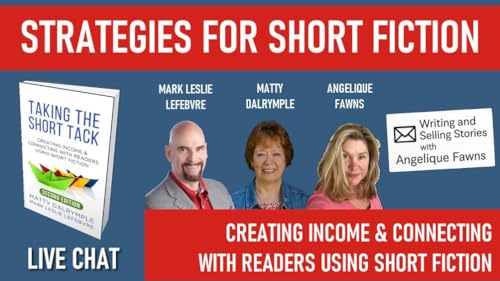
  • 55 Strategies for Short Fiction with Mark Leslie, Matty Dalrymple and Angelique Fawns
    2025/11/23
    This episode was originally created for the Stark Reflections podcast and hosted by Mark Leslie. I’m rebroadcasting it here on Substack for my short fiction writing friends. If you're a short story writer, or would like to be, you can’t miss this episode!Mark and Matty wrote an absolutely wonderful guide called Taking the Short Tack: Creating Income and Connecting with Readers Using Short Fiction, and this conversation is based on advice from that book.I consider Mark one of my mentors, and I learned so much from a consulting session with him (you can book your own HERE). It was on his advice that I reused my shorts in collections and braved a Kickstarter.Matty is a new find for me, and not only have I fallen in love with her, but I’m also obsessed with her character, Ann Kinnear. (This protagonist solves mysteries AND talks to dead people.)Here is a bit of what you’ll hear…Mark’s Take: Short Fiction Builds Careers Over TimeMark started writing in the 1980s, when selling short stories to magazines was the way to break in. Editors looked for proof you could deliver clean, compelling writing in a tight format.But decades later, Mark still finds short fiction valuable because:* You can sell it multiple times (first rights, reprints, anthologies)* You can collect stories into themed mini-books* You can serialize audio versions on YouTube or podcasts* You can use them in Kickstarters or special editions* You can pair them with long fiction for reader magnets or bundlesIn Mark’s world, a single story has many lives.Matty’s Take: Short Fiction Serves Your Existing ReadersMatty didn’t start in short fiction—she added it after she had two suspense novels out. But she realized:* Readers wanted more stories in the same world* Short fiction let her keep fans engaged between novels* Standalone shorts sell surprisingly well as ebooks* Holidays & seasons create perfect mini-launch momentsHer readers binge a full series… and then can keep getting a fix with the shorts.Short fiction becomes continuity glue.But Angelique, I’m not ready to do a full novel series? (Yup, I’m not quite there yet either.)This is my method and how Mark grew his career:* Write a story* Start with the highest-paying markets* Work your way down* Track your submissions* Push for pro rates when possible* Sell reprints after first publication* Later, collect the stories into minis or anthologiesWhy this works:* You build credentials quickly* You build relationships with editors* You grow an audience organically* You can resell the same story multiple times* You keep building a library of IPA 3,000-word story at pro rate (8 cents/word) earns $240—as much or more than many books earn in a full year.Short fiction can pay.Matty uses short fiction a little differently:* Standalone stories for $1.99* Available on Amazon, her website, and especially Curios* Seasonal releases (Halloween, Thanksgiving, etc.)* Shorts tied directly to her existing series* Audio editions added for bonus valueWhy this works:* Readers already love her worlds* They will pay small amounts for more content* Direct platforms give better revenue splits* Audio + ebook bundles add high perceived value* No waiting months for rejections* No rights tangles, no contracts to decodeTools, Platforms, and ServicesHere are the most useful tools that came up in our conversation.So, I’d never heard of Curios before, but it’s Matty’s fav tool. (Here is her store) https://www.curios.com/creators/mattydalrymple-X449BRCURIOSPerfect for direct sales.* Writers keep 100% of the list price* Readers pay the fees* Has its own e-reader and audio app* Allows ebook + audio bundles without price-parity issues* Costs around $20/yearI personally use Gumroad, but in two years, I’ve earned a total of $3.74, so I’m not sure it’s working for me. BOOKFUNNEL Matty, Mark, and I use BookFunnel to:* Deliver reader magnets* Deliver short story collections* Send ebooks securely* Reduce tech headaches for new subscribers* Host downloads for Kickstarter backers* Track who actually downloads the bookDRAFT2DIGITAL For print copies of short stories:* D2D Print auto-builds your wraparound cover* As long as you reach ~24–30 pages, it works* Great for in-person events, swag, bundles* Extremely low print costThese are powerful as:* giveaways* Kickstarter add-ons* “buy-two-books-get-a-short-free” convention dealsRights, Risks, and PitfallsWatch out for:* Markets that count public drafts as “published”* Anthologies grabbing all rights forever* Ambiguous language around audio or film rights* Submission platforms that default to “public”If you want to learn more about short fiction contracts, Michael La Ronn has a great video HEREUsing Short Fiction to Build Novels Matty writes short pieces inside her Ann Kinnear world.Mark has reused stories across platforms for 20+ years.And I’m now writing my stories inside the universe of my novel-in-progress. (You can join the adventure! I’...
    続きを読む 一部表示
    1 時間 4 分