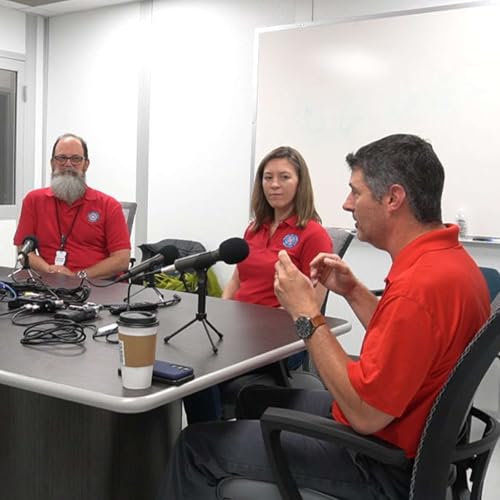
『RSM River Mechanics Podcast』のカバーアート

RSM River Mechanics Podcast

RSM River Mechanics Podcast

著者: Stanford Gibson
無料で聴く

今ならプレミアムプランが3カ月 月額99円

2026年5月12日まで。4か月目以降は月額1,500円で自動更新します。

概要

Conversations about River Mechanics, Sediment Transport, and Fluvial Geomorphology

© 2026 RSM River Mechanics Podcast
博物学 地球科学 科学 自然・生態学
エピソード
  • Bill Dietrich on Meander Mechanics, Hillslopes, and Where Rivers Begin
    2026/04/10

    Over his career Dr. Bill Dietrich has had an outsized influence on both the discipline of geomorphology and the community that surrounds the discipline. He is Professor Emeritus in the Department of Earth and Planetary Science at the University of California, Berkeley. Dr. Dietrich is one of the most influential geomorphologists of the last several decades, known for developing process-based theories of landscape evolution and geomorphic transport laws for soil production, hillslope transport, and river incision. His work spans hillslopes, rivers, debris flows, sediment transport, and the coupling of ecological and geomorphic processes. Over his career he has helped establish many of the conceptual and quantitative frameworks that modern geomorphology relies on today, and his publications are close to 70,000 citations (which is a truely astounding number). He was elected to the U.S. National Academy of Sciences in 2003 and has received several of the field’s highest honors, including the Robert E. Horton Medal of the American Geophysical Union for outstanding contributions to hydrology and the G.K. Gilbert Award for major advances in Earth-surface processes, which is apt because I see his work embodying Gilbert's tradition. Bill also began "the Gilbert Club" an AGU adjacent gathering that has become a center of mas for the geomorphic community, which we talk about in the episode.

    As I try to grow in my ability to predict river behavior and manage our interactions with our nation's waterways, I find I'm learning - approximately in equal parts - from the worlds of engineering and geomorphology, so I am trying to deliver heuristics and insights from those overlapping - but separate - thought worlds. In this episode we go deep into the science of upland river processes, including insights that have helped me along the way.

    We will have some bonus content on the YouTube channel...but you won't want to miss this: https://youtu.be/fixiMpBB3LE
    (an easter egg priview for the people who read episode notes)


    This series was funded by the Regional Sediment Management (RSM) program.

    Mike Loretto edited the first three seasons and created the theme music.
    Tessa Hall is editing most of Season 4.

    Stanford Gibson (HEC Sediment Specialist) hosts.

    Video shorts and other bonus content are available at the podcast website:
    https://www.hec.usace.army.mil/confluence/rasdocs/rastraining/latest/the-rsm-river-mechanics-podcast

    ...but most of the supplementary videos are available on the HEC Sediment YouTube channel:
    https://www.youtube.com/user/stanfordgibson

    If you have guest recommendations or feedback you can reach out to me on LinkedIn or ResearchGate or fill out this recommendation and feedback form: https://forms.gle/wWJLVSEYe7S8Cd248

    続きを読む 一部表示
    1 時間 28 分
  • Cohesive Sediment Properties and Processes with David Perkey, Jarrell Smith and Danielle Tarpley
    2026/03/13

    So far on this podcast we've generally used the noun "sediment" to describe sand, gravel, and maybe cobbles and boulders. But the same word also gets used for silts, clays, and muds - materials that behave so differently that lumping them together as "sediment" can blur important distinctions. This podcast was overdue for a conversation about fine sediment, and I knew exactly who I wanted to talk to.

    In the notebook where I track episode ideas, I labeled this one the “ERDC Cohesive Brain Trust.” I wanted to sit down with the team for the Corps of Engineers that I call when I have questions about "very small sediment", and the team I point engineers toward when they need cohesive measurements or insight for a project or model.

    That team is Dr. Dave Perkey, Dr. Jarrell Smith, and Dr. Danielle Tarpley, all based at the USACE Coastal and Hydraulics Laboratory (CHL) at the Engineering Research and Development Center (ERDC) in Vicksburg. A lot of the Corps’ sediment expertise lives there. We’ve had several guests from ERDC over the years, and I’ve spent a lot of my own career collaborating with sediment specialists there. But Dave, Jarrell, and Danielle work on a part of the sediment world that is very different from the sand-and-gravel problems that dominate a lot of my work.

    Their focus is sediment that is finer - often much finer - than about 60 to 70 microns, roughly the diameter of a human hair. In the first half of this conversation, they lay out the basic properties and processes of cohesive sediment. Then we move into the research they’ve done to push that science forward. So whether mud is new territory for you or already part of your world, I think there’s a lot here that you will find useful.

    Dave Perkey has spent nearly two decades at ERDC studying cohesive sediment properties and processes, especially erosion, transport, and geochemical composition. He also manages the Regional Sediment Management program - the RSM behind the title of this podcast - and it is not much of a stretch to say this season would not exist without him.

    Jarrell Smith has been a research engineer at ERDC since 1994, working on sediment transport, hydrodynamics, cohesive and mixed beds, and sediment-vegetation-turbulence interactions. We also talk about one of the tools he’s especially known for, the Particle Imaging Camera System, or PICS, which I recently recommended on one of our own reservoir projects.

    Danielle Tarpley is a research oceanographer whose work spans sediment transport and hydrodynamics in inland and coastal settings. She works across field data collection, analysis, and modeling, and brings a great project-grounded perspective to the conversation.

    Dave, Jarrell, and Danielle took different paths through the Carolinas for their master’s work, but all earned PhDs through VIMS at William & Mary.

    And watch the HEC sediment YouTube channel for some videos illustrating the fine-sediment measurement techniques they describe.


    This series was funded by the Regional Sediment Management (RSM) program.

    Mike Loretto edited the first three seasons and created the theme music.
    Tessa Hall is editing most of Season 4.

    Stanford Gibson (HEC Sediment Specialist) hosts.

    Video shorts and other bonus content are available at the podcast website:
    https://www.hec.usace.army.mil/confluence/rasdocs/rastraining/latest/the-rsm-river-mechanics-podcast

    ...but most of the supplementary videos are available on the HEC Sediment YouTube channel:
    https://www.youtube.com/user/stanfordgibson

    If you have guest recommendations or feedback you can reach out to me on LinkedIn or ResearchGate or fill out this recommendation and feedback form: https://forms.gle/wWJLVSEYe7S8Cd248

    続きを読む 一部表示
    1 時間 13 分
  • Mike Spoor on the Ohio River, Bank Failure, Glacial and Coal Mining Sediment Legacies...and 60 Years Working with Rivers
    2026/01/23

    I only know one person who can claim >60 years of federal service. This episode's guest, Mike Spoor. Mike spent those years with the US Army Corps of Engineers Huntington District (in West Virginia on the banks of the Ohio River) and even more years before that as a contractor to the Kansas City District.

    But Mike did not just log federal service. He focused curiosity and insight with a relentless field program to convert those years into insight. Mike's decades of stories on the Ohio River and it's tributaries, and the impact of disturbances old (glaciers) and new (coal mining) is exactly the sort of conversations I had in mind when I launched this project. I don't think we got to 10% of Mike's stories, but somehow managed to cover an impressive range of river processes and projects, and some real insight on how he approaches rivers.

    I talked to Mike about the history of the Ohio River, the flood of record, and untangling the role of glacial-legacy soils on bank failure processes...and how a careful, causal understanding of these processes helped him identify the most cost-effective approach to mittigate them. We also talked about the impact of coal mining on rivers and reservoirs and the island erosion and restoration work that led to his Golden Eagle award.

    It was a fun and informative conversation and I'm thrilled to share it.

    (The interlude music in this episode is Dusty Horizons by Score Wizzard and HEC did the editing on this one).


    This series was funded by the Regional Sediment Management (RSM) program.

    Mike Loretto edited the first three seasons and created the theme music.
    Tessa Hall is editing most of Season 4.

    Stanford Gibson (HEC Sediment Specialist) hosts.

    Video shorts and other bonus content are available at the podcast website:
    https://www.hec.usace.army.mil/confluence/rasdocs/rastraining/latest/the-rsm-river-mechanics-podcast

    ...but most of the supplementary videos are available on the HEC Sediment YouTube channel:
    https://www.youtube.com/user/stanfordgibson

    If you have guest recommendations or feedback you can reach out to me on LinkedIn or ResearchGate or fill out this recommendation and feedback form: https://forms.gle/wWJLVSEYe7S8Cd248

    続きを読む 一部表示
    1 時間 19 分
まだレビューはありません