エピソード

  • The Psychology of Belonging: How Groups Shape Who We Are | With Jay Van Bavel
    2026/10/13

    Groups can bring us together to accomplish things none of us could achieve alone. They can also fuel prejudice, division, and conflict. The groups we belong to shape whom we trust and how our brains respond to the people around us.

    NYU psychologist Jay Van Bavel has spent his career studying what makes groups so powerful and how we can harness that power for good. In this episode of Power & Impact, Jay and I explore the influence groups have on everything from our relationships to our politics.

    We discuss what happens when people lose their connections to groups and communities, including rising loneliness among young adults and the decline of traditional community institutions. Jay also talks about whether AI companions, with their tendency to tell us what we want to hear, could further weaken the social bonds that bring us together.

    In the workplace, Jay explains how groups develop their own cultures, why influential employees often have no formal leadership role, and how psychological safety helps teams work together more effectively. These ideas are central to his forthcoming book, Smarter Together.

    Perhaps nowhere is the power of group identity more apparent today than in our deeply polarized politics. Jay explains why we exaggerate our differences with people on the other side, how those perceptions fuel hostility, and what it might take to bridge the divide.

    続きを読む 一部表示
    46 分
  • He Left Google to Build a Community of 20,000 People | With Andrew Yeung
    2026/10/06

    When Andrew Yeung moved to New York, he landed jobs at Facebook and Google — and almost no one to hang out with. So he started bringing people together, beginning with a casual meetup in Central Park that drew 50 people.

    Those early gatherings grew into Fibe, a community that now hosts 100 events a year for some 20,000 entrepreneurs and tech leaders. Along the way, Andrew became such a fixture in New York's tech scene that he's been dubbed the "Gatsby of Silicon Alley."

    In this episode of Power & Impact, Andrew talks about leaving Google to build his own company, why helping others can be one of the best ways to get ahead, and how his own shyness taught him to create events where people connect.

    He also shares his perspective on ambition and community after growing up in Hong Kong, Taiwan, and Shanghai, and explains why he sees AI as a tool for creating more time for human relationships — including an app he built to preserve his parents' stories.

    Andrew came to New York looking for connection. He found his calling in creating it for others.

    続きを読む 一部表示
    39 分
  • Stop Following the Plan. Start Following Curiosity | With Craig Dubitsky
    2026/09/29

    What happens when you stop worrying about where your career is supposed to lead and start paying attention to what interests you? Craig Dubitsky has built a career on exactly that. He began on the floor of the commodities exchange and worked his way up to trader. Then he made a sharp turn into entrepreneurship, helping build Method and EOS before founding Hello Products. His latest venture is Happy, the coffee company he launched with Robert Downey Jr.

    On paper, those moves have little in common. To Craig, they're the same story. Each began with curiosity about something he couldn't leave alone, and with one question: Why does it have to be this way? In this week's Power & Impact, Craig explains how some of the biggest turns in his life began with simply saying yes to a meeting or starting a conversation. He makes the case that relationships have mattered more to his career than any carefully constructed plan. We also explore what great brands understand about human behavior, and why Craig believes curiosity and human connection will only grow more valuable in the age of AI.

    His career may look unconventional, but one idea runs through it: Pay attention to what interests you, and don't be afraid to follow an idea somewhere unexpected.

    続きを読む 一部表示
    55 分
  • Why Storytelling Is A Leadership Superpower | With Joe Lazer
    2026/09/22

    Every kid is a natural storyteller. Somewhere along the way, most of us lose our nerve for it. Joe Lazer believes rediscovering that skill may be one of the most powerful ways to connect with other people, especially in an age of AI.

    A writer, marketing executive, and AI strategist, Joe has spent his career studying what makes stories work. He sees storytelling as a human ability that starts early in life, and one most of us simply talk ourselves out of as we get older.

    In this week's Power & Impact, Joe and I explore why stories capture our attention, make ideas memorable, and create a shared emotional experience between people. Those qualities make storytelling especially valuable in business, and we talk about how leaders can use stories to communicate a vision and build trust.

    And then there's AI.

    As technology gets better at producing content and analysis, Joe believes our ability to form relationships and create emotional connection only becomes more valuable. He sees AI less as a replacement and more as a tool for thinking, an "intellectual sparring partner" that can challenge our assumptions.

    続きを読む 一部表示
    47 分
  • What Happens When Money Tests Family Trust | With Emily Bouchard
    2026/09/15

    Money can complicate even the strongest family relationships. It can bring to the surface questions about trust, loyalty, responsibility, and the roles everyone thought they understood.

    Those are questions Emily Bouchard has spent more than 20 years helping families work through. Her conversations often begin with wealth, inheritance, philanthropy, family businesses, or succession, but quickly get to the relationships underneath them.

    Her interest in family dynamics grew out of her own experience with loss. Emily was 14 when she suddenly lost her mother, and that loss has shaped how she thinks about resilience and about what holds a family together.

    In this week's Power & Impact, Emily and I explore what happens when money enters the family dynamic — and why the real challenges are rarely about the money itself. Trust is built in some moments and broken in others. Certain conversations get avoided, generation after generation.

    We also talk about what gets passed from one generation to the next, from wealth and responsibility to values and family stories. Emily's work is a reminder that what holds a family together can't always be measured on a balance sheet.

    続きを読む 一部表示
    34 分
  • He Turned Fortune Cookies Into a Global Media Business | With Shawn Porat
    2026/09/09

    What happens when you notice an opportunity hiding in plain sight?

    Shawn Porat has built his career around that instinct. He started a technology company while in law school and later created a marketplace for buying and selling legal judgments. His next idea came while sitting in a Chinese restaurant, watching diners open their fortune cookies. They read the messages, laughed, talked about them, took pictures, and tucked the fortunes into their pockets. Shawn recognized the value of that attention and began building a media platform around it.

    Today, his company reaches roughly 135 million Americans a month and works with some of the world's biggest brands. In this episode of Power & Impact, shawn tells me how he built the business, why cold outreach has opened so many doors, and how he kept going through $200,000 in credit card debt and moments when he was ready to quit. We also talk about AI, the future of advertising, the value of real-world experiences, and how shawn's unconventional approach has shaped the way he sees opportunities.

    His advice for anyone with an idea is simple: start by sending the email or making the call, because you don't need to know the entire path before taking the first step or getting that first response.

    続きを読む 一部表示
    38 分
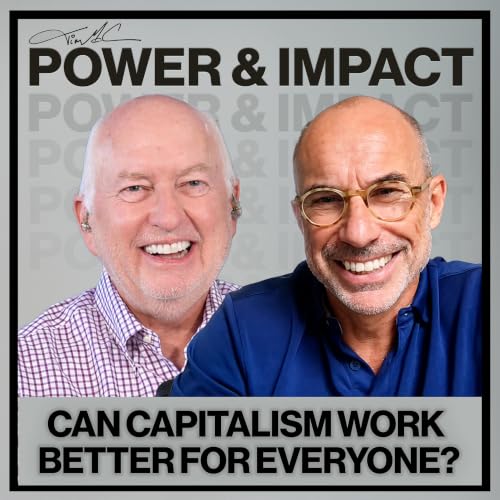
  • Can Capitalism Work Better for Everyone? | With Martin Whittaker
    2026/09/01

    Capitalism has a PR problem. Martin Whittaker thinks the solution isn't abandoning it but rather making it work better for more people.

    Martin is the CEO of JUST Capital, an organization built around a big idea: Business can be one of our most powerful tools for solving society's toughest problems, particularly when doing good and doing well point in the same direction.

    In this week's episode of Power & Impact, we talk about why Martin chose business after earning his Ph.D., how JUST Capital set out to "bend the arc of capitalism," and why jobs, wages, opportunity, and economic security matter so much to people's faith in the system.

    We also explore AI. Martin sees enormous potential for the technology to boost productivity and expand opportunity. How businesses put it to work will help determine what that opportunity looks like, especially for young people trying to find the entry-level jobs that have traditionally launched careers.

    Finally, we discuss philanthropy, incentives, the power of work, and creative approaches that bring business and social purpose together to solve difficult problems.

    It all comes back to one question: How do we build a future in which more people believe they have a stake?

    続きを読む 一部表示
    43 分
  • Building What Lasts
    2026/08/25

    What does it really take to build something that lasts? Starting something is hard. Making it successful is even harder. But building something that can survive changing markets, new technology, different generations and challenges you never saw coming takes something more.

    In this final episode of our Lessons Learned series, I look back at conversations with leaders who have built organizations and brands designed to endure.

    Jeff Sprecher shares how he recognized the lasting value of the New York Stock Exchange and why sometimes building the future means knowing what is worth preserving.

    Alan Fuerstman explains why culture, people and knowing what your brand stands for matter more than simply chasing growth. Omer Acar shows how powerful culture can become when employees are trusted and empowered to create meaningful experiences for customers.

    And Judy Marks shares why a company with nearly 173 years of history still has to embrace AI, technology and change to remain relevant. The lesson I took away from all of them is simple. Building what lasts doesn't mean building something that never changes.

    It means creating a strong enough foundation to evolve without losing what made it special in the first place. That's what I've learned about building what lasts.

    続きを読む 一部表示
    42 分