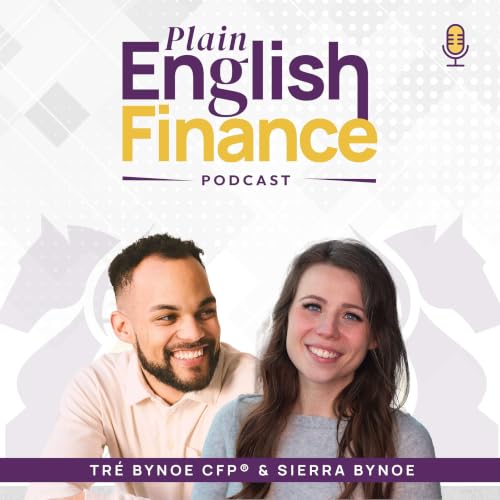
『Plain English Finance』のカバーアート

Plain English Finance

Plain English Finance

著者: Tré Bynoe CFP® CIM®
無料で聴く

The Plain English Finance podcast is hosted by Tré Bynoe CFP® CIM®, a financial planner with TCU Wealth Management and Aviso Wealth.


While Tré specializes in working with families with more complicated finances, typically involving corporations and trusts, this podcast is for anyone wanting to learn how to make high-quality decisions based on evidence, to give themselves the highest likelihood of financial success.


You should always consult with your financial, legal, and tax advisors before making changes.

This podcast is provided as a general source of information and should not be considered personal investment advice or solicitation to buy or sell any securities.

The views expressed are those of the individual and are not necessarily those of Aviso Financial Inc.

Mutual funds and other securities are offered through Aviso Wealth, a division of Aviso Financial Inc.


© 2026 Plain English Finance
個人ファイナンス 経済学
エピソード
  • A Good Decision Can Still Have a Bad Outcome | Ep. 65
    2026/08/28

    Send us Fan Mail

    You cannot judge the quality of a decision based only on the outcome.

    In this episode of the Plain English Finance Podcast, Tré and Sierra discuss how to make better financial decisions by focusing on the information you had, the range of possible outcomes, and whether the decision would still make sense if you repeated it many times under similar circumstances. The episode starts with a simple illustration: one person drinks and drives but gets home safely, while another takes a taxi and gets into an accident. The outcome looks backwards, but the taxi was still the better decision because it reduced unnecessary risk.

    The same idea applies to personal finance. A bad investment decision can occasionally work out. A good financial decision can still lead to an uncomfortable result. That does not mean the decision was wrong. It means decisions should be judged by process, not hindsight.

    In this episode, we discuss:

    • Why outcomes alone do not tell you whether a decision was good
    • Why likely outcomes matter more than perfect hindsight
    • Why a good decision should improve your odds, not guarantee success
    • Why bad decisions can sometimes lead to good outcomes
    • How to think about decisions you would repeat 1,000 times
    • Why too much information can lead to decision paralysis
    • How to decide what information actually matters
    • Why people often get stuck on small financial details
    • Why every decision has a downside
    • Why “safe” options can still carry risk
    • How to compare real alternatives instead of imaginary risk-free choices
    • Why worst-case scenarios matter
    • Why a financial plan should focus on avoiding unacceptable outcomes
    • When to revisit a decision after it has been made

    Good decisions do not guarantee good outcomes. They improve the odds, protect you from avoidable mistakes, and give you a defensible reason for acting when certainty is impossible.

    Website | Youtube | Linkedin

    続きを読む 一部表示
    32 分
  • Why You Can’t Stop Fighting About Money (And How To Fix It) | Ep. 64
    2026/08/21

    Send us Fan Mail

    Why do couples keep having the same money arguments?

    In this episode of the Plain English Finance Podcast, Sierra and Tré talk about the money conversations couples avoid and why many financial arguments are not really about the dollars. They're often about safety, security, freedom, control, fairness, guilt, or feeling unheard.

    The conversation touches on money scripts, financial infidelity, hidden accounts, different upbringings, perpetual relationship problems, and why couples can share the same financial goal but still disagree about how to get there. Sierra also connects the conversation to relationship research around recurring conflict, while Tré explains how these patterns often show up in financial planning conversations with couples.

    In this episode, we discuss:

    • Why money fights are often about deeper emotional needs
    • What “money scripts” are and why they matter
    • Why couples can see money through completely different lenses
    • How safety, security, control, freedom, fairness, and guilt show up in money decisions
    • Why hidden savings accounts can sometimes be tied to fear or insecurity
    • Why some money conflicts become recurring “perpetual problems”
    • Why couples often stay stuck arguing about the surface issue
    • How to reframe money arguments by asking what the real concern is
    • Why outside guidance can help when couples are gridlocked
    • How Tré and Sierra use systems to reduce daily money friction
    • Why separate spending accounts can reduce unnecessary conflict
    • Why check-ins still matter even when systems are in place
    • Why curiosity usually works better than criticism

    Website | Youtube | Linkedin

    続きを読む 一部表示
    22 分
  • Do Financial Planners Judge Your Money Decisions? | Ep. 63
    2026/08/14

    Send us Fan Mail

    What is it actually like to be married to a financial planner?

    In this episode of the Plain English Finance Podcast, Sierra and Tré talk about the pros, cons, myths, and awkward social dynamics that come with being married to someone who works in financial planning. The conversation covers financial literacy, complacency, money mistakes, judgment, family expectations, lending money, and the pressure people sometimes feel when money comes up socially.

    One of the biggest benefits is having someone deeply invested in the family’s financial picture. But one of the biggest risks is becoming too dependent on that person and not developing your own financial knowledge. Sierra talks about the temptation to default to Tré, while Tré explains why he still wants her involved in day-to-day financial decisions.

    In this episode, we discuss:

    • The obvious pros of being married to a financial planner
    • Why financial knowledge can create complacency
    • Why both spouses still need to understand the family finances
    • Why financial planners are still human and make mistakes
    • A real example involving property taxes early in marriage
    • Why people sometimes over-explain their spending around financial professionals
    • Whether financial planners are silently judging your choices
    • Why social money conversations can feel awkward
    • Why one-off financial decisions usually lack enough context to judge
    • The pressure to appear successful when people know what you do
    • Driving an older car while working in wealth management
    • First-generation wealth and family expectations
    • The difference between helping and enabling
    • Why lending money to friends or family can damage relationships
    • Why gifts and loans should be treated very differently

    Website | Youtube | Linkedin

    続きを読む 一部表示
    39 分
adbl_web_anon_alc_button_suppression_t1
まだレビューはありません