エピソード

  • N°105 - Small Stuff with Ian Bogost
    2026/07/07

    In this episode of the Near Future Laboratory Podcast, I talk with my old friend Ian Bogost about his new book, “The Small Stuff: How to Lead a More Gratifying Life” — a funny (like..I laughed out loud) , generous, and quietly radical invitation to recover the sensory enchantment of everyday life.Ian’s book begins with ordinary things: stick shifts, toasters, paper cups, plastic film, doorknobs, faucets, pre-ordering shirts, Diet Coke cans, plunger force cups when they are missing their handle, the texture of a phone case, the sound of ice in a motel ice bucket. Of course our conversation quickly opens into something larger, which I think Ian has been asking for awhile: how modern life has dematerialized so many of our encounters with the world, replacing small tactile gratifications with convenience, automation, frictionless interfaces, and screens.What I especially loved about this conversation is that Ian is not making a nostalgic argument for going backward. He is not saying we need to abandon technology or recreate some lost analog past. Instead, he is asking us to accept what the world is already offering everyday: these small, recurring, very much embodied encounters that make up the actual texture of a life. This isn't “mindfulness” as another productivity technique. Nor is it a kind of self-improvement as a grind. Ian is wondering about the possibility that contentment might be right in front of is, even as we appear to be just pulling the pull-tab on a can of suds; it's under our fingertips, in our peripheral vision, in the overlooked background of the day.We talk about the origins of the book, Ian’s long path from games and object-oriented philosophy to ordinary experience, the decline of sensory life, why curiosity may be a virtue worth defending, how to “bring the background into the foreground,” and why gratification and imagination might belong to the same family of openness.It is a conversation about small stuff, which means it is also a conversation about almost everything.https://smallstuffbook.comhttps://bogost.comhttps://www.theatlantic.com/author/ian-bogost/

    続きを読む 一部表示
    1 時間 11 分
  • N°104 - Marina Zurkow & Sarah Rothberg
    2026/06/25

    The podcast is back from hiatus with a fun one!

    Episode 104 is a conversation with Sarah Rothberg and my dear old friend and collaborator Marina Zurkow about More&More, their speculative card-deck and worldbuilding framework for making strange, useful futures with other people.

    We talk about why constraints are better than blank canvases, how a handful of absurd cards can quickly open up a whole social world, and why the point is not to invent dystopias but to imagine worlds you might actually want to live in.

    Along the way: the Whitney Museum, Hudson River speculation, public kitchens and bathrooms, communication by scent, abolitionist futures, AI ethics, material responsibility, and the impossibility of being perfectly virtuous while living inside messy technologies.

    It’s rangy, playful, and serious in the way good speculative work tends to be.

    Love these guys.

    続きを読む 一部表示
    1 時間
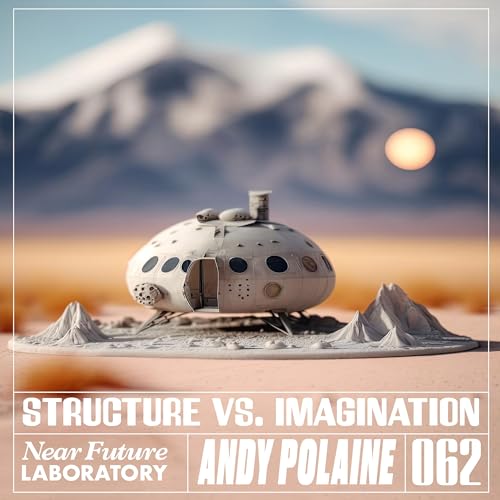
  • N°062 - Structure vs. Imagination with Andy Polaine
    2026/03/11

    Andy Polaine is a designer, educator, writer and podcast guy. He hosts the wonderful 'Power of Ten' podcast. Andy is known for his work as a service designer, innovation consultant and professional executive coach.

    Don't forget — please support the podcast and all the things over at https://patreon.com/nearfuturelaboratory. Your support would be very much appreciated.

    Oh, also? Please rate and write a review of the podcast over on Apple Podcasts. That stuff really does help!

    Thank you!

    Julian

    続きを読む 一部表示
    1 時間 3 分
  • N°103 - Tom Guarriello The Meaning of Branded Objects
    2025/12/22

    Please support the podcast on Patreon!

    Thank you to all of my paid subscribers!

    My friend Tom Guarriello joins me to unpack a deceptively simple question—why do some things matter more than others?

    How is it that “brands” are rarely just products.

    Tom describes how they’re meaning-machines: coffee cups, clothes, grocery aisles, and the everyday objects we carry through life are the things that quietly scaffold identity, aspiration, and sense of belonging.

    Choice arrives instantly; explanation comes later.

    Tom’s “meaning stack” helps us understand the rise of culture brands those brands that don’t just sell products, but stage worlds: concerts, exhibitions, lifestyles, and point-of-view.

    Tom's new book gets into all of this and more. Check out his "The Meaning of Branded Objects".

    https://tomguarriello.com

    続きを読む 一部表示
    41 分
  • N°102 - The Art of Possible with Dave Gray
    2025/09/19

    Here we are — where imagination becomes strategy and art is the engine of innovation. This is a rebroadcast of my conversation in Episode 54 with my friend Dave Gray - artist, visual thinker, and founder of the School of the Possible - in which we explore how drawing and creativity can unlock new ways of seeing, thinking, and shaping the future.

    Simple sketches can transform complex ideas and help organizations envision possibilities that don’t yet exist — Dave is a maestro.

    In our chat, Dave shares stories from his journey as an illustrator, consultant, and teacher, revealing how visual storytelling and hands-on creativity are essential tools for navigating uncertainty and designing better futures.

    Whether you’re a strategist, designer, or just curious about the power of art in business and life, this conversation will inspire you to pick up a pen, embrace your imagination and let it help you create the future you want to inhabit.

    続きを読む 一部表示
    1 時間 4 分
  • N°101 - Kirby Ferguson Infinite Remix
    2025/08/25

    Here is the link to the video we discuss: ⁠https://youtu.be/9pLCIoBZzd4


    You'll want to watch that first — I mistakenly said I would include it but I don't want to rug Kirby's Youtube channel!


    This is a special an curious episode of the podcast — a broadcast from my weekly Office Hours where people join to share and discuss their various “side projects”.


    Last Friday Kirby Ferguson joined to share his latest video project, “Infinite Remix”.


    So, you'll want to watch the video here: https://youtu.be/9pLCIoBZzd4 as I won't be playing it here so as to respect Kirby's work on his Youtube channel.


    As a filmmaker, educator, and writer, Kirby Ferguson has been on the pulse of creativity and its evolution for decades. "Infinite Remix," is a visually enthralling an engaging exploration of artificial intelligence's role in creativity today. One is taken on an Adam Curtis-esque journey through the AI landscape, pondering how machines interact with human creativity and, ultimately, transform it.


    I hope you enjoy this special edition of the podcast!


    Don't forget — please support this work over on Patreon: https://patreon.com/nearfuturelaboratory


    The value I am assuming you get from this work is more than "0". It's only $10 a month, an it really helps make it easier to spend the time and cover the costs of production and platforms this content lives on would be a great way of showing me that the work matters more than "0".


    Thank you!


    (p.s. Join Office Hours by joining the Patreon!)

    続きを読む 一部表示
    52 分
  • N°100 - N O R M A L S Futures Are Boring
    2025/08/03

    Please support the podcast over on Patreon.

    https://patreon.com/nearfuturelaboratory

    We don’t suffer from a lack of imagination about the future. We suffer from too much of the same imagination.

    Every deck, every keynote, every speculative prototype—still echoing the same tropes: chrome cities, self-driving pods, dystopian biotech. A future flattened by repetition. Familiar. Market-tested. Boring.

    In episode 100 of the podcast, I caught up (again) with the gang at N O R M A L S.

    We found ourselves circling this question: Why do so many futures feel interchangeable? And what would it take to build ones that aren’t?

    Their proposal: Near future archetypes—modular, remixable worlds that aren’t just provocations but tools. Not just imagined futures, but working assets for innovation, policy, and design. Think less “trend report,” more “playable terrain.”

    It’s a shift from one-off spectacle to living systems. Instead of discarding scenarios each year, why not iterate them? Build them out like open-source lore. Let them gain rules, friction, culture. Let them become strange enough to surprise us.

    Because here’s the quiet truth: people don’t just adopt futures because they’re rationally compelling. They adopt them because they feel like home — familiar, evocative of something deeper, some feeling they have been chasing after, some vision of a world that probably goes back to the worlds they imagined when they were kids, or visions they integrated into their imagination that felt ‘cool’.

    So maybe the work is not only to critique the dominant tropes, but to seed alternatives that others want to live in—and then give them tools to help build those places themselves.

    Maybe the job isn’t just to map what comes next. Maybe it’s to make futures that feel like a place worth going.

    What’s one overused future trope you’d like to retire—and what would you like to imagine instead?

    https://normalfutu.re/nfa/nfa-essay-pt1/

    続きを読む 一部表示
    53 分
  • N°099 - Outgoing
    2025/07/04

    Outgoing is Brett Gui Xin and Del Hardin Hoyle, they are a creative design team based in Brooklyn. In this chat we discuss their participation in some recent design fairs which gave them a chance to take a break and reflect back on a busy stretch of work. Their media are various: sculptural furniture, music, performance, found materials.

    We got into their creative processes, the uniqueness of their collaborative practice, and their defiance against the dominant corporate culture in design. They emphasize the importance of maintaining creative independence, the emotional aspects of their work, and the joy found in creative exploration.


    Good stories, great lessons.


    Please consider supporting the podcast by becoming a Patron: https://patreon.com/nearfuturelaboratory


    https://www.wallpaper.com/design-interiors/one-to-watch-brooklyn-studio-outgoing

    https://www.instagram.com/outgoinghq

    https://outgoing.website/

    https://www.wallpaper.com/design-interiors/one-to-watch-brooklyn-studio-outgoing

    https://www.instagram.com/delhardinhoyle/

    https://www.instagram.com/brettguixin/

    続きを読む 一部表示
    1 時間 28 分