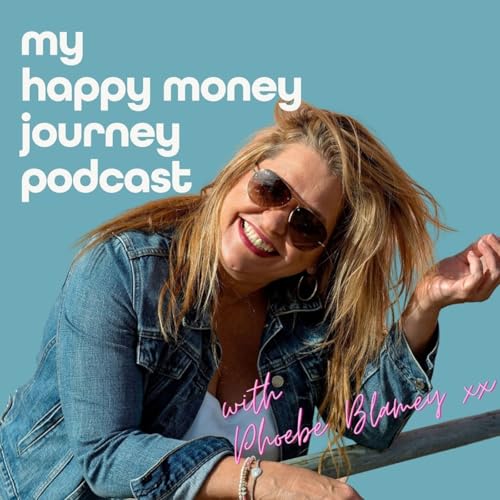
『My Happy Money Journey: money for mid life women with Phoebe Blamey』のカバーアート

My Happy Money Journey: money for mid life women with Phoebe Blamey

My Happy Money Journey: money for mid life women with Phoebe Blamey

著者: Phoebe Blamey retired financial and mortgage advisor podcaster coach and course creator
無料で聴く

Life changes as we get older. Kids grow up. Parents need care. Divorce, grief, and career curveballs can hit hard and suddenly, by choice or by chance, you’re in the financial driver’s seat.

My Happy Money Journey is the go to money podcast for women over 40 in Australia who are ready to take control of their finances, pay off debt, buy a home, invest build wealth, and live a fabulous life!

Phoebe Blamey is a bestselling author, former award winning financial services business owner turned small business coach. The podcast explores real conversations about money, midlife transitions, financial freedom, and difficult topics like sexually transmitted debt, death, inheritance and spending, all while making money simple, manageable and doable. This is real money talk for real people.

Super qualified Phoebe has a Graduate Certificate in Financial Planning, a Diploma in Mortgage Broking, an MBA, and a Graduate Certificate in Executive Coaching Phoebe brings 20+ years of expertise to help women heal their money stories, make smart financial choices, and thrive in this powerful life stage.

Disclaimer: The information in this podcast is general in nature and does not constitute personal financial advice or recommendations.

Copyright 2024 All rights reserved.
マネジメント マネジメント・リーダーシップ 個人ファイナンス 出世 就職活動 経済学
エピソード
  • S4 E34 Don't Let the House Sink You — Divorce, Assets and the Decisions That Matter Most (Part 1 of 3)
    2026/08/05
    Australian women come out of divorce around 30% worse off than they went in, and if you are over 50 that gap can stretch closer to 45%, often without ever fully recovering. In this first episode of a three-part series, Phoebe unpacks the decision that trips up more women than any other: what to do with the family home. She walks through why the house feels like safety, when keeping it is exactly the right call, when it quietly becomes the thing that sinks you, and the four back-of-an-envelope questions that turn the fog into a decision you can actually see. What we cover Why the financial hit of divorce lands so unevenly, and why the first 12 months of decisions matter mostThe emotional weight of the family home, and why "take the logic out of it" is step oneThinking fast vs thinking slow: why a stressed, exhausted brain fights to keep the houseThe line nobody says out loud: the house does not pay you, it charges you (roughly 2% of its value a year just to stay standing)The research that surprises everyone: on average, women who let the house go often did better"You take the house, I'll take the super," and why that can be the most expensive sentence a woman signsWhy super is a splittable asset that too many women give away, especially dangerous over 50The four questions to run on the back of an envelope before you decideMoney as information, not judgement, and building your one-page money mapThe client with a $2 million settlement and the financial advisor who told her not to buy a home Key takeaways (with timestamps) [00:00] The uneven hit. Research shows Australian women are around 30% worse off after divorce. Over 50, it is closer to 45%, and there may not be time for it to recover.[01:00] The family home is the flashpoint. It is the biggest number on paper and the most emotional. Christmases, growth marks on the wall, the whole life lived there.[03:00] The first year is everything. You are making enormous decisions from the bottom of a pit, tired and frightened, with everyone offering advice. That is exactly why they matter.[04:00] Fast brain vs slow brain. Under stress we run on feelings and stories, not logic. It is why the house feels like safety even when the maths says otherwise.[04:30] It earns nothing, it eats. A home costs roughly 2% of its value a year (a $1M house is $10k to $20k before you make it nicer), plus a possible loan on one income instead of two.[05:30] Letting go can be the win. Australian research suggests women who released the house were, on average, doing better, financially and in happiness.[06:00] Watch the super trade. Super is splittable in an Australian divorce. Most women give it away. Even if you did not earn it during the marriage, you are entitled to it.[10:00] The four questions. 1) Can I look after this solo? 2) What am I giving up to get it? 3) Does it earn it or eat it? 4) Am I keeping it, or just trying to keep my old life?[13:00] Money is information. No number on any page has anything to do with your worth. When you look at the data, the fog lifts.[14:00] The $2M client. Her advisor said rent and buy shares. She trusted what mattered to her, bought the home, and questioned the expensive advice. You are allowed to do the same.[16:00] Help exists. Free financial counsellors are available through the National Debt Helpline and Anglicare. The four questions (save these) Can I look after this solo? The loan, the rates, the insurance, the upkeep. Can your actual post-divorce income carry it and still let you breathe?What am I giving up to get it? Usually your share of the super. Write the trade in dollars, and think about the future value, not just today's number.Does it earn it or eat it? Your home consumes income, it does not generate it. Is it a lifestyle asset or a wealth-building one?Am I keeping it, or just trying to keep my old life? Sometimes fighting for the house is grief, not finance. Grief is valid. Just do not pay for it with your retirement. Resources The Money Map — Phoebe's free, fill-it-in-yourself one-pager (everything you own and owe, in and out). Going out with this week's newsletter. Subscribe on the website to get it. phoebeblamey.com.auFree financial counselling — National Debt Helpline and Anglicare offer free, sensible help through these decisions.The book that inspired the series — Strangers by Belle Burden. A note Everything in this episode is general information. It does not take your personal circumstances into account and it is not personal financial advice. It is an ex-finance person sharing what she has watched happen to a lot of women, so you can ask the sharp questions and think through the big decisions with clear eyes. If money in your relationship feels controlled, hidden, or used as a weapon, that is beyond a hard divorce. That is financial abuse, and it is the subject of the next episode. Support is available through 1800RESPECT (1800 737 732). Call to action Follow the show so the next two parts land in your feed, ...
    続きを読む 一部表示
    21 分
  • S4 E33 The belonging tax (or wtf are you still unstacking the dishwasher)
    2026/07/29

    These four pieces of real advice printed for women who out-earn their husbands, including leaving the house without your wallet so he gets a turn at being the provider, blew my mind. Then I had a conversation with Prue who got up super early to walk the dogs and unstack the dishwasher, while Mr Prue slept soundly. This week, why capable women keep themselves small, what it is costing, and the question underneath all of it....

    This is how it started...

    A research team went through ninety four newspaper and magazine articles written about women who earn more than their husbands, and pulled out what those articles told the women to do. Let him pay the bill at the restaurant. Leave the house without your wallet or your keys so he gets the opportunity to be the provider. Let him cover one particular family expense so there is a sense of purpose attached to his money. Play down your income and your success.

    Somebody was paid to write that. An editor decided it was reasonable. Some of it was published recently.

    Look at those four instructions together and they are all the same instruction. Make yourself smaller so you can stay where you are.

    That is what this episode is about. Not whether you can earn more than your partner, because clearly you can. What it costs you to be seen doing it, and the groups you are trying not to fall out of while you do.

    We talk about the marriage, the family you came from, the friends you have had for twenty five years, and the biggest group of all, which is the terms and conditions of being a woman with money in this country.

    There is a section for those of you who now earn more than your father ever did, because nobody tells you that this contains a loss as well as an achievement.

    Then there is Prue, who is made up like a mosaic of my favorite women in this situation. She runs a four million dollar cleaning business while unstacking the dishwasher at seven in the morning. She turned down two million dollars of work she was perfectly capable of doing. .

    I will be upfront that I do not have this fully solved. I have got a long way into it and I have got one thing I want you to do about it this week.

    What I want you to take away: protection is not a number. It never was. It is somebody's capacity to hold you, and that has nothing to do with what they earn.

    続きを読む 一部表示
    22 分
  • S4 E32 Get ready to hold a lot of money
    2026/07/21

    We talk about the property boom all the time. We almost never stop to explain what it actually means for you.

    Go back to the 1960s. Your parents buy an ordinary house in an ordinary inner suburb of Melbourne or Sydney. They live in it their whole lives, never thinking of it as anything more than the family home. Then one day that house is worth two million dollars, and it lands on your kitchen table as an inheritance.

    So we get into the real research on what happens to a capable woman when serious money arrives, why our bodies read a windfall as a threat rather than a reward, and the five things you can do this week to become the woman who can actually hold it. This one goes deep, and it is coming for a lot of you sooner than you think.

    Where the wealth actually came from. The property boom explained properly, with the real numbers, and what it means that a whole generation got wealthy through their houses without ever learning a thing about managing wealth.

    Sudden wealth syndrome. The psychologists who named the cluster of guilt, anxiety and paralysis that shows up when money arrives fast, and why feeling it does not make you broken.

    The lottery study nobody talks about. What thousands of winners taught us about why a windfall postpones trouble instead of fixing it, and why the money was never the thing that needed fixing.

    Your money scripts. The beliefs you formed about money in childhood, before you were old enough to question them, and how one of them quietly runs the show the moment real money lands.

    What happens in your body. Why financial change fires the same alarm system as physical danger, floods you with cortisol, and dims the exact part of your brain you need to make a good decision.

    The five things to do this week to get ready before the money arrives.

    The one action this week

    Sit down with a cup of tea and finish this sentence honestly: "In my family, money was..."

    Write down whatever comes up. Scarce and frightening? Never discussed? Something you were made to feel greedy for wanting? Then ask yourself gently, is that still true for me now?

    That is the whole task. It is private, it takes ten minutes, and it changes everything downstream.

    The five steps, in short
    1. Name your money script out loud. You cannot change a program you cannot see.
    2. Build the pause into your plan now. No big, irreversible decision in the first six months.
    3. Learn the language before you need it. A few key words, five minutes each.
    4. Choose your own advisor. Do not inherit one because you were tired and grieving.
    5. Break the silence. Tell one woman you trust that you are getting ready to hold real money.
    Come and find your people

    If you want to get your own financial world in order so you are ready to hold what is coming, come and join us inside the Happy Money Society. It is where this work happens together, without the guilt and without the jargon.

    Everything is over at phoebeblamey.com.au, and the link is right here in the show notes.

    A quick note

    Everything shared in this episode is general information only. It is not personal financial advice. Please take your own situation to a professional who can see your full picture.

    Until next week, whatever you're doing, wherever you're doing it, and whoever you're doing it with, enjoy your journey.

    続きを読む 一部表示
    23 分
adbl_web_anon_alc_button_suppression_t1
まだレビューはありません