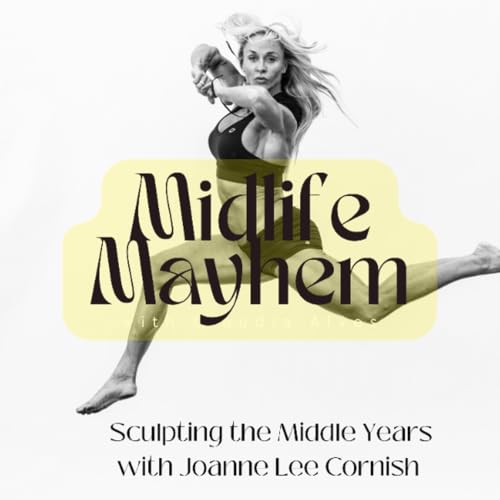
『Midlife Mayhem』のカバーアート

Midlife Mayhem

Midlife Mayhem

著者: joanne lee cornish
無料で聴く

概要

Welcome to Midlife Mayhem, where we embark on an empowering journey through the world of midlife body composition transformation. In this space, we challenge the misconceptions surrounding aging and redefine what’s possible for those navigating the exhilarating terrain of midlife and beyond. Join me as we explore the science, mindset shifts, and practical strategies that can help you sculpt the body of your dreams, proving that age is no barrier to achieving peak vitality and confidence. Whether you’re seeking to shed excess weight, gain lean muscle, or simply feel more vibrant, this podcast is your trusted companion in the pursuit of a healthier, stronger, and more resilient you. Welcome to a new era of limitless possibilities in midlife body transformation. ”Hi I’m Joanne, and I have been coaching body composition for over 30 years. I’ve worked with household names that you know, and I have worked with thousands of people in my group coaching programs. I was a pro bodybuilder in the 90’s with a top 10 physique in the world, but I only knew how to be in shape and out of shape. That frustration led me on a fascinating path of self-study where I found all the answers I could have asked for and more. But I had to dig for the answers, and I have my own ideas on why those answers are not mainstream and why the weight loss industry fails you, but I will save that for a Midlife Mayhem episode. Author of ”When Calories & Cardio Don’t Cut It”New podcast weblogCopyright 2023 All rights reserved. エクササイズ・フィットネス フィットネス・食生活・栄養 個人的成功 自己啓発 衛生・健康的な生活
エピソード
  • Leg Hair, Estrogen Patches & Taco Bell
    2026/02/10
    🤨 Three Topics That Should Never Be in the Same Episode (But Are) Today we’re talking about: Why women mysteriously stop growing leg hair as they age Why your estrogen patch might feel like it “stopped working” And why Taco Bell Supreme has sent my client to the ER every single time she eats it This is not a shock-value episode. This is a “your body is communicating very clearly and you should probably listen” episode. 🦵 Why You’re Not Shaving Your Legs Anymore (And Why That Matters) At some point — usually late 30s or 40s — many women notice: No stubble No sandpaper phase Weeks go by… and nothing grows It feels convenient. It also means something. What’s actually happening: Leg hair growth is driven by androgens (testosterone + DHT) As ovarian and adrenal hormone output declines, the signal weakens Hair follicles are signal-dependent, not loyal Growth slows → hair gets finer → follicles go quiet This process is called follicular miniaturization. Same biology as scalp hair thinning — just a very different emotional reaction. Why I care: Hair growth is a non-essential function. So is muscle. When your body stops prioritizing hair growth, it’s often signaling: Lower thyroid output Reduced circulation Insulin resistance Hormonal downshifts Which is exactly why “I lift weights and eat protein” is not enough to build muscle in midlife. You have to create the right internal environment. (Yes — Muscle Month teaches exactly that. More on timing below.) 🔄 Why Your Estrogen Patch “Stopped Working” This came up within an hour of recording. You start HRT → feel great → months later → bloodwork drops → symptoms creep back → “My patch isn’t working anymore.” Here’s the truth: 🧠 Hormones don’t act alone — receptors matter Hormones are keys. Receptors are locks. If the lock stops responding, it doesn’t matter how many keys you send. Estrogen receptors are: Active decision-makers Highly responsive to variation Easily bored by repetition When you place your estrogen patch in the same spot over and over, receptors can: Downregulate Reduce absorption efficiency Become less responsive locally Try this instead: Rotate thoughtfully: Lower abdomen → opposite side Upper outer glute → opposite side Change regions every 2–3 months This respects receptor biology, not just convenience — and many women see steadier bloodwork as a result. 🌮 Why Taco Bell Supreme Keeps Sending My Client to the ER This one’s funny… until it isn’t. My client: Eats Taco Bell Supreme Vomits violently Ends up in the ER Repeats the cycle This is not food poisoning. It’s a perfect biochemical storm. 🚨 The likely culprits: 1. Histamine overload Processed meats, cheese sauces, tomatoes, seasoning blends Common trigger in midlife, estrogen-dominant women Worse with gut permeability issues Symptoms can include: Nausea Vomiting Dizziness Rapid heart rate ER-level reactions (If wine suddenly wrecks you now — same category.) 2. Seed oils & emulsifiers Soybean oil, canola oil, stabilizers Increase gut permeability Let things into the bloodstream that don’t belong there Your immune system sees that and hits the panic button. 3. Gluten + FODMAP spice combo Even without celiac: Gluten increases zonulin Zonulin loosens gut lining Onion/garlic powders + spices irritate an already inflamed gut This can trigger mast cell activation and full-body reactions. 4. Gallbladder slowdown Estrogen slows bile release High-fat meals require strong bile flow Sluggish bile → nausea → vomiting So no — it’s not Taco Bell. It’s the context. 🧩 What Do Leg Hair, Estrogen Patches & Taco Bell Have in Common? They all point to the same truth: Midlife isn’t about being fragile — but it is less forgiving. You can’t ignore: Receptor biology Gut health Hormonal context Metabolic signals And you definitely can’t eat like a 22-year-old with a bulletproof liver anymore. 📣 A Quick Update: Muscle Month Muscle Month has been postponed. Not because I don’t love it — but because it requires: Me at home My full gym My full attention And I refuse to run programs half-present and stressed. 👉 New target start: end of March Dates will be updated at musclemonth.com (You now have extra time to decide if building muscle properly — not accidentally losing it — matters to you.) 🔗 Final Bits New website: joannelee.com Supplements are live on the site Programs are always rotating — check what’s open You can always email me: joanne@joannelee.com
    続きを読む 一部表示
    27 分
  • THE FEAR OF PROTEIN
    2026/02/07
    Muscle Month starts Feb 16 — quick note before we dive in

    If you enjoy this podcast, please consider Muscle Month. I simply can’t do topics like this true justice in a short podcast. Muscle Month is where I teach the actual physiology behind muscle building, fat loss, and long-term health—properly, in context, and without fear-based nonsense. 👉 Join here: musclemonth.com (or joannelee.com)

    Midlife Mayhem Show Notes The Protein Panic: How Fear-Based Science Derailed an Entire Generation

    It was only a few years ago that we lived through the protein panic.

    Fear-based documentaries told us protein was going to kill us and that we should avoid it at all costs. Films like Forks Over Knives painted protein—especially animal protein—as inflammatory, cancer-causing, and reckless.

    At the same time, I was in a constant verbal battle with would-be clients asking me to write “new” vegan diets while also wanting to build muscle.

    (Yes. Build muscle… while eating leaves.)

    It was a fun time to coach.

    But seriously—people became genuinely terrified of protein. And now? The very same people are being told to eat gobs of it.

    No explanation. No accountability. Just a hard pivot.

    So if you feel confused, cautious, or unsure who to believe—you’re not wrong. You’re watching what happens when badly handled science gets turned into marketing.

    This episode breaks down the three biochemical villains that were used to scare people away from protein:

    • TMAO

    • IGF-1

    • mTOR

    Here’s what actually matters.

    1) TMAO — the story that didn’t hold up

    The scary headline:

    “Red meat increases TMAO, and TMAO increases heart disease risk.”

    What was conveniently skipped:

    • TMAO production depends heavily on gut bacteria and fiber

    • Fish contains ~66× more TMAO than red meat, yet is consistently linked with better cardiovascular outcomes

    So no—TMAO is not a simple “protein = danger” equation.

    What actually helps if you’re concerned:
    • Soluble fiber (can reduce TMAO production ~60%)

    • Cruciferous vegetables & sprouts

    • Resveratrol, garlic, berberine

    • B vitamins, probiotics, vitamin D

    Translation: protein wasn’t the issue. Protein without plants might be—but that nuance didn’t sell documentaries.

    2) IGF-1 — essential, not evil

    IGF-1 supports:

    • connective tissue

    • heart tissue

    • brain health

    The fear came from animal studies suggesting lower IGF-1 may relate to longevity—without explaining that centenarians typically have normal IGF-1 but reduced sensitivity to it.

    Key facts that got lost:

    • Resistance training raises IGF-1

    • Adequate protein supports IGF-1

    • Fasting naturally lowers IGF-1

    Translation: IGF-1 isn’t something to eliminate. It’s something to cycle and balance.

    3) mTOR — the muscle switch everyone loves to blame

    mTOR is the pathway required for:

    • muscle protein synthesis

    • repair and recovery

    Protein (especially leucine) and resistance training help activate it.

    Yes—chronically elevated mTOR without balance can be problematic. But that’s a constant-feeding, low-movement lifestyle issue, not a “protein is dangerous” issue.

    Your natural counterbalance is AMPK, activated by:

    • exercise

    • fasting

    • glycogen depletion

    You’re meant to move between these pathways.

    Translation: mTOR isn’t the enemy. Misuse is.

    So what actually went wrong?

    A small amount of real science was:

    • oversimplified

    • taken out of context

    • weaponized with fear

    And in many cases, the loudest voices had financial incentives tied to plant-based products.

    Protein was never the problem.

    The real issues were always the unsexy ones:

    • ultra-processed food

    • lack of fiber

    • inactivity

    • metabolic imbalance

    Final reminder — Muscle Month starts Feb 16

    If this episode made you think “Oh… that explains a lot”, Muscle Month is where I teach this properly—with structure, timing, and application.

    You’ll learn how to:

    • eat enough protein without fear

    • trigger muscle-building pathways correctly

    • stay lean while building strength

    • stop trying harder and start getting results

    👉 Join here: musclemonth.com (or joannelee.com)

    It won’t be back for a long time

    続きを読む 一部表示
    40 分
  • From Skin Cells to Muscle Cells: Why Biology Beats Branding
    2026/02/04
    Niacinamide, Amino Acids, and Why Source Confusion Doesnt Matter

    In today’s episode, Joanne dives into two simple, misunderstood products — one for skin and one for muscle — and explains why what something does matters far more than where it comes from.

    This is a practical, science-backed conversation about cellular biology, not marketing hype.

    MUSCLE MONTH STARTS IN LESS THAN 2 WEEKS! www.musclemonth.com

    ✨ PART 1 — NIACINAMIDE: SIMPLE, CHEAP, AND INCREDIBLY EFFECTIVE

    Joanne shares her personal experience using niacinamide powder as part of her nightly skincare routine — a product that costs less than $10 and has quietly delivered some of the best skin results she’s had.

    In this segment, you’ll learn:

    • What niacinamide (vitamin B3) actually is

    • Why it’s a cellular support nutrient, not a cosmetic trick

    • Its role in NAD⁺ production, cellular energy, DNA repair, and inflammation control

    • Why niacinamide improves:

      • Skin barrier strength

      • Hydration retention

      • Redness and reactivity

      • Texture and overall resilience (over time, not overnight)

    Joanne also explains why she prefers niacinamide in powder form, including:

    • Greater stability

    • No unnecessary fillers

    • Fresh activation every time it’s mixed into a serum

    • Complete control over dose

    She discusses her experience using niacinamide from The Ordinary, a company known for simple, single-ingredient products without inflated pricing or marketing noise.

    Find it on Amazon for under $7 https://a.co/d/aWfMIJr

    💪 PART 2 — PROTEIN, PLANT-BASED AMINO ACIDS & A COMMON MISUNDERSTANDING

    A listener question sparks the second half of the episode:

    If complete proteins come from animals, how can a plant-based amino acid supplement be high quality?

    Joanne breaks this down clearly and practically.

    You’ll learn:

    • The difference between whole proteins and isolated amino acids

    • Why plants are considered “incomplete” at the food level — but not at the amino acid level

    • How amino acid supplements are produced using fermentation and purification

    • Why once isolated, amino acids are chemically identical regardless of source

    • Why muscle tissue does not care about labels, only:

      • Total essential amino acids

      • Leucine content

      • Proper ratios

      • mTOR activation

      • Muscle protein synthesis

    This segment is especially relevant for:

    • Midlife adults

    • People with gut sensitivities

    • Those struggling to hit protein targets

    • Anyone losing weight and trying to preserve muscle

    🧠 THE BIG TAKEAWAY

    Whether it’s skincare or nutrition, the mistake is the same:

    People judge the source instead of understanding the biology.

    Cells respond to:

    • Vitamins they recognize

    • Amino acids they can use

    Not branding, not buzzwords, not price tags.

    AMINO ACIDS for under $20 https://a.co/d/1TpEODX

    🚀 PROGRAM CTA — MUSCLE MONTH

    If this episode resonated, Muscle Month is where these concepts are taught in depth and applied correctly.

    🗓 February 16 – March 14 🎯 10 live coaching calls 🎯 Full access to Joanne for the entire month 🎯 Training, nutrition, and strategy 🎯 365-day access to a deep content library (50+ resources)

    If you want to:

    • Preserve muscle during weight loss

    • Understand leucine, mTOR, and protein strategy

    • Stop guessing and start training with intention

    👉 Learn more and join here: https://joannelee.com

    • Supplements & education

    • YouTube videos on amino acids, muscle, and metabolism

    続きを読む 一部表示
    23 分
まだレビューはありません