エピソード

  • Flash Floods: Why They Turn Deadly in Minutes
    2026/07/23

    Flash floods can happen almost anywhere from New York City subways and the rivers of Central Texas to mountain villages in Italy, the streets of China, and communities across Europe, Asia, and Africa. Why do they become deadly so quickly, even when people know heavy rain is coming?

    In this episode of Meteorology Matters, we explore the science behind one of the world’s fastest and most misunderstood weather hazards. Through unforgettable disasters and the lessons they taught, we explain how rainfall, terrain, infrastructure, forecasting, and human behavior combine to create life-threatening situations in just minutes.

    You’ll learn why some storms produce catastrophic flooding, how meteorologists detect these events, what today’s warning systems can and cannot do, and the decisions that often determine who survives. Whether you live in a major city, a mountain valley, or near a small creek, understanding flash floods could one day save your life.

    Follow meteorologist Rob Jones on Instagram, TikTok, YouTube, and Facebook for more weather insights, and subscribe to Meteorology Matters wherever you listen to podcasts.

    続きを読む 一部表示
    49 分
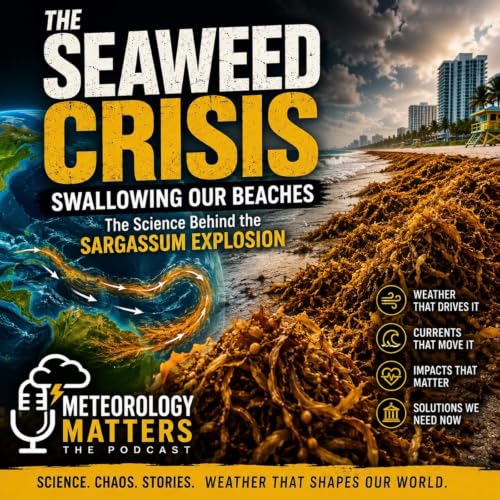
  • The Seaweed Crisis Swallowing Our Beaches | The Science Behind the Sargassum Explosion
    2026/07/21

    Why are beaches across Florida, the Caribbean, Mexico, and parts of the Gulf Coast being buried under mountains of seaweed and why has it become one of the fastest-growing environmental and economic challenges facing coastal communities?

    In this episode of Meteorology Matters, we explore the remarkable story of sargassum, a floating seaweed that serves as a vital offshore ecosystem but becomes a costly problem once it reaches shore. We examine the science behind the Great Atlantic Sargassum Belt, how weather patterns and ocean currents control where it accumulates, and why forecasting its arrival remains so challenging.

    Along the way, we discuss the impacts on tourism, marine life, public health, local governments, and coastal economies, while exploring the latest research into cleanup efforts, forecasting technology, and potential long-term solutions.

    Whether you’ve encountered sargassum on vacation or simply want to understand one of the Atlantic’s most fascinating environmental stories, this episode explains why the seaweed crisis is about much more than what’s washing up on the beach.

    続きを読む 一部表示
    45 分
  • The Hurricane Forecast Is Only Half the Story
    2026/07/16

    A hurricane forecast is only valuable if people understand it, trust it, and know how to act on it.

    In this episode of Meteorology Matters, meteorologist Rob Jones’ production explores why effective hurricane communication can be just as important as the forecast itself. Using lessons inspired by the career of hurricane specialist Bryan Norcross, we discuss how meteorologists communicate uncertainty, why public trust is earned over time, and how clear messaging can help people make better decisions before, during, and after a storm.

    We also examine the latest outlook for the 2026 Atlantic hurricane season, why a quieter season does not reduce your risk, and how even an unnamed tropical disturbance can produce dangerous flooding and life-threatening impacts.

    Along the way, we break down some of the biggest misconceptions in hurricane forecasting, including what the forecast cone really means, why hurricane categories don’t tell the whole story, and why impacts, not names or wind speeds alone, should drive preparedness.

    Whether you’re a weather enthusiast, emergency manager, fellow meteorologist, or someone who simply wants to better understand hurricanes, this episode offers practical insight into the science, psychology, and communication behind today’s forecasts.

    Follow Rob Jones on Instagram, TikTok, YouTube, and Facebook for more weather insights, and if you enjoyed this episode, please like, follow, share, and leave a rating or review. Your support helps more people discover Meteorology Matters.

    続きを読む 一部表示
    43 分
  • The Great Hackensack–New York City Tornado Disaster of 1895
    2026/07/14

    In July 1895, one of the most remarkable and least remembered tornado disasters in the history of the New York metropolitan area struck without warning. Historic Cherry Hill near modern day Hackensack and River Edge, New Jersey, was devastated as homes, businesses, farms, churches, and the railroad community were torn apart. The same day, another destructive tornado ripped through Woodhaven in what is now Queens, New York City.

    In this episode of Meteorology Matters, meteorologist Rob Jones reconstructs the disaster property by property, following the storm’s path through Cherry Hill while telling the stories of the people who lived through it. Along the way, we examine the deaths, rescues, destruction, and recovery, while exploring one of the biggest unanswered questions in American weather history: Was this one extraordinary tornado that crossed from New Jersey into New York City, or two separate tornadoes produced by the same storm system?

    Join us as we revisit one of the forgotten weather disasters that helped shape the history of the New York region.

    続きを読む 一部表示
    39 分
  • The Heat Wave That Changed America: How Weather Reshaped Modern Life
    2026/07/13

    What if one weather event quietly transformed an entire nation?

    The deadly heat wave of 1936 was far more than a record-breaking summer. It changed how Americans dressed, where they lived, how buildings were designed, and accelerated the adoption of air conditioning that would reshape cities, businesses, and everyday life for generations.

    In this episode of Meteorology Matters, we explore how extreme weather can leave lasting marks on society, not just through disasters, but through the ways people adapt. From sleeping porches and blocks of ice to modern heat domes, urban heat islands, and the future of cooling technology, this is the story of how weather quietly helped build the modern world.

    Whether you’re fascinated by meteorology, history, engineering, or simply curious about how our daily lives came to look the way they do, this episode reveals why some of the most important weather stories continue long after the forecast has ended.

    Follow meteorologist Rob Jones for more weather insights, hurricane coverage, and new episodes of Meteorology Matters.

    続きを読む 一部表示
    34 分
  • Can Scientists Really Steer Hurricanes?
    2026/07/08

    Can scientists really change the path of a hurricane or is that still science fiction?

    This episode explores one of the most fascinating questions in atmospheric science: whether humans could ever influence one of nature’s most powerful storms.

    From Project STORMFURY to modern cloud seeding research, computer modeling, and artificial intelligence, the conversation separates what is scientifically plausible from what remains theoretical, unproven, or misunderstood.

    The episode explains what cloud seeding can realistically do, why hurricanes are so difficult to modify, what recent research suggests about future possibilities, and why computer simulations should not be confused with real-world hurricane control.

    It also examines why weather-control conspiracy theories often spread after major hurricanes, heat waves, floods, and other high-impact events and how evidence-based meteorology helps separate science from misinformation.

    Whether you’re interested in hurricanes, weather modification, atmospheric science, or the future of forecasting technology, this episode looks at the real science, the limits, and the unanswered questions behind one of meteorology’s biggest ideas.

    Follow Rob Jones on Instagram, TikTok, YouTube, and Facebook for more weather content. Please like, follow, comment, rate the podcast, and share it with someone who loves weather.

    続きを読む 一部表示
    36 分
  • America’s 250th Nearly Melted Down: The Historic Heat Wave That Changed the Fourth of July
    2026/07/05

    America’s 250th birthday celebration was supposed to be one of the biggest events in the nation’s history. Instead, record-breaking heat, dangerous thunderstorms, emergency evacuations, and severe weather forced officials to cancel parades, alter major events, and protect hundreds of thousands of people from life-threatening conditions.

    Discover how a powerful heat dome sent temperatures soaring above 100°F across the Mid-Atlantic, why the heat index climbed well above 110°F, and how the atmosphere produced severe thunderstorms capable of disrupting celebrations on the National Mall just hours later.

    We also explore why extreme heat remains America’s deadliest weather hazard, how emergency managers prepared for millions of visitors, what happens to power grids, transportation systems, and infrastructure during prolonged heat waves, and the science behind the dangerous conditions that affected Washington, D.C., Maryland, Virginia, and much of the eastern United States.

    The episode also examines why weather misinformation spreads during major events, separates atmospheric science from online conspiracy theories, and explains what meteorologists actually know about weather modification.

    Finally, you’ll hear practical advice on recognizing heat exhaustion and heat stroke, protecting yourself during dangerous heat, and even how people survived summers before modern air conditioning.

    Whether you’re fascinated by meteorology, emergency management, climate, or simply want to understand one of the most remarkable weather events of the summer, this episode explains the science behind the story in a clear, balanced, and engaging conversation.

    Follow Meteorologist Rob Jones on Instagram, TikTok, YouTube, and Facebook for more weather discussions, hurricane coverage, and behind-the-scenes meteorology. If you enjoyed this episode, please follow the podcast, leave a rating and review, and share it with someone who loves weather.

    続きを読む 一部表示
    44 分
  • Twenty Years Later: What Scientists Got Right
    2026/06/19

    Twenty years after An Inconvenient Truth, how well have scientific warnings held up?

    In this episode of Meteorology Matters, we examine the lessons of the past two decades, from the recovery of the ozone layer and the decline of acid rain to growing concerns about extreme heat during the 2026 FIFA World Cup and remarkable winter warmth in Antarctica.

    We also explore a new challenge facing researchers and the public: the rise of AI-generated fake studies and the growing importance of trust in science and scientific communication.

    Join us for a thoughtful discussion about weather, environmental change, scientific integrity, artificial intelligence, and what the next twenty years may bring.

    続きを読む 一部表示
    32 分