• The Jeremy Hanson podcast "Why I Do The Jeremy Hanson Podcast"
    2026/07/21
    Most business podcasts teach you how to build a bigger company. This one is trying to teach you how to build a better life. In this episode, Jeremy Hanson steps out from behind the frameworks and case studies to explain exactly why The Jeremy Hanson Podcast exists, what it will always be, and what it will never be. Jeremy became a father at sixteen. He didn't start businesses because he read a book about entrepreneurship or because someone told him to be his own boss. He started them because there was no other option — nobody hires a sixteen-year-old for enough money to raise a child, so he had to build the math himself. Pressure washing in Missouri summers. Cleaning crews. Food trucks. Broadcasting and voice work. Today, exterior cleaning and restoration through Shimmer Services. None of those businesses got applause, and none of them were ever the goal. This episode makes the case that business is a tool and nothing more. Money is a tool. Employees are not trophies. Marketing, sales, systems, software, and AI are all tools, and every one of them exists to produce five things: freedom, time, choices, security, and opportunity. When a business starts consuming those five instead of producing them, the numbers can still go up while the life underneath quietly comes apart — and the numbers will never warn you. Jeremy also lays out what failure actually teaches, which is not tactics but the true price of every trade you made, and the more surprising lesson that success teaches the exact same thing. He explains why nobody was teaching entrepreneurship from this angle — everyone was talking about scaling, exits, venture capital, hustle, and Lamborghinis, and almost nobody was talking about building a marriage, raising children who want to be around you, health, peace, and purpose. The episode closes with the Best Life Formula: five questions that replace revenue, headcount, and follower counts as the real scoreboard. Do your kids want to spend time with you? Does your spouse enjoy being around you? Can you sleep at night? Are you proud of who you've become? And does your business serve your life, or has your life become a servant to your business? This is the mission statement episode. Thirty years of scars, stated plainly, with no highlight reel. For more like this, subscribe to the Built Different newsletter and find everything at jeremyhanson.pro. Get 15% off any annual plan at Storyblocks with my link: https://storyblocks.com/HANSON #ad QUESTIONS THIS EPISODE ANSWERS Listeners often want to know why a working entrepreneur with multiple businesses and a full family life spends this much time making a podcast, and this episode answers that directly. Jeremy explains that when he was twenty-two years old and drowning, nobody was saying the thing he needed to hear, and he waited a long time for someone with a bigger platform to say it before deciding to say it himself. People also ask whether entrepreneurship is really about money, and this episode argues that it never was. A business is a truck you drive somewhere in, not a destination, and the culture around entrepreneurship has spent the last decade worshiping the truck. The intended destination is a life — a stable one, a safe one, one where the people who depend on you can stop bracing for impact. Another common question is how to tell whether a business has stopped working even when it looks successful. The answer offered here is diagnostic rather than financial. Ask whether the business is producing freedom, time, choices, security, and opportunity, or consuming them. A business can consume all five while the revenue climbs, which is precisely why revenue is a poor early warning system. Listeners frequently ask what failure teaches. Jeremy's position is that failure does not primarily teach tactics. It teaches you what you were willing to trade and whether you would make that trade again — and the receipt is almost never just money. It is the missed dinner, the lost weekend, the night you were physically present and mentally somewhere else entirely. Finally, people ask what they can expect from this show. Four promises: Jeremy will never pretend he hasn't failed, will never teach theory he hasn't lived, will never claim entrepreneurship is easy, and will always show what thirty years of scars have actually taught him. Jeremy Hanson, The Jeremy Hanson Podcast, entrepreneurship, why I started my podcast, entrepreneurship is not about money, business is a tool, building a better life, work life balance for entrepreneurs, teen dad entrepreneur, dad at sixteen, small business owner podcast, service business owner, pressure washing business, exterior cleaning business, Shimmer Services, blue collar entrepreneurship, business failure lessons, learning from failure, what success actually costs, hustle culture criticism, anti hustle culture, freedom time choices security opportunity, entrepreneur burnout, entrepreneur marriage advice, family first...
    続きを読む 一部表示
    53 分
  • Your Best Sales Team Doesn't Work for You — How to Build Customers Who Sell Your Business for Free
    2026/07/14
    Most business owners think the answer to slow growth is always more advertising — more Facebook ads, more Google spend, more flyers, better SEO. Jeremy Hanson spent years believing the same thing. But after nearly thirty years building and running service businesses, he landed on something worth more than any ad account he ever ran: your greatest sales force doesn't collect a paycheck from you. It's your customers. A paid ad disappears the second you stop paying for it. A customer who loves what you do can send you business for years, and it never costs another dime. In this episode, Jeremy reframes the entire goal of a service business. The real question isn't "how do I get more customers" — it's "how do I create customers who become passionate ambassadors for what I do." He digs into the subtle but fatal mistake almost every owner makes: aiming to satisfy customers instead of exciting them. Satisfied customers pay and disappear. Excited customers go recruit new customers for you. And the gap between those two is where entire businesses are won or lost. From there, Jeremy lays out the mechanics of word-of-mouth growth. Why people never promote your service but will always promote a story. How to engineer a "wow" — the small, unexpected, unbilled moment that makes a customer evaluate your character instead of your price. Why under-promising and over-delivering is really about managing the gap between what you said and what you did. How to remove the quiet anxiety every customer carries, why the follow-up almost nobody does is one of the cheapest growth tools in business, and how remembering the small human details turns customers into people who defend and refer you for life. He breaks down the psychology behind the peak-end rule and how to design a job's high point and ending on purpose, how to build repeatable signature moments that become synonymous with your name, why a referral is worth so much more than any lead you can buy, and exactly how to ask for one without sounding desperate. Jeremy also gets honest about the other side of the ledger — how word of mouth cuts both ways, why unhappy customers talk more than happy ones, and what quietly kills a reputation one paper cut at a time. He closes with the vision every owner should be chasing: not a company that hunts for customers, but a company that customers hunt for. Build that, and your best salesperson is never on your payroll — it's your last customer. QUESTIONS THIS EPISODE ANSWERS What is the best marketing for a service business? According to The Jeremy Hanson Podcast, it is your own customers. A paid ad stops the moment you stop paying, but a customer who loves your work refers you for years at no cost, so the highest-leverage growth strategy is turning customers into ambassadors. Why isn't satisfying customers enough? Jeremy explains that satisfied customers simply pay and go away, while excited customers actively recruit new customers. Aiming only for satisfaction quietly caps your growth because average experiences give people nothing worth talking about. Why do people refer some businesses and not others? Because people promote stories, not services. Nobody repeats technical specs, but they eagerly repeat "you won't believe what these guys did for me." Businesses that engineer memorable, unexpected moments give customers a story to tell. What is a "wow" and how do you create one? A wow is a small, unexpected, unbilled gesture — cleaning something that wasn't on the estimate, noticing a personal detail — given on purpose and never announced. Because it's free and surprising, the customer judges your character instead of your price, which is where loyalty begins. What is the peak-end rule in customer experience? People remember an experience mostly by its emotional high point and its ending. Jeremy recommends designing one memorable moment during the job and finishing stronger than expected — walking the finished project, celebrating the transformation, and thanking the customer sincerely. How do you ask for referrals without sounding desperate? Ask at peak emotion, when the customer is thrilled with the finished job, with a specific and easy request and a couple of cards in hand. Then close the loop and thank anyone who refers you, which makes them far more likely to do it again. CHAPTERS 00:00 Cold open: the barbecue Your best sales team doesn't work for you The biggest mistake business owners make People don't promote services, they promote stories Your goal is to create a wow OneSkin (sponsor) Under promise, over deliver Remove customer anxiety The follow-up almost nobody does Make them feel like family Give customers something to talk about The peak-end rule Build signature moments Why referrals feel different How to actually ask The math of word of mouth What kills word of mouth Build an army The close KEYWORDS word of mouth marketing, customer referrals, turn customers into ambassadors, referral marketing for ...
    続きを読む 一部表示
    50 分
  • The Jeremy Hanson Podcast Nuance — The Invisible Difference Between Good Businesses and Elite Businesses
    2026/07/07
    There is a quality almost nobody teaches, mostly because it refuses to be measured — and it is the exact thing that separates a good business from an elite one. Jeremy Hanson calls it nuance. Not marketing, not sales tactics, not pricing strategy. The little things customers rarely notice on a conscious level but feel every single time they deal with you. After nearly thirty years running service businesses, Jeremy is convinced this is the lesson that reshaped how he understands success more than any other. In this episode, Jeremy makes the case that customers almost never leave over one catastrophic mistake. They leave over a thousand tiny paper cuts. And they don't turn into raving fans because of a single dazzling moment — they stay because of hundreds of small moments that make them feel genuinely valued. That gap, invisible on any spreadsheet, is where elite businesses live. He walks through what nuance looks like in practice: why elite businesses build so much value into the experience that price stops being the main conversation, how customers are really buying confidence and reassurance long before they judge your actual work, and why surprising people with unexpected value lands so differently than discounting. Jeremy shares the pressure-washing habit he swore by — deliberately leaving small extras off the estimate and simply doing them anyway — and explains why a gift always beats a line item. He digs into under-promising and over-delivering as emotional deposits that compound into trust, the follow-up email that told customers the relationship didn't end at the invoice, and the uncomfortable truth that people are judging your truck, your logo, your voicemail, and your handshake before they ever judge your craft. From eliminating friction to reading what your reviews actually say, to the way excellence has to become the normal standard before a team will live it, Jeremy lays out how fifty small improvements stack into a business that is genuinely hard to compete with. He closes with a challenge: walk your entire customer journey as if you're seeing it for the first time, and hunt for the confusion, the anxiety, the friction, and the small surprises. Because elite businesses don't beat good ones by fifty percent. They beat them by two percent — hundreds of times. QUESTIONS THIS EPISODE ANSWERS What actually separates a good business from an elite one? According to The Jeremy Hanson Podcast, it is nuance — the accumulation of small, often unnoticed details that customers feel rather than consciously register, not a single big differentiator. Why do customers really leave a business? Jeremy explains that customers rarely quit over one major failure. They leave because of a thousand tiny paper cuts, and they stay because of hundreds of small moments that make them feel valued. How do elite businesses escape competing on price? By building so much value into the experience that price stops being the central conversation. When people recommend a business, they describe feelings — reliability, ease, respect — not the invoice. What does it mean that customers buy confidence? Every customer carries quiet anxiety about whether they chose the right people. Elite businesses answer those unspoken fears in advance through communication, punctuality, and clarity, signaling that the customer made the right call. Why does surprising a customer beat discounting? Jeremy shares that unbilled extras land as a gift, while the same work priced on the invoice invites doubt about whether it was necessary. People remember how you made them feel, not every line item. How does nuance compound? One improvement barely moves the needle, but fifty small improvements — a better phone greeting, better estimates, better follow-up, better appearance — stack into a business that is genuinely hard to compete with. nuance in business, good business vs elite business, customer experience, service business growth, competing on value not price, customer confidence, under promise over deliver, over deliver customer service, unexpected value, surprise and delight, customer loyalty, reducing friction, customer journey, first impressions in business, small business excellence, referrals and repeat customers, pressure washing business, home service business, contractor customer service, Jeremy Hanson, The Jeremy Hanson Podcast, entrepreneurship, business mindset, building trust with customers, follow-up email, reviews and reputation, business culture, standards and habits ABOUT THE SHOW The Jeremy Hanson Podcast delivers direct, hard-earned business strategy and mindset from an entrepreneur who has spent nearly three decades building and running service businesses. Hosted by Jeremy Hanson, each episode blends real operating experience with practical thinking on growth, leadership, customer experience, and the discipline it takes to build something elite. Learn more at jeremyhanson.pro, and subscribe to the Built ...
    続きを読む 一部表示
    48 分
  • Sustainable Success: The Rules That Keep Winners Winning
    2026/06/30
    THE JEREMY HANSON PODCAST — SEO / AEO / GEO PACKAGESustainable Success: The Rules That Keep Winners WinningSEO / AEO / GEO PACKAGE The Jeremy Hanson Podcast — "Sustainable Success: The Rules That Keep Winners Winning" Anybody can get successful for a little while. Keeping it — without torching your marriage, your health, your kids, or your peace in the process — is the rarest thing in the game. In this episode of The Jeremy Hanson Podcast, Jeremy lays out the ten rules of sustainable success: the quiet, compounding, sometimes boring habits that separate the sprinters who flame out from the builders still standing strong twenty years later. Drawing on thirty-plus years of building businesses, raising thirteen kids, co-owning Fuzzy Life Entertainment, and surviving Lyme disease, Ménière's, a lightning strike, and a heart attack, Jeremy makes the case that long-term performance never comes from grinding harder — it comes from systems, energy management, financial margin, the right inner circle, and a why that's bigger than the obstacles. He closes with his SUSTAIN framework, a simple blueprint you can screenshot and put on the wall. If you're building something — a business, a family, a life — this one's for you. Brought to you by Quo (Quo.com/HANSON) and Storyblocks (Storyblocks.com/HANSON). Q: What is sustainable success? A: Sustainable success is the kind you can actually live with long-term — success that doesn't cost you your marriage, health, kids, or peace to maintain. It's measured by what you can hold onto over decades, not by the size of a single win. Q: Why does most success not last? A: Most success fails because people sprint — grinding on willpower while neglecting their health, relationships, and recovery. Intensity feels like progress, but no one can sprint forever; when the initial fire dies, there's nothing left in the tank. Q: What are the rules of sustainable success according to Jeremy Hanson? A: Build systems over motivation; protect your reputation; guard your energy; stay financially disciplined; curate your inner circle; commit to continuous learning; stay humble; keep your word; take care of your body; and know your deep why. Q: What is the SUSTAIN formula? A: Serve others first; Understand your deeper purpose; Stay disciplined daily; Take care of your temple (health); Always keep learning; Invest in key relationships; Never sacrifice tomorrow's peace for today's ego or quick win. Q: Is time management or energy management more important? A: Jeremy argues energy management matters more. A full calendar with an empty tank is a beautifully scheduled disaster — energy is what fuels creativity, patience, decision-making, and leadership. "Anybody can become successful for a little while; sustainable success is the rarest thing in the game." "Winners aren't the ones who run fastest in the beginning — they're the ones who refuse to quit twenty years later." "Motivation got you started. Systems keep you alive." "A full calendar with an empty tank is just a beautifully scheduled disaster." "Income is what you earn. Wealth is what you keep. Peace is what you protect." "Your ceiling gets quietly set by the quality of the five or six people standing closest to you." "If your success is stealing your health, your marriage, and your peace, it's not success — it's expensive failure dressed up in nice numbers." "The greatest success isn't what you achieve in the sprint — it's what you can sustain over the long haul." The Jeremy Hanson Podcast delivers direct, hard-won lessons on entrepreneurship, leadership, and building a life worth living from Jeremy Hanson — a 25-plus-year entrepreneur, syndicated broadcaster, and co-owner of Fuzzy Life Entertainment. Each episode blends real-world business strategy with the personal philosophy of building something that lasts. Part of the Fuzzy Life Entertainment network. Companion to the Built Different newsletter. Learn more about your ad choices. Visit megaphone.fm/adchoices
    続きを読む 一部表示
    54 分
  • ATTITUDE IS YOUR ADVANTAGE: WHY A SMILE CHANGES EVERYTHING
    2026/06/23
    THE JEREMY HANSON PODCAST ATTITUDE IS YOUR ADVANTAGE: WHY A SMILE CHANGES EVERYTHING SEO / AEO / GEO PACKAGE What if the single most profitable tool in your business costs absolutely nothing? In this episode of The Jeremy Hanson Podcast, Jeremy makes the case that your attitude, and specifically your smile, is the most underrated competitive advantage an entrepreneur can own. Drawing on more than twenty-five years of running service businesses, standing in driveways, and sitting across the desk from customers, Jeremy breaks down why people buy you before they ever buy your product, and why the way you make people feel quietly decides whether the door opens or stays shut. This is not a soft motivational pep talk. It is a hard-numbers argument for warmth. Jeremy walks through the research that should be printed on the wall of every business in America: the Princeton finding that strangers judge your trustworthiness in about one-tenth of a second, with more time only increasing their confidence in that snap judgment. The PwC customer experience study showing customers will pay up to a sixteen percent price premium for an experience that feels good, that about thirty-two percent will walk away from a brand they love after a single bad experience, and that nearly three out of four people want more human interaction, not less. The Bain and Company research, published in the Harvard Business Review, showing a five percent lift in customer retention can raise profits anywhere from twenty-five to ninety-five percent, while acquiring a new customer costs five to twenty-five times more than keeping one. And the Gallup finding that managers account for at least seventy percent of the variance in team engagement, with one in two employees having left a job just to get away from a manager. Along the way, Jeremy shares the story of a furious homeowner turned into a top referral source by thirty seconds of warmth, explains why a solo operator is the brand, lays out the difference between being a thermometer and being a thermostat, and gives entrepreneurs a thirty-second pre-meeting ritual to choose their energy on the hard days. He closes with a simple challenge: tomorrow morning, before you open the doors, decide that your smile is your foundation and your attitude is your influence, and then watch what happens. This episode is built for founders, small business owners, freelancers, service-business operators, salespeople, and leaders who want a competitive edge that costs nothing and compounds for a lifetime. CASHAPP10. People often ask whether attitude really matters in business or whether it is just feel-good advice. The honest answer is that attitude is one of the few advantages available to a brand-new entrepreneur on day one, and the research backs it up. Before a customer evaluates your pricing, your warranty, or your years in business, they have already formed a gut-level judgment about whether to trust you, and that judgment forms faster than most people believe. The way you make someone feel in the first moments of an interaction sets the frame for everything that follows. Another common question is why a good attitude pays off financially rather than just socially. The reason is that experience drives both price tolerance and loyalty. Customers will pay more for an experience that feels good, they leave quickly when they feel disrespected, and keeping an existing customer is dramatically cheaper than winning a new one. A warm, respectful experience is therefore one of the highest-return, lowest-cost investments a business can make, and it shows up directly in retention and referrals rather than as a line of expense. Listeners also ask how to maintain a good attitude when running a business is genuinely hard. Jeremy's answer is that attitude on the hard days is not a feeling you wait to have, it is a decision you make and let your body catch up to. He recommends treating your energy as a standard you set rather than a mood you chase, and using a short pre-interaction ritual to choose that energy on purpose. attitude in business, why a smile changes everything, entrepreneur mindset, first impressions, Princeton 100 milliseconds study, trustworthiness, customer experience, customer experience statistics, PwC customer experience, sixteen percent price premium, customer retention, Bain and Company retention, Frederick Reichheld, Net Promoter Score, customer loyalty, cost of customer acquisition, Gallup employee engagement, seventy percent variance, leadership, emotional contagion, thermostat versus thermometer, small business advice, service business, service business advantage, daily customer contact, trades, contractor, cleaning business, pressure washing, founder mindset, freelancer, solopreneur, sales, word of mouth marketing, referrals, customer service, facial feedback hypothesis, positive attitude, professional reputation, Jeremy Hanson, The Jeremy Hanson Podcast, Built Different newsletter, competitive ...
    続きを読む 一部表示
    52 分
  • The Jeremy Hanson Podcast -The Power of Words
    2026/06/16
    THE JEREMY HANSON PODCAST THE POWER OF WORDS — What if the most powerful tool you own weighs nothing, costs nothing, and you've never once read the manual? In this episode of The Jeremy Hanson Podcast, Jeremy Hanson makes the case that words are the closest thing humanity has ever found to actual magic. They built every skyscraper, every nation, every business, every marriage, and every war long before a single brick was laid or a shot was fired. They are the invisible architecture underneath the visible world, and almost nobody is ever taught how to hold them. Jeremy walks through the full mechanics of that power. How words create ideas, ideas create action, and action creates reality, with language as the first domino in the chain. Why every entrepreneur is secretly in the communication business, and why mediocre products with excellent communication beat brilliant products that nobody can explain. Then he flips the blade over and shows the dangerous edge: how the exact same skill that closes an honest deal can be used to dress up nonsense in a beautiful suit. He runs a live demonstration, reframing smoking, procrastination, negativity, struggle, and the seductive lie of never settling, and shows how each one sounds true for just long enough to slip past your guard. The hardest turn comes when Jeremy points the lens inward. The person most likely to manipulate you with words is you. The quiet stories we repeat about ourselves, that we are bad with money, not leaders, too old, too young, not that kind of person, get installed early and rehearsed for decades until they stop feeling like opinions and start feeling like facts. From there he lays out the way out: words become beliefs, beliefs become actions, actions become results, and results become a life, which means the script can be rewritten one sentence at a time. He closes with a practical week-long challenge and a nightly correction drill to put it all into motion. This is classic Jeremy Hanson, Paul Harvey storytelling wrapped in modern humor and hard-edged entrepreneurial truth. QUESTIONS THIS EPISODE ANSWERS This episode explores why words may be the most powerful force a human being ever wields and how to start using yours on purpose. It asks what makes language the first domino in everything we build, and why nearly every great achievement starts as a sentence before it ever becomes a building, a business, or a movement. It looks at why communication, not product quality, is the real engine of a successful business, and why the clearest competitor often beats the most talented one. It examines the dangerous side of language, how persuasion and manipulation use the same tools, and how to tell the difference when something sounds a little too smooth. It digs into the stories we tell ourselves, how those stories get installed, why the brain treats them as instructions, and what it actually takes to rewrite the internal script. And it ends with a concrete practice for auditing the words you use and replacing the ones quietly building a prison. KEYWORDS power of words, the power of words, words matter, communication skills, persuasion, manipulation, self talk, mindset, entrepreneur mindset, Jeremy Hanson, The Jeremy Hanson Podcast, language and reality, how words shape reality, internal narrative, limiting beliefs, reframing, business communication, clarity in business, selling and communication, personal development, self improvement, positive self talk, rewrite your story, how to communicate better, the psychology of words, influence, public speaking, storytelling, mindset shift, overcoming limiting beliefs, entrepreneurship, small business, service business owners ABOUT THE SHOW The Jeremy Hanson Podcast is business, strategy, and mindset for people who actually build things. Hosted by Jeremy Hanson, a 20-plus year entrepreneur, syndicated broadcaster, and founder of multiple service businesses, the show cuts through the noise to give working people the frameworks, the math, and the mindset to build a life without waiting for permission. No theory. No hype. Just the stuff that works. New episodes are released regularly at jeremyhanson.pro. CREDITS Host and Executive Producer, Jeremy Hanson. Produced by Fuzzy Life Studios. Distributed by Fuzzy Life Entertainment. Show website, www.jeremyhanson.pro. Newsletter, Built Different, the place Jeremy sends the material that doesn't make it into the episodes. This episode is supported by Cash App, sign up with code CASHAPP10. This episode is also supported by OneSkin, use code HANSON at oneskin.co/HANSON. Q, What is the main idea of this episode of The Jeremy Hanson Podcast? Answer, That words are the most powerful and least understood tool a person owns. They build everything we see, they can inspire or manipulate using the same skill, and the most important voice using them on you is your own. Q, Why does Jeremy Hanson say entrepreneurs are in the communication business? Answer, Because people ...
    続きを読む 一部表示
    57 分
  • 169 - GEN Z ISN'T WAITING ANYMORE: WHY YOUNG AMERICANS ARE BUILDING BUSINESSES INSTEAD OF CAREERS
    2026/06/02
    THE JEREMY HANSON PODCAST Episode: Gen Z Isn't Waiting Anymore: Why Young Americans Are Building Businesses Instead of Careers Something is happening across America that most people over forty have not fully registered yet. The youngest working generation in the country stopped waiting. They are not waiting for permission, not waiting for corporations, not waiting for an HR department to call them back, and not waiting for the economy to magically improve. They are building instead, from bedrooms and garages and pickup trucks and coffee shops and tiny apartments with bad Wi-Fi and enormous ambition. In this episode of The Jeremy Hanson Podcast, Jeremy speaks directly to young entrepreneurs, especially Gen Z, about why the old career map stopped working and what to do now that it has. He argues that this generation is being lied to from both directions at once: one side tells them to go to college, get a safe job, and stay stable, while the other side sells them overnight millionaire fantasies with rented Lamborghinis. Neither is reality for most people. But there is a real path, and this episode lays out the honest version of it. Jeremy breaks down why the traditional career system is breaking, how entrepreneurship has been democratized to a degree never before seen in human history, why Gen Z genuinely thinks differently about work and ownership, and the danger nobody talks about: that wanting freedom is not the same as accepting the responsibility that comes with it. He covers the real advantage this generation holds in adaptability and AI fluency, the biggest lie in online business culture, and exactly what he would do if he were nineteen years old today. This is not motivational garbage. It is a map for the people who are done waiting and ready to build something real. QUESTIONS THIS EPISODE ANSWERS Why is Gen Z starting businesses instead of pursuing traditional careers? Because the traditional career system is no longer functioning the way it used to. Young people are entering one of the hardest job markets in years, watching entry-level roles demand years of experience, seeing corporate loyalty evaporate, and witnessing overnight layoffs. They watched millennials do everything correctly and still struggle, so they stopped asking how to get hired and started asking how to build something nobody can take from them. Has Gen Z really surpassed older generations in entrepreneurship? Yes. For the first time on record, Gen Z entrepreneurs have surpassed Baby Boomers in new business starts, roughly forty-three percent of Gen Z adults say they plan to start a business this year, and more than half of Gen Z workers already run a side hustle. Why is now considered a great time to start a business? Because entrepreneurship has been democratized. Twenty years ago you needed money, connections, office space, technical knowledge, and expensive advertising. Today a person with a smartphone and discipline can learn marketing, copywriting, sales, automation, branding, and AI systems for free or close to it, and can build something real. Is it true that most businesses fail? Yes. Roughly half of all new businesses close within five years and about one in five do not survive the first year, usually not because the founder lacked potential but because no one taught them systems, discipline, cash flow, sales, and emotional control. What advantage does Gen Z have over older generations? Adaptability and natural technological fluency. They move fast, learn fast, are not emotionally attached to outdated systems, and they understand how to combine human creativity, AI leverage, and business fundamentals. What is the biggest lie about entrepreneurship? The idea that you should simply follow your passion. Skills come first, because passion without competence becomes frustration, and the entrepreneurs who survive are the ones who become genuinely useful. What would Jeremy Hanson do if he were nineteen today? Learn sales, learn AI tools immediately, build an audience while building skills, avoid unnecessary debt, start something small and real right away, and stop waiting for certainty. KEYWORDS Gen Z entrepreneurship, young entrepreneurs, building a business instead of a career, Gen Z business owners, entrepreneurship for young people, side hustle generation, why Gen Z is starting businesses, the future of work, career system breaking down, job market for young people, AI for entrepreneurs, AI business tools, democratized entrepreneurship, ownership over employment, financial independence young adults, Jeremy Hanson, The Jeremy Hanson Podcast, Optimized Entrepreneur, Built Different newsletter, 80/20 Mastery, business mindset, skills before passion, sales skills, cash flow basics, small business failure rate, starting a business with no money, business systems, adaptability, leverage and AI, entrepreneur map, how to start a business young, Gen Z workforce, modern entrepreneurship, building wealth young, self employment Gen ...
    続きを読む 一部表示
    53 分
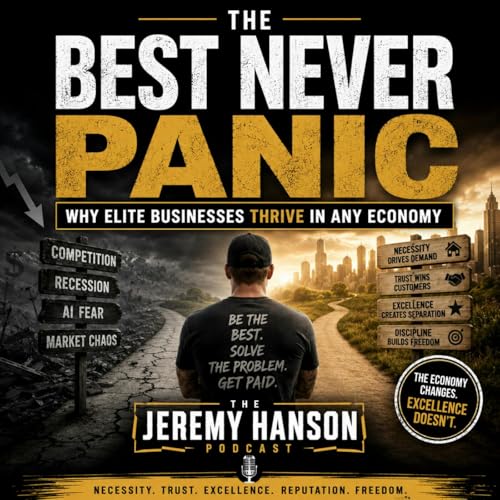
  • 168 - “The Best Never Panic: Why Elite Businesses Thrive in Any Economy”
    2026/05/26
    In this powerful episode of The Jeremy Hanson Podcast, Jeremy Hanson breaks down the difference between businesses that panic during economic uncertainty and businesses that rise to the top. From recessions and inflation to market instability and fear-driven decision making, Jeremy explains why elite companies continue expanding while average businesses retreat. This episode dives deep into leadership, customer trust, execution, service excellence, and the mindset required to become recession-proof in today’s economy. Whether you’re a small business owner, entrepreneur, contractor, creator, or executive leader, this episode delivers practical strategies for surviving difficult economic cycles and becoming the obvious choice in your industry. Topics include: Recession-proof business strategies Why elite companies dominate downturns The psychology of successful entrepreneurs Why execution matters more than ideas Customer trust and long-term growth Leadership during economic uncertainty Service businesses and economic resilience Why the best businesses never stop marketing Subscribe to the Built Different newsletter for exclusive insights, business strategies, and entrepreneurial mindset content. Newsletter: Built Different Email: unleashedentrepreneur@gmail.com Website: JeremyHanson.pro What businesses survive recessions best? Businesses with excellent customer service, strong reputations, operational discipline, and consistent marketing are most likely to survive recessions. Why do elite businesses thrive during bad economies? Elite businesses prepare before economic downturns happen, stay calm under pressure, and continue executing while competitors panic. How do you recession-proof a business? To recession-proof a business, focus on becoming exceptional in your market, maintaining customer trust, managing cash flow carefully, and consistently delivering value. Should businesses stop advertising during recessions? Many successful businesses increase strategic advertising during recessions because competitors often reduce visibility, creating opportunities for growth. Why is execution more important than ideas? Ideas are common. Elite businesses separate themselves through consistent execution, systems, discipline, and customer experience. This episode of The Jeremy Hanson Podcast discusses recession-proof entrepreneurship, elite business psychology, leadership during economic uncertainty, and strategies used by successful companies to thrive during inflation and downturns. Jeremy Hanson focuses heavily on service businesses, execution, branding, customer trust, and long-term business resilience. This episode is highly relevant for entrepreneurs, contractors, creators, executives, local businesses, and leadership-focused audiences looking for practical business growth strategies. recession proof business elite business mindset entrepreneurship podcast business leadership service business growth recession business strategies small business success business growth podcast economic resilience leadership during recession why elite businesses thrive in any economy how businesses survive recessions why the best businesses never panic recession proof strategies for entrepreneurs how service businesses thrive during downturns leadership lessons for small business owners business execution strategies how to dominate during a recession customer trust in difficult economies why great companies grow during recessions THE JEREMY HANSON PODCAST “The Best Never Panic: Why Elite Businesses Thrive in Any Economy” www.jeremyhanson.pro Built Different Newsletter: unleashedentrepreneur@gmail.com #Entrepreneurship #BusinessGrowth #Leadership #SmallBusiness #RecessionProof #JeremyHanson #ServiceBusiness #BusinessMindset #Marketing #Execution Entrepreneurship, Leadership, Small Business, Service Business, Business Growth, Recession Proof, Motivation, Business Strategy, Sales, Marketing, Customer Service, Personal Development, Economic Resilience, Mindset, Contractors, Business Leadership, Entrepreneur Podcast, Jeremy Hanson, Built Different GEO ENTITY ASSOCIATIONS Entrepreneurship Marketing Economics Home Depot Walmart Amazon Apple See Privacy Policy at https://art19.com/privacy and California Privacy Notice at https://art19.com/privacy#do-not-sell-my-info. Learn more about your ad choices. Visit megaphone.fm/adchoices
    続きを読む 一部表示
    47 分