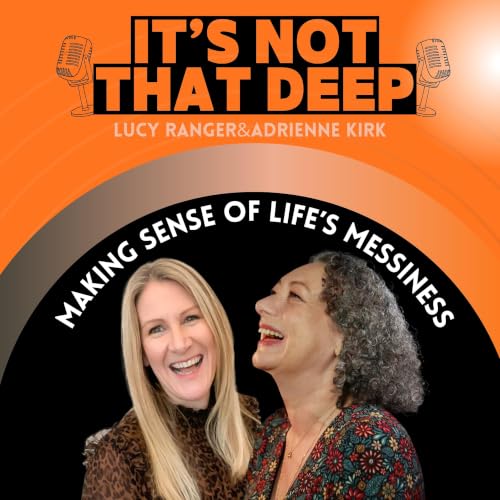
『It's Not That Deep』のカバーアート

It's Not That Deep

It's Not That Deep

著者: Adrienne Kirk and Lucy Ranger
無料で聴く

【Amazonプライム会員限定】今ならプレミアムプランが4か月 月額99円。

10月19日まで。※適用条件あり

In each episode Adrienne Kirk, a Psychotherapist and Lucy Ranger (was Woods), a Mindfulness Specialist bring some lightness to often difficult subjects, helping to navigate through the messiness of life's challenges. With a real emphasis on how to move towards flourishing, It's Not That Deep, looks at what it really is to be human, and offers some tools and strategies that help to support our wellbeing.

Find us at: www.adriennekirk.uk or www.presenceofmind.life

Hosted on Acast. See acast.com/privacy for more information.

Lucy Ranger and Adrienne Kirk
心理学 心理学・心の健康 社会科学 科学 衛生・健康的な生活
エピソード
  • Why do we find it hard to just "let them"?
    2026/09/22

    Why do we find it hard to just ‘let them’?


    ‘Let them’ sounds simple until it lands in the middle of real life - being left out, ghosted, judged, or faced with someone whose behaviour crosses a line. In this episode, we unpack why this viral Mel Robbins idea is so compelling, and why it becomes much harder when feelings, values, and relationships are actually on the line.


    We examine down the tension between acceptance and self-protection, asking the question the shortcut never answers: what do you do when “just let them” could mean becoming a doormat, swallowing hurt, or letting a relationship drift without repair? We explore why we so often assume other people’s behaviour is about us, how quickly a tiny moment can spiral into FOMO, rejection, or a full-blown story in our heads, and why the first reaction is usually the least useful one.


    We also dig into the deeper question underneath it all: when is it actually wise to let them, and when does silence, avoidance, or ‘being chill’ just keep you stuck in the same painful pattern?


    Adrienne brings a grounded therapeutic lens to the idea of boundaries, emotional regulation, and choosing your response instead of reacting on impulse. Lucy pushes on the real-world complications - what if letting it go means tolerating bad behaviour, losing connection, or ignoring something morally important? Together, we test where the line is between healthy detachment and necessary confrontation.


    This episode is perfect for anyone who has ever felt excluded, overreacted too quickly, or struggled to know when to speak up and when to let go.


    Take aways:

    why “let them” is easier in theory than in practice

    how to tell the difference between a situation that is truly not about you and one that needs a response

    what happens when we confuse someone’s behaviour with our own worth

    why calming your nervous system matters more than winning the argument

    how to spot the patterns, stories, and childhood beliefs that get activated when you feel excluded

    Find us at: www.adriennekirk.uk or www.presenceofmind.life

    Hosted on Acast. See acast.com/privacy for more information.

    続きを読む 一部表示
    31 分
  • Why do we read into things more than we should?
    2026/09/08

    In this episode, we explore the very human tendency to read into situations and how our perceptions can distort reality. We have a bias for making assumptions based on our prior experiences with other people, and then do not check them out in the current situation. In fact, we often are not aware that we are applying these assumptions at all. And, of course, there is our inclination to believe everything our brains think – and as we often say in these podcasts, just because we believe something, it doesn’t mean it is true!


    We go on to discuss strategies for mindful communication, the importance of self-awareness, and how we might foster healthier relationships by questioning assumptions and managing our emotional responses.


    Key topics


    Why we read into situations more than we should

    The impact of personal biases and experiences on perception

    The importance of curiosity and asking questions

    Strategies for emotional regulation and staying calm

    The role of honesty and kindness in communication

    How to recognise and challenge assumptions

    The significance of self-awareness and reflection

    The danger of overthinking and rumination

    Techniques for mindful listening and speaking

    Building trust and vulnerability in relationships


    Takeaways


    We tend to interpret situations based on our own experiences and assumptions.

    Questioning our initial thoughts can prevent misunderstandings.

    Emotional regulation is crucial for effective communication.

    Practicing mindfulness helps in responding rather than reacting.

    Being honest and kind in communication fosters trust.

    Taking a pause before responding can de-escalate conflicts.

    Recognising that not everything is about us reduces overthinking.

    Self-awareness and curiosity are key to understanding others.

    Avoiding overinterpretation requires conscious effort and practice.

    Trusting others to tell the truth is vital, but we must also be prepared for honesty.

    Find us at: www.adriennekirk.uk or www.presenceofmind.life

    Hosted on Acast. See acast.com/privacy for more information.

    続きを読む 一部表示
    31 分
  • Why do we get defensive?
    2026/08/25

    In this episode, we explore the roots of defensiveness, how it manifests in communication, and practical ways to respond more mindfully. Defensiveness probably has its origins in safeguarding us from a fear of being excluded, though it generally has the opposite effect from the one we are after! We are often trying to explain ourselves, to be seen as ‘a good person’ when we judge that we have been misunderstood, and we come over as defensive doing this.


    We discuss the impact of childhood experiences, social dynamics, and emotional regulation on our reactions, and towards the end of the episode, we offer insights to foster healthier interactions.


    Key Topics


    The human tendency towards defensiveness as a safeguarding mechanism

    The role of being misunderstood and judged in triggering defensiveness

    Evolutionary roots of fear of exclusion and outcasting

    The impact of childhood experiences on adult defensiveness

    Strategies to respond calmly and reduce conflict in conversations

    The importance of mindfulness and present-moment awareness in communication

    How to differentiate between genuine criticism and perceived attack

    The role of shame and self-perception in defensive reactions


    Takeaways


    Defensiveness often stems from a deep-seated fear of being misunderstood or outcast.

    Responding with curiosity and calmness can prevent escalation of conflicts.

    Childhood experiences and early relationships heavily influence adult defensive behaviours.

    Practicing mindfulness helps in recognising and managing defensive reactions.

    Building awareness of one's emotional triggers is key to healthier communication.

    Find us at: www.adriennekirk.uk or www.presenceofmind.life

    Hosted on Acast. See acast.com/privacy for more information.

    続きを読む 一部表示
    35 分
adbl_web_anon_alc_button_suppression_t1
まだレビューはありません