エピソード

  • Sci-Fi Walks the Runway
    2026/09/09
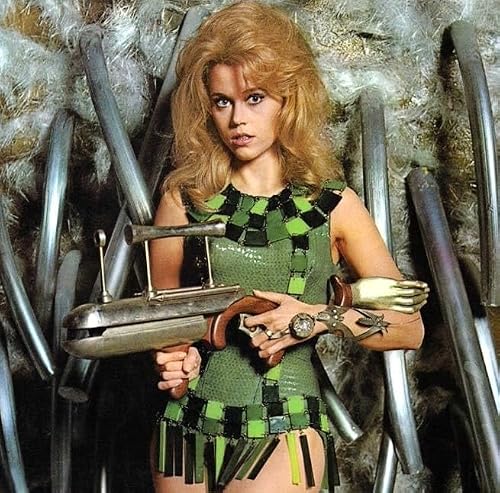
    When sci-fi movies take a big swing in depicting futuristic fashion, sometimes they end up creating iconic outfits and other times they create fashion which looks laughably outdated in a few years. I’ve became fascinated by three fashion designers whose work took center stage in sci-fi films and transcended the films themselves. I talk with fashion historians and authors Raissa Bretaña and Thèresa Winge about the influence of Paco Rabanne on Barbarella, the work of Jean-Paul Gaultier on The Fifth Element and the way Alexander McQueen was influenced by dystopian sci-fi, which informed the McQueen style in The Hunger Games: Catching Fire. Each of these collaborations left a lasting impact on cinema and fashion, from the runway to the shopping mall. Thèresa's book Fashion Adventures in Science Fiction Cinema comes out in December. This episode is sponsored by Quince. Download the Quince app for app exclusive offers or go to Quince.com/imaginary. Learn more about your ad choices. Visit podcastchoices.com/adchoices
    続きを読む 一部表示
    34 分
  • Widow’s Bay Builds a History with Horror
    2026/08/26
    I’m a little obsessed with Widow's Bay. It’s a horror-comedy series on Apple TV set on a fictional island off the coast of Massachusetts. The island isn’t as famous as Martha's Vineyard or Nantucket -- for good reason. Widow's Bay is cursed by a demonic entity. The show is nominated for 19 Emmy Awards, including Best Comedy, and I talked with their Emmy nominated production designer, Steve Arnold. We discuss the careful worldbuilding needed to blend horror and comedy, real and fake history, and subtle references to Jaws, The Fog, Halloween, The Shining, Carrie, and other works by Stephen King. We also look at why some of the props on the show became viral hits, like a set of creepy fake board games. We also have an update on our 2022 episode "Monsters in the Static: Why Gen Z Is Afraid of Analog Horror." I talk with digital folklore expert Diane A. Rodgers about why the web series Backrooms became a blockbuster film that resonated with younger fans this summer. The full version of my interview with Diane can be heard on our Patreon show, Between Imaginary Worlds. This episode is sponsored by Monarch. Use the code IMAGINARY at Monarch.com to get your first year of Monarch Core half off at just $50. Learn more about your ad choices. Visit podcastchoices.com/adchoices
    続きを読む 一部表示
    43 分
  • Economics in The Alien Franchise Isn't Science Fiction
    2026/08/12
    Even if you’ve never seen an Alien film, you probably know about the monster in the franchise. The Xenomorph has an elongated head, a second set of jaws that protrude from its mouth and a body that’s like cross between a giant insect and a skeletal dinosaur. But the alien creature may not be the real villain of the franchise. This week’s episode comes from the NPR podcast Planet Money. They explore whether the true monster is the sinister corporation pulling the strings in the background. Even more specifically, the real villain might be the economic system that allowed it to have so much unchecked power. Learn more about your ad choices. Visit podcastchoices.com/adchoices
    続きを読む 一部表示
    35 分
  • Is Money Ruining Fanfiction?
    2026/07/29
    The world of fanfiction has changed a lot since our 2017 episode, Fanfiction (Don’t Judge.) At the time, I thought that 50 Shades of Gray – the novel that began as Twilight fanfiction – was a fluke. It turned out to be a harbinger of a controversial fanfiction-to-media pipeline. I talk with Elizabeth Minkel, editor of the site Fansplaining, about how a financial motivation has altered the way fanfiction writers tell stories and the characters from pop culture they choose to focus on. We also discuss how the conversations around representation in fanfiction have become more complicated over the past decade. This episode was inspired by an episode of The Allusionist podcast. If you like this episode, you should check out our interview with Archive of Our Own co-founder Francesca Coppa and our episode Swept Away by Romantasy, which looks at how the blending of romance and fantasy took over the publishing industry. Learn more about your ad choices. Visit podcastchoices.com/adchoices
    続きを読む 一部表示
    44 分
  • Choose Your Own Odyssey
    2026/07/15
    Christopher Nolan’s film The Odyssey is part of a long line of film adaptations, but Homer’s epic poem has quietly shaped another medium: role-playing games. The structure of The Odyssey is practically a blueprint for tabletop and video game RPGs from the ‘boss fights’ with fantasy creatures to the way Odysseus levels up through the tale. Professor Roger Travis explains how ancient bards engaged in a similar type of immersive storytelling as game masters today. Laura Jenkinson-Brown argues that Odysseus’s choices are like a dialogue tree in a choose-your-own-adventure book. That’s why she wrote one called “You Are Odysseus. Plus, John Haygood and Jonathan Drake tell me how they’ve created tabletop role-playing games that tap into Greek myths and reward players for embracing the values of the Homeric world. To support the show, you can donate on Patreon where you get access to the ad-free version and our companion show Between Imaginary Worlds. Learn more about your ad choices. Visit podcastchoices.com/adchoices
    続きを読む 一部表示
    41 分
  • The U.S. of Play - Part 2: Silly Putty, Twister and Monopoly
    2026/07/01
    In honor of America's 250th anniversary, we're continuing our mini-series on iconic American toys and games that took on lives of their own. Strong National Museum of Play curators Michelle Parnett-Dwer and Mirek Stolee, along with game designer and author Tim Walsh, join me to unpack how Silly Putty, Twister, and Monopoly slipped between the complicated world of adults and the realm of childhood. HSE University professor Roman Abramov tells me how Soviet kids in the '80s built their own DIY versions of Monopoly behind the Iron Curtain. And I travel back to middle school to relive my role in a children's theater group that staged an original musical about Monopoly that was also a critique of capitalism. To support the show, you can donate on Patreon where you get access to the ad-free version and our companion show Between Imaginary Worlds. Learn more about your ad choices. Visit podcastchoices.com/adchoices
    続きを読む 一部表示
    43 分
  • The U.S. of Play - Part 1: Wagons, Bears and Dolls
    2026/06/17
    In honor of the 250th anniversary of the USA, we are doing a series of mini stories across two episodes that explore American toys and games. This week, we look at early childhood objects that became vehicles of the imagination. I talk with Michelle Parnett-Dwyer, senior curator at the Strong National Museum of Play, about how the origin of the Radio Flyer Wagon. Author Michael Kimmel tells me about his great-grand uncle who invented the teddy bear with a little help from the 26th president. I talk with Sara Broussard, director of the Houston Toy Museum, about the complicated history of Cabbage Patch Kids and my assistant producer Stephanie Billman recounts her obsession with the doll that adults were literally fighting over in the mid-1980s. To support the show, you can donate on Patreon where you get access to the ad-free version and our companion show Between Imaginary Worlds. Learn more about your ad choices. Visit podcastchoices.com/adchoices
    続きを読む 一部表示
    36 分
  • How Folklore Spirited Anime Away
    2026/06/03
    Anime and manga are a global phenomenon, and their popularity continues to grow. Many of these stories are populated by supernatural beings called yōkai. Even though yōkai can be portrayed as ghosts, demons, or monsters, they're rarely purely good or evil. We trace the history of yōkai from ancient folklore to Studio Ghibli films and shows like Dan Da Dan. I talk with scholars Kaitlyn Ugoretz, Deborah Shamoon, and Michael Dylan Foster about why these supernatural beings have captured people's imaginations, how they became central to modern pop culture, and the role they play in Japan even in times of national emergency. Deborah’s book, “Text and Image: Making Meaning in Manga and Comics” is available in the Fall. Kaitlyn’s YouTube channel is Eat Pray Anime. Michael Dylan Foster wrote several books on yōkai To support the show, you can donate on Patreon where you get access to the ad-free version and our companion show Between Imaginary Worlds. Learn more about your ad choices. Visit podcastchoices.com/adchoices
    続きを読む 一部表示
    38 分