エピソード

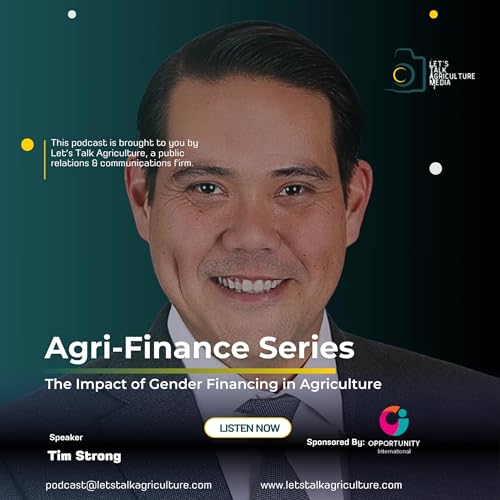
  • Impact of Gender Financing in the Agricultural sector with Timothy Strong
    2024/08/08
    Intro: [00:00:00] Sharon Idahosa: [00:43:00] Hello beautiful people. Welcome to the Let's Talk Agriculture podcast show, where we bring you the latest trends, opportunities, and innovations in the agriculture industry. Now this episode is brought to you by Opportunity International, a nonprofit organization equipping families with the tools [00:01:00] and training that they need to build their businesses, improve harvest, provide for their families and send their children to school, and even break the cycle of poverty. Now talk about innovative financial solutions. They can help families living in extreme poverty to build sustainable livelihood. Now, if you'd like to learn more and support the work that they do, quickly visit opportunity.org. Now, this is me bringing to you the impact that they have created so far when it comes to gender financing. We already know that women face so much challenges when it comes to getting access to finance. And if you're one of those, this is the best place, you know, to, you know, learn and get access to this initiative that they've put in place for you as a woman. And of course, if you are one of those supporting women, this is the best place to go. So, I encourage you to really just check out opportunity. org to see the best [00:02:00] ways that you can benefit. So, joining me today is Tim Strong, head of agricultural financing at Opportunity. Tim has successfully led the agri finance initiatives with his team in Malawi and beyond. Hello, Tim. Thank you so much for joining the show today. How are you doing? Timothy Strong: Thank you, Sharon. I'm really excited. As I said about it being Friday, I'm looking forward to the weekend ahead. It's absolutely a pleasure to be invited to join you on the podcast today. Sharon Idahosa: It's a pleasure to have you. I mean Fridays just look almost the same to me anyway. So, yeah, I looked through, um, the recent feature with you and your team on Bloomberg and I must say that you have done incredibly well. I mean a great job so far. So, I mean, why don't you share with us Um, the objectives of the gender finance projects and the implementation in Malawi. I know it was Implemented in Malawi or is it beyond Africa already? But I mean, let's just have this as a case study. Timothy Strong: Very cool Sharon So, um, it's definitely been a [00:03:00] pleasure to be able to spread the good news I think you and I have some very similar perspectives in terms of the gospel of the small holder farmer Uh, for us at Opportunity, it's really been a journey for us as we've continued to really focus what we do on listening to our clients. Um, so a lot of what, uh, you referenced to in terms of the Bloomberg article and how we're innovating with generative artificial intelligence to support farmers, it all boils down to that same piece is how do we make sure that we implement human centered design. How do we become specialists and listening to the needs of the variety of clients that we have for opportunity has been, uh, as I said, a journey and we've been in operations now for over 53 years Organizationally We've been able to reach over 19. 4 million clients and 95 percent of those whom are women. And we've partnered with 130 different financial institutions across 33 countries within our overall lending book of roughly 2. 3 billion. Um, over 450 million of [00:04:00] that, uh, is financing directly the unlock. Um, so for us, we really see our mission and our mandate to really make sure that we're bringing together the right partners and the right relationships to access, uh, to really have a centered focused on X. It's really, you know, capital as an access piece for farmers, training and support networks. Um, really a lot of this, uh, builds up on that, but, um, for our team and our program. We've come together for agricultural finance around a belief in rural prosperity. How do we really see that farmers are the major driving engine of economic growth in all of the co

    Support us on selar.com!

    続きを読む 一部表示
    30 分
  • Why Farmers Should Transition to Regenerative Agriculture with Dr. Rudolf Overbeek and Charles
    2024/04/25
    [00:00:00] Intro [00:00:36] Sharon Idahosa: Hey guys, welcome to another episode of our sustainability series. [00:00:41] Sharon Idahosa: It's really been an exciting and insightful time for me. I mean, I've been discussing with industry experts with a sustainability focus globally. Now, if this is your first time joining or listening, we've had about two episodes already, and you may want to go back and listen. [00:01:00] All of our episodes are available on letstalkagriculture. com [00:01:03] Sharon Idahosa: Now, this episode is exclusively sponsored by FoodChainid. So for more information, please do well to visit foodchainid.com. My name is Sharon Idahosa and I am your host. Once again, welcome to the Let's Talk Agriculture podcast show. Today, I will be discussing with two amazing personalities who will be sharing their perspective [00:01:26] Sharon Idahosa: and the work that they do on the topic of regenerative agriculture. So friends, families join me welcome Charles of Virco Group and Dr. Rudolf of Food Chain ID. Hello, gentlemen, thank you so much for joining the show today. How are you doing? [00:01:43] Ruud: Doing very fine. Thank you very much. And pleased to talk to you. [00:01:47] Sharon Idahosa: Charles. [00:01:48] Charles: I'm doing great, Sharon. Great. I'm doing great, Sharon. It's great to be here. so [00:01:51] Sharon Idahosa: Thank you so much. So I'm really excited about what we are going to learn today. And for us to get this ball rolling, I'm just going to need [00:02:00] to get your perspective on regenerative agriculture. What does it mean? What is, what is the idea behind regenerative agriculture? [00:02:09] Sharon Idahosa: Charles, maybe you can go first and then Rudolf, you can take over from Charles. [00:02:13] Charles: Okay. Thank you. Thank you for that. So over the years, um, quite recently, regenerative agriculture has become such a hot topic in the agricultural space, especially in this current times that there are issues with climate change and we're seeing the effects on what climate change is doing for us. [00:02:34] Charles: So to break it down to a simple term, regenerative agriculture from how I see it is all about farming or if you're into grazing, while solely based on regenerating the topsoil and allowing farmers to maintain crop yields, improve water retention, plants uptake, but the bottom line is increasing farm profitability and especially with how the food production currently [00:03:00] Charles: is leaning towards in terms of trends, there's a big importance on how people want to know food is being produced. So with this kind of situations, these are when regenerative agriculture comes into place because it puts a lot more focus, not just on crop, not just on crop yield, but more on strengthening the health and the vitality of the farm soil. [00:03:22] Charles: Because at the end of today, You know, once you put in these activities into your planting, you know, it helps a lot in the long term. So it's a, it's a, it's a, it's a, system that is being smiled upon now globally. And even with the issues with climate change that we are even experiencing here in Nigeria, you know, it's become important that these are the methods that should be adopted. [00:03:48] Charles: in the current day and time for farming, farming practices right now. So that's it's just a short, short, short idea on what we what we coined the term or [00:04:00] believe in the term; regenerative agriculture. [00:04:02] Sharon Idahosa: Thank you so much for sharing your thoughts. I would have wanted to ask how well it's really been adopted here in Nigeria, but maybe we'll come to that briefly. 00:04:12] Sharon Idahosa: Let me just hear from Rudolph. So, over to you. Yeah,

    Support us on selar.com!

    続きを読む 一部表示
    30 分