• He Remade a Film That Doesn’t Exist | Paul Bunnell on A Blind Bargain, Lost Cinema and Crispin Glover
    2026/04/29
    What does it mean to remake a film no one can see? The 1922 silent horror A Blind Bargain, starring Lon Chaney, is one of cinema’s great lost works—destroyed, surviving only in fragments and memory. And yet, over a century later, director Paul Bunnell set out to bring it back. In this episode of INSIDE THE ARTHOUSE, Bunnell discusses the strange challenge of rebuilding a film from absence—reimagining its story in the 1970s, and confronting themes of obsession, sacrifice, and transformation. With Crispin Glover stepping into one of Chaney’s roles, the film becomes something more than a remake—it’s an act of interpretation, speculation, and cinematic resurrection. How do you honor something that’s gone? And how far can you push it into something new? Learn more about your ad choices. Visit megaphone.fm/adchoices
    続きを読む 一部表示
    44 分
  • The Making of Mārama | Director Taratoa Stappard on Māori Gothic & Colonial History
    2026/04/22
    A haunting Māori Gothic ghost story — director Taratoa Stappard breaks down Mārama and the history, identity, and trauma behind the film. What is Mārama—and why does it feel unlike anything else in cinema right now? In this episode of Inside the Arthouse, hosts Greg Laemmle and Raphael Sbarge sit down with New Zealand filmmaker Taratoa Stappard to explore his haunting new film — a self-described “Māori Gothic ghost story” that blends psychological horror with a powerful historical reckoning. Set in 1859, Mārama follows a young Māori woman who travels to England in search of her past, only to uncover a devastating truth shaped by colonial violence, cultural erasure, and a legacy that refuses to stay buried. At the center is a fearless breakout performance by Ariāna Osborne, grounding a film that builds toward something both unsettling and deeply cathartic. Drawing from his own Māori and English heritage — and a lifetime of living between two worlds — Stappard crafts a story where history isn’t distant. It’s alive, unresolved, and deeply personal. In this conversation, we explore the origins of Mārama, the risks of blending genre with cultural trauma, and what it means to tell stories that challenge both audiences and the industry. In this episode: • What “Māori Gothic” means — and why it matters now • How Stappard’s whakapapa (heritage) shaped the film • The risks of confronting colonial trauma through horror • Ariāna Osborne’s extraordinary breakout performance • Why Mārama is resonating with audiences worldwide Official Selections: TIFF 2025, AFI Fest, Palm Springs International Film Festival, Sitges & moreDistributed by: Watermelon Pictures & Dark Sky Films Learn more about your ad choices. Visit megaphone.fm/adchoices
    続きを読む 一部表示
    47 分
  • Amy Goodman on Media Consolidation & Steal This Story, Please!
    2026/04/15
    Legendary journalist Amy Goodman joins us to discuss media consolidation, independent journalism, and the new documentary Steal This Story, Please! As corporate ownership reshapes the news landscape, the fight for a free and independent press has never been more urgent. In this episode of INSIDE THE ARTHOUSE, we’re joined by Goodman alongside Oscar-nominated filmmakers Tia Lessin and Carl Deal to explore the making of Steal This Story, Please! and the rise of Democracy Now! For over three decades, Goodman has challenged power, elevated underreported stories, and redefined what independent media can be. This conversation looks at the film, the evolving media landscape, and the urgent question: who controls the narrative? A timely discussion about truth, power, and the future of the free press. Keywords: Amy Goodman, Democracy Now, media consolidation, independent journalism, documentary film, Tia Lessin, Carl Deal INSIDE THE ARTHOUSE is a filmed podcast featuring in-depth filmmaker interviews focused on independent film, arthouse cinema, documentary filmmaking, and the film industry. Learn more about your ad choices. Visit megaphone.fm/adchoices
    続きを読む 一部表示
    59 分
  • Camus Didn’t Say Everything—Ozon Does. THE STRANGER
    2026/04/08
    François Ozon on Adapting Camus' The Stranger | Inside the Arthouse What does it mean to feel nothing — and why does that still resonate decades after Albert Camus first put it on the page? In this episode of Inside the Arthouse, we sit down with acclaimed French filmmaker François Ozon to discuss his bold new adaptation of Camus' The Stranger (L'Étranger) — one of the most widely read and persistently provocative novels of the 20th century. Translated into more than 75 languages and continuously in print since 1942, The Stranger has long been considered unadaptable. Ozon proves otherwise. Shot in evocative black and white, his film stays faithful to the novel's signature emotional detachment while expanding its lens on the colonial Algeria Camus largely left unexamined — bringing themes of racial injustice and moral ambiguity into sharp, contemporary focus. We talk with Ozon about what drew him to the material, the challenges of translating Meursault's inner silence to the screen, and what this story still has to say to audiences today. Featuring a precise, deeply controlled performance by Benjamin Voisin as Meursault, and Rebecca Marder bringing warmth and humanity as Marie. Nearly 30 years after his debut feature See the Sea screened in U.S. arthouses, Ozon remains one of international cinema's most versatile and essential voices. The Stranger is among his finest work. François Ozon. Albert Camus. A literary classic, reimagined. Inside the Arthouse — new episodes every week. Learn more about your ad choices. Visit megaphone.fm/adchoices
    続きを読む 一部表示
    29 分
  • Matthew Shear on the Personal Story Behind Fantasy Life
    2026/04/01
    Matthew Shear — writer, director, and star of Fantasy Life — joins us to talk about the deeply personal story behind his debut feature. In this conversation, Shear reflects on how his own experiences with anxiety and depression shaped the film, and why he wanted to portray mental health in a way that feels lived-in rather than sensationalized. Instead of leaning into extremes, Fantasy Life finds something more honest — where these struggles are simply part of everyday life. We also talk about the challenge of directing himself in the lead role, working alongside a remarkable cast including Amanda Peet and Alessandro Nivola, and what it meant to bring such a personal story to the screen for the first time. Fantasy Life premiered at SXSW, where it won the Audience Award, and has quickly become one of the most talked-about indie films of the year. This is a conversation about vulnerability, craft, and the courage it takes to tell a story that close to home. Learn more about your ad choices. Visit megaphone.fm/adchoices
    続きを読む 一部表示
    50 分
  • One of Cinema’s Greatest Directors Returns | Miroirs No.3 Christian Petzold Interview
    2026/03/25
    Christian Petzold is widely regarded as one of the most important filmmakers in contemporary world cinema. In this episode of INSIDE THE ARTHOUSE, we explore his latest film, MIROIRS NO. 3. From his early work to his international breakthrough with Barbara (2012), Petzold has built a remarkable body of films including Phoenix, Transit, Undine, and Afire. His collaborations with Nina Hoss and Paula Beer have helped define modern German cinema and global arthouse filmmaking. Now, Petzold reunites with Paula Beer for MIROIRS NO. 3, a luminous and deeply human film inspired by Maurice Ravel’s piano suite. The film continues his exploration of identity, memory, and recovery from trauma, told with an impressionistic and emotionally resonant style. In this conversation, Christian Petzold discusses the making of MIROIRS NO. 3, his creative process, working with Paula Beer, and the themes that have shaped his career. MIROIRS NO. 3 opened March 20 in New York and Los Angeles and is expanding to theaters nationwide. INSIDE THE ARTHOUSE is hosted by Greg Laemmle and Raphael Sbarge and features in-depth conversations with filmmakers, actors, and industry voices shaping independent and international cinema. Learn more about your ad choices. Visit megaphone.fm/adchoices
    続きを読む 一部表示
    37 分
  • Annemarie Jacir on PALESTINE 36 (Oscar Shortlisted) | Why This Film Matters Now
    2026/03/18
    A conversation with the Oscar-shortlisted director on history, myth, and the making of PALESTINE 36 What happens when history challenges the story we’ve been told? In this episode of INSIDE THE ARTHOUSE, we sit down with acclaimed filmmaker Annemarie Jacir to discuss her new film PALESTINE 36, a powerful historical drama that revisits the years leading up to the creation of the State of Israel and offers a perspective rarely explored in narrative cinema. For decades, the history of Palestine during this period has been shaped as much by cultural myth as by documented fact—popularized through works like Exodus and reinforced through generations of storytelling. But what happens when those narratives are questioned? As John Ford famously wrote in The Man Who Shot Liberty Valance: “When the legend becomes fact, print the legend.”PALESTINE 36 pushes in the opposite direction. In our conversation, Annemarie Jacir reflects on the historical context behind the film, the challenge of telling politically and culturally sensitive stories, and the long journey of bringing PALESTINE 36 to the screen. Premiering at the 2025 Toronto International Film Festival to a 20-minute standing ovation and shortlisted for the Academy Award for Best International Feature, PALESTINE 36 has already emerged as one of the most talked-about international films of the year. The film opens in New York City on March 20, expands to Los Angeles on March 27, and continues its North American rollout in the weeks that follow. This interview was recorded in person at the Royal Theatre. Learn more about your ad choices. Visit megaphone.fm/adchoices
    続きを読む 一部表示
    52 分
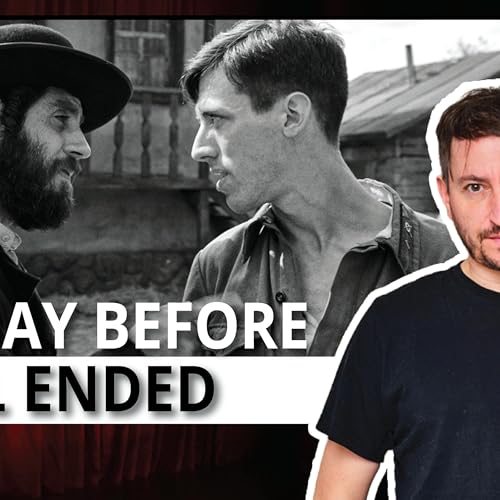
  • SHTTL: The Last Day Before the Invasion — Ady Walter with Moshe Lobel & Saul Rubinek
    2026/03/11
    SHTTL director Ady Walter and actors Moshe Lobel and Saul Rubinek discuss the film’s powerful portrait of Jewish life in a shtetl just before the Nazi invasion of Eastern Europe. What was life like in a Jewish shtetl just before the world changed forever? In this episode of INSIDE THE ARTHOUSE, we explore SHTTL, director Ady Walter’s striking film about life in a Jewish village on the eve of World War II, through conversations with the filmmaker and two of the film’s stars. In this conversation you’ll hear about recreating a lost world on screen, the role of Yiddish language and culture in the film, and how the cast approached portraying a community on the brink of historic upheaval. The word shtetl—Yiddish for the small towns across Eastern Europe where many Ashkenazi Jewish communities lived before the Holocaust—often carries a sense of nostalgia. For those born after the Shoah, it can evoke the dreamlike villages of Marc Chagall’s paintings or the storytelling of Isaac Bashevis Singer. But Walter’s film offers something more complex. SHTTL reveals a vibrant community filled with debates about religion, politics, gender roles, economics, and identity—a living world that feels surprisingly contemporary. The film has resonated strongly with audiences, recently becoming the longest-running film at New York’s New Plaza Cinema, where it has played continuously for more than 20 weeks. For this episode, we recorded three separate conversations with key members of the film’s creative team: *Ady Walter, speaking from Paris, discusses recreating a lost world and bringing Yiddish culture and pre-war Jewish life to the screen. *Saul Rubinek, the acclaimed actor and filmmaker who grew up speaking Yiddish in Montreal, reflects on his personal connection to the language and the story. *Moshe Lobel, the film’s star, shares his own relationship to Yiddish and the cultural traditions portrayed in the film. Together, these conversations offer a deeper look at the history, culture, and filmmaking behind SHTTL About the film SHTTL: Directed by Ady Walter, SHTTL is a historical drama set in a Jewish village in Eastern Europe on the eve of the Nazi invasion in 1941. Filmed largely in Yiddish, the film follows a community navigating questions of tradition, politics, identity, and modern life during the final hours before everything changes. @Laemmle @officialRaphaelSbarge @insideTheArthouse @moshelobellao @menemshafilms #SHTTL #SHTTLFilm #MosheLobel #MoisheLobel #SaulRubinek #AdyWalter #YiddishFilm #YiddishCinema #JewishCinema #JewishHistory #Shtetl #IndependentFilm #ArthouseCinema #InternationalCinema #FilmInterview #InsideTheArthouse Find clips from this interview @INSIDETHEARTHOUSEclips ​ INSIDE THE ARTHOUSE features conversations with filmmakers, actors, and industry leaders shaping independent and international cinema. Learn more about your ad choices. Visit megaphone.fm/adchoices
    続きを読む 一部表示
    49 分