エピソード

  • Annika Pasch: Focus on Health and Wellness
    2025/11/17

    From cross country skiing and running to ice hockey, sport has always been a big part of Minnesota native Annika Pasch’s life. Today, she’s added biathlon to her repertoire with the responsibility of managing health and wellness for the U.S. Biathlon Team as part of its partnership with University of Health. Pasch joined Heartbeat as she headed out to Europe for her second season wth the team.


    What motivated her to become an athletic trainer?


    “Just being an athlete, kind of identifying as an athlete myself for so long, just seeing the passion and the hard work that those athletes put into what can essentially become their career,” she said. “I just want to do everything I could to let them be successful. And that's a huge part of my job – just keeping that arrow pointed forward for someone to just keep on the track of success.”


    So what is health and wellness? And why is it important for athletes – and for all of us?


    “Health and wellness is what gets you through every day,” said Pasch. “And if you're not respecting your body and taking care of it 24 over seven, that's lost time. If you look at it as the athletes, it's their job.”


    Her background has taken her to basketball, hockey, and track. And one of the keys for her in her new role with U.S. Biathlon is her own background as a cross country skier.


    When describing her role to others who might not know what an athletic trainer does, she compares it as a cross between a physical therapist and an EMT. “A lot of the education and focus is on first response and emergency care,” she said. But today, a lot of energy goes into injury and illness prevention.


    “That's where that physical therapy, that rehab, the diagnostic piece comes into it,” she said. “And then layered within all of that in the education is pharmacology, general medicine, sports psychology, nutrition. We kind of get a little sprinkling of everything.”


    As a passionate cross country skier herself, she’s now become one of biathlon’s biggest fans. And, yes, she has picked up a biathlon rifle to try shooting. This winter, she will hopscotch around Europe as the U.S. Biathlon Team heads to Antholz for the Olympic Winter Games.


    Get to know Annika Pasch and the valuable support services she’s bringing to biathletes in this episode of Heartbeat, the U.S. Biathlon podcast.

    続きを読む 一部表示
    49 分
  • Jim Becker: Science of Success
    2025/10/31

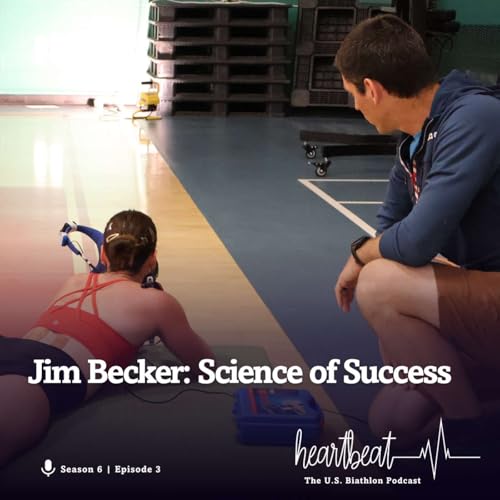
    Watching biathlon on NBC during the 2018 Winter Olympics inspired New England native Jim Becker to participate in the sport. Today, Dr. Jim Becker is leading an innovative biomechanics research project with the U.S. Biathlon Team, which could make a big difference at the 2026 Winter Games in Italy. Heartbeat met with Becker to discuss his innovative Montana State University program and how it’s helping American biathletes.


    Becker vividly remembers tuning into the Olympics on NBC in 2018. “It was just so cool to watch how things could change in an instant, right? One athlete is leading the race. They come in to shoot. They miss a target. All of a sudden, they're on the penalty loop. Somebody else goes out in the lead. Right? All the way up to the last shoot.


    “You didn't really know what was going to happen. It was just exciting the entire time. Also, as an athlete, you kind of really appreciated the fitness of these individuals and how hard they're working and how fast they're moving. And I've come to appreciate that even more, you know, really getting to know the sport.”


    Today, Becker works in kinesiology – the study of human movement. “From a biomechanical perspective, we're looking at what are the forces that generate that movement? What are the forces that are applied to your body during that movement?”


    The long and short of it is that Becker and his team study human movement to give athletes optimal tactics to capitalize on every single movement.


    Over the past few seasons, his Montana State University biomechanics research team has collected extensive data from video and other tools, analyzed it, and provided feedback to athletes and coaches.


    How can it work in practice? Becker discusses how video of athletes on a given course can provide data to offer tactical advice on how to ski that section faster or more efficiently, thereby conserving energy. And, yes, it really works!


    From Soldier Hollow to Lake Placid, Vuokatti to Antholz, Becker’s student researchers are making a difference for U.S. biathletes. If you like to geek out a bit on the science of sport, this is your podcast.


    Join us for season six, episode three with Dr. Jim Becker to learn more about how the U.S. Biathlon Team is shaving seconds and shooting straighter thanks to innovative data analysis.


    続きを読む 一部表示
    39 分
  • Jack Gierhart: Pride of Team
    2025/10/08

    It’s been three years since veteran Olympic sport leader Jack Gierhart found his way to U.S. Biathlon. Now entering his fourth season, Gierhart spoke with Heartbeat from the U.S. Biathlon headquarters in Soldier Hollow, outlining some of the innovative athlete support programs that have been implemented, discussing team culture, and sharing the story behind the new U.S. Biathlon logo released this month.


    Gierhart was enthusiastic about the athlete-staff initiative on team culture. In episode one of Heartbeat this season, we spoke with Kelsey Dickinson and Chloe Levins about the team’s initiative to create a values-based, positive team culture. “I remember talking with Kelsey and Jake (Brown), and a couple of other athletes a year-and-a-half ago or so,” said Gierhart. “They were enthusiastic about trying to get this going.” Now the shared values program, driven by both athletes and staff, is firmly in place heading into the 2025-26 season.


    He also highlighted some of the innovative high-performance programs implemented by U.S. Biathlon to support athletes. As an example, High Performance Director Lowell Bailey now works closely with Jim Becker, a masters biathlete himself, at Montana State University on a wide range of initiatives, from physiological biometric testing to 3D motion capture.


    “We're really seeing quite an impact on the performance of our athletes,” he said.


    Simple as it may seem on the surface, another priority area for U.S. Biathlon has been athlete wellness. “One of the areas we really started to focus on about a year and a half ago was how do we reduce athlete illness?” said Gierhart. “That's been the biggest impact on us!”


    He outlined programs in place now through U.S. Biathlon’s partnership with University of Utah Health. Last January, U of U Health Athletic Trainer Annika Pasch joined the team to support overall athlete wellness on the grueling schedule athletes face during the winter season.


    “This concept of minor illness prevention is incredibly important to us,” he added. “So we started to talk about how do we do that? How do we keep our athletes on the race course more frequently? And besides being able and having boots on the ground with the athletes that are able to monitor things in real time and react immediately, is really important.”


    The atmosphere at the final pre-season dryland camp was exhilarating. There was a lot on the line with team trials. And final preparation before the team reassembles in Obertilliach, Austria for a final on-snow test before the World Cup and IBU Cup openers.


    As he reflected back on the last three seasons, his look forward was one of pride. “The work that this team has done over the last three years – we have high goals. Everybody's working really hard. But whatever happens, I'm going to be incredibly proud of this team and our community of what we achieve.”


    Listen in to Heartbeat, season six, episode two, for an insightful look into U.S. Biathlon with CEO Jack Gierhart.


    続きを読む 一部表示
    43 分
  • The Culture of a Team
    2025/09/30

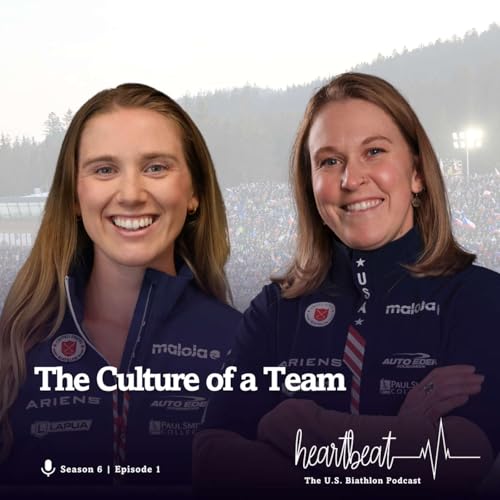
    There are many components to athletic success, from high-performance training to perfecting sport skills. But underlying every successful team is a culture that fosters an atmosphere of success. On the eve of team trials and a fall training camp at Soldier Hollow, veteran U.S. Biathlon Team athletes Kelsey Dickinson and Chloe Levins joined Heartbeat podcast host Tom Kelly for an in-depth look at the athlete-led initiative to build a values-based, positive team culture.


    In addition to competing on the international biathlon stage, both Dickinson and Levins have taken on leadership roles, serving as athlete representatives to both the U.S. Biathlon Board of Directors and the U.S. Olympic and Paralympic Committee. Quite simply, “Our role is really to represent the athlete voice in any decisions being made by US Biathlon,” said Dickinson.


    However, one of their most impactful roles over the last year has been their engagement with both teammates and U.S. Biathlon staff in building a recognizable team culture, including the identification of a set of values that staff and athletes can all rally around.


    US Biathlon Values

    • Respect
    • Grit
    • Growth Mindset


    “We decided that we could all stand by these,” said Levins. “They represent who we want to be, how we want to show up as Team USA – as the staff wants to show up for the athletes, as the athletes want to show up for the staff, and the greater organization as a whole and their country.


    “It was a really special thing to be a part of!”


    The values were adopted by athletes and staff together after a series of group sessions that began at the Vuokatti training camp before last season.


    “We’re looking at this from the perspective of emphasizing that we are a values-led organization,” sai Dickinson. “And creating those values that we can come together around and use to have discussions and support each other, and also hold each other accountable.”


    Want to hear more? Listen in on the new season six of Heartbeat as Chloe Levins and Kelsey Dickinson dive deep into the value-backed culture created by the U.S. Biathlon Team.

    ATHLETE OUTREACH
    Athletes, want to reach out to your US Biathlon athlete representatives? Simply send an email to: athletereps(@)usbiathlon.org.


    PAST EPISODES WITH CHLOE & KELSEY

    Kesley Dickinson: Athlete & Advocate (April 2025)

    Chloe Levins: Bouncing Back (Nov. 2022)

    Kelsey Dickinson: Nordic Culture of the Methow Valley (Dec. 2021)

    Chloe Levins: From Fairway to Biathlon Range (Sept. 2020)

    続きを読む 一部表示
    43 分
  • Armin Auchentaller: Seeing What's Possible
    2025/05/22

    At every level, the 2024-25 season was marked by positive steps forward for the U.S. Biathlon Team. As the season ended and a new one began with an on-snow camp in Bend, Ore., Head Coach Armin Auchentaller joined Heartbeat from his home in Antholz, characterizing the season as one of seeing what’s possible. But he was quickly pointed out that now it starts all over again. And how do you get even better?


    “It always helps to have results because people just stay positive,” said Auchentaller. “There's a good mood. People see that things are possible. But I think, the day after those good results or the season, when the next season training season starts, once you had those good results, I think the best is to come back on the ground and just think of almost like, ‘yeah, how can I get better?’”


    In this episode of Heartbeat, Auchentaller speaks to the showcase results of Campbell Wright, winning two silver medals at the World Championships, a career-best for Paul Schommer, and continued development progress by Maxime Germaine, Lucy Anderson and Margie Freed.


    One of the keys to that progress has been shooting. “In order to reach good shooting skills, we need to work on the basics a lot, like dividing all the little things, like learning how to trigger, learning how to aim, learning how to breathe, learning how to bolt, learning how to go into position quick, and all of those little things and little things. Then put those things together. Those need to be high quality. It will take a lot of patience. It will take a lot of personal workload in their off times when they are without the team on their own.”


    One of the keys to the growing success of development athletes is Olympic shooting champion Matt Emmons, who serves as a coach for U.S. Biathlon. “We try to use his expertise in a way where athletes get access to experience what he had himself and open up a different perspective, under a different light, and give the athletes a lot of theoretical feedback through that and a lot of sharing, experience and a lot of expertise from his shooting career.”


    From a 2025 recap to a breakdown of the Bend camp to the vital innovation in the Montana State physiological testing program, Auchentaller covers a lot of ground in this final episode of Heartbeat for the 2025 season.


    続きを読む 一部表示
    33 分
  • Kelsey Dickinson: Athlete & Advocate
    2025/04/21
    A veteran of over a decade on the U.S. Biathlon Team, Kelsey Dickinson is still packing her skis and biathlon rifle to the far reaches of the world. Along the way, her legacy is growing as a passionate advocate for her fellow athletes, and a pioneering leader for women in sport. Heartbeat co-hosts Tom Kellly and Sara Donatello spoke with Dickinson during a post-season spring break from her home in Bozeman, Mont., where she spends time while not training in Craftsbury, Vt.When Heartbeat last caught up with Dickinson in December, 2021, she talked about growing up in Washington’s Methow Valley as a cross country skier, later finding her passion for biathlon at St. Scholastica College in Duluth, Minn. She also spoke about the role women coaches had made in her career – foreshadowing what she’s been up to these last few seasons.Dickinson has taken her passion for the sport and become one of its most prominent advocates for change. She serves on the U.S. Biathlon board as an athlete representative and also represents her sport on the USOPC Athletes’ Advisory Council. She’s a gender equity athlete ambassador for the IBU, and served on the USOPC’s DEI Core Team leading up to the 2021 Tokyo Games. She has played a vital role with the USOPC Women’s Health Task Force, focusing on health-related issues affecting female athletes. She even served on a Team USA athlete advisory group that examined emerging digital assets, such as non-fungible tokens (NFTs).But amidst all of her giving back to her sport, one of the roles she cherishes most is serving as executive director of the Women Ski Coaches Association, the organization started by her college coach at St. Scholastica, Maria Stuber. What started as an initiative within NCAA programs, is now having an impact on a wide range of sports through programs like GearUp and Trail to Gold.Why does Dickinson devote so much time and energy with such passion? “Early on, I realized that for me to find meaning in sport, I really wanted to make it a place where my teammates or anyone, who wanted to be coaches could have the best experience possible.”Dickinson has seen the challenges through the eyes of some amazing female mentors, like Stuber, who have influenced her career.“I've had some experiences when I was younger that made me realize that, wow, like, sport doesn't necessarily put women and men on an equal level,” she said. “And it's not necessarily that anyone is trying to discriminate against women, but it just sort of exists in the fabric of the culture.”Dickinson has found a welcoming reception from U.S. Biathlon to the IBU to USOPC. “U.S. Biathlon understands that it to be to be a modern innovative sports organization, bringing in women voices and increasing diversity and is only going to benefit the success of the sport,” she said. “The bottom line – I think what U.S. Biathlon is doing is really important and essential for long term success.”Beyond equality initiatives, she sees her work benefiting other areas, including overall team culture and creating more coaches in the biathlon community, who can then grow their own junior programs.“I'm really glad that they're investing in this and taking the time to put their put their weight behind this program succeeding.”Reflecting back on her career as an athlete and an advocate, Dickinson speaks with confidence and satisfaction – as someone who can now see that the work she’s been doing has been fruitful.“I've always felt this purpose that – my impact on sport. I would rather be remembered for making sport a better place for women than necessarily my results. That’s always been driving me in this space.”Sport is fortunate to have an advocate like biathlete Kelsey Dickinson, who is a pioneer for change and not afraid to dive in and do the work. Through her eyes and experiences, this episode of Heartbeat showcases the impact athletes can have on their sports. Listen in as Kelsey Dickinson walks us through the myriad ways she’s having a profound impact on sport.RESOURCESExplore these links to learn more and to get engaged in programs.Women Ski Coaches AssociationU.S. Biathlon Women’s Coaching InitiativeNNF Trail to Gold Grant Program
    続きを読む 一部表示
    41 分
  • Campbell Wright: Silver Rush
    2025/03/07

    Two weeks after he made history at the BMW IBU World Championships with a pair of silver medals, U.S. biathlete Campbell Wright reflected on his accomplishments. Heartbeat caught up with Campbell relaxing in his hotel room at Nové Město, mentally preparing for the resumption of the BMW IBU World Cup.


    “Yeah, that was a pretty cool two weeks,” he said said with a grin!


    At the World Championships in Lenzerheide, Switzerland, Wright took silver in the sprint then backed it up the next day with silver in the pursuit. It was the first double medal for the U.S. men in history.


    Wright talked about how he approached the day just like any other. “I never had any expectations going into any race because that just leads to failure and disappointment,” he said. “And bad things every single time. So, no expectations as always. And, yeah, it's a good way to set yourself up for success.”


    In the Heartbeat interview, Wright recapped both races – where he found strengths, and where he found challengers. In the sprint, he shot clean, and had only one miss in four shootings in the pursuit.


    In the sprint, he ran well before some of the race favorites, so he had to endure a wait in the finish before he knew the outcome – with the top 15 biathletes in the world starting behind him. But one thing he knew from the start – he was happy with his performance.


    “It kind of sunk in when Fillon Maillet crossed the line, and he was behind me,” he said. “That's when I was like, ‘oh yeah, okay. Yeah, you've done well here, Campbell!’”


    With the pursuit the next day, there was little time for celebration. It was a surreal experience for Wright starting second. He missed one shot in the first shooting, but was clean the rest of the way. Still, it was a battle to the finish to hold onto the silver medal.


    Despite having just joined the U.S. Biathlon Team two years ago, the historic moment was not lost on him. Most of all, he spoke of what it meant for him to be on a list with his childhood heroes, Tim Burke and Lowell Bailey. Burke took silver in 2013 at Nové Město, while Bailey won gold at Hochfilzen in 2017.


    “I started watching biathlon or getting to become familiar with biathlon when Tim and Lowell were really in their heyday,” said Wright. “I don't think I'm there career-wise, but on the medal tally it says I am. But in real life, I still don't think I can compare my career to those guys.”


    Campbell Wright really opens up in this episode of Heartbeat. He showcases his motivations, philosophies as an athlete, and the vital importance of the support he has had from U.S. Biathlon to help him get there.

    続きを読む 一部表示
    27 分
  • Sara Studebaker Hall: World Championship TD
    2025/02/11
    The opening of the BMW IBU World Championships Biathlon in Lenzerheide will mark another milestone in a campaign to recruit more women into coaching and officiating. U.S. Biathlon’s Sara Studebaker-Hall, an Olympic veteran, will serve at technical delegate for the prestigious event. Heartbeat spoke to Studebaker-Hall as she prepared for the Championships, which begin Feb. 12.An impactful advocate for women in officiating, Studebaker-Hall has spent the last few years working her way up the officiating ladder, eventually becoming an IBU referee and passing her technical delegate exam. She made a big step a year ago by serving as a referee at the Hochfilzen IBU World Cup. This past December, she had her first TD assignment at the Junior Cup in Ridnau, Italy.Serving as technical delegate at the World Championships is clearly a major assignment. Studebaker-Hall had been in Lenzerheide last summer for a workshop, and received the news of her prestigious assignment on her way back to the USA.She was humbled by the role. “The IBU has a lot of female technical delegates at this point, and many who are more experienced than myself,” she said. “I'm very honored to fill this role.”Thanks in part to Studebaker-Hall’s advocacy the past few years, there is a growing number of women in officiating in America. But her passion still runs deep. “Without the officials, without the volunteers, you can't do the sport,” she said. “It doesn't work. And so being part of that and making sure that the races go off according to the rules and according to what the athletes are expecting is is really gratifying.”Studebaker-Hall goes into detail on her role at Lenzerheide, and the steps other can take to follow in her footsteps as a biathlon official. She also dives into the qualifying criteria for the 2026 Winter Games in Milan-Cortina.PAST EPISODES WITH SARA STUDEBAKER HALLAchieving IBU TD Certification - S3 Ep1 - Sept. 2022Bringing Life Experience to Biathlon - S1 Ep - S1 Ep2 - June 2020S5 Ep9 - Sara Studebaker-Hall - TRANSCRIPT[00:00:00] Tom Kelly: Welcome to Heartbeat, everyone. Today we have someone who actually, I think, is the most frequent guest on Heartbeat, Sara Studebaker-Hall. Sara, thank you for joining us once again.[00:00:13] Sara Studebaker-Hall: Yeah, Tom, it's always a pleasure to be here. I love talking with you.[00:00:15] Tom Kelly: And we're going to talk about a couple of different things today. We're going to talk about the World Championships. Sara will actually be serving as the technical delegate at the World Championships. World championships in Lenzerheide that start on February 12th. And we're going to also take a few minutes at the end to talk about the Olympic selection criteria. Qualifying criteria, as we are now literally just one year out. Actually just under one year out when this podcast comes out to the start of the games in Milan-Cortina. So, Sara, when are you heading over to Switzerland?[00:00:51] Sara Studebaker-Hall: Yeah. So I head over on Friday, so the seventh of, of February. So, um, just a few days before the event starts, but trying to be there enough ahead of time to kind of check things out before everybody gets on the ground.[00:01:05] Tom Kelly: Well, the last time we had you on, actually, no, I have to go back two times. Last time we had you on, it was a preview of the World Cup. And then two years ago, we had you on to talk about, uh, how you have been climbing up through the ranks of biathlon officials worldwide. But you will be the first female in IBU history to be the technical delegate at the World Championships. Congratulations.[00:01:27] Sara Studebaker-Hall: Thank you. Yeah, it's kind of a funny thing. I didn't quite believe it when. When someone told me that that was the case.You know, I know IBU is they've got a lot of female technical delegates at this point, and many who are more experienced than myself. But, of course, I'm very honored to fill this role and be that person.[00:01:48] Tom Kelly: If you look back, though, over the last few years, I know that you have been very active in this area, encouraging other women to get into coaching, to get into officiating. So, do you find that there is now a fraternity of sorts of women officials growing up within the international biathlon community.[00:02:09] Sara Studebaker-Hall: Yeah. For sure. You know, there's the group that I took my technical delegate test with included several women, and we've remained pretty close, and I've been lucky enough to serve with several of them and several of the other women who have more experience, as well as some women who are more new to the technical delegate pool. And in the other events that I've I've been an official for with IBU and it's it's really fun to see and I think it helps a lot. It helps the athletes to see more diverse faces out there officiating. And I think it helps, you know, within our community in the US, women who are wanting to become officials...
    続きを読む 一部表示
    36 分