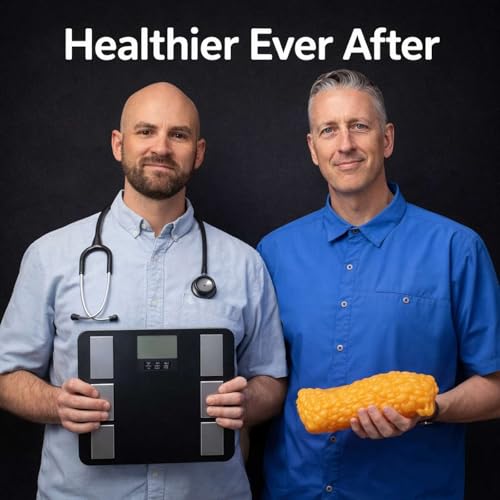
『Healthier Ever After』のカバーアート

Healthier Ever After

Healthier Ever After

著者: Support My Weight Loss
無料で聴く

Healthier Ever After is a weekly podcast dedicated to helping you build a healthier, more sustainable life—without extremes, gimmicks, or shame.


Each episode is drawn from our live weekly conversations, where we break down real-world weight loss challenges, healthy lifestyle habits, and long-term wellness strategies that actually work in everyday life. From medically guided weight loss and GLP-1 medications to nutrition, movement, mindset, and behavior change, we focus on progress you can maintain—for life.


Hosted by experienced healthcare professionals, Healthier Ever After blends medical insight with practical guidance, honest conversations, and encouragement for wherever you are on your journey. Whether you’re just getting started, navigating plateaus, or looking for sustainable ways to feel better, move better, and live better, this podcast meets you where you are.


Because the goal isn’t just weight loss—it’s living healthier ever after.


**The information shared on Healthier Ever After is for educational and informational purposes only and is not intended as medical advice. The content discussed does not replace consultation with a qualified healthcare professional. Always seek the advice of your physician or other licensed healthcare provider regarding any medical condition, treatment, medication, or lifestyle change. Never disregard professional medical advice or delay seeking care because of information heard on this podcast.


© 2026 Support My Weight Loss
衛生・健康的な生活
エピソード
  • Three Keys of GLP1 Medication
    2026/08/26

    Rick opens this one with an image he couldn't shake after a trip to Denmark: you could take a two-ton block of marble and hammer 25% of the weight off it, and you'd still have a block. It looks like nothing. That, he argues, is what crash dieting does — and the actual goal is to pick away gently and intentionally at what you don't want while keeping the form that's already inside the stone.

    From there, Rick and Greg build out the one-key, two-key, three-key model of GLP-1 medications. Every one of these drugs is a copycat key that fits a lock your body already has. Semaglutide turns one key, opening receptors in the brain that quiet food noise, in the stomach that slow gastric emptying, and in the pancreas that time insulin release to actual glucose spikes — with the tradeoff being nausea and GI side effects. Tirzepatide turns two, adding the GIP lock that calms the brain's nausea center and helps fat cells store fat where it belongs instead of tucking it into the liver and muscles, like dirty socks stuffed under the couch cushions. And retatrutide — still in trials, not approved, and the subject of some candid commentary here about Eli Lilly's biologic-classification maneuvering — turns three, adding glucagon to burn liver fat and nudge resting metabolic rate upward.

    The numbers tell the arc: roughly 15% body weight on semaglutide, 21% on tirzepatide, and 28–30% in early retatrutide trials. But Rick and Greg keep circling back to the marble. Losing a hundred pounds the right way isn't chipping the block. It's chiseling the Michelangelo.

    Educational and informational only. GLP-1 medications require a prescription and medical supervision. Retatrutide is not FDA approved and is not legally available. Talk with your healthcare provider before starting any medication, supplement, or weight loss program.

    続きを読む 一部表示
    36 分
  • All About Cortisol
    2026/08/19

    Cortisol has become the internet's favorite villain — but ask most people what it actually does and the answer is a shrug. Rick and Greg spend this episode fixing that, starting with the uncomfortable truth that you'd be very, very sick without it.

    The key insight is that cortisol works on a schedule, not a setting. It spikes sharply in the morning to pull you out of sleep, declines through the day, and bottoms out around midnight. Chronic stress and poor sleep don't make that curve taller or shorter — they flatten it. And a flat curve means no pep in the morning, too much alertness at bedtime, and a cycle that feeds itself until one rough week has quietly become six months. Along the way, cortisol drives belly fat storage (that midsection has extra cortisol receptors), pushes you toward cravings for fast sugar rather than actual hunger, and taps your muscle protein as backup fuel.

    Then comes the myth-busting: "cortisol face" isn't a medical term, adrenal fatigue and adrenal burnout aren't recognized diagnoses, a cortisol lab test is clinically close to meaningless unless you're screening for a specific disease like Addison's, and "adaptogen" is a marketing word rather than a pharmacological one. Rick calls what's left the boring list, and he's not wrong — sleep seven to nine hours on a consistent schedule, exercise you can actually recover from, morning daylight and dim light at night, eat enough on a regular schedule, breathe, spend time with people you like, and cut caffeine off eight to ten hours before bed. Unglamorous, free, and more effective than anything on the supplement shelf.

    Greg's closing line says it best: cortisol isn't the enemy. Dysregulation is.

    Educational and informational only. Talk with your healthcare provider before starting any supplement, exercise regimen, or weight loss program — and especially if you're dealing with persistent insomnia.

    続きを読む 一部表示
    34 分
  • Understanding Creatine
    2026/08/12

    Creatine is having a moment — it's in gummies, powders, capsules, and about half the ads in your feed. So Rick and Greg sat down to sort out what's real. In this episode they explain what creatine actually does at the cellular level (it recharges the ATP "battery pack" your muscles burn through in the first seconds of any effort), and why that matters more than the marketing suggests. The honest version: creatine doesn't build muscle. It gives you the energy to do two more reps or run one more mile — and that's what builds muscle. They cover realistic dosing at three to five grams a day, why timing matters far less than consistency, the water weight you might see early on, and the newer research pointing toward brain and cognitive benefits at higher doses. They also tackle the kidney myth head-on, explaining the lab-value mix-up between creatine and creatinine that sends so many patients into an unnecessary panic — and why you should simply tell your provider you're taking it. Plus: who benefits most (vegetarians, older adults, and anyone actively losing weight on a GLP-1), who should check with a clinician first, and the buying advice that'll save you money — plain creatine monohydrate from a reputable brand is what every study used, and there's no such thing as men's or women's creatine.

    Educational and informational only. Talk with your healthcare provider before starting any supplement, especially if you have kidney or liver disease, uncontrolled high blood pressure, are pregnant or breastfeeding, or are under 18.

    続きを読む 一部表示
    31 分
adbl_web_anon_alc_button_suppression_t1
まだレビューはありません