エピソード

  • Brazil rides the 'Donroe Doctrine's' orange wave
    2026/10/09

    Right now former Brazilian President Jair Bolsonaro is on house arrest, after being sentenced to 27 years in prison. On Sunday his son Flavio won the first round of that country's presidential elections, his wife, and two more of his children were voted into office. A runoff election is three weeks away.


    It's a stunning political turnaround.


    In part, because the man who could be toppled by the return of the Bolsonaros, is a towering figure of leftist Latin American politics: Lula da Silva. Under Lula's leadership, tens of millions of Brazilians have been lifted out of poverty. He's currently serving his third term as President.


    These early results in Brazil mirror a right-wing surge across the region. One that aligns with Donald Trump's so-called 'Donroe Doctrine' where America has free reign to influence, coerce and pick favourites to further U.S. interests.


    We're joined today by Brian Winter, author of several books on Latin America, editor in chief of Americas Quarterly and Vice President of policy at the Council of the Americas.


    For transcripts of Front Burner, please visit: https://www.cbc.ca/radio/frontburner/transcripts

    続きを読む 一部表示
    32 分
  • Decoding the Russian plague scare
    2026/10/08

    Since last week, there have been a series of alarming bits of news emerging from Siberia. It began with the mysterious death of a woman who worked at a plague research institute. Russia has said she contracted pneumonia but has been slim on details. But the World Health Organization wants more information, including details about whether or not there has been a second case, which has been rumoured, but not confirmed.


    All of this, including Russia’s moves to quarantine, has people scared of an outbreak of one of the most aggressive forms of plague: the pneumonic plague.


    So we wanted to talk to someone who looks at global health risks and biosecurity to get a temperature check. Gregory Koblentz is the Director of the Biodefense Graduate Program at George Mason University’s Schar School of Policy and Government. He’s also the co-director of the Global Bio Labs initiative which tracks high containment labs around the world.

    For transcripts of Front Burner, please visit: https://www.cbc.ca/radio/frontburner/transcripts

    続きを読む 一部表示
    27 分
  • Quebec separatism in the 'elbows up' era
    2026/10/07

    With the election of the Parti Québécois in Quebec Monday night, it's the first time in twelve years that Canada will have a separatist government in power.


    Over the course of the campaign, the party's leader, Paul St-Pierre Plamondon, made clear some of the fights he could take up with Ottawa, over issues like immigration. He also vowed to hold a referendum on separation in his first term, a promise he doubled down on this week despite only securing a minority government.


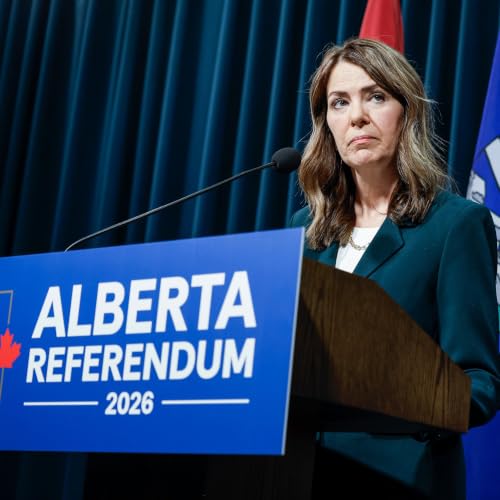
    With the Alberta referendum coming up, this means Mark Carney is now dealing with separatist movements on both ends of the country, at a time when he's trying to lead a united front against U.S. aggression.


    Montreal-based journalist Martin Patriquin joins us to talk about what this election means for the country right now.


    For transcripts of Front Burner, please visit: https://www.cbc.ca/radio/frontburner/transcripts

    続きを読む 一部表示
    28 分
  • Naomi Klein on Carney, trade war and 'end times'
    2026/10/06

    Celebrated author Naomi Klein joins the show to talk about how Mark Carney's response to Trump's trade war echoes themes in her book The Shock Doctrine: The Rise of Disaster Capitalism. We also discuss her latest work "End Times Fascism: And the Fight for the Living World.


    For transcripts of Front Burner, please visit: https://www.cbc.ca/radio/frontburner/transcripts

    続きを読む 一部表示
    43 分
  • Brexit's lessons for Alberta
    2026/10/05

    Ten years ago, Britain voted 52 per cent to 48 per cent to leave the European Union. The result reshaped British politics, triggered years of negotiations and remains deeply contested a decade later. Now, as Alberta prepares to vote on whether to begin a process that could eventually lead to separation from Canada, there are obvious differences between the two situations, but also some striking parallels.


    We hear from three people who experienced Brexit from very different perspectives: a former Conservative MP who supported leaving the EU, an Alberta separatist who says independence needs a concrete plan, and a Brexit scholar who warns that the political fallout from a referendum can last for years.


    For transcripts of Front Burner, please visit: https://www.cbc.ca/radio/frontburner/transcripts

    続きを読む 一部表示
    21 分
  • 764: the violent extremist network targeting kids online
    2026/10/02

    A recent terrorism arrest in Alberta has been linked to the group 764, an extremist network that coerces children into self-harming and sharing sexual material. But many of the perpetrators aren't adults, they're also minors.


    CBC’s senior reporter and co-host of The Fifth Estate, Ionna Roumeliotis, has reported extensively on the 764 network. She joins Jayme Poisson to talk about who this group is, how it operates, and why some victims have struggled to get law enforcement to take action.


    For transcripts of Front Burner, please visit: https://www.cbc.ca/radio/frontburner/transcripts

    続きを読む 一部表示
    25 分
  • Who owns Canada's economy?
    2026/10/01

    Prime Minister Mark Carney has been working to bring more foreign investment into Canada. At his recent Investment Summit, he told investors from all over the world that Canada “has what the world wants."


    This got us wondering, who already owns Canada's businesses and infrastructure? And could that change now that the government is courting more outside investment?


    Earlier this year, Marc Lee, a senior economist with the Canadian Centre for Policy Alternatives, wrote a piece called “Masters in our own house”, where he looked at how much of our economy is owned by foreign entities. He talks about what a new wave of foreign investment means for our sovereignty.


    For transcripts of Front Burner, please visit: https://www.cbc.ca/radio/frontburner/transcripts

    続きを読む 一部表示
    28 分
  • Why are residential school testimonies being destroyed?
    2026/09/30

    Today is the sixth National Day for Truth and Reconciliation, where the country remembers the 150,000 Indigenous kids who were taken from their communities and forced to enrol in Indian Residential Schools. While there, they were subjected to widespread abuse and mistreatment. Thousands died before they could return home.


    There is a large historical record attesting to this fact. But tens of thousands of survivor testimonies are on track to be destroyed next year. These painful stories were heard and documented as part of the Indian Residential Schools Settlement agreement.


    Connie Walker is the host of the Pulitzer and Peabody prize winning podcast Stolen: Surviving St. Michaels which looked at her own father's experience at a residential school. She has been working to build a new archive of residential school survivor testimonies. She talks about the urgency of preserving these stories, at a time when there's an upswing in residential school denialism.


    For transcripts of Front Burner, please visit: https://www.cbc.ca/radio/frontburner/transcripts

    続きを読む 一部表示
    29 分