エピソード

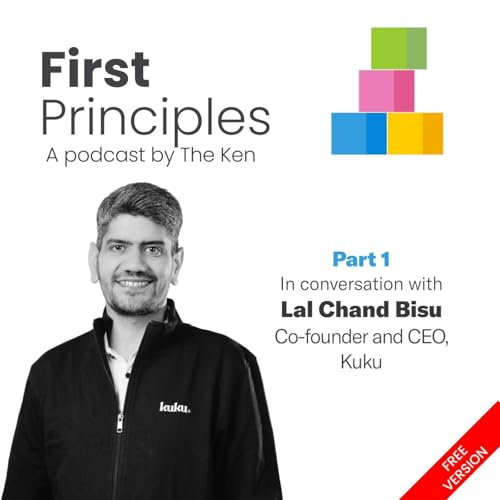
  • Part 2: Kuku’s Lal Chand Bisu on the Bathoth-to-Bandra arc, learning from iterations not books, and why nos beat yeses
    2026/05/04

    Part 2 picks up exactly where I left Bisu — on why a 7-year-old audio platform is releasing a theatrical film on May 8. From there, we go everywhere. Bisu's actual journey from a small village in Shekhawati to Bandra. The "full equation" view of metrics. Why saying no requires more work than saying yes. Why most of his learning comes from iterations, not books. And, in his closing answer, a quietly devastating line about the startup ecosystem itself.

    If you haven't heard Part 1 yet, please go back and start there first.


    Chapter list

    • 01:02Indian Institute of Zombies: why theatrical, why in-house, why AI in the pipeline. The decision-making cadence behind it
    • 01:08"Your vision grows with you." How the original vision changed from "premium storytelling for Bharat" to something larger
    • 01:10 — Bathoth → Shekhawati → IIT Jodhpur → Bandra. Studying in Hindi until Class 10, then +2 in Hindi, then English at IIT
    • 01:18 — The discipline of saying no. Why nos require more work than yeses, and why nos are usually the better answer
    • 01:19"The full equation." Why CAC alone is meaningless; why he tracks revenue, CAC, LTV and cohort profit together. The two real metrics: equation health and engagement
    • 01:21 — Numbers beyond a limit give you an illusion. "Don't go deeper in the data — keep your life simple."
    • 01:21 — Co-founders, span of control, how the four-way role split actually got sorted
    • 01:22 — How Bisu learns: most of it from doing and iterations; books help him articulate what the iterations have already taught him
    • 01:25 — Pet phrases at work — "build it like a business, not a startup" — and what management style his colleagues would say he has
    • 01:28 — Biggest value add as Bisu, not as CEO. The Uber-power-user analogy
    • 01:29 — When did he change his mind about managing people? Going from technical-first to people-first
    • 01:34 — Hiring: the open-ended questions Bisu actually asks when he meets potential leaders
    • 01:36 — What motivates and drives him on a daily basis
    • 01:42 — Family, parenting, and the village memory of his grandmother telling stories by oil lamp in the evenings — the original storyteller in his life
    • 01:45 — The personal questions: which morning of the week, how he spends weekends, what a productive day looks like, sleep
    • 01:46 — On a scale of 1 to 10, how Bisu rates himself as a CEO
    • 01:51 — The closing thought. Would the average Kuku FM subscriber actually want to listen to a two-hour interview with the CEO of Kuku FM? "We live in a bubble. The startup ecosystem feels that the world thinks what we think. It doesn't."
    • 01:53 — Goodbye

    Things mentioned in Part 2

    • People: Vinod Kumar Meena, Vikas Goyal (co-founders); Kunj Sanghvi (Kuku's Content Head, previously on Two by Two and Zero Shot); the Dalal brothers (script of Indian Institute of Zombies — Hussain and Abbas Dalal of Brahmāstra / Farzi); Gaganjeet Singh and Alok Dwivedi (directors); Bisu's grandmother
    • Places: Bathoth (village in Shekhawati, Rajasthan); IIT Jodhpur; Bandra
    • Concepts: the full equation — Bisu's name for treating CAC, revenue, LTV and cohort profit as one calculation, not separate metrics; content is the only product; vision grows with you

    To listen to all of First Principles

    If you'd like to listen to all 54 First Principles episodes — that's close to 110 hours of conversations with founders and leaders building India's most interesting companies — please subscribe to The Ken directly, or to our premium channel on Apple Podcasts.

    続きを読む 一部表示
    1 時間 15 分
  • Part 1: Kuku's Lal Chand Bisu on killing three products, ditching the free tier and charging Bharat ₹399 a year
    2026/04/27

    Lal Chand Bisu started Kuku in audio in 2018. Almost everyone in the press wrote them off — the louder competitor was getting the headlines, the VCs didn't believe vernacular India would pay, and the assumption was that short-video would flatten audio. None of that aged well. Kuku FM did ₹242 Cr in FY25 at 175% YoY growth, with roughly 10 million paying subscribers. This is the conversation Bisu, who is just not the kind of founder who walks around telling you these numbers, finally agreed to do.

    In Part 1, we get into the company history, the pivots, the contrarian decision to cut the free tier, and what 40 million Hindi listens to Rich Dad Poor Dad really mean.


    Chapter list

    • 00:00 — How old is Kuku FM, and what Bisu was doing before (Easy Prep, two and a half years at Toppr)
    • 00:02 — June birthdays, coincidence, and Bisu's definition of luck — "most things are out of control"
    • 00:04 — The three pivots: podcast aggregator → UGC → PUGC. What killed each one and what was kept constant
    • 00:09 — Why vernacular audio IP didn't exist, and why Kuku had to become a studio rather than an aggregator
    • 00:14 — January 2021: cutting the free tier and charging ₹399 a year. The investor pushback. Why no ads, ever
    • 00:23Rich Dad Poor Dad in Hindi: 40 million listens. What that number tells you about the listener that English-first publishers have been missing
    • 00:27 — How Kuku's content mix has shifted from entertainment to educational and inspirational
    • 00:30 — Audio first, then video. Why audio is roughly 50x cheaper to produce and 50x cheaper to stream
    • 00:33 — AI in the marketing pipeline: 500 ads/month → 5,000 ads/month, same cost
    • 00:42 — The competitor we don't name. What being the also-ran in the press for years cost — in hires, partnerships, and inside Bisu's own head
    • 00:45 — The fundraising history: ~$156M raised, the Granite Asia round, and how much of the last cheque is actually still untouched
    • 00:50 — Biggest learnings from unsuccessful fundraising. Why nos are usually the harder, better answer
    • 00:55 — Kuku TV: from launch to #1 on India's App Store in four months. Microdrama, the ReelShort wave, MS Dhoni
    • 01:01 — Cliffhanger: the Indian Institute of Zombies theatrical bet — and why an audio platform wrote, produced and AI-assisted its own film instead of licensing one. Bisu's answer to this is in Part 2.

    Things mentioned in Part 1

    • People: Vinod Kumar Meena and Vikas Goyal (co-founders, IIT Jodhpur batchmates); Hansa Bisu (Bisu's wife); MS Dhoni (Kuku FM brand ambassador); Nandan Nilekani / Fundamentum
    • Companies & investors: Mebigo Labs, Toppr, Easy Prep, Pocket FM (the unnamed competitor), Granite Asia, Vertex Ventures, Krafton, Bitkraft, IFC, 3one4 Capital, Shunwei, India Quotient
    • Content & references: Rich Dad Poor Dad (Hindi); Ankur Warikoo's Hindi book; ReelShort; Kuku TV

    To listen to all of First Principles

    If you'd like to listen to all 54 First Principles episodes — that's close to 110 hours of conversations with founders and leaders building India's most interesting companies — please subscribe to The Ken directly, or to our premium channel on Apple Podcasts.

    Correction: During the conversation, Bisu mentions that the total amount of venture capital raised by Kuku is $170 million. The company has subsequently clarified that the correct figure is $120 million.


    続きを読む 一部表示
    1 時間 4 分
  • Part 2: Curefoods' Ankit Nagori on why Indians only eat healthy Monday to Thursday, focusing on brand over scale, and what drives him now
    2026/03/30

    Welcome back to First Principles. This is Part 2 of our full conversation with Ankit Nagori, founder and CEO of Curefoods. If you have not listened to Part 1, go back and start there.

    In this half, the conversation slows down a little and gets even more interesting. Ankit has strong opinions about why healthy food will always lose to biryani on a Friday night, what building a brand people actually love looks like, and what a Unilever of foods means to him. He is also candid about how he hires, how he spends his Sundays with his son, and what drives him beyond the business.
    _________

    This episode was produced by Uddantika Kashyap and mixed and mastered by Rajiv CN.

    Write to us at fp@the-ken.com with your feedback, suggestions, and guests you would want to see on First Principles.

    If you enjoyed this episode, please help us spread the word by sharing and gifting it to your friends and family.


    🚨 The Ken's Zero Shot podcast is hosting a live event! This is a speculative yet realistic discussion built around one premise: what happens when AI agents take off in India? How will they rewire existing habits, business models and profit pools? Since nobody knows for sure, we won't pretend to have all the answers. Instead we are going to break the narrative. Click here for details.

    続きを読む 一部表示
    1 時間 3 分
  • Part 1: Curefoods' Ankit Nagori on cold emailing his way into Flipkart, designing for talent density, and surviving a pandemic on 2 crores a month
    2026/03/23

    Welcome to First Principles. This is Part 1 of our full conversation with Ankit Nagori, founder and CEO of Curefoods.

    Ankit joined Flipkart as the 22nd employee after cold emailing its founders at a book fair with almost no relevant experience and within six years he was Chief Business Officer. He then co-founded Cult with Mukesh Bansal, built it into one of India's most recognised fitness brands, and spun out Curefoods in the middle of a pandemic when the business was down to 2 crores a month.

    In this half, Rohin and Ankit get into what those Flipkart years really felt like, what talent density means and whether you can actually design for it, and how Curefoods found its footing when everything was falling apart.
    ________

    This episode was produced by Uddantika Kashyap and mixed and mastered by Rajiv CN.

    Write to us at fp@the-ken.com with your feedback, suggestions, and guests you would want to see on First Principles.

    If you enjoyed this episode, please help us spread the word by sharing and gifting it to your friends and family.


    🚨 The Ken's Zero Shot podcast is hosting a live event! This is a speculative yet realistic discussion built around one premise: what happens when AI agents take off in India? How will they rewire existing habits, business models and profit pools? Since nobody knows for sure, we won't pretend to have all the answers. Instead we are going to break the narrative. Click here for details.

    続きを読む 一部表示
    54 分
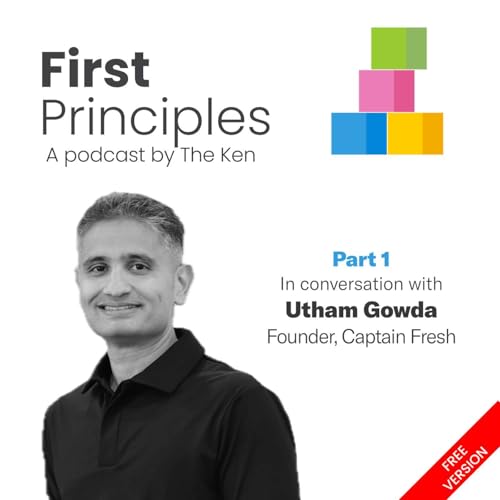
  • Part 2: Captain Fresh's Utham Gowda on seafood as the world's last unorganised trillion-dollar industry, why undervaluation is a founder's superpower and his “reverse career path”
    2026/03/02

    Welcome to First Principles! This is part 2 of episode 52, the full conversation.

    Rohin met Utham Gowda at Spacebot Studio in Indiranagar on a Tuesday afternoon. Utham was compact, measured, and precise in the way he spoke, like someone who has spent years learning when to talk and when to listen. What's striking was how quickly he opened up. Within the first half hour of the conversation, you got the sense that this is someone who has thought very deeply about his own life, his choices, and what drives him. It makes for one of the best examples on this podcast of a guest easing into a conversation and then, almost without noticing, going places you didn't expect.

    The story itself is hard to believe. A kid from landlocked Mysore, with no connection to the sea, no family background in business, builds a billion-dollar global seafood company. He took salary cuts at every job change, even after getting married. He has never owned a car and the highest tax he paid was in 2015. And his eight-year-old son, unable to get his father's attention any other way, started a fake company called Blackfish and would set up a little boardroom at home, just to have something to talk to his dad about.

    This episode covers what seafood as an industry actually looks like, why the last 1000 years haven't changed it, what it really means to build a global company from India, and what happens when a founder finally stops chasing money and has to sit with the question of what he actually wants from all of it.

    **********

    This episode was produced by Uddantika Kashyap and mixed and mastered by Rajiv CN.

    Write to us at fp@the-ken.com with your feedback, suggestions, and guests you would want to see on First Principles.

    If you enjoyed this episode, please help us spread the word by sharing and gifting it to your friends and family.

    続きを読む 一部表示
    58 分
  • Part 1: Captain Fresh's Utham Gowda on seafood as the world's last unorganised trillion-dollar industry, why undervaluation is a founder's superpower and his “reverse career path”
    2026/02/23

    Welcome to First Principles! This is part 1 of episode 52, the full conversation.

    Rohin met Utham Gowda at Spacebot Studio in Indiranagar on a Tuesday afternoon. Utham was compact, measured, and precise in the way he spoke, like someone who has spent years learning when to talk and when to listen. What's striking was how quickly he opened up. Within the first half hour of the conversation, you got the sense that this is someone who has thought very deeply about his own life, his choices, and what drives him. It makes for one of the best examples on this podcast of a guest easing into a conversation and then, almost without noticing, going places you didn't expect.

    The story itself is hard to believe. A kid from landlocked Mysore, with no connection to the sea, no family background in business, builds a billion-dollar global seafood company. He took salary cuts at every job change, even after getting married. He has never owned a car and the highest tax he paid was in 2015. And his eight-year-old son, unable to get his father's attention any other way, started a fake company called Blackfish and would set up a little boardroom at home, just to have something to talk to his dad about.

    This episode covers what seafood as an industry actually looks like, why the last 1000 years haven't changed it, what it really means to build a global company from India, and what happens when a founder finally stops chasing money and has to sit with the question of what he actually wants from all of it.

    **********

    This episode was produced by Uddantika Kashyap and mixed and mastered by Rajiv CN.

    Write to us at fp@the-ken.com with your feedback, suggestions, and guests you would want to see on First Principles.

    If you enjoyed this episode, please help us spread the word by sharing and gifting it to your friends and family.

    続きを読む 一部表示
    1 時間 6 分
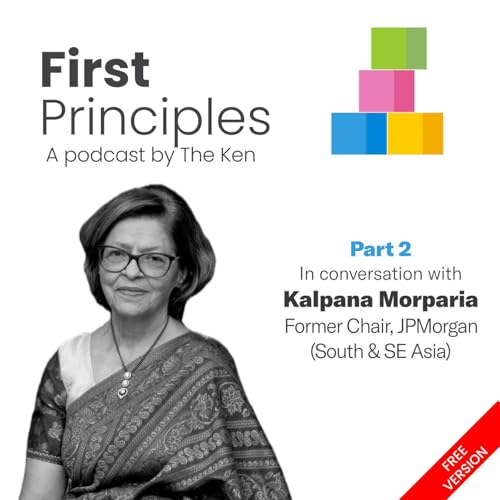
  • Part 2: Kalpana Morparia on the culture of dissent, the 90-day NYSE race, and why ambition requires self-redundancy
    2026/02/09

    Hello, listeners, and welcome back to part 2 of the 51st episode of First Principles.

    Ms. Kalpana Morparia reached out to us via email after the bro-ification episode. It was the most pleasant surprise and we immediately knew we had to get her on the podcast.

    Here's someone who joined ICICI in 1975 as a lawyer, had absolutely no background in finance, and was then asked to run Treasury. She was terrified but her colleagues told her: "You do not say no to Mr. Kamath and live to have a great career in ICICI."

    So she said yes and built one of the most remarkable careers in Indian banking.

    She talks about the ICICI culture where contradicting the chairman wasn't just allowed, it was encouraged. A senior JPMorgan executive once said the most impressive thing about ICICI was that "the junior-most person could contradict the chairman and get away with it."

    She also gets candid about things most leaders don't talk about. Like why she wishes she had done an MBA. Why she has strong opinions about people's physical appearance at work and knows it's a flaw. Why her spiritual guru completely changed her relationship with the one thing she considered her biggest regret in life.

    She went to a Ferrari racetrack and hit 304 kmph. She believes work-life balance is nonsense and wishes every youngster would realize that life is work and work is life.

    Listen in for all this and more, including why she thinks India's next 30 years belong to banking, healthcare, and infrastructure. Why retirement at 60 is an outdated concept. And why on a scale of 1 to 10, she rates her happiness at 9 plus.

    **********

    This episode was produced by Uddantika Kashyap and mixed and mastered by Rajiv CN.

    Write to us at fp@the-ken.com with your feedback, suggestions, and guests you would want to see on First Principles.

    If you enjoyed this episode, please help us spread the word by sharing and gifting it to your friends and family.v

    続きを読む 一部表示
    57 分
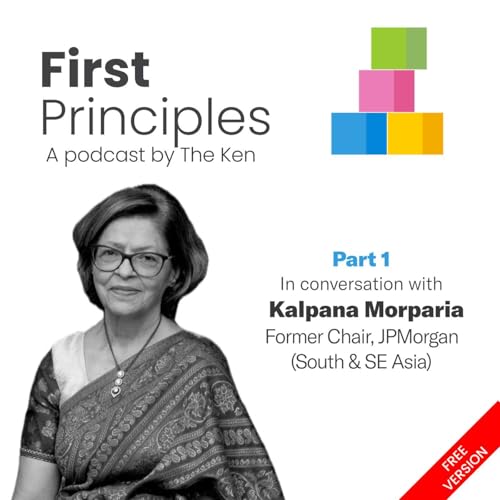
  • Part 1: Kalpana Morparia on the culture of dissent, the 90-day NYSE race, and why ambition requires self-redundancy
    2026/02/02

    Hello, listeners, and welcome back to part 1 of the 51st episode of First Principles.

    Ms. Kalpana Morparia reached out to us via email after the bro-ification episode. It was the most pleasant surprise and we immediately knew we had to get her on the podcast.

    Here's someone who joined ICICI in 1975 as a lawyer, had absolutely no background in finance, and was then asked to run Treasury. She was terrified but her colleagues told her: "You do not say no to Mr. Kamath and live to have a great career in ICICI."

    So she said yes and built one of the most remarkable careers in Indian banking.

    She talks about the ICICI culture where contradicting the chairman wasn't just allowed, it was encouraged. A senior JPMorgan executive once said the most impressive thing about ICICI was that "the junior-most person could contradict the chairman and get away with it."

    She also gets candid about things most leaders don't talk about. Like why she wishes she had done an MBA. Why she has strong opinions about people's physical appearance at work and knows it's a flaw. Why her spiritual guru completely changed her relationship with the one thing she considered her biggest regret in life.

    She went to a Ferrari racetrack and hit 304 kmph. She believes work-life balance is nonsense and wishes every youngster would realize that life is work and work is life.

    Listen in for all this and more, including why she thinks India's next 30 years belong to banking, healthcare, and infrastructure. Why retirement at 60 is an outdated concept. And why on a scale of 1 to 10, she rates her happiness at 9 plus.

    **********

    This episode was produced by Uddantika Kashyap and mixed and mastered by Rajiv CN.

    Write to us at fp@the-ken.com with your feedback, suggestions, and guests you would want to see on First Principles.

    If you enjoyed this episode, please help us spread the word by sharing and gifting it to your friends and family.

    続きを読む 一部表示
    1 時間