エピソード

  • Fall Asleep to Saturn's Rings
    2026/10/28

    A calm, slow journey out to Saturn's rings, to fall asleep to. What the rings are made of and how thin they are, the small shepherd moons that shape them, the ring fed by the ocean moon Enceladus, the Cassini spacecraft's thirteen years there, and the open question of how old the rings are. Sleep Stories is our audio-only series of slow, factual space stories.


    Every fact is checked against NASA and ESA sources; where something is an estimate or still uncertain, the narration says so.


    Chapters

    0:00 Welcome

    3:09 The long way out

    5:58 Weather on a giant

    7:15 What the rings are made of

    9:17 How wide, and how thin

    12:25 The first people to see them

    13:59 The shepherd moons

    17:05 The ring made by a moon

    18:08 The first visitors

    19:23 Thirteen years among the rings

    22:38 How old are the rings?

    24:42 Moons in the sky

    26:02 A slow orbit


    Sources

    • NASA, Saturn facts: https://science.nasa.gov/saturn/facts/

    • NASA, Cassini: rings: https://science.nasa.gov/mission/cassini/science/rings/

    • NASA, Cassini Grand Finale: https://science.nasa.gov/mission/cassini/grand-finale/overview/

    • NASA, Pan: https://science.nasa.gov/saturn/moons/pan/

    • NASA, Cassini data show Saturn's rings relatively new (2019): https://science.nasa.gov/missions/cassini/nasas-cassini-data-show-saturns-rings-relatively-new/

    • NASA JPL, Scientists finally know what time it is on Saturn (2019): https://www.jpl.nasa.gov/news/scientists-finally-know-what-time-it-is-on-saturn/

    • ESA, Anniversary of the birth of Christiaan Huygens: https://esa.int/Science_Exploration/Space_Science/Cassini-Huygens/Anniversary_of_the_birth_of_Christiaan_Huygens

    • ESA, Jean-Dominique Cassini: https://www.esa.int/About_Us/ESA_history/Jean-Dominique_Cassini_Astrology_to_astronomy

    • NASA, The Day the Earth Smiled: https://science.nasa.gov/photojournal/the-day-the-earth-smiled/


    Narration: synthetic voice. Music: original.


    Eight Minutes Old on YouTube: https://www.youtube.com/@EightMinutesOld

    Listen on Spotify: https://open.spotify.com/show/6Ac2pRp4qYvJ2C7NLenHr3

    続きを読む 一部表示
    32 分
  • What If You Fell Into Jupiter?
    2026/10/27

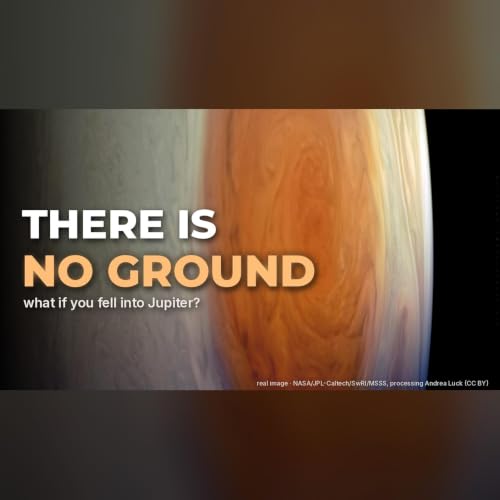
    Jupiter has no surface, so what would happen if you fell into it? In 1995 NASA's Galileo probe did exactly that and radioed back 58 minutes of data on the way down. We follow it through the radiation, clouds and storms, then keep going with physics and Juno's gravity data, through helium rain and metallic hydrogen to a "fuzzy" core with no clear edge.


    🎧 Listen on Spotify: https://open.spotify.com/show/6Ac2pRp4qYvJ2C7NLenHr3

    ▶ Watch the video, with every source and image credit: https://youtu.be/4Bau3dnWrbY

    Eight Minutes Old on YouTube: https://www.youtube.com/@EightMinutesOld · TikTok: https://www.tiktok.com/@eightminutesold · Instagram: https://www.instagram.com/eightminutesold


    Chapters

    0:00 Jupiter has no surface

    0:27 Getting there alive

    1:11 The "surface" and the clouds

    1:57 The shrinking Great Red Spot

    2:19 Lightning and mushballs

    2:40 The Galileo probe's last hour

    3:20 No measurements from here down

    3:55 Helium rain

    4:22 An ocean of metal

    4:50 The fuzzy core

    5:33 Is Jupiter a failed star?

    5:47 No bottom


    Beyond the Galileo probe's 58 minutes of data, the descent is a physics-based thought experiment; models of Jupiter's core are still debated.


    Sources

    • NASA Jupiter fact sheet: https://nssdc.gsfc.nasa.gov/planetary/factsheet/jupiterfact.html

    • Seiff et al. 1998, JGR (Galileo probe temperature profile): https://doi.org/10.1029/98JE01766

    • Brygoo et al. 2021, Nature (helium rain): https://www.nature.com/articles/s41586-021-03516-0

    • Wahl et al. 2017, GRL (dilute core): https://doi.org/10.1002/2017GL073160

    • Militzer et al. 2022, PSJ (Juno interior models): https://doi.org/10.3847/PSJ/ac7ec8

    • NASA, Galileo mission: https://science.nasa.gov/mission/galileo/


    Labels: in the video every claim carries an on-screen label (FACT, THEORY, ESTIMATE, HYPOTHESIS, SPECULATION); in this audio edition the narration says out loud when something is an estimate or a thought experiment.

    Narration: synthetic voice. Music: original.

    #space #astronomy #science #eightminutesold

    続きを読む 一部表示
    6 分
  • Night Sky This Week: 26 Oct to 1 Nov
    2026/10/26

    What you can see from Ireland and Britain this week, the first week after the clocks go back. A full Hunter's Moon that covers stars of the Pleiades in the small hours of Wednesday, Saturn in the evening, Jupiter and Mars before dawn, the Taurids (honestly: a quiet shower this week), and our object of the week, the Pleiades. The story: why their distance once didn't add up, and how astronomers checked.


    All times are for Dublin, in Greenwich Mean Time. In Britain, rising and setting times are earlier, by up to about half an hour in London. Sky positions were computed with PyEphem for 53.35° N and checked against published 2026 calendars.


    Chapters

    0:00 Welcome

    0:58 The Moon

    2:44 The planets

    3:59 Shooting stars

    4:33 Also this week

    4:58 The Pleiades

    5:40 How far away is it?


    Sources

    • Positions, rise and set times: computed with PyEphem (Dublin, 53.35° N, 6.26° W)

    • Cross-checks: Sky at Night, "Planet alignment Nov–Dec 2026": https://www.skyatnightmagazine.com/news/planet-alignment-november-december-2026

    • Star Walk, Astronomy Calendar 2026: https://starwalk.space/en/news/astronomy-calendar-2026

    • Derekscope, Astronomical Calendar 2026: https://derekscope.co.uk/astronomical-calendar-for-2026/

    • Meteor showers: IMO 2026 Meteor Shower Calendar https://www.imo.net/files/meteor-shower/cal2026.pdf and AMS calendar https://www.amsmeteors.org/calendar/

    • Space station passes: NASA Spot the Station https://spotthestation.nasa.gov/ and https://www.heavens-above.com/

    • NASA, Messier 45: https://science.nasa.gov/mission/hubble/science/explore-the-night-sky/hubble-messier-catalog/messier-45/

    • NASA, Hubble refines distance to the Pleiades (2004): https://science.nasa.gov/missions/hubble/hubble-refines-distance-to-pleiades-star-cluster

    • NRAO, Radio telescopes settle controversy over distance to Pleiades (2014): https://public.nrao.edu/news/radio-telescopes-settle-controversy/


    Narration: synthetic voice. Music: original.


    Eight Minutes Old on YouTube: https://www.youtube.com/@EightMinutesOld

    Listen on Spotify: https://open.spotify.com/show/6Ac2pRp4qYvJ2C7NLenHr3

    続きを読む 一部表示
    8 分
  • The Coldest Natural Place in the Universe Isn't Empty Space
    2026/10/23

    About 5,000 light-years away, a dying star has made a cloud of gas colder than the afterglow of the Big Bang: about 1 degree above absolute zero. This is the Boomerang Nebula, the coldest natural place known. We explain how a star made something colder than space itself, and compare it with the coldest places on Earth, on the Moon and in our laboratories.


    🎧 Listen on Spotify: https://open.spotify.com/show/6Ac2pRp4qYvJ2C7NLenHr3

    ▶ Watch the video, with every source and image credit: https://youtu.be/g4naxOpfz5c

    Eight Minutes Old on YouTube: https://www.youtube.com/@EightMinutesOld · TikTok: https://www.tiktok.com/@eightminutesold · Instagram: https://www.instagram.com/eightminutesold


    Chapters

    0:00 Colder than space

    0:26 What "cold" means in space

    0:56 The Boomerang (or Bow Tie) Nebula

    1:27 A shadow on the Big Bang's light

    2:01 The cosmic refrigerator

    2:39 A star that swallowed its partner?

    3:12 ALMA's view

    3:34 The ladder of cold

    4:20 The Universe is still cooling

    4:44 A record, for now


    Sources

    • Sahai & Nyman 1997, ApJ 487, L155: https://iopscience.iop.org/article/10.1086/310897

    • Sahai et al. 2013, ApJ 777, 92: https://arxiv.org/abs/1308.4360

    • Sahai, Vlemmings & Nyman 2017, ApJ 841, 110: https://arxiv.org/abs/1703.06929

    • ALMA 2013, the Boomerang Nebula: https://www.almaobservatory.org/en/press-releases/alma-reveals-ghostly-shape-of-coldest-place-in-the-universe/

    • Fixsen 2009 (temperature of the cosmic microwave background): https://arxiv.org/abs/0911.1955

    • NASA LRO, the coldest crater on the Moon: https://svs.gsfc.nasa.gov/10595


    Labels: in the video every claim carries an on-screen label (FACT, THEORY, ESTIMATE, HYPOTHESIS, SPECULATION); in this audio edition the narration says out loud when something is an estimate or a thought experiment.

    Narration: synthetic voice. Music: original.

    #space #astronomy #science #eightminutesold

    続きを読む 一部表示
    5 分
  • What If Earth Stopped Spinning?
    2026/10/22

    Right now you are moving at up to about 1,670 km/h and you feel nothing. What would happen if the ground stopped and the air didn't? A science-first thought experiment on supersonic winds, oceans running to the poles and a day that lasts a year, plus Venus, the planet that barely spins, and why Earth just had its shortest day ever measured.


    🎧 Listen on Spotify: https://open.spotify.com/show/6Ac2pRp4qYvJ2C7NLenHr3

    ▶ Watch the video, with every source and image credit: https://youtu.be/OLuRVapNfkw

    Eight Minutes Old on YouTube: https://www.youtube.com/@EightMinutesOld · TikTok: https://www.tiktok.com/@eightminutesold · Instagram: https://www.instagram.com/eightminutesold


    Chapters

    0:00 You're moving faster than sound

    0:23 This can't happen (but what if?)

    0:47 How we know Earth spins

    1:24 The sudden stop

    2:05 Two oceans, one continent

    2:49 A day that lasts a year

    3:21 Weather without a spin

    3:57 Venus, the planet that barely spins

    4:24 Is Earth slowing down?

    5:06 The ride


    A thought experiment: Earth cannot suddenly stop spinning (the narration says so at 0:23).


    Sources

    • NASA Earth fact sheet: https://nssdc.gsfc.nasa.gov/planetary/factsheet/earthfact.html

    • Fraczek 2010, Esri ArcUser (GIS model of a non-spinning Earth): https://www.esri.com/about/newsroom/arcuser/what-would-happen-if-earth-stopped-spinning

    • NASA Venus fact sheet: https://nssdc.gsfc.nasa.gov/planetary/factsheet/venusfact.html

    • Stephenson et al. 2016, Proc. R. Soc. A (length of day): https://pmc.ncbi.nlm.nih.gov/articles/PMC5247521/

    • NASA, tidal locking: https://science.nasa.gov/moon/tidal-locking/


    Labels: in the video every claim carries an on-screen label (FACT, THEORY, ESTIMATE, HYPOTHESIS, SPECULATION); in this audio edition the narration says out loud when something is an estimate or a thought experiment.

    Narration: synthetic voice. Music: original.

    #space #astronomy #science #eightminutesold

    続きを読む 一部表示
    6 分
  • The Flash That Bounced Off the Moon: When a Dead Star Hit Earth
    2026/10/22

    On 27 December 2004 a magnetar called SGR 1806-20, tens of thousands of light-years away, released a giant flare that for about 0.2 seconds was brighter than the full Moon in gamma rays. It overwhelmed detectors on spacecraft from Earth orbit to Mars, bounced off the Moon and disturbed Earth's upper atmosphere. This is the true story of the brightest flash ever recorded from beyond the Solar System, and of the dead stars called magnetars.


    🎧 Listen on Spotify: https://open.spotify.com/show/6Ac2pRp4qYvJ2C7NLenHr3

    ▶ Watch the video, with every source and image credit: https://youtu.be/-02pyd687P8

    Eight Minutes Old on YouTube: https://www.youtube.com/@EightMinutesOld · TikTok: https://www.tiktok.com/@eightminutesold · Instagram: https://www.instagram.com/eightminutesold


    Chapters

    0:00 The day the satellites were blinded

    0:32 The flash

    1:13 An echo from the Moon

    1:40 It reached our sky

    2:11 Where did it come from?

    2:43 What is a magnetar?

    3:23 A starquake

    3:59 How much energy?

    4:19 Giant flares in other galaxies

    5:09 Should we worry?

    5:27 Another one is on its way


    The magnetar's distance is uncertain; modern estimates are lower than the 50,000 light-years often quoted.


    Sources

    • Palmer et al. 2005, Nature (the giant flare): https://arxiv.org/abs/astro-ph/0503030

    • Hurley et al. 2005, Nature: https://arxiv.org/abs/astro-ph/0502329

    • Gaensler et al. 2005 (radio afterglow): https://arxiv.org/abs/astro-ph/0502393

    • Mereghetti et al. 2005 (INTEGRAL and the Moon echo): https://arxiv.org/abs/astro-ph/0502577

    • Inan et al. 2007, GRL (Earth's ionosphere): https://agupubs.onlinelibrary.wiley.com/doi/10.1029/2006GL029145

    • Svirski, Nakar & Ofek 2011 (distance): https://arxiv.org/abs/1103.0006


    Labels: in the video every claim carries an on-screen label (FACT, THEORY, ESTIMATE, HYPOTHESIS, SPECULATION); in this audio edition the narration says out loud when something is an estimate or a thought experiment.

    Narration: synthetic voice. Music: original.

    #space #astronomy #science #eightminutesold

    続きを読む 一部表示
    6 分
  • What If the Moon Disappeared Tonight?
    2026/10/22

    What would really happen if the Moon disappeared tonight? In this science-first thought experiment Earth keeps spinning and the tide still comes in, only smaller and at the same time every day. We separate myth from physics on tides, moonlight and nocturnal wildlife, eclipses, Earth's axial tilt and the length of the day, and Apollo's laser mirrors show the Moon drifting away by about 3.8 cm a year.


    🎧 Listen on Spotify: https://open.spotify.com/show/6Ac2pRp4qYvJ2C7NLenHr3

    ▶ Watch the video, with every source and image credit: https://youtu.be/CWt2Qwkf3_E

    Eight Minutes Old on YouTube: https://www.youtube.com/@EightMinutesOld · TikTok: https://www.tiktok.com/@eightminutesold · Instagram: https://www.instagram.com/eightminutesold


    Chapters

    0:00 Tonight, the Moon is gone

    0:36 Can the Moon really disappear?

    1:02 The Moon is leaving us

    1:33 The tides would shrink, not vanish

    2:09 Life that runs on the Moon

    2:51 Darker nights

    3:26 The last eclipse

    3:59 Would Earth tip over?

    4:54 The lengthening day

    5:35 Does the Moon affect sleep?

    6:00 Where the Moon came from

    6:35 Just not tonight


    The whole episode is a thought experiment (the narration says so at 0:47): the Moon is not going anywhere.


    Sources

    • NASA Moon fact sheet: https://nssdc.gsfc.nasa.gov/planetary/factsheet/moonfact.html

    • NASA JPL, Lunar Laser Ranging (3.8 cm a year): https://www.jpl.nasa.gov/news/apollo-11-experiment-continues-to-return-valuable-data/

    • NOAA, what causes tides: https://oceanservice.noaa.gov/education/tutorial_tides/tides02_cause.html

    • Laskar et al. 1993, Nature (the Moon and Earth's tilt): https://www.nature.com/articles/361615a0

    • Lissauer, Barnes & Chambers 2012, Icarus (a moonless Earth): http://barnesos.net/publications/papers/2012.01.Icarus.Barnes.Moonless.Earth.pdf

    • Stephenson et al. 2016, Proc. R. Soc. A (length of day): https://pmc.ncbi.nlm.nih.gov/articles/PMC5247521/


    Labels: in the video every claim carries an on-screen label (FACT, THEORY, ESTIMATE, HYPOTHESIS, SPECULATION); in this audio edition the narration says out loud when something is an estimate or a thought experiment.

    Narration: synthetic voice. Music: original.

    #space #astronomy #science #eightminutesold

    続きを読む 一部表示
    7 分
  • Three Objects Have Come From Another Star. We Missed Most of Them.
    2026/10/22

    Three interstellar objects have passed through our Solar System: 'Oumuamua (2017), comet 2I/Borisov (2019) and 3I/ATLAS (2025). We cover how each was found, one of them in images taken ten days before anyone noticed it, what pushed 'Oumuamua, and why 3I/ATLAS carries water that may be older than the Sun. Astronomers estimate thousands more are passing through unseen, and the Vera C. Rubin Observatory and ESA's Comet Interceptor are built to catch the next one.


    🎧 Listen on Spotify: https://open.spotify.com/show/6Ac2pRp4qYvJ2C7NLenHr3

    ▶ Watch the video, with every source and image credit: https://youtu.be/FlwpMrtFzhk

    Eight Minutes Old on YouTube: https://www.youtube.com/@EightMinutesOld · TikTok: https://www.tiktok.com/@eightminutesold · Instagram: https://www.instagram.com/eightminutesold


    Chapters

    0:00 Three visitors from other stars

    0:42 The first interstellar object

    1:26 Found 40 days too late

    1:57 The strangest object ever studied

    2:42 What was pushing 'Oumuamua?

    3:26 2I/Borisov: an amateur's discovery

    4:13 3I/ATLAS: seen, but not noticed

    5:00 Water from another star

    5:31 Older than the Sun?

    5:56 Is it alien technology?

    6:33 Why we keep missing them

    7:09 Rubin Observatory starts watching

    7:40 Comet Interceptor

    8:14 Pieces of other worlds


    The light-sail idea (5:56) is a hypothesis; NASA's 19 Nov 2025 briefing: "This object is a comet."


    Sources

    • Meech et al. 2017, Nature ('Oumuamua): https://www.nature.com/articles/nature25020

    • Micheli et al. 2018, Nature (non-gravitational acceleration): https://www.nature.com/articles/s41586-018-0254-4

    • Bodewits et al. 2020 (2I/Borisov, carbon monoxide): https://arxiv.org/abs/2004.08972

    • Seligman et al. 2025 (3I/ATLAS orbit and speed): https://arxiv.org/abs/2507.02757

    • Cordiner et al. 2026, Nature (3I/ATLAS deuterium and age): https://www.nature.com/articles/s41586-026-10771-6

    • NASA, 3I/ATLAS: https://science.nasa.gov/solar-system/comets/3i-atlas/


    Labels: in the video every claim carries an on-screen label (FACT, THEORY, ESTIMATE, HYPOTHESIS, SPECULATION); in this audio edition the narration says out loud when something is an estimate or a thought experiment.

    Narration: synthetic voice. Music: original.

    #space #astronomy #science #eightminutesold

    続きを読む 一部表示
    9 分