『Eight Minutes Old: Space Documentaries and Sleep Stories』のカバーアート

Eight Minutes Old: Space Documentaries and Sleep Stories

Eight Minutes Old: Space Documentaries and Sleep Stories

著者: Eight Minutes Old
無料で聴く

Sunlight is about eight minutes old when it reaches you. Everything we know about space arrives late, from the past, and incomplete. Eight Minutes Old turns that gap into calm, carefully sourced audio: documentaries on black holes, dying stars, gravitational waves and the Fermi paradox, plus Sleep Science, long slow journeys through real astronomy to fall asleep to every Sunday. Every claim is checked against NASA, ESA, ESO and peer-reviewed research, and speculation is named as such. Narration: synthetic voice. Music: original.Eight Minutes Old 天文学 天文学・宇宙科学 科学
エピソード
  • Fall Asleep to Saturn's Rings
    2026/10/28

    A calm, slow journey out to Saturn's rings, to fall asleep to. What the rings are made of and how thin they are, the small shepherd moons that shape them, the ring fed by the ocean moon Enceladus, the Cassini spacecraft's thirteen years there, and the open question of how old the rings are. Sleep Stories is our audio-only series of slow, factual space stories.


    Every fact is checked against NASA and ESA sources; where something is an estimate or still uncertain, the narration says so.


    Chapters

    0:00 Welcome

    3:09 The long way out

    5:58 Weather on a giant

    7:15 What the rings are made of

    9:17 How wide, and how thin

    12:25 The first people to see them

    13:59 The shepherd moons

    17:05 The ring made by a moon

    18:08 The first visitors

    19:23 Thirteen years among the rings

    22:38 How old are the rings?

    24:42 Moons in the sky

    26:02 A slow orbit


    Sources

    • NASA, Saturn facts: https://science.nasa.gov/saturn/facts/

    • NASA, Cassini: rings: https://science.nasa.gov/mission/cassini/science/rings/

    • NASA, Cassini Grand Finale: https://science.nasa.gov/mission/cassini/grand-finale/overview/

    • NASA, Pan: https://science.nasa.gov/saturn/moons/pan/

    • NASA, Cassini data show Saturn's rings relatively new (2019): https://science.nasa.gov/missions/cassini/nasas-cassini-data-show-saturns-rings-relatively-new/

    • NASA JPL, Scientists finally know what time it is on Saturn (2019): https://www.jpl.nasa.gov/news/scientists-finally-know-what-time-it-is-on-saturn/

    • ESA, Anniversary of the birth of Christiaan Huygens: https://esa.int/Science_Exploration/Space_Science/Cassini-Huygens/Anniversary_of_the_birth_of_Christiaan_Huygens

    • ESA, Jean-Dominique Cassini: https://www.esa.int/About_Us/ESA_history/Jean-Dominique_Cassini_Astrology_to_astronomy

    • NASA, The Day the Earth Smiled: https://science.nasa.gov/photojournal/the-day-the-earth-smiled/


    Narration: synthetic voice. Music: original.


    Eight Minutes Old on YouTube: https://www.youtube.com/@EightMinutesOld

    Listen on Spotify: https://open.spotify.com/show/6Ac2pRp4qYvJ2C7NLenHr3

    続きを読む 一部表示
    32 分
  • What If You Fell Into Jupiter?
    2026/10/27

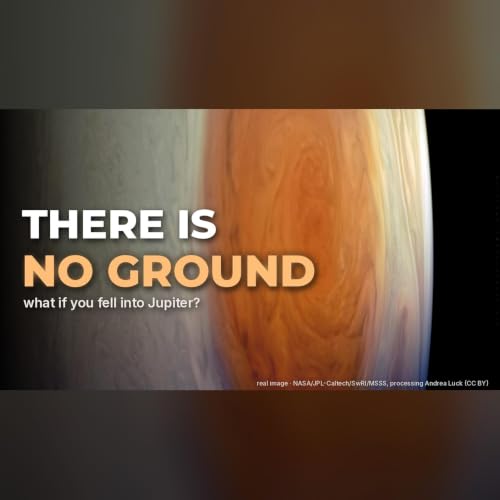
    Jupiter has no surface, so what would happen if you fell into it? In 1995 NASA's Galileo probe did exactly that and radioed back 58 minutes of data on the way down. We follow it through the radiation, clouds and storms, then keep going with physics and Juno's gravity data, through helium rain and metallic hydrogen to a "fuzzy" core with no clear edge.


    🎧 Listen on Spotify: https://open.spotify.com/show/6Ac2pRp4qYvJ2C7NLenHr3

    ▶ Watch the video, with every source and image credit: https://youtu.be/4Bau3dnWrbY

    Eight Minutes Old on YouTube: https://www.youtube.com/@EightMinutesOld · TikTok: https://www.tiktok.com/@eightminutesold · Instagram: https://www.instagram.com/eightminutesold


    Chapters

    0:00 Jupiter has no surface

    0:27 Getting there alive

    1:11 The "surface" and the clouds

    1:57 The shrinking Great Red Spot

    2:19 Lightning and mushballs

    2:40 The Galileo probe's last hour

    3:20 No measurements from here down

    3:55 Helium rain

    4:22 An ocean of metal

    4:50 The fuzzy core

    5:33 Is Jupiter a failed star?

    5:47 No bottom


    Beyond the Galileo probe's 58 minutes of data, the descent is a physics-based thought experiment; models of Jupiter's core are still debated.


    Sources

    • NASA Jupiter fact sheet: https://nssdc.gsfc.nasa.gov/planetary/factsheet/jupiterfact.html

    • Seiff et al. 1998, JGR (Galileo probe temperature profile): https://doi.org/10.1029/98JE01766

    • Brygoo et al. 2021, Nature (helium rain): https://www.nature.com/articles/s41586-021-03516-0

    • Wahl et al. 2017, GRL (dilute core): https://doi.org/10.1002/2017GL073160

    • Militzer et al. 2022, PSJ (Juno interior models): https://doi.org/10.3847/PSJ/ac7ec8

    • NASA, Galileo mission: https://science.nasa.gov/mission/galileo/


    Labels: in the video every claim carries an on-screen label (FACT, THEORY, ESTIMATE, HYPOTHESIS, SPECULATION); in this audio edition the narration says out loud when something is an estimate or a thought experiment.

    Narration: synthetic voice. Music: original.

    #space #astronomy #science #eightminutesold

    続きを読む 一部表示
    6 分
  • Night Sky This Week: 26 Oct to 1 Nov
    2026/10/26

    What you can see from Ireland and Britain this week, the first week after the clocks go back. A full Hunter's Moon that covers stars of the Pleiades in the small hours of Wednesday, Saturn in the evening, Jupiter and Mars before dawn, the Taurids (honestly: a quiet shower this week), and our object of the week, the Pleiades. The story: why their distance once didn't add up, and how astronomers checked.


    All times are for Dublin, in Greenwich Mean Time. In Britain, rising and setting times are earlier, by up to about half an hour in London. Sky positions were computed with PyEphem for 53.35° N and checked against published 2026 calendars.


    Chapters

    0:00 Welcome

    0:58 The Moon

    2:44 The planets

    3:59 Shooting stars

    4:33 Also this week

    4:58 The Pleiades

    5:40 How far away is it?


    Sources

    • Positions, rise and set times: computed with PyEphem (Dublin, 53.35° N, 6.26° W)

    • Cross-checks: Sky at Night, "Planet alignment Nov–Dec 2026": https://www.skyatnightmagazine.com/news/planet-alignment-november-december-2026

    • Star Walk, Astronomy Calendar 2026: https://starwalk.space/en/news/astronomy-calendar-2026

    • Derekscope, Astronomical Calendar 2026: https://derekscope.co.uk/astronomical-calendar-for-2026/

    • Meteor showers: IMO 2026 Meteor Shower Calendar https://www.imo.net/files/meteor-shower/cal2026.pdf and AMS calendar https://www.amsmeteors.org/calendar/

    • Space station passes: NASA Spot the Station https://spotthestation.nasa.gov/ and https://www.heavens-above.com/

    • NASA, Messier 45: https://science.nasa.gov/mission/hubble/science/explore-the-night-sky/hubble-messier-catalog/messier-45/

    • NASA, Hubble refines distance to the Pleiades (2004): https://science.nasa.gov/missions/hubble/hubble-refines-distance-to-pleiades-star-cluster

    • NRAO, Radio telescopes settle controversy over distance to Pleiades (2014): https://public.nrao.edu/news/radio-telescopes-settle-controversy/


    Narration: synthetic voice. Music: original.


    Eight Minutes Old on YouTube: https://www.youtube.com/@EightMinutesOld

    Listen on Spotify: https://open.spotify.com/show/6Ac2pRp4qYvJ2C7NLenHr3

    続きを読む 一部表示
    8 分
adbl_web_anon_alc_button_suppression_t1
まだレビューはありません