エピソード

  • 101: The Future of Coaching: AI, Ethics, and Belonging
    2025/12/10
    Show Notes
    In this episode Simon speaks with Tatiana Bachkirova, a leading scholar in coaching psychology. They explore how AI is impacting on the field of coaching and what it means to remain human in a world increasingly driven by algorithms. The discussion moves fluidly between neuroscience, pseudo-science, identity, belonging, and ethics, reflecting on the tensions between performance culture and authentic human development.
    They discuss how coaching must expand beyond individual self-optimization toward supporting meaningful, value-based projects and understanding the broader social and organisational contexts in which people live and work.
    AI underscores the need for ethical grounding in coaching. Ultimately, the episode reclaims coaching as a moral and relational practice, reminding listeners that the future of coaching depends not on technology, but on how we choose to stay human within it.

    Key Reflections
    • AI is often a solution in search of a problem, revealing more about our anxieties than our needs.
    • Coaching must evolve with the changing world, engaging complexity rather than retreating to technique.
    • The focus should be on meaningful, value-driven projects that connect personal purpose with collective good.
    • AI coaching risks eroding depth, ethics, and relational presence if not grounded in human awareness.
    • Critical thinking anchors coaching in understanding rather than compliance, enabling ethical discernment.
    • The relational quality defines coaching effectiveness - authentic dialogue remains its living core.
    • Coaching should move from performance and self-optimization to reflection, purpose, and contribution.
    • Human connection and ethical practice sustain trust, belonging, and relevance in the digital age.
    • The future of coaching lies in integrating technology without losing our humanity.
    Keywords
    Coaching psychology, AI in coaching, organisational coaching, identity, belonging, neuroscience, critical thinking, human coaching, coaching ethics, coaching research

    Brief Bio
    Tatiana Bachkirova is Professor of Coaching Psychology in the International Centre for Coaching and Mentoring Studies at Oxford Brookes University, UK. She supervises doctoral students as an academic, and human coaches as a practitioner. She is a leading scholar in Coaching Psychology and in recent years has been exploring themes such as the role of AI in coaching, the deeper purpose of organisational coaching, what leaders seek to learn at work, and critical perspectives on the neuroscience of coaching. In her over 80 research articles in leading journals, book chapters and books and in her many speaking engagements she addresses most challenging issues of coaching as a service to individuals, organisations and wider societies.
    続きを読む 一部表示
    37 分
  • 100: Soul at Work: Living a Good Life in a Disruptive Age
    2025/10/15
    Show Notes
    In this special 100th episode of Edgy Ideas, we mark a moment of reflection and celebration. Simon is joined by a panel of thoughtful voices; Chris Yates, Leslie Brissett, Eleanor Moore and Hetty Einzig, to explore a topic close to the heart, the soul at work and what it means to live a good life amidst the turbulence of our times. They reflect on the quiet yet powerful force of soul, not as something otherworldly, but that which connects us more deeply to ourselves, to each other, and to the work we do. The panel discusses: how do we re-enchant the workplace? How do we speak about 'soul' without falling into cliche or sentimentality? And how do we cultivate a spirituality that is lived, relational, and grounded in everyday acts?
    Their conversation weaves personal stories with collective insights, inviting you into a space where the sacred and the secular meet.
    Enjoy this rich and resonant conversation as we mark a century of episodes, and step forward soulfully into what comes next.

    Key Reflections
    • Edgy Ideas has evolved to meet the moment - seeking pathways to live well in disruptive times.
    • Soul at work is not a luxury, but a necessity - a call to engage the whole person: mind, body, and essence.
    • Everyday spirituality matters. It's found not in lofty ideas, but in presence, care, and connection.
    • Work can uplift or diminish the soul - context and culture matter.
    • Relational dynamics are the hidden architecture of soulful work.
    • Activism and soul are not opposites - activism can be a soulful practice.
    • Grace appears in the ordinary fleeting moments that illuminate meaning.
    • Sacred spaces can be created anywhere we choose to be present.
    • Soul embraces the paradox - the light and the dark, joy and struggle, both shaping who we are.
    • To witness another with kindness is perhaps the most radical act of all.
    Keywords
    Soul, Spirituality, Connection, Presence, Grace, Wholeness, Meaning, Authenticity, Relationships, Transformation, Soul at Work, Everyday Spirituality

    続きを読む 一部表示
    43 分
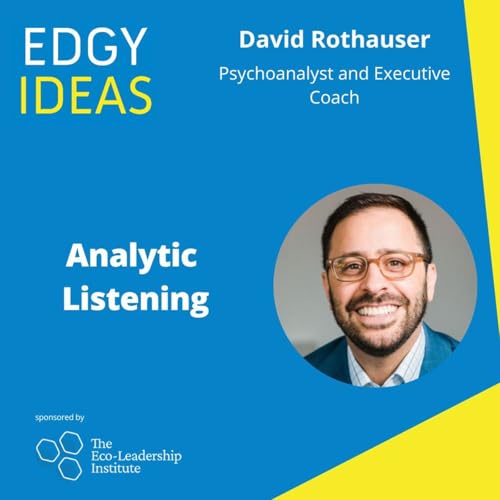
  • 99: Analytic Listening
    2025/09/04
    Show Notes
    In this episode of Edgy Ideas, Simon Western is joined by David Rothauser, psychoanalyst, organisational consultant, and executive coach, to explore the practice of analytic listening. They discuss what it means to listen beyond words, to hear silences as much as speech, and to create spaces where deeper human connection becomes possible. Their discussion explores the role of voice and transmission and how psychoanalytic traditions of listening extend into coaching, consulting, and organizational life. Attention is given to how cultural and historical contexts shape psychoanalytic practice, and how listening itself can become a radical act in today’s fast-paced world. The exchange is punctuated with insights and stories from practice. As David notes, “Analytic listening is not just about hearing words; it’s about understanding the unspoken and creating a space for genuine connection.” This episode invites listeners to consider listening not as a passive skill but as an active stance that redefines relationships, organisations, and communities.

    Key Reflections
    • Analytic listening is introduced as a concept with deep significance for today’s world.
    • Consideration is given to the role and nuances of psychoanalytic listening in coaching, consulting and organizational life.
    • The challenge of sustaining safe spaces for expression within complex organisational systems is examined.
    • Receptivity to conscious and unconscious communications in learning psychoanalysis and the similarities to transmission of knowledge in various spiritual traditions is explored.
    Keywords
    Psychoanalysis, Coaching, Analytic Listening, Human Connection, Receptivity, Safe Spaces

    Brief Bio
    David Rothauser is a psychoanalyst, organizational consultant, executive coach, educator and supervisor. He maintains a private psychoanalytic practice, leads training groups for coaches and consultants, and engages senior leaders and their teams in reflective practice. David has coached and consulted in a range of industries, including entertainment, PE- and VC-backed tech startups, data analytics, the commercial space industry, cyber security, real estate, healthcare, and education. He trained in coaching supervision at Oxford Brookes University, executive coaching at Columbia University, psychodynamic group leadership at the Center for Group Studies, and psychoanalysis at the Center for Modern Psychoanalytic Studies, where he is on faculty. David is based outside of Philadelphia.


    続きを読む 一部表示
    38 分
  • 98: Freedom and Meaning: Existential Coaching Approach
    2025/08/19
    Show Notes
    In this episode, Simon is joined by Natalie to open up the existential questions that lie at the heart of coaching: What does it mean to live well? How do we find meaning in a finite life? How do we coach for authenticity, freedom and responsibility?
    Far from being bleak, existentialism is revealed here as a liberating practice. Death is not avoided but faced - giving urgency and clarity to our choices, reminding us that life is finite and must be lived meaningfully. This conversation shows how reinvention is possible at any stage of life, and how helping others can deepen our own sense of happiness and fulfillment.
    Together, Simon and Natalie highlight the value of micro meanings - the everyday rituals, relationships and joys that ground us in significance. They reflect on the importance of structure in supporting growth, while also recognising the liberation that comes when we accept life’s pointlessness and take responsibility for creating meaning ourselves. To live authentically, we must face uncomfortable truths, resist “bad faith,” and embrace freedom with courage.
    Existential coaching, then, is less about problem-solving and more about opening a space where clients can explore their choices, discover what matters, and move towards a life without regrets. It speaks to the universal human pursuit of meaning, and to the possibility of finding spirituality and depth even in the midst of uncertainty.

    Key Reflections
    • Coaching at its best creates space for clients to face the uncomfortable truths of freedom, choice, and responsibility.
    • Awareness of death can deepen our sense of aliveness and urgency to live meaningfully.
    • Micro meanings - rituals, relationships, and small daily joys - are vital in shaping a good life.
    • Bad faith often creeps into coaching conversations, and part of the coach’s role is to gently challenge it.
    • Balancing structure and freedom is essential, both for personal growth and for effective coaching practice.
    Keywords
    existential coaching, good life, meaning, spirituality, death, personal growth, coaching psychology, self-discovery, relationships, happiness

    Brief Bio
    Dr Natalie Lancer CPsychol is a Chartered Coaching Psychologist, experienced supervisor and Former Chair of the British Psychological Society’s Division of Coaching Psychology (DoCP). She coaches a range of people from doctoral students keeping up their motivation and self-belief to get their thesis over the line, to young people applying for their first job, as well as female executives and retired professionals, often using The Eight Tensions framework. She runs professional development and training for coaches and coaching psychologists including Eight Tensions Coach Training (based on existential psychology), Coach Development Club and The School of Supervision. Natalie is a Master’s and PhD supervisor at the New School of Psychotherapy and Counselling. In 2016, she co-authored ‘Techniques for Coaching and Mentoring’ with David Clutterbuck. She also is a stand-up comic and performed most recently at the BPS DoCP 2025 Conference.
    続きを読む 一部表示
    37 分
  • 97: Ikigai in Coaching Practice
    2025/08/07
    Show Notes:
    Simon Western is joined by Yoko Kunii Aldous - lecturer, coach, hypnotherapist and cultural translator - to explore the deeper roots of this Japanese concept, revealing it to be less a “life purpose formula” and more a way of being-in-the-world.
    Yoko reflects on her journey from Japan to the UK and how living between languages and cultures opens up inner landscapes. She shares the real history of Ikigai - not as a productivity hack, but a pre-capitalist way of locating oneself in community and cosmos - and interrogates why the popular Western Venn diagram (“what you love, what you’re good at…”) oversimplifies and erases its cultural nuance. Drawing on Japanese concepts, Yoko frames language as a worldview where nature, spirit, and objects are integral to self-understanding. She speaks of spirituality in everyday life - from cherry blossoms to chopsticks - and explains why Ikigai should be seen as fluid, shifting across life stages and relationships, rather than as a fixed endpoint. The conversation explores the tension between individualism and collective responsibility, asking whether one can truly have Ikigai without caring for the village. From embracing imperfection through wabi-sabi, to recognising sacrifice and service as pathways to fulfilment, the episode challenges Western coaching to move beyond self-improvement toward a more relational, ecological, and culturally entangled way of living.

    Key Reflections:
    • True Ikigai cannot be pinned down or defined - it must be lived
    • Culture shapes not only what we think, but how we feel our way into meaning
    • Japanese aesthetics embrace imperfection (wabi-sabi) as essential to beauty and purpose
    • Spirituality in Japan is woven into the everyday - from teacups to trees
    • Personal meaning and collective wellbeing are not separate projects
    • Every item has a spirit
    Keywords:
    Ikigai, cultural insights, coaching, psychology, Japan, Western perspectives, personal development, spirituality, Venn diagram

    Brief Bio:
    Yoko Kunii Aldous is an award-winning university lecturer, coach, and language and culture trainer for the Ministry of Defence. She holds an MA in Applied Linguistics and an MSc in Coaching Psychology, and is a certified coach, hypnotherapist, and yoga instructor. Her background in language and communication informs her work in higher education, cross-cultural training, and personal development coaching.
    Her latest research explores how the Japanese concept of Ikigai is understood and applied by non-Japanese coaches. Her study critically examines how Ikigai is interpreted and integrated into coaching practices outside Japan, revealing common misconceptions and promoting a more culturally authentic understanding. This work was recognised with the Best Early Career Research Paper award by BPS Division of Coaching Psychology.
    By integrating Eastern philosophy with Western psychological theory, Yoko offers a coaching approach that is reflective, holistic, and grounded in cultural nuance. She supports individuals and professionals in aligning their core values with purposeful action, towards meaningful and sustainable change.
    続きを読む 一部表示
    34 分
  • 96: Place: Identity and Belonging
    2025/07/25
    Show Notes
    In this episode, Simon Western is joined by Daniel B. Frank and Caro Bainbridge to explore how our connection to place shapes who we are, how we relate to others, and how we make sense of the world. They share stories of growing up in Chicago and Liverpool, revealing how personal and collective histories are held within the places we call home.
    The conversation moves between the intimate and the systemic. Dan and Caro reflect on how certain streets evoke safety or sorrow, how schools have taken on roles far beyond education, and how cultural roots are both grounding and restrictive. They examine the emotional weight of returning to one’s childhood city, and the strangeness that can accompany that return.
    With digital life pulling people away from physical presence and history, the episode raises timely questions about what it means to belong - and how identity is shaped in an era of mobility, forgetting, and cultural fragmentation.

    Key Reflections
    • A sense of place gives structure to identity and meaning to memory.
    • Emotional ties to place can be nurturing or suffocating—or both at once.
    • The same place is experienced differently depending on one’s history, role, and identity.
    • The legacy of slavery and colonialism shapes how some communities relate to home. Being physically present in a place doesn't always mean belonging to it.
    • Schools are now expected to hold emotional, moral, and community roles once carried by families.
    • Digital technology creates new forms of disconnection, despite increased connectivity.
    • Living well includes being present - to place, to people, and to time.

    Keywords
    sense of place, identity, displacement, cultural connections, history, emotional well-being, modernity, community, education, technology

    Brief Bios

    Daniel B. Frank, Ph.D. is a graduate of Francis W. Parker School in Chicago where he has been has been its Principal for over 20 years and has been a senior administrator there since 1988. He is the founding Executive Editor of the international education journal Schools: Studies in Education, which is published by the University of Chicago Press, and has served as Executive Director of the International Society for the Psychoanalytic Study of Organizations.

    Caro Bainbridge works at the intersection of psychoanalysis, culture and organisational life. She is an organisational consultant, leadership development expert and executive coach, known for bringing depth insight to complex systems and supporting individuals and teams as they navigate change, uncertainty and transformation. Her practice is grounded in a long academic career: she is Emeritus Professor of Psychoanalysis & Culture, a former editor of Free Associations and of the film section of the International Journal of Psychoanalysis, and co-editor of Routledge’s Psychoanalysis and Popular Culture book series. Caro is a Fellow of the RSA and a Founding Scholar of the British Psychoanalytic Council. She is widely published in the academic context, and has recently launched The Culture Fix on Substack, where she explores the emotional and symbolic currents shaping contemporary life. Her work is animated by a belief in the generative potential of thresholds and transitions - a perspective shaped, in part, by her daily walks near Antony Gormley’s Another Place, where art, nature and thought meet at the water’s edge.
    続きを読む 一部表示
    53 分
  • 95: The Leadership of Pope Francis
    2025/07/09
    Show Notes
    In this episode of Edgy Ideas, Simon Western is joined by Fr. David McCallum, a Jesuit priest and Executive Director of the Program for Discerning Leadership. Together, they explore the unique leadership style of Pope Francis and what it means for the future of the Catholic Church - and humanity at large.
    The conversation unfolds around the radical shift Pope Francis has led, prioritizing humility, listening, and symbolic action over institutional command. Fr. David shares moving anecdotes from his encounters with the Pope, offering insight into how leadership rooted in deep presence and discernment can inspire systemic change. They reflect on synodality as a leadership practice - a process rooted in dialogue, participation, and inclusion - and the ways it reorients traditional hierarchies toward relational and collective discernment.
    They discuss how change often emerges from the margins rather than the center, and how Pope Francis embraced paradox and complexity rather than rushing to resolve it. In a world increasingly polarized, this leadership invites us to see difference as generative and to engage across divides with empathy and courage.
    Looking ahead, the conversation calls on leaders across sectors to let go of rigid structures and embrace more inclusive, compassionate and participatory ways of leading. Through stories, reflection, and critical insight, this episode challenges the dominant narratives of leadership and offers a deeply human alternative.

    Key Reflections
    • Leadership is a relational and spiritual practice, not a role tied to status or control.
    • Navigating polarity and difference is essential in an increasingly divided world.
    • The Church’s transformation under Pope Francis offers broader insights into how leaders can hold space for complexity.
    • Leadership rooted in presence, encounter, and discernment can offer healing and direction in times of global uncertainty.
    • Every meaningful interaction has the potential to be a transformative leadership act.

    Keywords
    Pope Francis, Jesuit leadership, synodality, listening, symbolic action, humility, Catholic Church, polarity, discernment, relational leadership, spiritual leadership, inclusion, soul at work

    Brief Bio
    Fr. David McCallum, S.J., Ed.D, is a Jesuit priest from the USA who serves as the founding Executive Director of the Program for Discerning Leadership, a special initiative of the Society of Jesus headquartered in Rome. The Program provides leadership formation and organizational development support for senior Vatican officials and major superiors of religious orders headquartered in Rome and internationally. From 2021-2024, Fr. McCallum has worked with the Secretariat for the Synod of Bishops on the Commission on Methodology, as a member of the international group that developed the synthesis of the National and Regional Bishop’s Conferences reports at Frascati, and as a facilitator expert at the Synods in October 2023 and 2024. Formerly, Fr. McCallum served as faculty member and then the Dean of the Madden School of Business and as the VP of Mission Integration and Development at Le Moyne College in Syracuse, NY. His doctoral research at Teachers College, Columbia University, focused on the implications of developmental diversity in meeting the leadership challenges of conflict, complexity, and ambiguity.
    続きを読む 一部表示
    38 分
  • 94: Building Civil Society: Reflections from a Lebanese Activist
    2025/05/30
    Show Notes
    In this episode, Simon Western speaks with Lebanese scholar and activist Karim Safieddine. Together, they discuss the vibrant and volatile political landscape of Lebanon, exploring how social movements, intellectual traditions, and grassroots activism collide and coalesce in the streets of Beirut. Karim shares his personal story of growing up amidst conflict, complexity, and contradiction, offering a lens into how identity is formed in a fractured society and how hope emerges through resistance.
    They explore themes of secularism, anti-establishment politics, and the evolving role of intellectuals in social change. The conversation touches deeply on what it means to live a good life and how ordinary people - through organising, dissent, and imagination - shape the possibility of a good civile society.
    Key Reflections
    · Elites often suppress transformative movements; activism persists through localised, organic mobilisation.
    · Intellectuals must step beyond theory and engage meaningfully with activist work.
    · A good life is not about material excess but about meaningful relationships, creativity, and communal survival.
    · Resistance is necessary for vitality; dissent keeps societies alive and evolving.
    · Bridging academia and activism is essential for sustainable change.
    · Empowering local voices and grassroots movements is crucial to Lebanon’s future.

    Keywords
    social movements, political sociology, secularism, identity, intellectuals, activism, anti-establishment, cosmopolitanism
    Brief Bio
    Karim Safieddine is a PhD student in Sociology at the University of Pittsburgh whose work explores the intersection of social movements, intellectual history, and political power in Lebanon. With a particular focus on the Lebanese Left, Karim investigates how oppositional movements both contest and reproduce dominant ideological frameworks and structures of authority from the late 20th century to the present.
    Rooted in a Gramscian tradition yet open to diverse theoretical tools, his research engages with questions of leadership, resistance, and hegemony. His work bridges political sociology and historical analysis, offering critical insights into how movements emerge, evolve, and navigate Lebanon's sectarian and neoliberal political terrain.
    Karim holds an MSc in Comparative Politics from the London School of Economics (2020) and a BA in Economics from the American University of Beirut (2019). His academic interests include political and historical sociology, social movements, and the role of intellectuals in shaping public discourse.
    続きを読む 一部表示
    38 分