『Designed for the Creative Mind™』のカバーアート

Designed for the Creative Mind™

Designed for the Creative Mind™

著者: Michelle Lynne
無料で聴く

【Amazonプライム会員限定】今ならプレミアムプランが4か月 月額99円。

10月19日まで。※適用条件あり
Your designs are beautiful, but you're struggling with the business of your interior design business. Join successful interior design business owner, Michelle Lynne, of ML Interiors Group each Monday morning as she shares the processes she has found useful in growing her own 7-figure design firm, interviews industry related guests, and brings her own team of designers on for lively conversations. If you aren't happy with the performance of your interior design business, are tired of trading your time for money, and know you were made for more, this show is for you. アート
エピソード
  • Ep 244:Do You Actually Want to Own an Interior Design Business?
    2026/09/21

    Being an interior designer and being an interior design business owner are two very different jobs. Have you actually decided which one you want?

    We talk a lot about the dream of owning an interior design firm: creative freedom, choosing your clients, setting your own schedule, and building something that is completely yours.

    And those things can absolutely be part of business ownership.

    But there's another side of the equation that doesn't always make it into the Instagram caption.

    Because when you own the business, you're not just the designer. You're also the salesperson, financial manager, problem solver, technology department, decision-maker, and the person who ultimately has to deal with whatever goes sideways.

    In this episode, Michelle Lynne gets very honest about what it actually means to own an interior design business—and asks a question that more designers should be asking:

    Do you actually want to own a business, or do you want to be an interior designer?

    Neither answer is wrong.

    Working for an established design firm can offer the opportunity to focus on the creative work without carrying the full weight of sales, finances, operations, and business risk. And for some designers, that may genuinely be the career they want.

    For others, the autonomy and opportunity that comes with ownership are worth the responsibility and uncertainty.

    The important thing is knowing which one you're actually choosing—and making that decision based on the life and work you want, rather than what sounds more ambitious or impressive.

    In this episode, Michelle talks about:
    • The difference between being an interior designer and being an interior design business owner

    • Why design is only one part of the job when you own the firm

    • The reality of being responsible for sales, finances, technology, and problem-solving

    • Why impressive revenue numbers don't necessarily mean a business is profitable

    • The personal development that comes with putting yourself—and your work—out there

    • Rejection, perfectionism, imposter syndrome, and vulnerability as a business owner

    • The financial risk and uncertainty that come with starting a firm

    • Why working for another design firm is not a fallback or a failure

    • What you can learn by working inside an established design business

    • How to think about ownership versus employment based on the actual life you want

    • Why you're allowed to change your mind about the path you've chosen

    The question to sit with:

    What do you want your actual days to look like?

    If you want to spend most of your time sourcing, designing, presenting, and installing, working inside an established firm may be exactly what you're looking for.

    If you want to build something that's yours, make the decisions, take the risk, and reap the rewards—and you're willing to engage with the unglamorous parts of running a business—ownership may be the path for you.

    There's no prize for choosing the harder option.

    There's no shame in changing your mind.

    And there's certainly no reason to build a business simply because everyone around you says that's what successful designers are supposed to do.

    Choose the career that actually fits the life you want to live.

    Want to work with Michelle?

    If you're wrestling with whether to start, grow, change, or rethink your interior design business, private coaching gives you the opportunity to look at your specific situation—including your goals, numbers, circumstances, and what you actually want your work and life to look like.

    Learn more about private coaching with Michelle Lynne by visiting https://thedesignbakehouse.com/private-coaching

    Share this episode

    Know an interior designer who's trying to figure out whether they actually want to own a business?

    Send this episode their way. Sometimes the most useful thing we can give someone isn't permission to make a particular choice—it's a clearer picture of the choice they're actually making.

    続きを読む 一部表示
    29 分
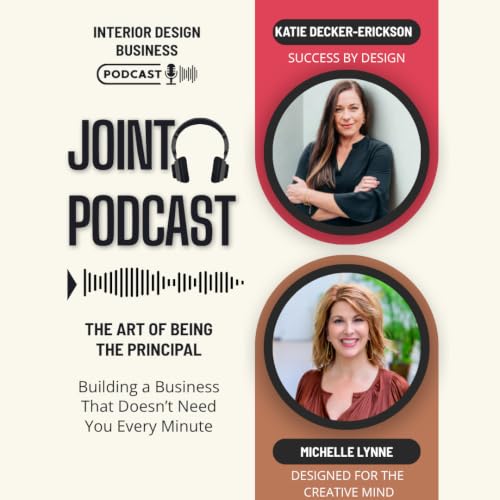
  • Ep 243: The Art of Being Principal: Building a Business That Doesn't Need You Every Minute with Katie Decker-Erickson
    2026/09/14

    What if the real measure of a successful design firm isn't how much the principal can personally accomplish—but how well the business operates when they're not there?

    In this episode of The Art of Being Principal, Michelle Lynne and Katie Decker-Erickson have one of their trademark conversations: part business strategy, part leadership lesson, and part "how did we get on this subject?"

    They dive into why strong operations are so important for design firms, especially as a business grows beyond the principal doing everything herself. From documenting processes and empowering your team to conducting project postmortems and creating space to step away, they explore what it actually takes to build a firm that can function without you.

    And yes, they talk about Fiji.

    Michelle shares her "Fiji Factor"—the idea that if she and her lead designer could disappear to Fiji tomorrow, the business should still be able to operate. Katie adds her own twist: processes should be consistent, but not so rigid that there's no room for the unique needs of a luxury client or the lessons you learn along the way.

    The conversation also gets into one of the biggest leadership shifts a principal can make: stopping yourself from being the person who solves every problem.

    Because when your team has responsibility and the authority to make decisions, something important happens. You get your time back. Your team gets stronger. And the business becomes less dependent on you.

    In this episode, Michelle and Katie talk about:
    • Why documented processes are essential—even for small and solo design firms

    • The "Fiji Factor" and why your business should be able to function without you

    • Why 90% of your process should stay consistent while leaving room for the other 10%

    • Charging appropriately for high-maintenance or high-touch clients

    • How to stop being the person who has to know and solve everything

    • The difference between responsibility and authority when managing a team

    • Why hiring for "care" and character can matter more than hiring for every skill on the job description

    • How to trust your team while still having checks and balances

    • Why project postmortems should capture what went RIGHT—not just what went wrong

    • How to recognize when an old process no longer serves your clients or your firm

    • The importance of auditing your processes, subscriptions, tools, and systems

    • Why the right tools can save you from working harder just to get the same result

    • How creating white space in your business gives you room to think, create, and breathe

    • Why principals need to take real time away from the business

    • The connection between good operations, sustainability, and actually enjoying your business again

    One of the biggest takeaways from the conversation is simple:

    Operations may not sound sexy, but they're what give you the freedom to build the business—and the life—you actually want.

    Whether you want to grow a seven-figure firm, take six clients a year, spend more time designing, or simply be able to take a vacation without your phone exploding, the goal is the same: build a business that doesn't require you to hold every piece in your head.

    And sometimes, the best leadership move you can make is to step back and let your people figure it out.

    Because you don't have to know everything.

    You don't have to solve everything.

    And your business shouldn't need you to do everything.


    Connect with Us

    You can learn more about Michelle by visiting https://thedesignbakehouse.com/ or following her on IG: https://www.instagram.com/by_michelle_lynne/

    You can learn more about Katie by visiting https://successbydesign.coach/ or following her on IG: https://www.instagram.com/successbydesign_coach_podcast/

    Want to get on the waitlist for Sidemark 2.0? This software will be THE software to run your entire interior design business. A true all-in-one. https://api.mysidemark.com/widget/form/4Ug6Rgg2uqCX0MydoJ2v?notrack=true

    続きを読む 一部表示
    53 分
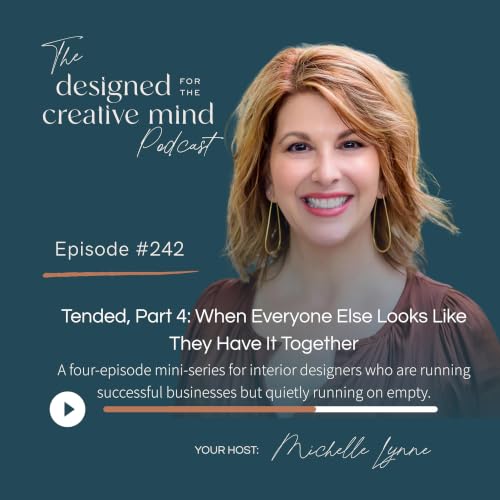
  • Ep 242: Tended, Pt 4 - When Everyone Else Looks Like They Have It Together
    2026/09/07

    Have you ever looked around at other interior designers and thought, What do they know that I don't?

    They're booked out. Their projects look incredible. Their social media is polished. They seem confident, successful, and completely on top of their business.

    Meanwhile, you're staring at a quiet pipeline, difficult clients, late shipments, team issues, or a slow month and wondering if you're doing something terribly wrong.

    In this final episode of Tended, Michelle Lynne gets unusually honest about a season when her own business looked successful from the outside—but felt anything but successful on the inside.

    After unexpectedly losing two key team members in 2023, navigating the launch of Studio Works and Sidemark, and then experiencing a prolonged slowdown in leads through 2024 and 2025, Michelle found herself questioning everything—including whether she should walk away from her design firm altogether.

    And yet, if you had followed ML Interiors Group on social media during that time, you probably would have had no idea.

    The projects were still being photographed. The posts were still going out. The business was still moving.

    That's the point.

    You are comparing your behind-the-scenes to someone else's highlight reel.

    And that comparison can lead you to make decisions based on information you don't actually have.

    In this episode, Michelle talks about:
    • What it feels like to go through a genuinely difficult season while your business still looks successful from the outside

    • Why social media gives you an incomplete picture of another designer's business

    • The danger of assuming that a designer who is "swamped" is necessarily profitable or successful

    • Why busyness and business success are not the same thing

    • How industry events and conversations at market can fuel comparison

    • Why year-end highlight reels can make a slow season feel even worse

    • How Michelle pulled herself out of the comparison spiral by returning to her own numbers, pipeline, margins, clients, marketing, and team

    • The difference between learning from another designer and reshaping your business because of what you see them doing

    • Why slow seasons don't necessarily mean you're falling behind

    • The reminder that you are not uniquely behind and probably aren't missing some magical secret everyone else has figured out

    The big takeaway

    The version of someone else's business that you can see is always edited.

    You don't know their margins. You don't know their client relationships. You don't know whether they're profitable. You don't know what is happening behind the beautiful project photos or the confident conversation at market.

    So before you change your positioning, blow up your brand, restructure your services, or decide that everyone else has figured something out that you haven't, come back to your own business.

    Look at your actual numbers. Your pipeline. Your margins. Your clients. Your marketing. Your team. Your goals.

    Your business needs a North Star—not a comparison.

    And perhaps most importantly, remember:

    You are not separate from your business.

    Tending to yourself isn't the soft work or the extra work. It's part of the work.

    Running an interior design firm is hard. You don't have to pretend otherwise.

    Ready for support?

    If this episode—and the entire Tended series—hit a little too close to home, private coaching may be the right next step.

    Michelle works with interior designers who want experienced guidance from someone who understands the realities of building and running a design firm.

    Learn more about Private Coaching at Design Bakehouse.

    Join Michelle at the Northeast Design Conference

    Michelle will be speaking at the Northeastern Design Conference during the first week of October.

    Use code MICHELLE10 for 10% off your registration.

    Check the show notes for conference details and registration information.

    続きを読む 一部表示
    17 分
adbl_web_anon_alc_button_suppression_t1
まだレビューはありません