エピソード

  • The Islamic Dilemma
    2026/04/24
    In this episode we present a critical comparative analysis between Islam and Christianity. Jay Smith utilizes historical and manuscript evidence from the seventh century to challenge the origins of Muhammad, the Quran, and the city of Mecca. He argues that the standard Islamic narrative is a later fabrication, contrasting it with the earlier eyewitness documentation supporting the New Testament. Similarly, Nabeel Qureshi explores the theological divide between the two faiths, focusing on the Trinity versus Tawhid and the nature of salvation. Qureshi maintains that historical testimony and the concept of God’s personhood favor the deity of Jesus over Islamic teachings. We also look at David Wood's Islamic Dilemma and how the very text of the Quran proves it false and the Bible true. Ultimately, the materials serve as apologetic resources intended to defend the reliability of the Bible while inviting Muslims to reconsider the historical foundations of their faith. STUDY GUIDE TOP TEN TAKEAWAYS 1. Chronological and Geographical Isolation of Sources: The "Standard Islamic Narrative" (SIN) relies on biographies and traditions (Hadith, Sira, Tafsir) written 200 to 300 years after the death of Muhammad. Furthermore, the authors of these traditions lived in regions like Baghdad, Uzbekistan, and Northern Iran—often 1,200 to 2,600 miles away from Mecca. 2. The Historical Invisibility of Mecca: There is no map, archaeological evidence, or external historical reference to Mecca as a city or a trade center until the 8th century (specifically 741 AD). Ancient maps and the records of the Greeks, Romans, Persians, and Nabataeans are entirely silent regarding the city. 3. Qibla Direction Discrepancies: Archaeological research into early mosques (prior to 706 AD) reveals that the Qibla (direction of prayer) was consistently facing Petra in Jordan, not Mecca. It was not until 727 AD that the first mosque was built facing Mecca. 4. Topographical and Agricultural Mismatch: The Quran and early traditions describe a verdant location for the "Prophet’s city" featuring streams, olive trees, and fruit. Mecca, however, is a waterless desert valley with no historical agricultural capacity, whereas Petra matches these descriptions. 5. Failure of the Trade Route Theory: The theory that Mecca was a hub for Indian Ocean trade is debunked by the fact that Mecca is located 3,000 feet down from the Western Plateau trade route and lacks water for caravans. Historically, trade remained on ships in the Red Sea, which utilized ports on the African coast rather than the Arabian side. 6. Preservation of the Quran: Contrary to the claim that the Quran is uncreated and unchanged, there are currently 30 different versions of the Quran (such as Huffs and Warsh) with 93,000 documented differences in dots and vowels. These variations lead to differences in doctrine and practice. 7. Manuscript Evidence and Standardization: The earliest complete Quranic manuscripts date from the 8th to 10th centuries and do not align perfectly with the modern standardized text. The current "standard" Quran was chosen by a single scholar in Cairo in 1924 and only became a global standard after the Saudi government adopted it in 1985. 8. Theological Incompatibility: Christianity and Islam differ fundamentally in their diagnosis of humanity's problem and the solution. Islam identifies the problem as "ignorance" and offers "Sharia" (law) as the remedy. Christianity identifies the problem as "sin/brokenness" and offers a relationship with God (the Gospel) as the remedy. 9. Tawhid vs. Trinity: While both faiths are monotheistic, they disagree on God's personhood. Islam emphasizes Tawhid (a monadic, impersonal conception of God), while Christianity teaches the Trinity (one God in three persons), emphasizing God’s desire for intimacy and His willingness to suffer for humanity. 10. Historical Foundations of Jesus: The central claims of Christianity—Jesus' deity, crucifixion, and resurrection—are grounded in eyewitness accounts written within decades of the events. In contrast, the Islamic account of Jesus and the early church requires overlooking almost the entirety of the historical record of the 1st century. -------------------------------------------------------------------------------- STUDY GUIDE I. The Historical Critique of the Standard Islamic Narrative (SIN) The Standard Islamic Narrative posits that Islam was fully formed in the Hijaz (Central Arabia) by 661 AD, based on revelations received by Muhammad in Mecca and Medina. However, historical analysis reveals a significant gap between the events and the records: * Late Documentation: The biography of Muhammad (Sira) by Ibn Ishaq was written 130 years after Muhammad’s death (765 AD), and the current version by Ibn Hisham is even later (833 AD). The Hadith (sayings) were first compiled by Al-Bukhari in 870 AD—240 years after the fact. * Comparison ...
    続きを読む 一部表示
    29 分
  • Two Centuries of Christian Persecution
    2026/04/23
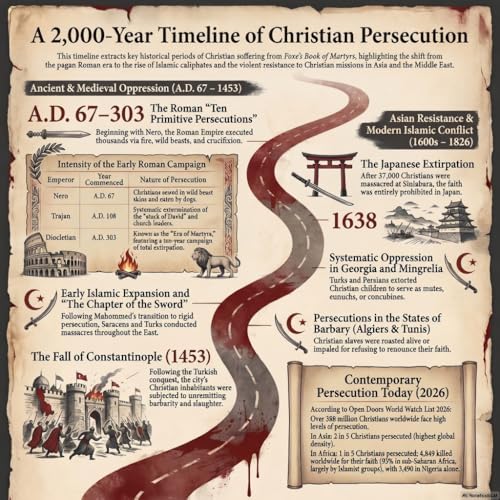
    John Foxe’s Book of Martyrs serves as a foundational historical record documenting the persecutions and deaths of Christian believers from the early church through the nineteenth century. This updated edition expands upon Foxe's original work to include primitive martyrs, victims of the Inquisition, and individuals targeted during the French Revolution. The text specifically highlights the intense suffering of Protestant reformers and missionaries while offering a stern critique of the papal hierarchy and its historical use of force. Through detailed narratives of figures like St. Stephen and various apostles, the collection portrays martyrdom as a testament to unshakable faith amidst systemic cruelty and hatred. Study Guide: Foxe’s History of Christian Martyrdom This study guide provides a comprehensive review of the historical narratives, theological arguments, and specific accounts of martyrdom detailed in the provided excerpts of "Foxe’s Book of Martyrs," as updated by Harold J. Chadwick. The text traces the history of religious persecution from the primitive church through the early 19th century. The Theoretical Framework of Persecution The text posits that the history of the Christian church is fundamentally a history of trials and sufferings. Persecution is described as arising from two primary sources: external opposition from pagan or "infidel" forces and internal schisms where members of the same faith turn against one another. The Origin of Hostility Persecution is framed as a reaction to "pure and unsophisticated morality." The source identifies the "inherent vice" in unsanctified human nature as the drive to use physical force to restrain obnoxious sentiments and propagate favorite opinions. This trend began with the martyrdom of John the Baptist and the crucifixion of Jesus Christ, which serve as the basis for all subsequent Christian martyrdom. The Papal System and Infallibility The document presents a sharp critique of the papal hierarchy, distinguishing it from other sects. While many groups have persecuted opponents during times of excitement or decline, the text argues that the Roman Catholic Church is unique in adopting the "right to destroy heretics" as a fundamental article of religious belief. This is tied to the claim of infallibility; because the church claims it cannot err, it must continue to defend and repeat its past violent actions against dissenters. Persecution by Infidelity The text contrasts religious persecution with "infidel" persecution, specifically citing the French Revolution of 1789. It argues that while Christianity is often blamed for the actions of its "nominal followers," infidelity offers no restraint on human passion. The French Revolution is used as a case study for how the rejection of the Bible and social institutions like marriage leads to anarchy, where "blood spouted up in living streams." -------------------------------------------------------------------------------- The Apostolic Age and Primitive Martyrs The history of martyrdom officially begins following the resurrection of Christ and the mission of the Holy Spirit, which emboldened the apostles to proclaim the gospel despite Jewish and Roman opposition. The First Martyrs St. Stephen: The first martyr of the primitive church, stoned to death after preaching to those who killed Christ.James the Great: Beheaded ten years after Stephen’s death by order of Herod Agrippa. His accuser was reportedly so moved by James’s courage that he converted and was beheaded alongside him.Philip: Scourged, imprisoned, and crucified in Phrygia in A.D. 54. Fates of the Apostles and Evangelists Matthew: Slain with a halberd in Ethiopia in A.D. 60.James the Less: At age 94, he was beaten, stoned, and had his brains dashed out with a fuller’s club.Andrew: Crucified on a transverse cross (St. Andrew’s Cross) in Edessa.St. Mark: Dragged to pieces by a mob in Alexandria during a solemnity for the idol Serapis.Peter: Crucified with his head downward at Rome (though the text notes his visit to Rome is historically uncertain).Paul: Beheaded in Rome under Nero after traveling through Greece, Spain, and France.Thomas: Thrust through with a spear in India.Luke: Supposedly hanged on an olive tree by idolatrous priests in Greece.John: The only apostle to escape a violent death. He survived being cast into boiling oil, was banished to Patmos, and was later recalled by Nerva. -------------------------------------------------------------------------------- The Ten Primitive Persecutions Between the reign of Nero and the rise of Constantine, the Roman Empire engaged in ten distinct waves of general persecution. Under Nero (A.D. 67): Initiated after Nero set fire to Rome and blamed Christians. Victims were sewn into wild beast skins and worried by dogs or used as human torches to light gardens.Under Domitian (A.D. 81): Involved the banishment of St. John and the death of Timothy, who was beaten with clubs...
    続きを読む 一部表示
    26 分
  • The Soil and the Sword : Samuel Whittemore
    2026/04/22
    This episode highlights the life of Samuel Whittemore, an American colonial farmer who became a legendary figure of the Revolutionary War. The author presents Whittemore’s biography through the lens of Biblical masculinity, emphasizing his lifelong dedication to physical labor, family leadership, and community protection. At eighty years old, Whittemore famously survived a brutal confrontation with British soldiers during the retreat from Lexington and Concord, an act the source frames as the ultimate expression of godly resolve. By detailing his survival and his legacy of nearly two hundred descendants, the narrative seeks to inspire modern men to embrace similar roles as steadfast providers and defenders. The source ultimately uses this historical account to advocate for a multigenerational faith rooted in Reformed Protestant values and active leadership. STUDY GUIDE This study guide examines the life and legacy of Samuel Whittemore (1694–1793), a colonial Massachusetts farmer whose actions during the American Revolution and throughout his long life serve as a primary case study for "Biblical masculinity" within a Reformed Protestant framework. The following sections synthesize his biography, military service, and the theological principles he embodied. TOP TEN TAKEAWAYS Remarkable Longevity and Resilience: Samuel Whittemore lived to the age of 98 (1694–1793), surviving catastrophic combat injuries at age 80 that included being shot in the face, bayoneted multiple times, and clubbed with musket butts.Multigenerational Legacy: Through two covenant marriages, Whittemore fathered at least ten children and had 185 direct descendants by the time of his death, illustrating the concept of a "multi-generational household."Vocation as Worship: As a farmer in Menotomy (modern-day Arlington), Whittemore viewed manual labor and land stewardship as a divine mandate based on Genesis 2:15.Extensive Military Experience: Before the Revolution, Whittemore served in King George’s War (at the Fortress of Louisbourg) and the French and Indian War, reaching the rank of captain of the dragoons at age 64.The Stand at Menotomy: On April 19, 1775, at age 80, Whittemore independently engaged a British relief brigade, killing two soldiers and mortally wounding a third before being overtaken.Biblical Provision: His life emphasized the duty of provision outlined in 1 Timothy 5:8, prioritizing the physical and spiritual needs of his household over personal ease.Complementarian Leadership: Whittemore practiced a complementarian marriage model, leading with sacrificial love while his wives (Elizabeth Spring and later Esther Prentice) supported the household as co-heirs in Christ.Reformed Protestant Worldview: His actions were shaped by the Puritan and Congregationalist heritage of colonial Massachusetts, which viewed resistance to tyranny as obedience to a higher divine authority.Tactical Versatility: In his final battle, Whittemore demonstrated "warrior-poet" traits by transitioning through primary (musket), secondary (pistols), and tertiary (sword) weapons.State Recognition: In 2005, the Massachusetts legislature officially declared Samuel Whittemore the state hero, recognizing his enduring impact on American history. -------------------------------------------------------------------------------- STUDY GUIDE I. Biographical Foundations and Early Life Samuel Whittemore, Junior was born on February 27, 1694, in Charlestown, Massachusetts. He spent much of his life as a farmer in Menotomy, a section of Cambridge now known as Arlington. His life was defined by the rhythm of agricultural labor—raising crops and livestock—which he viewed not as an optional hobby but as obedience to the "first mandate" given in Genesis 2:15: "The Lord God took the man and put him in the garden of Eden to work it and keep it." Whittemore’s lifestyle was rooted in the Reformed Protestant worldview of New England, which emphasized vocation as a divine summons. This perspective required a man to provide for his relatives and household, adhering to the standard set in 1 Timothy 5:8, which equates the failure to provide with denying the faith. II. Marriage, Family, and Household Leadership Whittemore’s domestic life was characterized by "covenant faithfulness" and a complementarian structure. First Marriage: In 1721, he married Elizabeth Spring. Together they had at least three sons and seven daughters.Second Marriage: Following Elizabeth’s death, he married Esther Prentice, the widow of Amos Muzzey.Legacy: At his death, his descendants numbered 185. Whittemore’s approach to fatherhood involved spiritual and practical formation. He taught his sons the dignity of labor and the necessity of standing for truth, while modeling for his daughters the value of godly womanhood by honoring their mother. He viewed the family as the "first line of defense for the Gospel" and the primary training ground for the next generation of warriors....
    続きを読む 一部表示
    20 分
  • Stewardship & First-Fruits
    2026/04/21
    Biblical financial stewardship is a comprehensive process for men to lead their households by recognizing that all resources belong to God and must be managed according to His Word. The foundation of this journey begins with honoring the Lord through "first fruits" giving, prioritizing a systematic ten percent tithe as a baseline act of worship and trust. To achieve true freedom and better serve the Kingdom, men must eliminate debt using the "debt snowball" method with "gazelle intensity," acknowledging that the borrower is a slave to the lender. This discipline is maintained through zero-based budgeting, where every dollar is assigned a purpose before the month begins, allowing for long-term wealth building via low-cost index funds. Ultimately, a faithful steward must train his children in work ethic and diligence, ensuring that any inherited wealth becomes a blessing rather than a curse for future generations. STUDY GUIDE TOP TEN TAKEAWAYS God as Absolute Owner: All wealth, resources, and skills are gifts from God. According to 1 Chronicles 29:11 and Psalm 50:10, He owns everything in the heavens and the earth, including "the cattle on a thousand hills." Humans are stewards, not owners.The Priority of First Fruits: Stewardship begins with honoring God first. Following the example of Abel and the statutes in Leviticus, the "first fruits"—a systematic, off-the-top tenth (tithe)—should be given to God before any other expenses.Debt as Bondage: Debt is characterized as a form of slavery. Proverbs 22:7 states that "the borrower is the slave of the lender." Eliminating debt is essential to regaining the freedom to serve God's Kingdom.Behavior Over Knowledge: Personal finance is approximately 80% behavior and only 20% head knowledge. Success depends on disciplined action and "gazelle intensity" rather than just understanding mathematical formulas.The Debt Snowball Method: This strategy prioritizes psychological momentum by paying off debts from smallest balance to largest, regardless of interest rates. Success in the smallest debt creates the motivation needed to tackle larger ones.Zero-Based Budgeting: A budget is a tool for freedom, not restriction. It involves assigning every dollar a name before the month begins so that "income minus expenses equals zero."Spousal Unity in Finance: Effective stewardship requires a husband and wife to work together as "one flesh." They must sit down monthly to assign every dollar and review the budget weekly to ensure transparency and agreement.The Power of Index Funds: Wealth building should be simple and low-cost. Traditional index funds, which buy the "whole market" (like the S&P 500), eliminate individual stock risk and minimize the "tyranny" of compounding investment costs.Generational Legacy: A "good man" leaves an inheritance to his children's children (Proverbs 13:22). This involves passing down not just money, but also a strong work ethic and the character required to steward wealth faithfully.Diligence and Contentment: True gain is found in godliness with contentment. Stewardship requires a commitment to hard work (diligence) while avoiding the cultural traps of luxury and "hasty" searches for wealth. -------------------------------------------------------------------------------- STUDY GUIDE I. The Theological Foundation of Stewardship The concept of biblical stewardship is rooted in the recognition of God’s absolute sovereignty. As established in 1 Chronicles 29:11 and 1 Corinthians 4:7, humans possess nothing by right; every paycheck, skill, and asset is a gift on loan from the Creator. A faithful steward acknowledges that they are a manager of the King’s resources. First Fruits vs. Leftovers: The distinction between the offerings of Cain and Abel (Genesis 4) illustrates the importance of giving the "first and the best" rather than whatever remains at the end of the month.The Tithe: Leviticus 27:30 defines the tithe as a tenth of all produce and livestock, set apart as holy to the Lord. This is considered the baseline for worshipful giving, acknowledging God as the source of all provision.Radical Trust: The story of the widow's mite (Mark 12:41-44) demonstrates that the value of an offering is not in its size, but in the sacrifice and trust it represents. II. The Battle Against Debt Debt is viewed as a primary obstacle to faithful stewardship because it mortgages the future for today’s comfort and creates a master-slave relationship between the lender and the borrower. The Emergency Fund: The first step in financial recovery is saving $1,000 quickly to act as a buffer against "Murphy’s Law." This prevents minor crises (like a car repair) from forcing a family back into debt.Gazelle Intensity: This term describes the extreme focus and urgency required to escape debt. It involves cutting all non-essential spending ("beans and rice") and selling assets to accelerate the debt payoff.The Debt Snowball: Unlike the "debt avalanche" (which targets ...
    続きを読む 一部表示
    22 分
  • The Divine Architect's Fine-Tuned Universe
    2026/04/20
    This podcast explores the fine-tuned universe argument for God's existence, framing scientific data as a "battle hymn" for Christian men to lead and protect their families. The various physical constants and ratios, such as gravity and the cosmological constant, and their extreme precision makes random chance a mathematical impossibility. Beyond physics, there is biological complexity, the information stored in DNA and irreducibly complex systems like the bacterial flagellum are evidence of a Divine Architect. Throughout the discussion, we deconstruct secular objections like the multiverse theory, a philosophical dodge rather than empirical science. Ultimately, this material serves to equip believers with a blend of scientific evidence and Scripture to defend their faith against atheistic worldviews. The Divine Architect's Fine-Tuned Universe: STUDY GUIDE TOP TEN TAKEAWAYS The Watchmaker Analogy: Derived from William Paley in 1802, the argument posits that just as the specified complexity of a pocket watch implies a craftsman, the purposeful arrangement of the universe screams for a Divine Architect rather than blind chance.Fundamental Physical Constants: The universe is governed by dozens of dimensionless numbers (e.g., the strength of gravity or electromagnetism) that are "baked into" reality. If any of these were shifted by a fraction of a percent, the universe would be incapable of supporting life.The Cosmological Constant (Lambda): This value, which describes the density of dark energy, is fine-tuned to one part in 10^{120}. This level of precision is compared to the impossibility of balancing a pencil on its sharpened tip.Initial Entropy (The Penrose Number): Roger Penrose calculated that the odds of the universe starting in a low-entropy, highly ordered state are one in 10^{10^{123}}. This number is so large it could not be written down even if every particle in the universe were used as a digit.Expansion Rate Precision: The expansion rate of the universe following the Big Bang is tuned to one part in 10^{60}. This is analogous to firing a bullet from 20 billion light-years away and hitting a one-inch target dead center.Information as Design: DNA is not merely a chemical structure; it is a code containing encyclopedia-level data. According to William Dembski, this "specified complexity" (non-repetitive, non-random, and contingent) requires an "Informer" or a Mind, as natural laws do not generate information.Irreducible Complexity: Coined by Michael Behe, this concept describes systems (like the bacterial flagellum or the human eye) where every part is necessary for the system to function. Removing one part renders the whole useless, challenging the Darwinian model of step-by-step undirected evolution.The "Goldilocks" Solar System: Beyond cosmic constants, Earth itself sits in a narrow band of habitability involving over 30 parameters, including axial tilt, distance from the sun, crust thickness, and the gravitational interaction with the moon.The Failure of the Multiverse Theory: Naturalist objections like the "multiverse" are viewed as philosophical dodges rather than empirical science. Even if a multiverse existed, the "multiverse generator" would itself require fine-tuning.Scientific and Scriptural Convergence: Prominent scientists like Arno Penzias, Robert Jastrow, and Louis Pasteur have noted that astronomical data aligns with the biblical account of creation, specifically the "ordered dance" of the cosmos described in Romans 1 and Psalm 19. -------------------------------------------------------------------------------- STUDY GUIDE I. The Foundations of the Design Argument The study of the fine-tuned universe begins with the Teleological Argument, derived from the Greek word telos (purpose or end goal). This argument has historical roots in the works of Plato, Aristotle, and Thomas Aquinas, but it was most famously articulated by William Paley. Paley's 1802 analogy compares finding a watch in the woods to observing the universe. Just as the watch’s gears, springs, and cogs are arranged for the purpose of telling time, the universe’s fundamental constants are arranged to support life. Modern proponents of Intelligent Design, such as Michael Behe and William Dembski, have updated this classical reasoning with cutting-edge scientific data. II. The Arsenal of Fine-Tuning: Physical Constants The universe is calibrated by "dimensionless constants"—pure numbers that must be exact for reality to exist. N (Electromagnetism vs. Gravity): This is the ratio of the strength of electromagnetism to gravity (10^{36}). If this ratio varied, stars would either burn out instantly or atoms would be ripped apart. The odds of this setting are compared to picking one specific red coin out of a stack of coins covering a billion Americas, reaching from the earth to the moon.Epsilon (Nuclear Efficiency): Set at 0.007, this governs the fusion of hydrogen into helium. If it were 0.006, only hydrogen ...
    続きを読む 一部表示
    30 分
  • Make War!
    2026/04/14
    This episode serves as a call to action for Christian men to engage in a spiritual "war" against internal sin to protect their families and faith. Drawing heavily on the teachings of John Piper and the song Make War by Tedashii [link below], we argue that while God is a loving father, the process of sanctifying the soul requires the violent metaphors of battle and execution found in the New Testament. Small, seemingly harmless temptations, like a lingering glance, can escalate into destructive behaviors that ruin marriages, our witness, and our leadership. To counter this, we men must "starve the root" of desire by treasuring the superior beauty of Christ over fleeting worldly pleasures. This proactive stance is framed as the essential duty of a biblical provider and protector, emphasizing that passive grace must be paired with Spirit-led discipline. Ultimately, killing sin is not a matter of willpower but a daily commitment to Christ with biblical meditation and accountability. Make War by Tedashii https://youtu.be/ASU6kCbgxfs?si=UGn4TV17o1Gb3eIH MAKE WAR! - MAN’S BATTLE FOR HOLINESS AND HOME STUDY GUIDE TOP TEN TAKEAWAYS The Christian Life is Warfare: While the Bible uses images of family, farming, and athletics, the image of a soldier is essential for dealing with sin. Life is a battlefield where men must "make war" on the flesh daily.The Cross Reveals Sin’s Ugliness: The bloody slaughter of Jesus Christ on the cross serves as a graphic portrayal of the unimaginable offensiveness of sin to a holy God. If Christ had to die to destroy sin, the believer's battle against it cannot be a "walk in the park."The Mandate of Mortification: Scripture commands believers to "put to death" the deeds of the body. The logic is: Christ was killed for sin; the believer was killed in Him; therefore, the believer must kill the "quivering corpse" of sin in themselves.The Insidious Progression of Sin: Sin rarely starts with a major failure. It begins as a glance, moves to a linger, evolves into an entertained thought, and escalates through moral justification into full-blown destruction.Complementarianism as Battle Formation: God-designed marital roles are not just about order but are a defensive formation. A husband’s war on personal sin is the frontline defense for his wife’s holiness and his children’s future.The Power of Spirit-Empowered Beholding: Killing sin is not achieved through white-knuckle willpower but by "root replacement." This involves beholding the superior beauty and glory of Christ so that the attractiveness of sin is suffocated.Sin’s Power is Limited: Using the illustration of a "100-pound-test cord," the text demonstrates that sin’s pull has a breaking point. Only those who resist to the very end discover that sin is not irresistible when one refuses to consent.The Danger of "Cheap Grace": Grace is not a license for licentiousness or a "get out of jail free card." True biblical grace provides both the pardon for sin and the power to fight it; a refusal to kill sin calls one's faith into question.The Duty of Spiritual Leadership: Husbands are called to sacrificial leadership, mirroring Christ’s love for the Church. This includes "laying down one's life" by guarding the home from spiritual threats and modeling repentance.The Necessity of Brotherhood and Accountability: Men cannot fight this war in isolation. Practical victory requires "battle buddies"—other men in the trenches who ask hard questions and stand together in the face of temptation. -------------------------------------------------------------------------------- STUDY GUIDE The Energetic Call to Action The source context establishes a tone of military urgency, rejecting "polite religious small talk" and "murmuring" about failures. Drawing from the energy of the song "Make War" by Tedashii and John Piper, the text calls for men to stand "shoulder to shoulder" as warriors. The premise is that sin is an insidious enemy that starts as a whisper or a glance but ends in a "death grip" that destroys hearts, homes, and churches. The Theology of Warfare John Piper provides the primary theological framework, arguing that while the "family image" of God as Father is precious, it must not crowd out the reality of the battlefield. Diverse Biblical Images: The Christian life is variously described as that of a farmer, athlete, investor, apprentice, manager, slave, and soldier.The Severity of Sin: When dealing directly with the devil and remaining sin, the imagery of the Bible becomes severe. This severity is rooted in the cross. The infinite wrath of God poured out on His Son demonstrates that there was no peaceful way to crush sin.The Pattern of Death: He was killed for our sin.We were killed in Him (united in a death like His).We must kill sin in ourselves (mortification). The Progression of Sin’s Deception The text outlines a specific, four-stage progression through which sin destroys a man's life: The Glance: A ...
    続きを読む 一部表示
    27 分
  • God's Sovereignty vs Man's Responsibility?
    2026/04/11
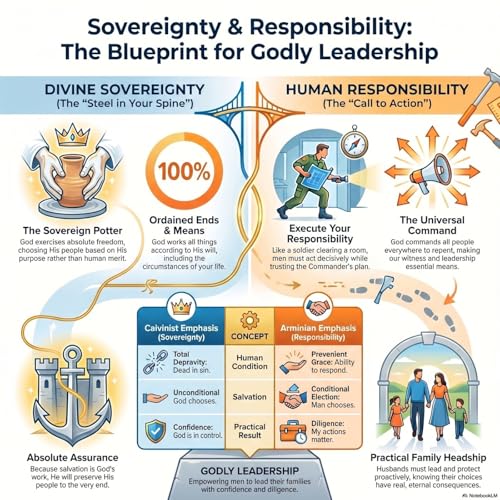
    Today we examine the theological tension between divine sovereignty and human responsibility, framing these doctrines as essential tools for men leading their families and communities. This episode provides a balanced "steel-man" overview of Calvinism, Arminianism, and Molinism, urging readers to embrace the biblical "both-and" rather than falling into extremes like hyper-Calvinism. By explaining concepts such as total depravity and middle knowledge, recognizing God’s ultimate control should actually fuel, rather than hinder, a man’s diligence as a provider and protector. Practical applications are woven throughout, and a firm grasp of these truths supports complementarian marriage and courageous leadership in a chaotic culture. Ultimately, we are called to theological humility and unity, and the Gospel remains the central foundation for every believer. SOVEREIGNTY & RESPONSIBILITY STUDY GUIDE This study guide examines the relationship between God’s absolute sovereignty and human responsibility. Designed for men seeking to lead their families and communities, it synthesizes theological frameworks—Calvinism, Arminianism, Hyper-Calvinism, and Molinism—with practical applications for leadership, marriage, and fatherhood. -------------------------------------------------------------------------------- TOP TEN TAKEAWAYS The Biblical Both-And: Scripture consistently affirms both God’s absolute sovereignty and genuine human responsibility, often within the same passages (e.g., Romans 9 and 10, John 6, Philippians 2:12–13).Calvinism and TULIP: This framework emphasizes God’s initiation in salvation through Total Depravity, Unconditional Election, Limited Atonement, Irresistible Grace, and Perseverance of the Saints.Arminianism and Choice: This view highlights human responsibility and the free offer of the gospel, often citing God’s desire for all people to be saved and the role of "prevenient grace" in enabling a response.The Danger of Hyper-Calvinism: This extreme view suggests that because God is sovereign, there is no need for a universal gospel call. It is rejected by the Reformers and modern teachers as a fatalistic error that ignores biblical commands to repent and preach to all nations.Molinism and Middle Knowledge: Named after Luis de Molina, this perspective argues that God possesses "middle knowledge" of what free creatures would do in any circumstance, allowing Him to sovereignly decree a world that fulfills His purposes without violating libertarian free will.Sovereignty as Strength: Understanding that God works all things according to the counsel of His will provides men with "steel in the spine" to face economic instability, cultural pressure, and family struggles.Responsibility as Diligence: Human responsibility serves as an antidote to passivity. Men are called to be "prophets and priests" of their homes, actively training children and pursuing their wives.Complementarianism: The biblical model of marriage reflects the relationship between Christ and the Church. A husband leads and protects as a servant-leader, trusting God’s sovereignty while taking full responsibility for his household.The Goal of Unity: Theological study should fuel worship and holiness rather than division. Believers should show grace to those who interpret secondary points differently, provided they remain united on salvation by grace alone through faith alone in Christ alone.The Means of Grace: God ordains both the ends (salvation) and the means (preaching, parenting, and prayer). Therefore, faithful human action is the very instrument God uses to accomplish His sovereign plan. -------------------------------------------------------------------------------- STUDY GUIDE I. Calvinism: The Doctrines of Grace Calvinism, rooted in the teachings of John Calvin and defended by figures like Charles Spurgeon, John Piper, and James White, focuses on the absolute freedom and power of God in the work of redemption. It is summarized by the TULIP acronym: Total Depravity: Based on Genesis 6:5 and Romans 3, this doctrine teaches that every part of man is affected by sin. Humans are "dead in trespasses" and unable to initiate saving faith on their own.Unconditional Election: God chooses individuals for salvation based solely on His good pleasure and purpose, not on any foreseen merit or choice (Ephesians 1:4–6, Romans 9:11).Limited Atonement (Particular Redemption): Christ’s death was specifically effective for His "sheep"—the elect (John 10:11, Ephesians 5:25). It is sufficient for all but efficient only for those the Father gave the Son.Irresistible Grace: When God calls His elect, He regenerates the heart so the will gladly responds. It is not a coercive act but a spiritual resurrection (John 6:37, 44).Perseverance of the Saints: Those chosen by God will endure to the end. The "golden chain" of Romans 8:29–30 ensures that those God calls will ultimately be glorified. II. Arminianism: Human ...
    続きを読む 一部表示
    30 分
  • John Calvin and His "Institutes"
    2026/04/10
    This episode presents John Calvin’s Institutes of the Christian Religion as a tactical manual for modern men seeking to fulfill their roles as godly protectors and providers. It emphasizes that true wisdom begins with the knowledge of God and self, arguing that human nature is fundamentally corrupted by sin and requires divine grace for restoration. Calvin's explanation of doctrine are not as abstract theory, but a battle-tested foundation for leading families, defending the faith, and resisting cultural shifts toward secularism. By exploring themes of sovereignty, providence, and self-denial, the Calvin encourages men to adopt a disciplined, "warrior-like" spiritual posture. He ultimately advocates for a Scripture-saturated life where the husband’s sacrificial leadership reflects Christ’s relationship with the church. Through this lens, Calvin's Institutes become a practical tool for to strengthening marriages, households, and societies for the glory of God. While we may not all agree with every single understanding or conclusion that Calvin draws in the Institutes, that doesn’t prevent us from greatly appreciating the strength of his arguments, the white-hot zeal he had for the glory of God, and the tremendous positive impact his work and legacy have had on the kingdom of God across the centuries. His clear, Scripture-saturated teaching has equipped generations of men to stand firm as protectors and providers, strengthening marriages, families, churches, and societies for the glory of Christ. So whether you’re fully Reformed or still wrestling through some of these doctrines, there is rich gold here for every man seeking to defend his faith and lead his family with courage and conviction. John Calvin and His "Institutes" Study Guide TOP TEN TAKEAWAYS The Inseparable Knowledge of God and Self: True wisdom consists of two parts: the knowledge of God and the knowledge of ourselves. One cannot be truly understood without the other; we only recognize our own profound sinfulness when we contemplate the perfection of God.Scripture as "Spectacles": While God is revealed in creation (natural revelation), human sin blinds the heart. Scripture acts as necessary spectacles, gathering confused knowledge and focusing the "eyes of the heart" to see the true God clearly.Total Depravity and the Enslaved Will: Since the Fall, human nature is hereditarily corrupt in every faculty (intellect, will, and affections). The human will is not merely weakened but enslaved to sin, requiring regenerating grace to choose good.The Absolute Sovereignty of Providence: Nothing happens without God’s counsel. He governs all parts of the world, overruling even the evil intentions of men to accomplish His holy purposes without becoming the author of sin.The Necessity of the Mediator: To bridge the gap between a Holy God and fallen humanity, the eternal Son had to become man. Christ’s dual nature—fully divine and fully human—allows Him to serve as the perfect Mediator.Justification by Faith Alone: A man’s standing before God is not earned through performance or works. Righteousness is a gift of grace, credited to the believer through faith alone based on Christ’s perfect obedience.Self-Denial as the Sum of Christian Living: The core of the Christian life is the dethronement of the ego and the flesh. True self-denial involves daily taking up the cross to follow Christ, prioritizing His glory over personal comfort or ambition.The Trinity as One Essence in Three Persons: God exists as one simple, undivided divine essence in three distinct eternal Persons: Father, Son, and Holy Spirit.Election as a Ground for Boldness: Predestination is a biblical doctrine that displays both God’s mercy and justice. It is intended to produce humble boldness and trust in God’s sovereign plan rather than fatalism.Tactical Application of Doctrine: Theology is not merely for academic study but is "battle-tested doctrine." It is designed to equip men to lead households, guard churches, and engage in the public square with courage and conviction. -------------------------------------------------------------------------------- I. The Knowledge of God and the Image-Bearer The foundation of all true wisdom is the dual knowledge of the Creator and the creature. According to the text, these are connected by many ties, making it difficult to determine which precedes the other. The Mirrored Knowledge: We do not truly know ourselves until we have contemplated the face of God. This mutual knowledge humbles a man, leading him to realize he is not an autonomous hero but a redeemed sinner leading a family under a sovereign King.Knowledge as Worship: Knowing God is not a matter of bare speculation. Its purpose is to draw men to reverence, love, worship, and a total dependence on His providence.The Implantation of Knowledge: Every mind has a sense of the divine implanted in it. However, because of sin, men corrupt this knowledge, ...
    続きを読む 一部表示
    30 分