『Defending Faith and Family』のカバーアート

Defending Faith and Family

Defending Faith and Family

著者: Defending Faith and Family
無料で聴く

Welcome to The Defending Faith and Family Podcast, where we equip and enable the current and future generations of Protectors and Providers to stand as bold, mighty men of God in every aspect of life—rooted in Scripture and lived out in faithful homes and communities.

Because when men lead well and their wives support well as co-heirs in Christ, families thrive for God's glory.

Intro and Outro music courtesy of ScriptureRiffs. Used with express permission. Find more at https://open.spotify.com/show/4AC1ZhLEP8D6RMPIjuTFa5?si=hGxWVfCjR2eyh350q8-ctg

Copyright 2026 All rights reserved.
キリスト教 スピリチュアリティ 聖職・福音主義
エピソード
  • The Islamic Dilemma
    2026/04/24
    In this episode we present a critical comparative analysis between Islam and Christianity. Jay Smith utilizes historical and manuscript evidence from the seventh century to challenge the origins of Muhammad, the Quran, and the city of Mecca. He argues that the standard Islamic narrative is a later fabrication, contrasting it with the earlier eyewitness documentation supporting the New Testament. Similarly, Nabeel Qureshi explores the theological divide between the two faiths, focusing on the Trinity versus Tawhid and the nature of salvation. Qureshi maintains that historical testimony and the concept of God’s personhood favor the deity of Jesus over Islamic teachings. We also look at David Wood's Islamic Dilemma and how the very text of the Quran proves it false and the Bible true. Ultimately, the materials serve as apologetic resources intended to defend the reliability of the Bible while inviting Muslims to reconsider the historical foundations of their faith. STUDY GUIDE TOP TEN TAKEAWAYS 1. Chronological and Geographical Isolation of Sources: The "Standard Islamic Narrative" (SIN) relies on biographies and traditions (Hadith, Sira, Tafsir) written 200 to 300 years after the death of Muhammad. Furthermore, the authors of these traditions lived in regions like Baghdad, Uzbekistan, and Northern Iran—often 1,200 to 2,600 miles away from Mecca. 2. The Historical Invisibility of Mecca: There is no map, archaeological evidence, or external historical reference to Mecca as a city or a trade center until the 8th century (specifically 741 AD). Ancient maps and the records of the Greeks, Romans, Persians, and Nabataeans are entirely silent regarding the city. 3. Qibla Direction Discrepancies: Archaeological research into early mosques (prior to 706 AD) reveals that the Qibla (direction of prayer) was consistently facing Petra in Jordan, not Mecca. It was not until 727 AD that the first mosque was built facing Mecca. 4. Topographical and Agricultural Mismatch: The Quran and early traditions describe a verdant location for the "Prophet’s city" featuring streams, olive trees, and fruit. Mecca, however, is a waterless desert valley with no historical agricultural capacity, whereas Petra matches these descriptions. 5. Failure of the Trade Route Theory: The theory that Mecca was a hub for Indian Ocean trade is debunked by the fact that Mecca is located 3,000 feet down from the Western Plateau trade route and lacks water for caravans. Historically, trade remained on ships in the Red Sea, which utilized ports on the African coast rather than the Arabian side. 6. Preservation of the Quran: Contrary to the claim that the Quran is uncreated and unchanged, there are currently 30 different versions of the Quran (such as Huffs and Warsh) with 93,000 documented differences in dots and vowels. These variations lead to differences in doctrine and practice. 7. Manuscript Evidence and Standardization: The earliest complete Quranic manuscripts date from the 8th to 10th centuries and do not align perfectly with the modern standardized text. The current "standard" Quran was chosen by a single scholar in Cairo in 1924 and only became a global standard after the Saudi government adopted it in 1985. 8. Theological Incompatibility: Christianity and Islam differ fundamentally in their diagnosis of humanity's problem and the solution. Islam identifies the problem as "ignorance" and offers "Sharia" (law) as the remedy. Christianity identifies the problem as "sin/brokenness" and offers a relationship with God (the Gospel) as the remedy. 9. Tawhid vs. Trinity: While both faiths are monotheistic, they disagree on God's personhood. Islam emphasizes Tawhid (a monadic, impersonal conception of God), while Christianity teaches the Trinity (one God in three persons), emphasizing God’s desire for intimacy and His willingness to suffer for humanity. 10. Historical Foundations of Jesus: The central claims of Christianity—Jesus' deity, crucifixion, and resurrection—are grounded in eyewitness accounts written within decades of the events. In contrast, the Islamic account of Jesus and the early church requires overlooking almost the entirety of the historical record of the 1st century. -------------------------------------------------------------------------------- STUDY GUIDE I. The Historical Critique of the Standard Islamic Narrative (SIN) The Standard Islamic Narrative posits that Islam was fully formed in the Hijaz (Central Arabia) by 661 AD, based on revelations received by Muhammad in Mecca and Medina. However, historical analysis reveals a significant gap between the events and the records: * Late Documentation: The biography of Muhammad (Sira) by Ibn Ishaq was written 130 years after Muhammad’s death (765 AD), and the current version by Ibn Hisham is even later (833 AD). The Hadith (sayings) were first compiled by Al-Bukhari in 870 AD—240 years after the fact. * Comparison ...
    続きを読む 一部表示
    29 分
  • Two Centuries of Christian Persecution
    2026/04/23
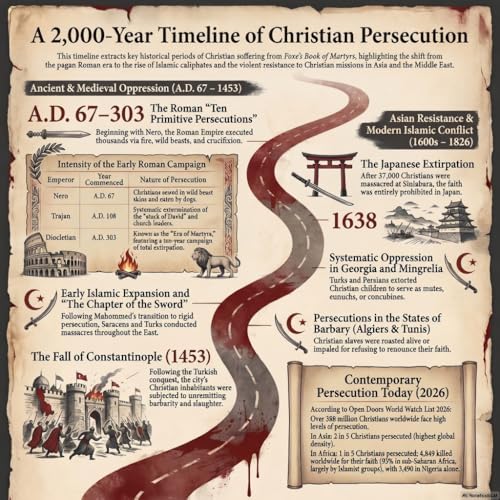
    John Foxe’s Book of Martyrs serves as a foundational historical record documenting the persecutions and deaths of Christian believers from the early church through the nineteenth century. This updated edition expands upon Foxe's original work to include primitive martyrs, victims of the Inquisition, and individuals targeted during the French Revolution. The text specifically highlights the intense suffering of Protestant reformers and missionaries while offering a stern critique of the papal hierarchy and its historical use of force. Through detailed narratives of figures like St. Stephen and various apostles, the collection portrays martyrdom as a testament to unshakable faith amidst systemic cruelty and hatred. Study Guide: Foxe’s History of Christian Martyrdom This study guide provides a comprehensive review of the historical narratives, theological arguments, and specific accounts of martyrdom detailed in the provided excerpts of "Foxe’s Book of Martyrs," as updated by Harold J. Chadwick. The text traces the history of religious persecution from the primitive church through the early 19th century. The Theoretical Framework of Persecution The text posits that the history of the Christian church is fundamentally a history of trials and sufferings. Persecution is described as arising from two primary sources: external opposition from pagan or "infidel" forces and internal schisms where members of the same faith turn against one another. The Origin of Hostility Persecution is framed as a reaction to "pure and unsophisticated morality." The source identifies the "inherent vice" in unsanctified human nature as the drive to use physical force to restrain obnoxious sentiments and propagate favorite opinions. This trend began with the martyrdom of John the Baptist and the crucifixion of Jesus Christ, which serve as the basis for all subsequent Christian martyrdom. The Papal System and Infallibility The document presents a sharp critique of the papal hierarchy, distinguishing it from other sects. While many groups have persecuted opponents during times of excitement or decline, the text argues that the Roman Catholic Church is unique in adopting the "right to destroy heretics" as a fundamental article of religious belief. This is tied to the claim of infallibility; because the church claims it cannot err, it must continue to defend and repeat its past violent actions against dissenters. Persecution by Infidelity The text contrasts religious persecution with "infidel" persecution, specifically citing the French Revolution of 1789. It argues that while Christianity is often blamed for the actions of its "nominal followers," infidelity offers no restraint on human passion. The French Revolution is used as a case study for how the rejection of the Bible and social institutions like marriage leads to anarchy, where "blood spouted up in living streams." -------------------------------------------------------------------------------- The Apostolic Age and Primitive Martyrs The history of martyrdom officially begins following the resurrection of Christ and the mission of the Holy Spirit, which emboldened the apostles to proclaim the gospel despite Jewish and Roman opposition. The First Martyrs St. Stephen: The first martyr of the primitive church, stoned to death after preaching to those who killed Christ.James the Great: Beheaded ten years after Stephen’s death by order of Herod Agrippa. His accuser was reportedly so moved by James’s courage that he converted and was beheaded alongside him.Philip: Scourged, imprisoned, and crucified in Phrygia in A.D. 54. Fates of the Apostles and Evangelists Matthew: Slain with a halberd in Ethiopia in A.D. 60.James the Less: At age 94, he was beaten, stoned, and had his brains dashed out with a fuller’s club.Andrew: Crucified on a transverse cross (St. Andrew’s Cross) in Edessa.St. Mark: Dragged to pieces by a mob in Alexandria during a solemnity for the idol Serapis.Peter: Crucified with his head downward at Rome (though the text notes his visit to Rome is historically uncertain).Paul: Beheaded in Rome under Nero after traveling through Greece, Spain, and France.Thomas: Thrust through with a spear in India.Luke: Supposedly hanged on an olive tree by idolatrous priests in Greece.John: The only apostle to escape a violent death. He survived being cast into boiling oil, was banished to Patmos, and was later recalled by Nerva. -------------------------------------------------------------------------------- The Ten Primitive Persecutions Between the reign of Nero and the rise of Constantine, the Roman Empire engaged in ten distinct waves of general persecution. Under Nero (A.D. 67): Initiated after Nero set fire to Rome and blamed Christians. Victims were sewn into wild beast skins and worried by dogs or used as human torches to light gardens.Under Domitian (A.D. 81): Involved the banishment of St. John and the death of Timothy, who was beaten with clubs...
    続きを読む 一部表示
    26 分
  • The Soil and the Sword : Samuel Whittemore
    2026/04/22
    This episode highlights the life of Samuel Whittemore, an American colonial farmer who became a legendary figure of the Revolutionary War. The author presents Whittemore’s biography through the lens of Biblical masculinity, emphasizing his lifelong dedication to physical labor, family leadership, and community protection. At eighty years old, Whittemore famously survived a brutal confrontation with British soldiers during the retreat from Lexington and Concord, an act the source frames as the ultimate expression of godly resolve. By detailing his survival and his legacy of nearly two hundred descendants, the narrative seeks to inspire modern men to embrace similar roles as steadfast providers and defenders. The source ultimately uses this historical account to advocate for a multigenerational faith rooted in Reformed Protestant values and active leadership. STUDY GUIDE This study guide examines the life and legacy of Samuel Whittemore (1694–1793), a colonial Massachusetts farmer whose actions during the American Revolution and throughout his long life serve as a primary case study for "Biblical masculinity" within a Reformed Protestant framework. The following sections synthesize his biography, military service, and the theological principles he embodied. TOP TEN TAKEAWAYS Remarkable Longevity and Resilience: Samuel Whittemore lived to the age of 98 (1694–1793), surviving catastrophic combat injuries at age 80 that included being shot in the face, bayoneted multiple times, and clubbed with musket butts.Multigenerational Legacy: Through two covenant marriages, Whittemore fathered at least ten children and had 185 direct descendants by the time of his death, illustrating the concept of a "multi-generational household."Vocation as Worship: As a farmer in Menotomy (modern-day Arlington), Whittemore viewed manual labor and land stewardship as a divine mandate based on Genesis 2:15.Extensive Military Experience: Before the Revolution, Whittemore served in King George’s War (at the Fortress of Louisbourg) and the French and Indian War, reaching the rank of captain of the dragoons at age 64.The Stand at Menotomy: On April 19, 1775, at age 80, Whittemore independently engaged a British relief brigade, killing two soldiers and mortally wounding a third before being overtaken.Biblical Provision: His life emphasized the duty of provision outlined in 1 Timothy 5:8, prioritizing the physical and spiritual needs of his household over personal ease.Complementarian Leadership: Whittemore practiced a complementarian marriage model, leading with sacrificial love while his wives (Elizabeth Spring and later Esther Prentice) supported the household as co-heirs in Christ.Reformed Protestant Worldview: His actions were shaped by the Puritan and Congregationalist heritage of colonial Massachusetts, which viewed resistance to tyranny as obedience to a higher divine authority.Tactical Versatility: In his final battle, Whittemore demonstrated "warrior-poet" traits by transitioning through primary (musket), secondary (pistols), and tertiary (sword) weapons.State Recognition: In 2005, the Massachusetts legislature officially declared Samuel Whittemore the state hero, recognizing his enduring impact on American history. -------------------------------------------------------------------------------- STUDY GUIDE I. Biographical Foundations and Early Life Samuel Whittemore, Junior was born on February 27, 1694, in Charlestown, Massachusetts. He spent much of his life as a farmer in Menotomy, a section of Cambridge now known as Arlington. His life was defined by the rhythm of agricultural labor—raising crops and livestock—which he viewed not as an optional hobby but as obedience to the "first mandate" given in Genesis 2:15: "The Lord God took the man and put him in the garden of Eden to work it and keep it." Whittemore’s lifestyle was rooted in the Reformed Protestant worldview of New England, which emphasized vocation as a divine summons. This perspective required a man to provide for his relatives and household, adhering to the standard set in 1 Timothy 5:8, which equates the failure to provide with denying the faith. II. Marriage, Family, and Household Leadership Whittemore’s domestic life was characterized by "covenant faithfulness" and a complementarian structure. First Marriage: In 1721, he married Elizabeth Spring. Together they had at least three sons and seven daughters.Second Marriage: Following Elizabeth’s death, he married Esther Prentice, the widow of Amos Muzzey.Legacy: At his death, his descendants numbered 185. Whittemore’s approach to fatherhood involved spiritual and practical formation. He taught his sons the dignity of labor and the necessity of standing for truth, while modeling for his daughters the value of godly womanhood by honoring their mother. He viewed the family as the "first line of defense for the Gospel" and the primary training ground for the next generation of warriors....
    続きを読む 一部表示
    20 分
adbl_web_anon_alc_button_suppression_t1
まだレビューはありません