『Two Centuries of Christian Persecution』のカバーアート

Two Centuries of Christian Persecution

Two Centuries of Christian Persecution

無料で聴く

ポッドキャストの詳細を見る
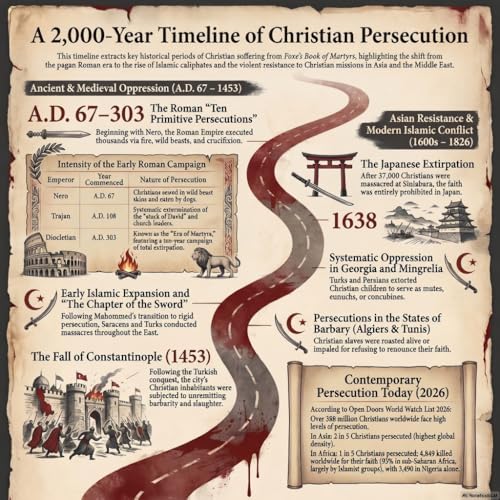
John Foxe’s Book of Martyrs serves as a foundational historical record documenting the persecutions and deaths of Christian believers from the early church through the nineteenth century. This updated edition expands upon Foxe's original work to include primitive martyrs, victims of the Inquisition, and individuals targeted during the French Revolution. The text specifically highlights the intense suffering of Protestant reformers and missionaries while offering a stern critique of the papal hierarchy and its historical use of force. Through detailed narratives of figures like St. Stephen and various apostles, the collection portrays martyrdom as a testament to unshakable faith amidst systemic cruelty and hatred. Study Guide: Foxe’s History of Christian Martyrdom This study guide provides a comprehensive review of the historical narratives, theological arguments, and specific accounts of martyrdom detailed in the provided excerpts of "Foxe’s Book of Martyrs," as updated by Harold J. Chadwick. The text traces the history of religious persecution from the primitive church through the early 19th century. The Theoretical Framework of Persecution The text posits that the history of the Christian church is fundamentally a history of trials and sufferings. Persecution is described as arising from two primary sources: external opposition from pagan or "infidel" forces and internal schisms where members of the same faith turn against one another. The Origin of Hostility Persecution is framed as a reaction to "pure and unsophisticated morality." The source identifies the "inherent vice" in unsanctified human nature as the drive to use physical force to restrain obnoxious sentiments and propagate favorite opinions. This trend began with the martyrdom of John the Baptist and the crucifixion of Jesus Christ, which serve as the basis for all subsequent Christian martyrdom. The Papal System and Infallibility The document presents a sharp critique of the papal hierarchy, distinguishing it from other sects. While many groups have persecuted opponents during times of excitement or decline, the text argues that the Roman Catholic Church is unique in adopting the "right to destroy heretics" as a fundamental article of religious belief. This is tied to the claim of infallibility; because the church claims it cannot err, it must continue to defend and repeat its past violent actions against dissenters. Persecution by Infidelity The text contrasts religious persecution with "infidel" persecution, specifically citing the French Revolution of 1789. It argues that while Christianity is often blamed for the actions of its "nominal followers," infidelity offers no restraint on human passion. The French Revolution is used as a case study for how the rejection of the Bible and social institutions like marriage leads to anarchy, where "blood spouted up in living streams." -------------------------------------------------------------------------------- The Apostolic Age and Primitive Martyrs The history of martyrdom officially begins following the resurrection of Christ and the mission of the Holy Spirit, which emboldened the apostles to proclaim the gospel despite Jewish and Roman opposition. The First Martyrs St. Stephen: The first martyr of the primitive church, stoned to death after preaching to those who killed Christ.James the Great: Beheaded ten years after Stephen’s death by order of Herod Agrippa. His accuser was reportedly so moved by James’s courage that he converted and was beheaded alongside him.Philip: Scourged, imprisoned, and crucified in Phrygia in A.D. 54. Fates of the Apostles and Evangelists Matthew: Slain with a halberd in Ethiopia in A.D. 60.James the Less: At age 94, he was beaten, stoned, and had his brains dashed out with a fuller’s club.Andrew: Crucified on a transverse cross (St. Andrew’s Cross) in Edessa.St. Mark: Dragged to pieces by a mob in Alexandria during a solemnity for the idol Serapis.Peter: Crucified with his head downward at Rome (though the text notes his visit to Rome is historically uncertain).Paul: Beheaded in Rome under Nero after traveling through Greece, Spain, and France.Thomas: Thrust through with a spear in India.Luke: Supposedly hanged on an olive tree by idolatrous priests in Greece.John: The only apostle to escape a violent death. He survived being cast into boiling oil, was banished to Patmos, and was later recalled by Nerva. -------------------------------------------------------------------------------- The Ten Primitive Persecutions Between the reign of Nero and the rise of Constantine, the Roman Empire engaged in ten distinct waves of general persecution. Under Nero (A.D. 67): Initiated after Nero set fire to Rome and blamed Christians. Victims were sewn into wild beast skins and worried by dogs or used as human torches to light gardens.Under Domitian (A.D. 81): Involved the banishment of St. John and the death of Timothy, who was beaten with clubs...
adbl_web_anon_alc_button_suppression_t1
まだレビューはありません