『Cold Logic』のカバーアート

Cold Logic

Cold Logic

著者: Myia Hanson and Jeremy Hanson
無料で聴く

Cold Logic Podcast is a cinematic investigative series that blends cutting-edge storytelling with AI-assisted research to probe the world’s most elusive events, suppressed narratives, and unexplained global phenomena. From vanishing civilizations and black-budget experiments to digital propaganda and psychological warfare, each episode uncovers hidden threads woven into the fabric of history, power, and control.AI is used in the procurement and analysis of information, helping us detect buried connections and forgotten records that traditional reporting often misses. But it’s the storytelling—guided by logic, shadowed by mystery—that drives this journey through the unknown.With each episode, Cold Logic invites listeners to follow the trail of evidence into a world where truth is fragmented, facts are filtered, and reality may be stranger than fiction.Follow the logic. Question everything.Copyright Myia Hanson and Jeremy Hanson ノンフィクション犯罪 世界
エピソード
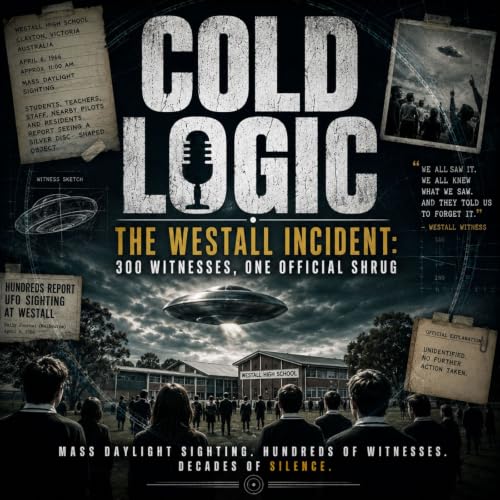
  • Cold Logic - The Westall Incident: 300 Witnesses, One Official Shrug
    2026/08/18
    Episode Summary The Westall Incident: 300 Witnesses, One Official Shrug explores one of Australia’s largest and most credible mass UFO sightings. On April 6, 1966, hundreds of eyewitnesses reported a silver object and circling aircraft, followed by a rapid official response and instructions to stay silent. Key Focus Project HIBAL, a Cold War high-altitude balloon program tied to nuclear monitoring. While it fits the evidence better than most alternatives, destroyed records prevent definitive proof. Chapters 00:00 Cold Open — Eleven O'Clock, April Sixth 02:30 Why This Episode Is Different 04:20 Clayton South, 1966 06:45 What the Witnesses Actually Described 09:10 The Aircraft 14:00 The 1966 Paper Trail 23:15 Told to Stay Silent 32:40 Project HIBAL 39:20 The Missing File 50:00 What the Witnesses Were Owed 52:20 Close — The Shape of the Hole Credits Hosted by Jeremy Hanson Produced by Fuzzy Life Studios Distributed by Fuzzy Life Entertainment About Cold Logic Cold Logic examines the space between confirmed evidence and unasked questions. Each episode follows the record, clearly separates what is proven from what is not, and respects your intelligence.
    Hosted by Simplecast, an AdsWizz company. See pcm.adswizz.com for information about our collection and use of personal data for advertising.
    続きを読む 一部表示
    47 分
  • Jeremy Hanson Attachments 1:05 PM (37 minutes ago) to me COLD LOGIC — THE LEAD MASKS CASE: BRAZIL'S DEAD ENGINEERS
    2026/08/04
    QUESTIONS THIS EPISODE ANSWERS What was the Lead Masks Case? The Lead Masks Case refers to the deaths of two Brazilian electronics technicians, Manoel Pereira da Cruz and Miguel José Viana, whose bodies were found on Morro do Vintém near Niterói, Rio de Janeiro, on August 20, 1966. They were dressed in formal suits and waterproof coats, each wearing a homemade mask cut from sheet lead that covered only the eyes. No cause of death was ever determined. What did the note found at the scene say? A page in a notebook near the bodies contained a set of instructions that translate approximately as: sixteen thirty, be at the agreed place; eighteen thirty, ingest capsules; after the effect, protect metals; await signal; mask. The original Portuguese is fragmented and can be punctuated in more than one way, which is why translations of it differ. Why were they wearing lead masks? No one knows, but the physical facts narrow the possibilities considerably. The masks covered only the eyes and left the entire body unprotected, which makes them essentially useless as genuine radiation shielding. This suggests the men either expected an intense flash or light, believed energy would enter specifically through the eyes, were copying a procedure they did not fully understand, or intended the masks symbolically. The masks establish what the men believed, not whether that belief was accurate. Were the men poisoned? It cannot be determined, and that is the central failure of the case. Contrary to the common claim that autopsies showed no signs of poisoning, there was never a clean toxicological result. The bodies were badly decomposed by the time they were recovered, the organs were retained but sat untested, the office reportedly lacked the necessary reagents, and the organs eventually deteriorated beyond usefulness and were discarded. One journalist who covered the case, Mário Dias, later concluded the men had been poisoned with cicuta, or hemlock, though this was never tested. What about the UFO sighting over Vintém Hill? On the evening of August 17, 1966, a well regarded local woman named Gracinda Barbosa Coutinho da Sousa reported seeing an oval orange object with a band of fire around its edges hovering above Vintém Hill, watching it with her three children for roughly four minutes. Her account was taken seriously. However, the wave of additional sightings from other residents arrived only after her report was published, which means those later accounts were not independent. And even accepted at face value, the sighting establishes an unidentified light near a hill, not contact and not causation. Was it a robbery? The record cannot settle it. Some accounts state the men left home with a significant amount of cash that was never recovered. Other accounts state their pockets still contained money and receipts. Both cannot be true. Beyond that, robbery does not explain the lead masks, the written instructions, or two men lying down side by side and remaining there. What is the most likely explanation? The episode argues that the explanation requiring the fewest unsupported assumptions is that the two men voluntarily participated in a procedure connected to their spiritual and technical beliefs, ingested capsules whose effects they misunderstood, and died from them. The masks reflect an expected flash or energy that the men believed in. The remaining open question is whether they designed the procedure themselves or trusted someone else to design it for them. Why does this case still matter? Because it is a study in how mysteries are manufactured by evidentiary failure rather than by extraordinary events. The episode's argument is that the supernatural reading of this case became possible only after the ordinary readings became impossible to test.
    Hosted by Simplecast, an AdsWizz company. See pcm.adswizz.com for information about our collection and use of personal data for advertising.
    続きを読む 一部表示
    47 分
  • COLD LOGIC — THE STARLIGHT TOURS: WHEN INSTITUTIONS STOP SEEING PEOPLE
    2026/07/21
    QUESTIONS THIS EPISODE ANSWERS What was a Starlight Tour? The term refers to a practice in which police officers detained a person, usually Indigenous and usually male, drove them beyond the city limits at night in winter, and abandoned them there without arrest, charge, transport home, or documentation. The name comes from the fact that the only light left overhead was starlight. Accounts of the practice in Saskatchewan have been traced back to at least the 1970s. Who was Neil Stonechild? Neil Stonechild was a seventeen year old Saulteaux First Nation teenager last seen in Saskatoon on the night of November 24, 1990, when the temperature reached roughly twenty eight below zero Celsius. His frozen body was found five days later in an industrial area on the northwest edge of the city, roughly nine kilometers from where he was last seen, wearing a light jacket and one shoe, with marks on his wrists and two parallel cuts on the bridge of his nose. The original investigation was closed in six days and his death was ruled accidental hypothermia. Who was Darrell Night and why does his case matter? Darrell Night was a thirty three year old Cree man picked up by Saskatoon police on January 28, 2000, and driven to the southwest industrial outskirts of the city near the Queen Elizabeth power station in roughly twenty two below zero Celsius weather, wearing a jean jacket and summer shoes. He survived by reaching the power station, where a worker let him in to call a cab. His case matters because he lived to describe the practice, which is what turned decades of individual accounts into a visible pattern and triggered a province wide investigation. Was anyone convicted? Yes, but only in the case of the survivor. Constables Dan Hatchen and Ken Munson were convicted of unlawful confinement in September 2001 for abandoning Darrell Night, and were sentenced to eight months in jail. The maximum penalty for unlawful confinement in Canada is ten years. Their appeal was rejected by the Saskatchewan Court of Appeal. No Saskatoon police officer has ever been convicted of causing a freezing death. What did the Stonechild Inquiry find? Justice David Wright released his report on October 26, 2004, after forty three witnesses and sixty four days of hearings. He found that constables Larry Hartwig and Brad Senger had Neil Stonechild in their custody the last night he was seen alive, that the marks on his body were likely caused by handcuffs, that the original investigation by Sergeant Keith Jarvis was superficial and totally inadequate, and that senior levels of the police service had rejected or ignored evidence for years afterward. Both constables were dismissed in November 2004 for failing to report that Stonechild had been in their custody. Neither was ever criminally charged. What happened to Rodney Naistus, Lawrence Wegner and Lloyd Dustyhorn? All three Indigenous men were found frozen to death in Saskatoon between January and February 2000. Coroner's inquests found hypothermia in each case. The Dustyhorn inquest found accidental death. The Naistus jury found no evidence of police involvement. The Wegner inquest found hypothermia from prolonged exposure with the means undetermined. No charges were laid in any of the three deaths. What is normalization of deviance and how does it apply here? Normalization of deviance describes the process by which a deviation from proper procedure produces no immediate consequence, is repeated, and gradually stops being perceived as a deviation at all. It has been identified in aviation disasters, hospital error clusters, and engineering failures. In this case, the enabling gap was documentary rather than criminal. Because officers were not required to record who they placed in their vehicles, there was no record that anyone had been in a vehicle, and the system did not need to lie in order to conceal. CHAPTERS 00:00 Cold Open — Twenty Below 02:05 What a Starlight Tour Actually Was 05:10 November 24, 1990 — Neil Stonechild 09:20 Six Days: The File That Closed 13:15 A Practice With a Nickname 15:40 January 2000 — Lloyd Dustyhorn 17:30 The Man Who Lived — Darrell Night 21:05 Naistus and Wegner 24:15 Why This Was Never National News 27:00 The Trial, the Inquests, and the Undetermined Finding 30:40 The Wright Inquiry 33:20 The Case for the Defense 35:05 The Logic Test 37:10 The Evidence Line 38:40 Normalization of Deviance 40:30 The Bigger Lesson 42:15 Close — Follow the Evidence KEYWORDS starlight tours, saskatoon freezing deaths, neil stonechild, darrell night, stonechild inquiry, saskatoon police service, rodney naistus, lawrence wegner, lloyd dustyhorn, justice david wright, larry hartwig, brad senger, dan hatchen, ken munson, jason roy, indigenous deaths in police custody, canadian police misconduct, unlawful confinement conviction, coroner inquest hypothermia, systemic racism policing canada, saskatchewan history, normalization of deviance, institutional failure, missing and ...
    続きを読む 一部表示
    49 分
adbl_web_anon_alc_button_suppression_t1
まだレビューはありません