エピソード

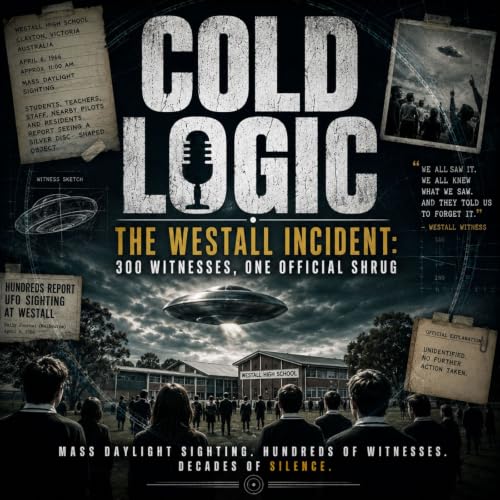
  • Cold Logic - The Westall Incident: 300 Witnesses, One Official Shrug
    2026/08/18
    Episode Summary The Westall Incident: 300 Witnesses, One Official Shrug explores one of Australia’s largest and most credible mass UFO sightings. On April 6, 1966, hundreds of eyewitnesses reported a silver object and circling aircraft, followed by a rapid official response and instructions to stay silent. Key Focus Project HIBAL, a Cold War high-altitude balloon program tied to nuclear monitoring. While it fits the evidence better than most alternatives, destroyed records prevent definitive proof. Chapters 00:00 Cold Open — Eleven O'Clock, April Sixth 02:30 Why This Episode Is Different 04:20 Clayton South, 1966 06:45 What the Witnesses Actually Described 09:10 The Aircraft 14:00 The 1966 Paper Trail 23:15 Told to Stay Silent 32:40 Project HIBAL 39:20 The Missing File 50:00 What the Witnesses Were Owed 52:20 Close — The Shape of the Hole Credits Hosted by Jeremy Hanson Produced by Fuzzy Life Studios Distributed by Fuzzy Life Entertainment About Cold Logic Cold Logic examines the space between confirmed evidence and unasked questions. Each episode follows the record, clearly separates what is proven from what is not, and respects your intelligence.
    Hosted by Simplecast, an AdsWizz company. See pcm.adswizz.com for information about our collection and use of personal data for advertising.
    続きを読む 一部表示
    47 分
  • Jeremy Hanson Attachments 1:05 PM (37 minutes ago) to me COLD LOGIC — THE LEAD MASKS CASE: BRAZIL'S DEAD ENGINEERS
    2026/08/04
    QUESTIONS THIS EPISODE ANSWERS What was the Lead Masks Case? The Lead Masks Case refers to the deaths of two Brazilian electronics technicians, Manoel Pereira da Cruz and Miguel José Viana, whose bodies were found on Morro do Vintém near Niterói, Rio de Janeiro, on August 20, 1966. They were dressed in formal suits and waterproof coats, each wearing a homemade mask cut from sheet lead that covered only the eyes. No cause of death was ever determined. What did the note found at the scene say? A page in a notebook near the bodies contained a set of instructions that translate approximately as: sixteen thirty, be at the agreed place; eighteen thirty, ingest capsules; after the effect, protect metals; await signal; mask. The original Portuguese is fragmented and can be punctuated in more than one way, which is why translations of it differ. Why were they wearing lead masks? No one knows, but the physical facts narrow the possibilities considerably. The masks covered only the eyes and left the entire body unprotected, which makes them essentially useless as genuine radiation shielding. This suggests the men either expected an intense flash or light, believed energy would enter specifically through the eyes, were copying a procedure they did not fully understand, or intended the masks symbolically. The masks establish what the men believed, not whether that belief was accurate. Were the men poisoned? It cannot be determined, and that is the central failure of the case. Contrary to the common claim that autopsies showed no signs of poisoning, there was never a clean toxicological result. The bodies were badly decomposed by the time they were recovered, the organs were retained but sat untested, the office reportedly lacked the necessary reagents, and the organs eventually deteriorated beyond usefulness and were discarded. One journalist who covered the case, Mário Dias, later concluded the men had been poisoned with cicuta, or hemlock, though this was never tested. What about the UFO sighting over Vintém Hill? On the evening of August 17, 1966, a well regarded local woman named Gracinda Barbosa Coutinho da Sousa reported seeing an oval orange object with a band of fire around its edges hovering above Vintém Hill, watching it with her three children for roughly four minutes. Her account was taken seriously. However, the wave of additional sightings from other residents arrived only after her report was published, which means those later accounts were not independent. And even accepted at face value, the sighting establishes an unidentified light near a hill, not contact and not causation. Was it a robbery? The record cannot settle it. Some accounts state the men left home with a significant amount of cash that was never recovered. Other accounts state their pockets still contained money and receipts. Both cannot be true. Beyond that, robbery does not explain the lead masks, the written instructions, or two men lying down side by side and remaining there. What is the most likely explanation? The episode argues that the explanation requiring the fewest unsupported assumptions is that the two men voluntarily participated in a procedure connected to their spiritual and technical beliefs, ingested capsules whose effects they misunderstood, and died from them. The masks reflect an expected flash or energy that the men believed in. The remaining open question is whether they designed the procedure themselves or trusted someone else to design it for them. Why does this case still matter? Because it is a study in how mysteries are manufactured by evidentiary failure rather than by extraordinary events. The episode's argument is that the supernatural reading of this case became possible only after the ordinary readings became impossible to test.
    Hosted by Simplecast, an AdsWizz company. See pcm.adswizz.com for information about our collection and use of personal data for advertising.
    続きを読む 一部表示
    47 分
  • COLD LOGIC — THE STARLIGHT TOURS: WHEN INSTITUTIONS STOP SEEING PEOPLE
    2026/07/21
    QUESTIONS THIS EPISODE ANSWERS What was a Starlight Tour? The term refers to a practice in which police officers detained a person, usually Indigenous and usually male, drove them beyond the city limits at night in winter, and abandoned them there without arrest, charge, transport home, or documentation. The name comes from the fact that the only light left overhead was starlight. Accounts of the practice in Saskatchewan have been traced back to at least the 1970s. Who was Neil Stonechild? Neil Stonechild was a seventeen year old Saulteaux First Nation teenager last seen in Saskatoon on the night of November 24, 1990, when the temperature reached roughly twenty eight below zero Celsius. His frozen body was found five days later in an industrial area on the northwest edge of the city, roughly nine kilometers from where he was last seen, wearing a light jacket and one shoe, with marks on his wrists and two parallel cuts on the bridge of his nose. The original investigation was closed in six days and his death was ruled accidental hypothermia. Who was Darrell Night and why does his case matter? Darrell Night was a thirty three year old Cree man picked up by Saskatoon police on January 28, 2000, and driven to the southwest industrial outskirts of the city near the Queen Elizabeth power station in roughly twenty two below zero Celsius weather, wearing a jean jacket and summer shoes. He survived by reaching the power station, where a worker let him in to call a cab. His case matters because he lived to describe the practice, which is what turned decades of individual accounts into a visible pattern and triggered a province wide investigation. Was anyone convicted? Yes, but only in the case of the survivor. Constables Dan Hatchen and Ken Munson were convicted of unlawful confinement in September 2001 for abandoning Darrell Night, and were sentenced to eight months in jail. The maximum penalty for unlawful confinement in Canada is ten years. Their appeal was rejected by the Saskatchewan Court of Appeal. No Saskatoon police officer has ever been convicted of causing a freezing death. What did the Stonechild Inquiry find? Justice David Wright released his report on October 26, 2004, after forty three witnesses and sixty four days of hearings. He found that constables Larry Hartwig and Brad Senger had Neil Stonechild in their custody the last night he was seen alive, that the marks on his body were likely caused by handcuffs, that the original investigation by Sergeant Keith Jarvis was superficial and totally inadequate, and that senior levels of the police service had rejected or ignored evidence for years afterward. Both constables were dismissed in November 2004 for failing to report that Stonechild had been in their custody. Neither was ever criminally charged. What happened to Rodney Naistus, Lawrence Wegner and Lloyd Dustyhorn? All three Indigenous men were found frozen to death in Saskatoon between January and February 2000. Coroner's inquests found hypothermia in each case. The Dustyhorn inquest found accidental death. The Naistus jury found no evidence of police involvement. The Wegner inquest found hypothermia from prolonged exposure with the means undetermined. No charges were laid in any of the three deaths. What is normalization of deviance and how does it apply here? Normalization of deviance describes the process by which a deviation from proper procedure produces no immediate consequence, is repeated, and gradually stops being perceived as a deviation at all. It has been identified in aviation disasters, hospital error clusters, and engineering failures. In this case, the enabling gap was documentary rather than criminal. Because officers were not required to record who they placed in their vehicles, there was no record that anyone had been in a vehicle, and the system did not need to lie in order to conceal. CHAPTERS 00:00 Cold Open — Twenty Below 02:05 What a Starlight Tour Actually Was 05:10 November 24, 1990 — Neil Stonechild 09:20 Six Days: The File That Closed 13:15 A Practice With a Nickname 15:40 January 2000 — Lloyd Dustyhorn 17:30 The Man Who Lived — Darrell Night 21:05 Naistus and Wegner 24:15 Why This Was Never National News 27:00 The Trial, the Inquests, and the Undetermined Finding 30:40 The Wright Inquiry 33:20 The Case for the Defense 35:05 The Logic Test 37:10 The Evidence Line 38:40 Normalization of Deviance 40:30 The Bigger Lesson 42:15 Close — Follow the Evidence KEYWORDS starlight tours, saskatoon freezing deaths, neil stonechild, darrell night, stonechild inquiry, saskatoon police service, rodney naistus, lawrence wegner, lloyd dustyhorn, justice david wright, larry hartwig, brad senger, dan hatchen, ken munson, jason roy, indigenous deaths in police custody, canadian police misconduct, unlawful confinement conviction, coroner inquest hypothermia, systemic racism policing canada, saskatchewan history, normalization of deviance, institutional failure, missing and ...
    続きを読む 一部表示
    49 分
  • Cold Logic The Ocean Floor Blackouts: Why Deep-Sea Cables Keep Getting Cut
    2026/05/26
    COLD LOGIC — Episode 6The Ocean Floor Blackouts: Why Deep-Sea Cables Keep Getting CutCold Logic is the investigative podcast that follows the signal — tracking the intersection of suppressed science, frontier research, and the questions that powerful institutions would rather you not ask. Each episode builds a case from documented evidence and follows it wherever it leads.not through satellites or wireless signals — but through submarine fiber-optic cables on the ocean floor. Over eight hundred thousand miles of them. Carrying SWIFT financial transactions, NATO communications, Five Eyes intelligence sharing, and every email, video stream, and cloud interaction in the world. In Episode 6 of Cold Logic, we trace the architecture of this invisible infrastructure — and the pattern of incidents that governments and telecommunications companies have been characterizing as accidents.We document the specific incidents: the West African cable cluster failures in January 2022; the Eastern European disruptions as Russian forces massed on Ukraine's border in February 2022; the severing of the Gotland cable within days of the Nord Stream pipeline sabotage in October 2022; the Baltic Sea cable damage in November 2024 and the Chinese-flagged Yi Peng 3 that anchored in international waters for weeks while NATO nations sought to board it for investigation.We examine Russia's GUGI deep-water research directorate and the Yantar oceanographic vessel documented operating directly above Atlantic cable routes. We look at the Belgorod submarine — designed to carry deep-water midget submarines capable of reaching any cable in the Atlantic or Arctic. We examine Chinese cable ownership stakes, deep-water autonomous vehicle capability, and PLA exercises focused specifically on cutting Taiwan's fourteen submarine cables.Then we ask the question neither governments nor cable companies want to answer directly: at what point does a pattern of anchor damage in geopolitically sensitive locations at geopolitically sensitive moments stop being a coincidence — and start being warfare that nobody is acknowledging?This isn't conspiracy theory. It's Cold Logic.Ninety-nine percent of global internet traffic runs through cables on the ocean floor. They keep getting cut — in clusters, near geopolitical flashpoints, in ways that official explanations don't fully account for. Cold Logic Episode 6 follows what happens when the signal disappears.submarine cable sabotageundersea cable securityinternet ocean floor cablesBaltic Sea cable damage 2024Yi Peng 3 cable incidentGUGI Russian submarine cablesTaiwan undersea cables vulnerabilityNord Stream cable sabotageNATO undersea infrastructurewhy do submarine cables keep getting cut geopoliticsRussia GUGI Yantar submarine cable surveillance operationsYi Peng 3 Baltic Sea cable damage China investigation 2024Taiwan submarine cables vulnerability PLA conflict scenarioBelgorod submarine deep water midget submarine cable operationsNord Stream Gotland cable sabotage connection October 2022NATO Coordination Cell Undersea Infrastructure Northwood 2023Chinese entities owning submarine cable systems security riskUNCLOS submarine cable protection legal inadequacyreflexive control Russian doctrine information warfare cablesWest African submarine cable failures January 2022 patternhow deep can submarines access submarine cablesprivate company ownership submarine cables Google Meta Amazonsubmarine cable repair ship fleet contestation conflictZimmermann Telegram British cut German telegraph cables WWIHow much of the internet travels through submarine cables? A: Approximately ninety-nine percent of international internet traffic travels through submarine cables on the ocean floor — not through satellites or wireless signals. There are over four hundred active submarine cables worldwide, stretching more than eight hundred thousand miles, carrying financial transactions, government communications, military data, and all everyday internet traffic between continents.Who damaged the Baltic Sea cables in 2024? A: In November 2024, two submarine cables in the Baltic Sea were damaged — one connecting Finland to Germany and another connecting Sweden to Lithuania. Maritime tracking data placed the Chinese-flagged vessel Yi Peng 3 near the cables at the time of the damage. The vessel anchored in international waters for weeks while Swedish, Finnish, German, and Danish authorities sought to conduct an investigation. China declined to cooperate. No official cause was confirmed and the ship eventually departed.What is Russia's GUGI and what does it do? A: GUGI — Russia's Main Directorate of Deep-Sea Research — operates a fleet of specialized deep-water submarines and submersibles designed for operations near underwater infrastructure, including cable tapping, cable monitoring, and potentially cable disruption. The Yantar, an oceanographic research vessel associated with GUGI, has been documented operating ...
    続きを読む 一部表示
    43 分
  • COLD LOGIC "The Shadow Insurance Market: Betting on Disasters Before They Happen"
    2026/05/19
    COLD LOGIC The Shadow Insurance Market: Betting on Disasters Before They HappenSERIES POSITIONING STATEMENTCold Logic is the investigative podcast that follows the signal — tracking the intersection of suppressed science, frontier research, and the questions that powerful institutions would rather you not ask. Each episode builds a case from documented evidence and follows it wherever it leads.Before the storm makes landfall, before the evacuation orders go out, before the cameras arrive — the financial markets are already moving. In Episode 5 of Cold Logic, we trace the architecture of the global catastrophe finance market: a multi-hundred-billion-dollar system in which institutional investors hold financial positions tied to whether specific natural disasters occur, priced by proprietary catastrophe models whose outputs flow to capital market participants before they reach the communities in the disaster's path.We trace the history from Hurricane Andrew in 1992 — which nearly collapsed the American property insurance market and catalyzed the development of catastrophe bonds — through the growth of the cat bond secondary market to over forty billion dollars in outstanding positions. We examine the catastrophe modeling firms whose products are probability: RMS, AIR Worldwide, and Karen Clark and Company, whose proprietary outputs feed financial positioning decisions that the general public cannot access.We examine the full architecture of insurance-linked securities — cat bonds, weather derivatives, collateralized reinsurance, and industry loss warranties — and the regulatory vacuum that governs them. We draw the parallel to mortgage-backed securities and credit default swaps, tracing the documented arc from legitimate risk management tool to complex, opaque, systemically significant market operating ahead of its regulatory framework. We examine the climate dimension — a warming world that expands the catastrophe finance market while the capital in that market flows away from mitigation. And we ask the question the industry has no institutional incentive to answer: at what point does proprietary disaster probability data become information that the people in the disaster's path have a right to know?This isn't conspiracy theory. It's Cold Logic.- catastrophe bonds explained- cat bond market investing- disaster finance market- weather derivatives trading- reinsurance market explained- Hurricane Andrew insurance collapse- disaster information asymmetry- climate finance catastrophe- insurance-linked securities- cold logic podcast- how catastrophe bonds work and who invests in them- what is the cat bond secondary market and how does it trade- RMS AIR Worldwide catastrophe modeling firms proprietary data- insurance-linked securities market size and structure- Hurricane Andrew 1992 insurance industry near collapse- Hurricane Katrina reinsurance market absorption losses- weather derivatives speculation vs hedging- Bermuda reinsurance market catastrophe risk capital- regulatory gap catastrophe finance SEC CFTC jurisdiction- information asymmetry natural disaster financial markets- credit default swaps mortgage backed securities comparison catastrophe bonds- climate change catastrophe bond market expansion- who profits from natural disasters financial market- Goldman Sachs Paulson subprime short position parallel catastrophe- proprietary disaster probability data public disclosure obligationWhat are catastrophe bonds and how do they work? A: Catastrophe bonds — or cat bonds — are financial instruments that transfer catastrophic risk from insurance and reinsurance companies to capital market investors. A sponsor creates a special purpose vehicle that issues bonds to investors, who receive above-market interest payments in exchange for accepting the risk of losing their principal if a defined catastrophic event — such as a hurricane of specified intensity or an earthquake above a certain magnitude — occurs. The cat bond market has grown to over forty billion dollars in outstanding positions.Who buys catastrophe bonds? A: The primary buyers of catastrophe bonds are institutional investors including hedge funds, pension funds, university endowments, and dedicated insurance-linked securities funds. These investors are attracted primarily by the uncorrelated return profile — cat bond performance is largely independent of stock and bond market movements, since natural disasters don't respond to interest rate policy or economic cycles.What is the reinsurance market and why does it exist? A: Reinsurance companies — including Swiss Re, Munich Re, Lloyd's of London, and Hannover Re — provide insurance coverage to primary insurance companies, allowing them to transfer catastrophic risk that exceeds their capital reserves. Without the reinsurance layer, a single major hurricane or earthquake could generate losses large enough to bankrupt multiple primary insurers simultaneously. Hurricane Andrew ...
    続きを読む 一部表示
    44 分
  • COLD LOGIC The Great Food Illusion: Are We Eating Real Food Anymore?
    2026/05/12
    COLD LOGICEPISODE TITLEThe Great Food Illusion: Are We Eating Real Food Anymore?SERIES POSITIONING STATEMENTCold Logic is the investigative podcast that follows the signal — tracking the intersection of suppressed science, frontier research, and the questions that powerful institutions would rather you not ask. Each episode builds a case from documented evidence and follows it wherever it leads.Sixty percent of American calories now come from ultra-processed foods. Most people have no idea what that actually means — or what it costs them. In Episode 4 of Cold Logic, we break down the architecture of the modern food system: the flavor chemistry that replaced real ingredients, the behavioral science that engineered your cravings, and the regulatory framework that was designed to protect you and was captured by the industry it was supposed to oversee.We trace the concept of the bliss point — the sugar-salt-fat combination calibrated to bypass satiety signals — from food scientist Howard Moskowitz's original work for Pepsi to its adoption as the industry standard across every product category in the grocery store. We examine vanishing caloric density, acoustic engineering for crunch, and colorant use to manipulate flavor perception. We look at the FDA's GRAS self-certification system, which allowed over ten thousand additives into the American food supply — many never independently reviewed for safety.We document the Sugar Research Foundation's deliberate funding of Harvard research to redirect dietary science away from sugar and toward fat, a deception concealed for fifty years and discovered only when internal documents surfaced in 2016. We examine the consistent findings across multiple large-scale studies linking ultra-processed food consumption to cardiovascular disease, type 2 diabetes, obesity, and all-cause mortality. And we ask the question the industry's marketing infrastructure was designed to prevent: who designed the environment in which your food choices are made, and who profits from the choices you make?This isn't conspiracy theory. It's Cold Logic.ultra processed food dangersfood additives safety concernsengineered food bliss pointnatural flavors deceptionFDA GRAS system problemssugar industry cover upfood desert health impactare we eating real foodprocessed food health effectscold logic podcastwhat is the bliss point in food science and how is it usedare natural flavors on food labels actually naturalFDA GRAS self-certification food additive safety problemsSugar Research Foundation Harvard study 1965 cover upultra processed food linked to cardiovascular disease BMJ studyvanishing caloric density chips engineered to make you eat morefood additives never independently reviewed for safety NRDCpotassium bromate banned Europe legal United Statesfood deserts ultra processed food health disparitiesNOVA classification ultra processed food Carlos Monteirohow food companies use behavioral science to engineer cravingsrevolving door FDA food industry regulatory capturehow flavor companies design food taste International Flavors Fragrancesbrominated vegetable oil FDA GRAS revoked 2023what percentage of American calories come from ultra processed foodAre natural flavors on food labels actually natural? A: Not necessarily. Under FDA regulations, a "natural flavor" is any flavoring derived from plant or animal material — but can involve extensive chemical processing, compound isolation, and reconstruction. Natural flavors are the fourth most common ingredient on American food labels and can include complex mixtures of chemically processed components from sources completely unrelated to the food being flavored. Companies are not required to disclose the specific compounds involved.What is the bliss point in food science? A: The bliss point is the combination of sugar, salt, and fat that produces the maximum desire to continue consuming a food — not the point at which it tastes best, but the point at which it most effectively bypasses the brain's satiety signals. The concept was developed by food scientist Howard Moskowitz and became a standard framework for product development across the American food industry.Is the FDA GRAS system safe? A: The GRAS — Generally Recognized As Safe — system allows food companies to self-certify the safety of additives without independent FDA review or approval before the substance enters the food supply. A 2010 Government Accountability Office investigation found the FDA could not ensure the safety of all substances being added to food. A 2013 NRDC report identified over 10,000 additives in the food supply, many never independently reviewed for safety.Did the sugar industry really cover up research linking sugar to heart disease? A: Yes. Internal documents obtained by UC San Francisco researchers and published in 2016 revealed that the Sugar Research Foundation paid Harvard scientists in 1965 to publish a review concluding that fat — not sugar — was ...
    続きを読む 一部表示
    43 分
  • COLD LOGIC — "The Memory Trade: Can Your Thoughts Be Recorded and Sold?"
    2026/05/05
    COLD LOGIC — "The Memory Trade: Can Your Thoughts Be Recorded and Sold?"Cold Logic is the investigative podcast that follows the signal — tracking the intersection of suppressed science, frontier research, and the questions that powerful institutions would rather you not ask. Each episode builds a case from documented evidence and follows it wherever it leads.For most of human history, the mind was the one space no one could reach. That is no longer true. In Episode 3 of Cold Logic, we trace the documented arc of brain-computer interface technology — from the landmark 2011 UC Berkeley study that reconstructed visual imagery from fMRI data, to the 2023 University of Texas research that decoded continuous internal language from brain activity, to the Neuralink and Synchron devices already implanted in human patients reading individual neuron firing patterns in real time.But this episode doesn't stop at the technology. It follows the data — asking who owns the neural signals collected by these devices, what the current legal framework does and doesn't protect, and what the commercial landscape looks like when the buyers include advertisers, employers, insurers, political campaigns, and government agencies — all with direct financial interest in access to your psychological interior.We cover the neuroscience of memory reconsolidation: the documented labile state every memory enters during recall, during which it can be modified by external intervention. We examine the published animal research demonstrating that false memories can be neurally implanted, that specific memories can be triggered from outside the organism, and that a device capable of reading memory patterns is technically capable of writing them. We trace the parallel to the social media data economy — from Facebook's 2004 launch to the Cambridge Analytica scandal fourteen years later — and ask what the equivalent looks like when the data being harvested is not your Facebook likes but the electrical signatures of your deepest memories.This isn't conspiracy theory. It's Cold Logic.Your thoughts have a physical signature. Researchers can already decode visual imagery and internal language from brain activity. Neural interfaces are in human patients right now. And the legal framework that might protect you from what comes next doesn't exist yet. Cold Logic Episode 3 follows the memory trade.can thoughts be recordedneural interface privacybrain data ownershipmemory recording technologyneuralink privacy concernsbrain computer interface dataneural decoding fMRIthought surveillance technologyneurorights legislationcold logic podcastcan fMRI technology read your thoughts and memorieswho owns neural data collected by brain computer interfacesneuralink synchron privacy data collection concernsmemory reconsolidation and neural interface vulnerabilityUC Berkeley fMRI brain activity visual reconstruction 2011University of Texas neural language decoding study 2023false memory implantation animal research optogeneticsconsumer EEG headsets data privacy Emotiv MuseCambridge Analytica neural data parallel comparisonBRAIN Initiative dual use neuroscience researchneurorights Chile Colorado Minnesota brain data lawcan neural interfaces modify memories reconsolidation windowbrain data commercial buyers advertisers employers governmentwhat is memory reconsolidation and why does it matterlegal framework for neural data privacy United StatesCan technology read your thoughts or memories? A: Yes, at an early but rapidly advancing level. Researchers at UC Berkeley demonstrated in 2011 that visual imagery could be reconstructed from fMRI brain activity data. In 2023, researchers at the University of Texas at Austin used a brain scanner combined with a large language model to decode continuous internal language — the gist of what a person was thinking — from neural activity alone. Neural interfaces already implanted in human patients can read individual neuron firing patterns in real time.Who owns neural data collected by brain-computer interfaces? A: Under current U.S. law, there is no federal statute specifically governing the ownership of neural data. Data generated by a device is typically owned by the manufacturer or platform operator rather than the user. Only a small number of states — including Colorado and Minnesota — have passed legislation classifying neural data as sensitive personal information. Chile is the first country to have added neurorights to its national constitution.What is memory reconsolidation? A: Memory reconsolidation is the neurological process by which a recalled memory temporarily re-enters an unstable, labile state before being re-stored in long-term memory. During this window, the memory is vulnerable to modification. New information can be incorporated, emotional associations can shift, and external stimulation can alter what gets reconsolidated. This mechanism is the basis for reconsolidation-based trauma therapy ...
    続きを読む 一部表示
    44 分
  • COLD LOGIC "The Pentagon's Insect Army: Spy Bugs That Already Exist"
    2026/04/28
    COLD LOGIC "The Pentagon's Insect Army: Spy Bugs That Already Exist"Cold Logic is the investigative podcast that follows the signal — tracking the intersection of suppressed science, frontier research, and the questions that powerful institutions would rather you not ask. Each episode builds a case from documented evidence and follows it wherever it leads.What if the most dangerous surveillance device in existence weighs twelve milligrams and has already been in your home? In Episode 2 of Cold Logic, we follow the documented evidence of the Pentagon's cyborg insect programs — the federally funded research that was published, demonstrated, and then went quiet in the way that defense technology always goes quiet when it moves from proof of concept to operational capability.We trace the DARPA HI-MEMS program — Hybrid Insect Micro-Electro-Mechanical Systems — and the University of California Berkeley experiments that produced remotely controlled beetles with implanted neural electrodes. We examine the metamorphic integration technique that embeds electronics into an insect before it fully forms, so that by the time it emerges as an adult, the hardware is part of its biology. We cover parallel programs using moths as living chemical sensors, honeybee colonies as trained explosive detectors, and DARPA's DragonflEye project which achieved wireless directional control of a dragonfly using an optical neural interface — all published, all federally funded, all gone dark.Then we ask the question the public record has been constructed to leave unanswered: what does fifteen years of classified refinement produce? And we examine the legal framework — or the absence of one — that governs a surveillance platform that is not a device, not a wiretap, and not a drone, but an organism that was already going to be there.This isn't conspiracy theory. It's Cold Logic.cyborg insects DARPAinsect surveillance technologyspy bug military researchHI-MEMS programDARPA insect dronebeetle remote controldragonfly spy droneinsect surveillance podcastcold logic podcastDARPA HI-MEMS hybrid insect micro electro mechanical systems programremotely controlled cyborg beetle University of California Berkeleyhow are insects used for military surveillanceDragonflEye DARPA dragonfly neural interface programinsects implanted with electronics during metamorphosisare governments using insects for spyinghoneybees trained to detect explosives DARPA programmoth antenna chemical sensor military researchinsect surveillance Fourth Amendment legal frameworkcyborg insect technology classified programspiezoelectric energy harvesting insect wingoptogenetics insect control defense researchCOINTELPRO MK-Ultra surveillance precedent patternwhat happens when DARPA programs go classifiedinsect based surveillance no legal frameworkDid DARPA really create cyborg insects? A: Yes. DARPA funded a program called HI-MEMS — Hybrid Insect Micro-Electro-Mechanical Systems — which produced documented results including remotely controlled beetles with implanted neural electrodes. Researchers at UC Berkeley demonstrated directional flight control of large beetles via wireless radio commands to electronics implanted during the pupal stage of metamorphosis. Results were published in peer-reviewed literature and DARPA's funding was acknowledged.What is the DARPA DragonflEye program? A: DragonflEye was a publicly acknowledged DARPA program developed in partnership with Howard Hughes Medical Institute that achieved directional control of live dragonflies using a miniaturized optical neural interface. Light pulses transmitted through a tiny backpack device activated specific neurons in the dragonfly's ventral nerve cord, producing left, right, up, down, and altitude-hold responses without surgery or permanent modification to the insect.How do scientists implant electronics into insects? A: The technique central to programs like HI-MEMS involves placing microelectronics inside an insect during its pupal stage — the developmental phase when the larval body dissolves and reforms. Because the body is actively constructing new tissue during metamorphosis, it grows around the implanted device rather than rejecting it, resulting in stable biological integration that persists into adulthood.Can bees be trained to detect explosives? A: Yes. DARPA-funded research demonstrated that honeybees can be conditioned through classical reward association to detect explosive compounds and chemical threat agent precursors. When conditioned bees encounter the target chemical, they extend their proboscis — a readable reflex that can be detected optically at the hive entrance, effectively turning a bee colony into a self-sustaining biological detection array.Is insect surveillance legal under the Fourth Amendment? A: This question has never been adjudicated in any court because no insect surveillance deployment has ever been publicly acknowledged. An insect is not a device, a wiretap,...
    続きを読む 一部表示
    45 分