『Career in Motion with Dr. Cooper』のカバーアート

Career in Motion with Dr. Cooper

Career in Motion with Dr. Cooper

著者: Dr. James Cooper
無料で聴く

A practical and developmental podcast helping students and professionals build careers through strategic action, reflection, movement, confidence, and adaptability.

James Cooper
出世 就職活動 経済学
エピソード
  • Episode 8: AI and Your Career: AI Literacy – Thinking Critically About Large Language Models | Career in Motion with Dr. Cooper
    2026/07/18

    RSS Show Notes

    Dr. Cooper explores one of the fastest-changing topics affecting every profession today:

    Artificial Intelligence

    Not from the perspective of fear.

    Not from the perspective of replacing people.

    But from the perspective of becoming a better professional.

    Every day we hear headlines suggesting AI is coming for our jobs. While artificial intelligence is certainly changing the workplace, Dr. Cooper argues that the real opportunity is not competing against AI, it is learning how to work alongside it.

    As Dr. Cooper explains:

    "AI is one of the most powerful professional tools ever created, but it is still just a tool. Your judgment remains your greatest competitive advantage."

    This episode introduces the concept of AI Literacy, the ability to think critically about large language models rather than simply accepting or rejecting what they produce.

    Listeners learn that AI does not think like people. It predicts. It models. It generates.

    And that distinction changes how professionals should use it.

    Dr. Cooper demonstrates how experienced professionals evaluate AI-generated information instead of assuming it is always correct.

    Within the M.O.V.E. Framework, this episode focuses on: E = Evaluate

    Great professionals don't simply use AI. They evaluate it.

    They ask:

    • Is this accurate?
    • What assumptions is AI making?
    • What might be missing?
    • Does this fit my situation?
    • What does my own experience tell me?

    Technology may generate information.

    Professionals generate judgment.

    The episode also explores applying AI directly to your career by examining your work through the Knowledge, Skills, Abilities, and Other Characteristics (KSAO) framework.

    At the center of the conversation is one important realization:

    The future belongs to professionals who know how to think with AI—not simply use AI.

    Key Topics Discussed

    • What Large Language Models actually do
    • Why AI should be viewed as a professional tool
    • AI Literacy and critical thinking
    • The MML Value Framework
    • Evaluating AI-generated information
    • Applying AI using the KSAO framework
    • Human judgment versus artificial intelligence
    • AI as a developmental partner
    • Ethical decision making in the age of AI
    • The future of careers and intelligent technology

    Listener Takeaways

    • AI is most valuable when used to augment human capability.
    • Large Language Models generate predictions, not understanding.
    • Critical thinking is more important than prompting.
    • Human judgment remains essential in professional decision making.
    • AI can improve productivity, learning, and creativity when used intentionally.
    • Evaluating AI output is a professional skill.
    • The future belongs to professionals who collaborate effectively with intelligent technologies.

    Career in Motion Challenge

    Choose one major responsibility in your current job.

    Using the KSAO framework, identify the Knowledge, Skills, Abilities, and Other Characteristics required to perform it successfully.

    Then ask yourself:

    • Where can AI save me time?
    • Where can AI improve my thinking?
    • Where must my judgment remain the final authority?

    Finally, reflect:

    "Am I using AI simply to get answers, or am I using AI to become a better professional?"

    続きを読む 一部表示
    31 分
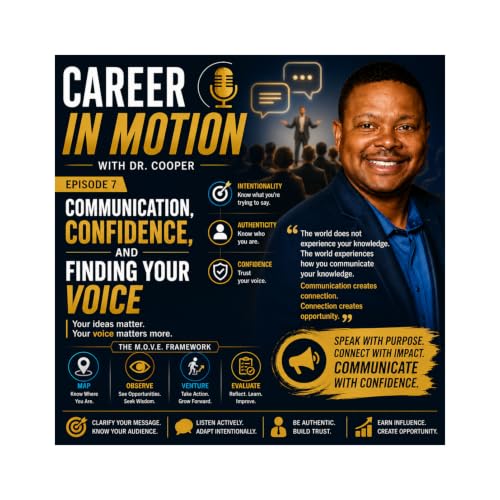
  • Episode 7: Communication, Confidence, and Finding Your Voice | Careers in Motion with Dr. Cooper
    2026/06/26

    Episode 7 – RSS Show Notes

    Dr. Cooper explores one of the most important professional skills:

    Communication

    Not simply public speaking.

    Not simply presentations.

    Not simply email.

    Communication is how your experiences, knowledge, skills, and ideas come alive in other people's minds.

    You can have tremendous expertise, experience, and credentials. But if you cannot communicate, the world may never fully understand the value you bring.

    As Dr. Cooper explains:

    Communication is not simply talking. Communication is translation.

    It is the ability to take what is in your mind and intentionally help another person understand it.

    Every interaction involves:

    • a sender
    • a message
    • an audience
    • context
    • perceptions
    • noise
    • interpretation
    • feedback

    Communication is wonderfully messy.

    Within the M.O.V.E. framework, communication falls under:

    E = Evaluate

    Great communicators are constantly evaluating.

    They ask:

    • Am I being understood?
    • Does this message fit my audience?
    • What feedback am I receiving?
    • Should I pivot?
    • Is my message landing?

    Communication, like career movement, requires adaptation.

    The episode also explores three essential ingredients of effective communication:

    • Intentionality
    • Authenticity
    • Confidence

    Listeners are reminded that communication is about connecting.

    Dr. Cooper also challenges the idea that communication is a natural talent, but a developmental skill that can be practiced and improved through:

    • message organization
    • tone
    • delivery
    • listening
    • presence
    • persuasiveness
    • feedback
    • reflection

    At the center of the episode is an important realization:

    The world does not experience your knowledge. The world experiences how you communicate your knowledge.

    Listeners become more intentional, authentic, and confident communicators in their everyday interactions.

    Key Topics Discussed

    • Why communication is a critical career skill
    • Communication as translation and connection
    • The communication process and its complexities
    • Intentionality, authenticity, and confidence
    • Communication as a developmental skill
    • The importance of feedback and adaptation
    • Presence, delivery, and persuasiveness
    • Communication and career movement

    Listener Takeaways

    • Communication is much more than speaking.
    • Great communicators continuously evaluate and adapt.
    • Confidence in communication is built, not inherited.
    • Communication improves through practice and reflection.
    • Intentionality and authenticity matter more than perfection.
    • Listening is just as important as speaking.
    • Strong communication creates connection, trust, and opportunity.

    Career in Motion Challenge

    Choose one communication interaction this week.

    After it is over, spend five minutes reflecting:

    • What was my intended message?
    • Was I understood?
    • Did I adapt to my audience?
    • What feedback did I observe?
    • What would I do differently next time?

    Repeat this process for one week.

    Then ask yourself:

    “Am I becoming more intentional, authentic, and confident in my communication?”

    続きを読む 一部表示
    18 分
  • Episode 6: When Opportunities Quietly Appear | Career in Motion with Dr. Cooper
    2026/06/13

    Episode Description / RSS Show Notes

    Welcome back to Career in Motion with Dr. Cooper — a podcast about careers, confidence, strategy, and movement.

    In Episode 6, Dr. Cooper explores one of the most overlooked yet powerful skills in career development:

    Opportunity Recognition

    Many people spend the early stages of their careers chasing opportunities: jobs, promotions, credentials, and experiences. But over time, something begins to shift.

    Opportunities do not necessarily become more abundant.

    We become better at seeing them.

    As Dr. Cooper explains:

    “Many opportunities do not arrive with a spotlight on them. Sometimes opportunities quietly appear through observation, conversations, timing, awareness, and preparation.”

    This episode explores why opportunities are often misunderstood. Opportunities do not always mean a new job, more money, or a promotion.

    They are hidden within relationships, conversations, projects, problems, responsibilities, learning experiences, and quietly reappearing patterns.

    Dr. Cooper introduces Eleven Ways Opportunities Tend to Appear:

    • Consensus Among Others
    • Necessity
    • Anxiety
    • Avoiding the Obvious
    • Fear of Letting Yourself Down
    • Pattern Recognition
    • Deliberate Planning
    • Expectations
    • Going for the Improbable
    • Passion
    • Persistence

    Through personal stories and reflections, listeners are challenged to think differently about how opportunities materialize and why some people recognize them while others walk right past them.

    At the center of the episode is an important realization:

    The rewards of recognizing and seizing opportunities often lag the moment of opportunity itself.

    Opportunity recognition is not luck; it's a skill.

    The episode closes with a practical challenge designed to help listeners identify opportunities that may already be quietly operating in their current roles and lives.

    Key Topics Discussed

    • What opportunity recognition means
    • Why opportunities often appear quietly
    • The difference between chasing opportunities and recognizing opportunities
    • Why opportunities are more than jobs and promotions
    • Eleven ways opportunities tend to materialize
    • Pattern recognition and awareness
    • Passion and persistence as opportunity catalysts
    • The role of preparation and timing
    • Creating an Opportunity Recognition Map
    • How awareness changes careers

    Listener Takeaways

    • Opportunities often emerge through observation and preparation
    • Rewards frequently lag the moment of opportunity
    • Opportunity recognition is a learnable workplace skill
    • Relationships and conversations can become significant opportunities
    • Patterns and recurring themes deserve attention
    • Courage often precedes confidence

    Career in Motion Challenge

    Create your own Opportunity Recognition Map.

    Step 1:

    Write down the eleven opportunity principles discussed in the episode.

    Step 2:

    Identify one example of each from your own career, education, or personal life.

    Step 3:

    Determine which principle may be quietly operating in your current role right now.

    Step 4:

    Take one action this week that moves you toward that opportunity.

    Then ask yourself:

    “What opportunity is quietly appearing in my life that I have not fully recognized yet?”

    続きを読む 一部表示
    20 分
adbl_web_anon_alc_button_suppression_t1
まだレビューはありません