エピソード

  • Episode 25 - Metaphysics Affects Everything
    2026/03/06

    What do such metaphysical concepts as Nominalism, Realism, and Voluntarism have to do with the trans movement, woke politics, and anxiety about one’s salvation?

    You’ll find out on this week’s episode of Canterbury Trails, as hosts C. Jay Engel and Jared Lovell welcome back to the show Dr. Thomas Price to discuss these matters and much more.

    Don’t overlook this one just because it sounds too abstract or difficult. It’s important to think through these things; and you’ll learn in this episode that you ought to have at least a rudimentary understanding of what’s going on behind the scenes. Why? Because these metaphysical concepts play into everything, including modern politics, the sacraments, the liturgy, your personal spiritual development, and your understanding of the Grace of God in the Christian life.

    Dr. Tom Price is Adjunct Professor of Christian Thought at Gordon Conwell Theological Seminary, where he teaches Theology, Christian Ethics, and Apologetics. He also teaches Theology, Religion, Ethics, and Philosophy at several other institutions. He is ordained and has served the church in a host of teaching, preaching, and equipping engagements. Dr. Price is also one of the co-hosts of The Theology Pugcast. He resides in Connecticut with his wife and two sons. Visit him online below:

    Dr. Price’s “Retrieving Babylon” talk at the 2024 Grace RE Church conference, “Shattering the Iron Crown”: https://youtu.be/gB5EbCTIR7Q?si=URAzTwzX5ZYKG67Y

    Dr. Price at Gordon Conwell Theological Seminary: https://www.gordonconwell.edu/faculty/adjunct/thomas-price/

    Theology Pugcast: https://crwiley.com/the-theology-pugcast/


    Image of Anglo-Saxon map by Hel-hama - Own work using:InkscapeSource: England and Wales at the time of the Treaty of Chippenham (AD 878). From the Atlas of European History, Earle W Dowe (d. 1946), G Bell and Sons, London, 1910 (see: File:England-878ad.jpg), CC BY-SA 3.0, https://commons.wikimedia.org/w/index.php?curid=19885072

    続きを読む 一部表示
    1 時間 9 分
  • Episode 24 - The Formularies and Christian Life
    2026/02/19

    If you want to understand some Christian denominations or churches, you will likely be pointed to a systematic theology or a confession or catechism. In short, you will be given a set of propositions to compare with other systems.

    Anglicanism has propositions, to be sure, but to really understand it, you have to understand the history, the unfolding of the actual, dramatic experience of the Church of England.

    The Anglican Formularies—The Thirty-Nine Articles of Religion; The Book of Common Prayer; The Ordinal; and The Books of Homilies—are the result of this inherited, embodied, historical, approach to theology.

    C. Jay and Jared are back for another episode of Canterbury Trails, and today it’s the uniquely historical and national approach to Christian faith and life, as laid out in the Formularies, that they’ll be discussing, as the conclusion to their three-part series on Anglicanism 101.

    Anglicanism is unique in that it is a national church tradition. The goal was to keep England together in a difficult time. The Formularies was not the result of a few theologians in an ivory tower hammering out fine points of doctrine. It was a project to publish a worship book and a statement of faith that declared, “this is how we worship, here in England, in these isles, and here is what we believe.”

    The Book of Common Prayer, for instance, has a lot of theology, but it’s not just a statement of beliefs—it’s a course of action. And this is where Anglicanism’s historical expression of the Faith meets Christians today. For in reading through the Scriptures at home each day, and by engaging in Morning and Evening prayer, we learn that it is the rhythms of life we get into, and the things we pray for, that most shape us.

    Image of Anglo-Saxon map by Hel-hama - Own work using:InkscapeSource: England and Wales at the time of the Treaty of Chippenham (AD 878). From the Atlas of European History, Earle W Dowe (d. 1946), G Bell and Sons, London, 1910 (see: File:England-878ad.jpg), CC BY-SA 3.0, https://commons.wikimedia.org/w/index.php?curid=19885072

    続きを読む 一部表示
    1 時間 7 分
  • Episode 23 - Church Authority and Christian Unity
    2026/02/16

    One issue that continues to divide Christians is the question of spiritual authority. All Christians agree that the Holy Scriptures are the Word of God. But what about other authoritative voices and claims within the Church? Which authorities have the right to bind the conscience? Is the Protestant doctrine of Sola Scriptura valid, and if so, what is the proper understanding of it? What about pastors, priests, popes?

    Anglicans are the third largest group of Christians in the world after Roman Catholics and Eastern Orthodox. But many global Anglicans do not recognize the US Episcopal Church as a true church nor the Archbishop of Canterbury as a true Archbishop. How are we to understand these differences?

    Is there authority to be found in the institutional church as it manifests in various denominations? And if church officials or bodies misuse their authority is serious ways, is it best to stay within our ecclesiastical institutions and work for reform? Or should we separate and form new micro-denominations? And what is the effect of all these disagreements on the unity of Christ’s body?

    These are among the questions tackled by Jared Lovell and C. Jay Engel in this second installment of our Canterbury Trails series, "Anglicanism 101." And when they’re done, our hosts conclude by asking: how can we best seek Christian unity? The answer will help you to think more clearly about these matters, and how you can work toward genuine unity without compromise.


    Image of Anglo-Saxon map by Hel-hama - Own work using:InkscapeSource: England and Wales at the time of the Treaty of Chippenham (AD 878). From the Atlas of European History, Earle W Dowe (d. 1946), G Bell and Sons, London, 1910 (see: File:England-878ad.jpg), CC BY-SA 3.0, https://commons.wikimedia.org/w/index.php?curid=19885072

    続きを読む 一部表示
    1 時間 12 分
  • Episode 22 - Anglicanism 101: Worship and Liturgy
    2026/02/05

    On today’s Canterbury Trails, Jared Lovell and C. Jay Engel introduce a new series for the podcast: Anglicanism 101, tackling questions that those new to Anglicanism—or those who are just curious—might ask.

    For this first installment in the series, we’ll talk about Worship and Liturgy. Why do Anglican (and other high worship) traditions seems so strange to modern Evangelicals?

    Is Sunday morning just about fellowship and an inspirational talk?

    Or is it intended to be something more?

    Perhaps the most important difference between liturgical and evangelical worship is that liturgical worship is about enacting the story of Christ together. That’s why historic Christian worship begins with a call to worship, continues on with a confession of sins, assurance of pardon, and a proclamation of God’s word, concluding on the high note of Communion where we receive Christ’s body and blood, at His table.

    C. Jay and Jared discuss such questions as, Why do I need to be reminded of forgiveness by the priest when I already know it from the Bible? What is the point of robes, and other elements of high liturgy? How often should we take Communion? Isn’t it inauthentic to kneel or do other things just because everybody else is doing it?

    Join the conversation and discover the riches—and true emotional depth—of the Anglican liturgy.

    Image of Anglo-Saxon map by Hel-hama - Own work using:InkscapeSource: England and Wales at the time of the Treaty of Chippenham (AD 878). From the Atlas of European History, Earle W Dowe (d. 1946), G Bell and Sons, London, 1910 (see: File:England-878ad.jpg), CC BY-SA 3.0, https://commons.wikimedia.org/w/index.php?curid=19885072

    続きを読む 一部表示
    1 時間 10 分
  • Episode 21 - Death, Mourning, and Christian Burial
    2026/01/30

    The Dead are Not Gone. They are simply further ahead on the journey than you are.

    In Episode 21 of Canterbury Trails, C. Jay Engel and Jared Lovell discuss Jared’s new article in The North American Anglican: “Because I Could Not Stop for Death: A Study of the Evangelical Decline of the Burial Rites in the English and American Prayer Books”.

    Scripture speaks of the Great Cloud of Witnesses; Chesterton of the Democracy of the Dead; Burke of the Contract with the Living, Dead, and Unborn. We need to be reminded that Society consists of more than just our generation: those behind us and before us are connected to us in real and important ways.

    And how we say goodbye to those who precede us in death matters profoundly.

    Some superstition had crept into the burial rites of the Church by the late Middle Ages, and the theological changes brought about by the English Reformation had a significant effect on how such services would be performed in England from that point. Purgatory undermined the assurance and joy of the Church’s hope, but the earliestsurviving church liturgies contain prayers for the dead. What are we to make of this? And what did the language of “commending the soul to God” at burial services really mean?

    A difficult but necessary conversation, our hosts tackle many important issues and questions on this vital but neglected subject. Join us and let us know what you think in the comments below.

    Jared’s article in the North American Anglican: https://northamanglican.com/because-i-could-not-stop-for-death/


    Image of Anglo-Saxon map by Hel-hama - Own work using:InkscapeSource: England and Wales at the time of the Treaty of Chippenham (AD 878). From the Atlas of European History, Earle W Dowe (d. 1946), G Bell and Sons, London, 1910 (see: File:England-878ad.jpg), CC BY-SA 3.0, https://commons.wikimedia.org/w/index.php?curid=19885072

    続きを読む 一部表示
    1 時間 25 分
  • Episode 20 - Scrooge, Virtuous Economics, and the English Christmas
    2025/12/23

    You can’t miss Christmas when you’re talking about English faith and culture! Despite the busy-ness of the past couple of months that has prevented the production of new episodes of the Canterbury Trails podcast, the boys are back in town, just in time for Christmas!

    Join us as our hosts, C. Jay Engel and Jared Lovell, talk about why “The English do Christmas Best.” This fun and engaging episode tackles everything from Scrooge and Figgy Pudding to the economics of Dickens’ A Christmas Carol, to the odd English tradition of Christmas Cracker Crowns.

    Jared and C. Jay address the libertarian critique of Dickens’ classic work (and their unintentionally hilarious defense of pre-redemption Scrooge), and how “the Jacobin character of American style Capitalism” has affected the celebration of Christmas.

    Our hosts ably defend Dickens, particularity, virtuous economics, and even the frivolities of cultural Christmas celebrations.

    And they remind us that the frivolities are the point. That’s where the memories lie. You won’t remember the specific gifts you get each year, but you will remember the frivolous things, the patterns that are replicated from year to year. Those are the things that shape the soul.

    And those are the things that Christmas can really bring to life.

    So get ready to say, “Bah! Humbug!” to the free market absolutists (like Ben Shapiro) who think that Scrooge and Potter (from It’s a Wonderful Life) are the real heroes of their stories, and find a little room in your heart for Cratchit, Tiny Tim, and the people right in front of you this Christmas season.

    And God bless us. Every one.

    続きを読む 一部表示
    1 時間 21 分
  • Episode 19 - The Oxford Movement
    2025/10/01

    Who were the Tractarians? What was the Oxford Movement? Was this a good, necessary, and salutary development for the Anglican Church? Or not?

    C. Jay is away today, but Jared is joined by Dr. Charles Erlandson, his former professor and mentor at Cranmer Theological House to discuss the Oxford Movement of the nineteenth century.

    For some new to Anglicanism (like Jared in his early days), the first impression of the Oxford Movement is that it was the source of all evils in modern Anglicanism: liberalism, pride flags, and everything else. And why? Because it was an Anglo-Catholic movement! But Jared began to read and learn, over time, that there’s more nuance than he had suspected. Was the Oxford Movement truly an Anglo-Catholic movement? Did it open the door to liberalism in the church? What can we learn from the Tractarians today?

    Join us on Canterbury Trails today as Jared and Dr. Erlandson discuss all this and much more, including the Oxford Movement as a catholic revival and reaction against the excesses of Evangelicalism; the Oxford Triumvirate of John Keble, John Henry Newman, and Edward Pusey; Keble’s poetic works and links to Romanticism; Newman’s infamous Tract 90 and eventual conversion to the Roman Catholic Church; the Oxford Movement and the Thirty-Nine Articles; et cetera.

    Our guest, the Rev. Dr. Charles Erlandson, is head of the department of church history at Cranmer Theological House and assistant rector at Good Shepherd Reformed Episcopal Church in Tyler, TX. He is the author of Orthodox Anglican Identity: The Complexity of Religious Identities in a Post-Modern World, among other books, and is working on a new book on English history. Visit him online at:

    https://gsrec.org/ (Good Shepherd Reformed Episcopal Church)

    https://www.cranmerhouse.org/ (Cranmer Theological House)

    Image of Anglo-Saxon map by Hel-hama - Own work using:InkscapeSource: England and Wales at the time of the Treaty of Chippenham (AD 878). From the Atlas of European History, Earle W Dowe (d. 1946), G Bell and Sons, London, 1910 (see: File:England-878ad.jpg), CC BY-SA 3.0, https://commons.wikimedia.org/w/index.php?curid=19885072

    続きを読む 一部表示
    1 時間 11 分
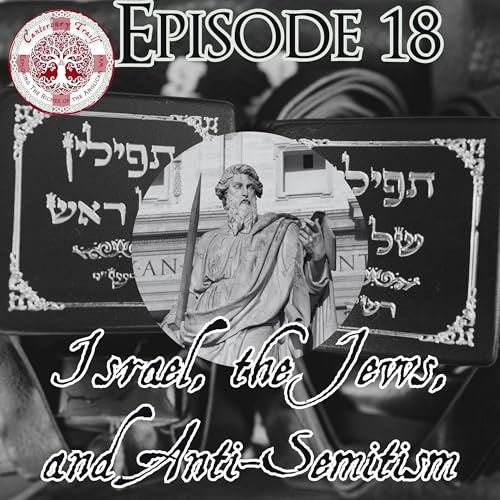
  • Episode 18 - Israel, Jews, and Antisemitism
    2025/09/10

    Few hot button issues are hotter than the question of the Jewish people and antisemitism. But that’s the very question on the table in today’s episode of Canterbury Trails.

    Our listeners know this podcast is dedicated to the cultural apologetic for Anglicanism, so why are we talking about this subject? We're responding to a recent article in The Christian Post (“New Antisemitism Rising Among Christians is Heresy”) written by a prominent Anglican professor, Dr. Gerald McDermott.

    And here’s the problem: McDermott’s article adopts a Zionist perspective—a perspective in opposition to the historic views of the Church—then equates rejection of his Zionism to antisemitism, which he then defines as a heresy.

    We’re not looking for a fight, but we are looking to shift the terms of this debate.

    To help answer this inflammatory article, our hosts, Jared Lovell and C. Jay Engel, have invited Father Ricky McCarl of Good Shepherd Anglican Church in Harrisburg as today’s guest. Father Ricky serves as vicar of the church, and as a hospice chaplain. His uncle was a Palestinian and a Christian who witnessed firsthand a lot of appalling history in that part of the world—and he shared those stories with Father Ricky as a young man.

    The article sets the narrative right up front: “antisemites” who disagree with McDermott’s Zionism are heretics in the tradition of Marcion, Arius, and Pelagius. But “antisemitism” increasingly has no meaning. To some, the Christian desire to see Jewish people come to Jesus is itself antisemitic. None of our hosts or guests are antisemitic or are promoting hatred or violence against the Jews. Nor do they believe Jews are behind every bad thing that happens in the world.

    Instead, contra McDermott, they believe we can condemn murder and hatred of Jews without entering into theological error concerning the nature of the Jewish people and covenant.

    The point of this episode is not to create controversy or sow division by picking a juicy topic to talk about, but rather, to promote peace: to suggest that maybe we should not be calling those who hold positions that have been held throughout the history of the church heretics and antisemites.

    Visit Father Ricky online at Good Shepherd Anglican Church: https://www.goodshepherdanglican.net/

    Read Professor McDermott’s article on antisemitism: https://www.christianpost.com/voices/new-antisemitism-rising-among-christians-is-heresy.html

    By Hel-hama - Own work using:InkscapeSource: England and Wales at the time of the Treaty of Chippenham (AD 878). From the Atlas of European History, Earle W Dowe (d. 1946), G Bell and Sons, London, 1910 (see: File:England-878ad.jpg), CC BY-SA 3.0, https://commons.wikimedia.org/w/index.php?curid=19885072

    続きを読む 一部表示
    1 時間 29 分