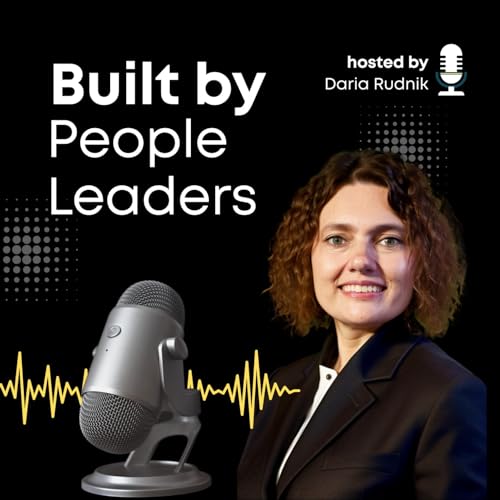
『Built by People Leaders』のカバーアート

Built by People Leaders

Built by People Leaders

著者: Daria Rudnik
無料で聴く

Built by People Leaders is a podcast for HR, People, and L&D leaders at scale-ups and fast-growing companies. Host Daria Rudnik — Team Architect, Executive Leadership Coach, and former Chief People Officer — talks with the in-house HR and People leaders building the people side of scale.

Each episode goes inside the real work: designing leadership development that keeps up with growth, earning trust at the executive table, and turning people strategy into measurable business impact. These are practical conversations for anyone leading a People function inside a company that's moving fast.

Daria brings a global perspective from her work with clients across six continents and her years at Deloitte, leading through financial crises, war, and the pandemic. She is the author of CLICKING: A Team Building Strategy for Overloaded Leaders and co-author of The AI Revolution: Thriving Within Civilization's Next Big Disruption.

If you're an HR or People leader scaling a fast-moving company, Built by People Leaders is where the people side of growth gets figured out.

Copyright 2026 All rights reserved.
マネジメント マネジメント・リーダーシップ 出世 就職活動 経済学
エピソード
  • #32 How to Build Workplace Communities with Katherine Hawkins-Jones, Chief People Officer at Somerset Bridge Group
    2026/07/13

    Katherine Hawkins-Jones is Chief People Officer at a UK-based motor insurance company and founder of the People Experience Consultancy PeopleScape. She entered HR from retail and hospitality management, completed her CIPD qualifications, and built over two decades of experience across insurance, financial services, automotive, retail, hospitality, and education — specializing in change and transformation. In this episode, Katherine explains the Bridge Builders model: a system of self-selected, trained employee advocates who launch and sustain internal communities using a shared playbook.

    The core friction Katherine unpacks is what happens as a company scales past the point where informal "water cooler" connection holds it together. In a 100–1,500 person organization, junior and newer employees lose visibility to leadership and access to projects, and community initiatives die without structure. Katherine argues that the People team is uniquely positioned to fix this, using its cross-department "aerial view" to connect people who would never otherwise meet.

    Challenges Addressed
    • Informal networks break down as headcount grows: Katherine Hawkins-Jones describes how "water cooler" collisions that once sparked connection and innovation stop scaling once a company spreads across multiple offices and remote workers. Leadership can no longer oversee every relationship directly, so connection needs deliberate structure.
    • Junior and newer employees get locked out: Katherine shares her own early-career experience of being excluded from working groups and projects, a pattern that repeats for new starters and recently transferred staff who lack access and leadership visibility.
    • Community initiatives die from lack of structure: Katherine explains that most workplace communities fail because they are launched for the wrong reasons, try to please everyone, and receive no sustained investment, agenda, or scheduled time.
    Actionable Takeaways
    1. Appoint self-selected Bridge Builders: Identify natural connectors who volunteer, then train them on your platform tools (Microsoft Teams, Slack), communication, and event planning. Never conscript people, because forced participation kills the organic energy that sustains a community.
    2. Block calendar time, like Deal Days: Katherine's "Drop Everything and Learn" (DLD) program schedules learning time directly in diaries with structured comms and shared collision points. Put the time in the calendar rather than trusting that people will find it.
    3. Run an opt-in access system like "Me Please": Create a channel where employees raise their hand for upcoming projects and initiatives. Katherine's "Me Please" group gave underrepresented staff a simple way to say yes to opportunities that were previously invisible to them.
    Questions This Episode Answers
    • How do we keep workplace communities alive as we scale past 100 employees? Katherine Hawkins-Jones says communities survive through patience, investment, diligence, and consistency, not instant results. Assign trained Bridge Builders, set agendas, send pre-meeting thinking points, and monitor conversation quality rather than chasing member counts.
    • How big should an internal community be before it stops working? Katherine argues that depth beats size: once a group grows too large, conversation quality erodes and psychological safety drops. She recommends smaller, focused communities united under one organizational identity rather than one group that serves nobody well.
    • Can remote and hybrid teams build genuine community without an office? Yes. Katherine's Women in Insurance Network runs as a hybrid group connecting Bristol offices, Newcastle offices, and home workers. She stresses that technology builds meaningful connection when used deliberately, making hybrid formats more inclusive of parents, carers, and those with health or travel constraints.

    Links & Resources Mentioned:

    • Connect with Katherine Hawkins-Jones on LinkedIn
    • PeopleScape website and free organizational health check diagnostic tool
    続きを読む 一部表示
    31 分
  • #31 How Workday Saved 600,000 Hours with AI with Greta Stahl, VP of Organizational Learning
    2026/07/06

    Greta Stahl, Vice President of Organizational Learning and Development at Workday, ran the largest L&D program in the company's 20-year history: Everyday AI, which reached over 85% monthly AI adoption (a 40%+ jump from baseline) and conservatively saved more than 600,000 hours. Greta structured that program on a three-part framework—Mindset, Skill Set, and Habits—and her central argument is that AI delivers value only when organizations redesign roles and embed tools into core workflows, not bolt them onto old processes.

    For People and L&D teams in scaling companies, the friction Greta unpacks is concrete: AI gives employees time back, but without clear role design, that time gets reinvested in more low-value busywork instead of strategy, collaboration, and relationship building. Greta details how Workday re-architected its own L&D roles to move people from content execution toward business consulting—proving the shift can be a win for both the business and the people doing the work.

    Challenges Addressed
    • AI creating busywork instead of capacity: Greta Stahl explains that employees who get time back from AI often fill it with more repeatable, low-value work unless their roles are deliberately redesigned to focus on high-value tasks.
    • Bolt-on tools that fail to deliver ROI: Greta cites research showing only 27% of organizations embed AI into core workflows; the rest run standalone tools that never produce the business value they expect.
    • Atrophying human skills: As employees spend more of the day working with AI agents, Greta warns that interpersonal skills like relationship building and candid communication can depreciate without intentional investment from HR and L&D.
    Actionable Takeaways
    1. Run role redesign with your business partners: Sit down with a business leader this week to map a single workflow—which parts AI handles, which parts the person handles, and where reclaimed time gets reinvested in high-value work.
    2. Build the Mindset, Skill Set, Habits structure: Activate mindset through events (Greta's team ran "Prompt-a-thons"), grow skills with a single learning destination, and build habits through personal goals and usage dashboards employees track themselves.
    3. Measure quality outcomes, not speed: Track quality of hire in recruiting, forecast accuracy in finance, and time reinvested into collaboration—not transaction volume—to prove whether AI is actually delivering value.
    Questions This Episode Answers
    • How do I get my organization to actually adopt AI instead of ignoring the tools? Greta Stahl's Everyday AI program at Workday hit 85%+ monthly adoption by combining mindset-activation events, a digital academy with gamification, and habit-building activations like personal goals and usage dashboards. The program treated adoption as behavior change, not a one-time rollout.
    • Why aren't we seeing ROI from the AI tools we bought? Greta points to two failures: most companies bolt AI onto old processes rather than embedding it into core workflows (only 27% succeed at integration), and they don't enable people to use the tools effectively. Both the workflow design and the human enablement have to be right.
    • What skills should I be developing as AI takes over more tasks? Greta defines the core skills as judgment (knowing when to override AI and apply responsible AI principles), creativity and complex problem solving, and interpersonal skills like relationship building and candid communication. She stresses that interpersonal skills need deliberate investment because they can fade with heavy AI use.

    Links & Resources Mentioned:

    • Connect with Greta Stahl on LinkedIn
    続きを読む 一部表示
    29 分
  • #30 Scaling HR Operations with a 2-Person Team & AI Automation with Dom Dib, Head of HR at 'Maplewave'
    2026/06/29

    Dom Dib is Head of Human Resources at 'Maplewave', a technology firm that won the Digital Nova Scotia Talent Champion Award and recognition as one of the best places to work in Atlantic Canada. Dom runs a two-person HR team supporting a globally distributed workforce across Canada, South Africa, and the Middle East, and his core operating principle is "Continuous Curiosity" — a company value that drives both product innovation and how his team adopts AI. After 20 years in HR, starting in retail sales management, Dom treats automation as a way to remove administrative load so the team can focus on strategy.

    This episode addresses the friction point People leaders hit between 100 and 1,500 employees: informal communication stops working, leadership can no longer oversee everything directly, and a small People team must scale culture and decision-making without scaling headcount. Dom Dib explains the specific systems 'Maplewave' built to solve this with two people.

    Challenges Addressed
    • Scaling a lean People team across borders: Dom Dib runs HR for a globally distributed company with only two people, requiring standardized processes and intentional connectivity instead of in-office proximity.
    • Preserving culture and psychological safety in remote/hybrid setups: 'Maplewave' lost natural in-person connection during the COVID transition and had to rebuild it deliberately across time zones.
    • Keeping human judgment in AI-assisted talent decisions: Dom Dib stresses that AI at 'Maplewave' produces recommendations only, and personal employee data is never fed into AI systems for assessment.
    Actionable Takeaways
    1. Map behavioral interview questions to each core value: For "Continuous Curiosity," Dom Dib's team asks candidates how they stay current with technology and whether they use AI in their work, so cultural fit is measured, not assumed.
    2. Automate 30/60/90-day check-ins for both sides: 'Maplewave' sends automated survey links to new hires and managers on each milestone, then uses AI to analyze sentiment on satisfaction, psychological safety, and onboarding gaps. This surfaces relationship and training gaps without manual tracking.
    3. Build AI learning paths from de-identified role data: Have leaders map skills and competencies per role, then let AI recommend training against those gaps. Dom Dib confirms 'Maplewave' uses only role-based data, never personal employee data, and advises checking privacy laws first.
    Questions This Episode Answers
    • How do you scale HR across multiple countries with a tiny team? Dom Dib relies on process standardization and rollout so every location knows the same values, tools, and processes. 'Maplewave' also assigns intentional connectivity work to keep distributed teams aligned, a practice that became critical during COVID.
    • How can you use AI in talent development without violating privacy laws? At 'Maplewave', leaders first map role competencies, and AI recommends training only against that de-identified, role-based data. Dom Dib advises checking your jurisdiction's privacy laws before deploying AI in any talent assessment or screening.
    • How do you get leaders to buy into HR initiatives? Dom Dib leads by giving the end result and ROI first, then explaining the work, rather than telling the full story upfront. He frames HR as a partner that enables leaders, defining its own success by the success of leaders and employees.

    Links & Resources Mentioned:

    • Connect with Dom Dib on LinkedIn
    • 'Maplewave' website: www.maplewave.com
    続きを読む 一部表示
    30 分
adbl_web_anon_alc_button_suppression_t1
まだレビューはありません