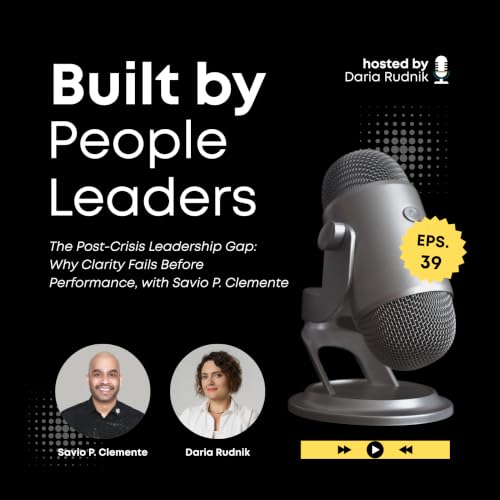
• #39 The Post-Crisis Leadership Gap with Savio P. Clemente
    2026/08/31

    Savio P. Clemente is a keynote and TEDx speaker, healthcare leadership strategist, journalist, and board-certified coach who has conducted more than 2,000 interviews with executives, clinicians, and high performers. A two-time cancer survivor and stem cell transplant recipient, Savio treated his 29-day hospital stay in 2024 as a field study in high-stakes decision-making, and built his Adaptive Resilience Framework around what he observed. His central thesis is that the first thing that fails is clarity and after that performance.

    The episode targets the Post-Crisis Leadership Gap — the period after a restructure, leadership change, or failed initiative when things look stable but decision quality, alignment, and confidence quietly erode. For People teams at scaleups of 100–1,500 employees, this is the exact moment informal oversight breaks down and no one owns the recalibration. Savio explains why this drift widens into a chasm when leaders skip the recovery phase.

    Challenges Addressed

    • Drift after the crisis ends: Savio P. Clemente names the Post-Crisis Leadership Gap as the phase where cognitive load quietly undermines decisions long after the emergency is declared over. Left unaddressed, the gap widens into a chasm that is far harder to close.
    • Leaders performing instead of leading: Savio observes that executives, like the celebrities he covered at the Oscars red carpet, keep "acting" a role and mask real needs — which corrodes trust across scaling People and talent orgs.
    • Poor decision quality under pressure: Savio cites an estimated $935 billion in US healthcare waste, attributing much of it to poor decision-making after high-stakes disruption rather than to equipment or admin costs.
    Actionable Takeaways

    1. Run the ALOHA Reboot in 7 minutes: Savio P. Clemente's practice — Acknowledge, Listen, Open, Harness, Act — helps a leader regain clarity fast. Do one letter per minute a day over five days if seven minutes feels impossible.
    2. Survey how the team feels, not just where they align: Before a big initiative, ask people to name a past moment with a similar feeling (not situation) and how they resourced it. This opens a concrete pathway to action.
    3. Name the crisis to create psychological distance: Explicitly labelling what is happening lets a team categorise the disruption and step back from it. Frame the conversation through psychological safety — trust and vulnerability — not clinical terms like metacognition.
    Questions This Episode Answers

    • What is the post-crisis leadership gap and why does it matter? Savio P. Clemente defines it as the period after disruption when performance is still expected but decision-making, confidence, and alignment quietly drift. It matters because organisations win or lose in the recovery phase, not during the emergency itself.
    • How do I rebuild team decision-making after a restructure or major change? Savio recommends first identifying where the decision drift began, then using the ALOHA Reboot and framing discussions around psychological safety. Ask people to recall a past feeling they navigated successfully to unblock action.
    • Who is accountable when a company delegates decisions to AI? Savio argues AI carries no consequence for a bad output, while human leaders do — so AI adoption must stay responsible.

    Links & Resources Mentioned:

    • Connect with Savio P. Clemente on LinkedIn
    • TEDx Talk: "Seven Minutes to Wellness, How to Love Your Inner Stranger"
    続きを読む 一部表示
    29 分
  • #38 Automating the Human Out of HR — On Purpose, with David González, Head of People Performance & Growth at Snowflake
    2026/08/28

    David González is Head of People Performance & Growth who joined Snowflake to build its performance architecture after the company came out of hypergrowth. David holds a PhD in Performance Improvement and started his career in advertising, working on Coca-Cola, Bud Light, and Procter brands before shifting into People work through his "Brand ME" project and the Center for Creative Leadership. His central argument in this episode: use AI to automate the administrative core of HR and redeploy People professionals as "performance architects" — executive coaches and strategic truth-tellers who handle judgment, politics, and behavioral change.

    For People leaders at 100–1,500 person scaleups, González targets the exact friction of this stage: data scattered across the company, multiple inconsistent performance scales, and siloed, subjective decisions. He describes arriving at Snowflake to find "an untended garden" and walks through the Performance Excellence Architecture he built to replace it.

    Challenges Addressed

    • Fragmented performance data: At Snowflake, David González found data scattered across the company with multiple performance scales and inconsistent processes, forcing a move from decentralized, subjective decisions to enterprise-wide, data-driven insights.
    • Administrative burden on people leaders: David explains how a quarterly performance cadence created too much administrative load, and how removing it accidentally opened a coverage gap in manager-employee touchpoints.
    • Scaling without killing startup culture: David addresses leadership fear that adding process slows a high-growth company, arguing for methodical, minimal infrastructure introduced in tight partnership with the executive team.
    Actionable Takeaways

    1. Start from the vision, not the tool: Build top-down — define your ethos, then design principles, then measurement tools. David structured it at Snowflake around four North Stars: clarity, accountability, advancement, and rewards.
    2. Let employees tell you where to start: David used annual engagement and pulse survey data to identify that employees wanted clearer performance measurement and career guidance, which then became a company OKR.
    3. Measure both the "what" and the "how": David introduced a unified five-point look-back scale that embeds two "how" questions into a weighted rating, reducing bias and evaluating every employee consistently across functions.
    Questions This Episode Answers

    • How do I make data-driven People decisions when my company is too small to have much data? David González advises running a focused engagement survey with questions relevant to your company, then using AI interview tools that now deliver fast, low-cost qualitative data — even a 50-person startup can interview its leadership team and managers to build a usable data set.
    • How do I add HR structure without slowing down our startup culture? David recommends being surgical and methodical, introducing only infrastructure whose value you can prove with data, and partnering closely with the executive team while iterating over time rather than overlaying heavy process at once.
    • What will HR professionals do once AI handles the admin? According to David González, People professionals become performance architects — extreme executive coaches skilled in conflict resolution, systemic influence, and systems thinking who provide the human judgment, context, and body-language reading that AI cannot replicate.

    Links & Resources Mentioned:

    • Connect with David González on LinkedIn
    続きを読む 一部表示
    27 分
  • #37 Why Conflict Isn't a Problem to Fix: Dr. Irvine Nugent on Building Conflict Capacity as Your People Team Scales
    2026/08/17

    Dr. Irvine Nugent is co-founder of ConflictEQ and a former nonprofit CEO with a Ph.D. in Management who helps leaders navigate pressure and difficult conversations without losing clarity or connection. In this episode, Dr. Nugent argues that conflict is not a signal something has gone wrong—it is the natural friction of differing opinions and perspectives, and it is the fuel scaling companies need for creativity and problem-solving. He describes his own turning point as a "recovering conflict coward": a key employee quit because the team was not having the conversations it needed to have.

    For People leaders at companies in the 100–1,500 employee range, Dr. Nugent addresses a familiar breakdown. As headcount grows, informal communication stops working, HR teams get pulled in as the constant referee, and leadership meetings turn either performatively calm or aggressively winner-take-all. Both patterns stall the decisions high-growth companies cannot afford to delay.

    Challenges Addressed
    • HR as the permanent referee: Dr. Nugent describes how People teams at scaleups burn out because managers escalate every interpersonal tension instead of handling it themselves, expecting HR to resolve conflict "out of a puff of air."
    • Calm meetings hiding cynicism: Dr. Nugent explains that high engagement scores and agreeable leadership meetings often mask resignation—people stopped raising ideas because past attempts went nowhere, which stalls critical initiatives like AI adoption and org redesign.
    • Two instinctive threat responses: Dr. Nugent frames conflict avoidance (freeze) and conflict aggression (fight) as untrained instincts that both create destructive patterns as the old "we're a family" culture stops scaling.
    Actionable Takeaways
    1. Shift People Ops from referee to capacity-builder: Dr. Nugent advises People leaders to invest in conflict-capacity training so managers can hold hard conversations themselves, rather than escalating every tension to HR.
    2. Open with pressure, not correction: When addressing a colleague's unhealthy behavior, start with "What are you overwhelmed with right now?" instead of "Your behavior is a problem." Surfacing the underlying stress opens a real conversation.
    3. Map your triggers before you regulate: Dr. Nugent recommends writing down your specific emotional triggers and the patterns that follow—for example, asking "Am I 10-angry or 4-angry?"—because self-awareness alone introduces choice and breaks automatic responses.
    Questions This Episode Answers
    • How do I stop being the HR referee for every team conflict? Dr. Nugent recommends building conflict capacity across your leadership team through realistic, tension-filled training rather than staying the person who resolves every dispute. When managers develop their own skills, People teams stop being pulled in as the default fixer.
    • My engagement scores are high but no one raises hard truths—is that a red flag? Yes. Dr. Nugent warns that surface calm often hides resignation and cynicism. If no one debates ideas in a leadership meeting at a company facing market pressure, conflict avoidance has calcified, and important decisions are stalling beneath the quiet.
    • How do I give tough feedback to my CEO? Dr. Nugent advises learning how the executive prefers to consume information, pre-framing your feedback with genuine concern for the organization, and accepting short-term discomfort. The truth may not land immediately, but it holds weight over time when events prove it out.

    Links & Resources Mentioned:

    • Connect with Dr. Irvine Nugent on LinkedIn, where he shares educational conflict-management resources
    • ConflictEQ website with a free conflict-response assessment: https://www.conflicteq.com/
    続きを読む 一部表示
    28 分
  • #36 When to Lead vs. When to Manage (and Why Most Founders Get It Wrong) with Michael K. Cobb, ECI Development
    2026/08/11

    Michael K. Cobb, Founder and CEO of ECI Development, has run three fully remote businesses across Central America for 30 years: a mortgage bank in Belize, an international real estate development company, and a teak timber operation in Panama that started with 100 acres planted in 1999 and now runs its own sawmill. His single biggest argument for scaling People teams: leadership and management are different jobs, and most growing organizations must deliberately build management infrastructure even when founders resist it.

    For scaleups in the 100–1,500 employee tier, informal information sharing—the water cooler, the coffee pot—breaks down as headcount grows and leadership can no longer oversee everything directly. Michael Cobb built remote protocols to replace those channels long before COVID, starting with fax machines in the mid-1990s. He explains how People leaders rebuild connection and trust when co-location is no longer the glue.

    Challenges Addressed
    • Losing informal communication in remote scaleups: Michael Cobb explains that remote and high-growth companies lose the informal "water cooler" network that co-located offices rely on, and must replace it with deliberate structure.
    • Founders resisting management structure: Michael Cobb assumed autonomy always drives satisfaction, but morale rose when he hired a Chief Operating Officer in the early-to-mid 2000s to add management structure.
    • HR seen only as a problem-surfacer: Michael Cobb describes how People teams struggle to earn executive trust when they only bring problems to leadership rather than offering to help.
    Actionable Takeaways
    1. Make remote connection an institution, not an accident: Require cameras on for every Zoom meeting and fund regular in-person gatherings so senior teams get the informal exchange that formal agendas miss.
    2. Calibrate management structure to each person: Some employees want autonomy and others want direction; hire managers who can read where each person sits on that spectrum and give them the right amount of structure.
    3. Open HR conversations with "How can I be more helpful to you?": Michael Cobb says this question earns immediate attention from leadership because most people arrive with problems, not offers of support.
    Questions This Episode Answers
    • How do you replace water cooler conversations in a remote company? Michael Cobb rebuilds informal networks through deliberate protocols: mandatory camera-on Zoom meetings, company-funded in-person gatherings, and both formal HR and informal "mother hen" support roles. He argues connection must be intentional because it no longer happens automatically.
    • What is the difference between leadership and management? Michael Cobb defines leadership as inspiring people and forecasting future needs, and management as providing the structure that helps employees do their jobs. He says most growing organizations need dedicated management infrastructure, and that founders often confuse the two roles.
    • How can HR build trust with business leadership? Michael Cobb recommends that HR leaders proactively engage executives and ask how they can help, rather than only surfacing problems. He notes that HR combines hard functions (payroll, recruiting, vacation tracking) with the softer, high-trust work of supporting employees through interpersonal and emotional challenges.

    Links & Resources Mentioned:

    • Connect with Michael K. Cobb on LinkedIn
    • Michael K. Cobb's website: michaelkcobb.com
    • Book: How to Buy Your Home Overseas and Get It Right the First Time (available on Amazon)
    続きを読む 一部表示
    30 分
  • #35 The 91st Day: How Nate Hill Stops Post-Onboarding Attrition and Rebuilds Trust in Scaling Organizations
    2026/08/03

    Nathaniel Sietz is an HR professional who built an entire People function from scratch as the only HR Manager at a logistics company that had no HR infrastructure. In this episode of Built by People Leaders, Nate introduces The 91st Day framework—a practical way to keep onboarding and culture-building going beyond the standard 90-day probation period. Ironically, that’s exactly when most companies stop investing in new hires, even though it’s also when many people decide to leave. He published the framework under the name Nate Hill.

    Nate talks about the challenges People teams face as companies grow: onboarding that ends after the first week, managers who push back on structure because “things change too fast,” and acquisitions that create rumors and uncertainty, leading to preventable turnover. For companies that have outgrown informal communication and where leaders can’t keep track of everything themselves anymore, Nate explains how to replace ad hoc ways of working with simple, consistent people practices that scale.

    Challenges Addressed
    • Onboarding that stops at day 90: Nate Hill explains how companies spend roughly $20,000 to hire one person, then withdraw cultural attention after probation—forcing repeat spend when new hires leave inside the three-month window.
    • Trust erosion during acquisitions and rapid growth: Nate Hill describes employees updating resumes and crying in his office over layoff rumors, and how leadership distraction with new departments left the core team feeling left behind.
    • Managers without an onboarding framework: Nate Hill addresses the gap where managers own onboarding but lack a structured plan, defaulting to one-week classroom orientations instead of month-long integration.
    Actionable Takeaways
    1. Co-design a month-long onboarding plan with each manager: Sit down with the hiring manager to build a role-specific 30-day timeline instead of using a generic company template. Secure manager buy-in so the plan is followed, not filed away.
    2. Run 30-, 60-, and 90-day self-evaluations for employees and managers: Use these surveys to catch onboarding failures before the three-month attrition window. A downward trend signals it is time to rebuild that manager's onboarding plan.
    3. Translate HR issues into leadership's own language: Reframe turnover, meeting time, and disengagement as financial cost for money-focused executives. Bring survey data and cost breakdowns as proof rather than subjective opinion.
    Questions This Episode Answers
    • Why do new hires quit right after the probation period? Nate Hill explains that culture and manager attention often stop at day 90, so employees who impressed early feel forgotten once they are "safe." Most resignations happen around the three-month mark, which is why Nate Hill pushes companies to sustain support into the 91st day.
    • How do you keep employees calm during an acquisition or rapid growth? Nate Hill recommends direct, top-down reassurance: he organized an all-hands meeting where the CEO personally told staff their jobs were safe, because rumors spread faster than management can contain them. Hearing it from the owner rebuilt trust that middle-layer messaging could not.
    • How does HR earn trust with a skeptical executive team? Nate Hill positions HR as a partner, not a subordinate, and explicitly requests trust during interviews. He uses industry-specific analogies—like a surgeon showing up drunk to the OR as a "never do moment"—to make policy decisions land with leaders who don't think in HR terms.

    Links & Resources Mentioned:

    • Connect with Nate Hill on LinkedIn: https://www.linkedin.com/in/nathanielsietz/
    • The 91st Day by Nate Hill — available on Kindle (Amazon) and hardcover (Barnes & Noble): www.the91stday.com
    続きを読む 一部表示
    29 分
  • #34 Why Training Fails and How to Build L&D That Changes Behavior with Maria Kolesnikoff, Former Head of Talent Management
    2026/07/27

    Maria Kolesnikoff spent 20 years across every HR function—recruitment, compensation, organizational design, and change management—before becoming head of talent management at the corporate investment business unit of a large bank, and now works as an ICF PCC coach. In this episode of Built by People Leaders with Daria Rudnik, Maria Kolesnikoff argues that effective learning and development must be built as infrastructure across performance management, compensation, succession planning, and recruitment—not delivered as one-touch training events that end when people leave the room.

    The friction Maria Kolesnikoff unpacks matters most for People teams in the 100–1,500 employee range, where informal oversight breaks down and standalone programs stop working. Content-only training covers learning but skips practice and feedback, so behavior never changes. Maria Kolesnikoff shows how systemic incentives—not entertainment—push people out of their comfort zone and make new behaviors stick.

    Challenges Addressed

    • Training that delivers content but no behavior change: Maria Kolesnikoff explains that content-focused programs only cover learning, leaving out the practice and feedback that the full development cycle requires.
    • Low buy-in and disengagement in talent programs: After running a talent program for one year at her banking organization, Maria Kolesnikoff found weak engagement because stakeholders were never involved in the design.
    • The HR–business language gap: Maria Kolesnikoff notes that most HR and L&D professionals speak in behaviors and psychology, while leaders respond to numbers and business outcomes.

    Actionable Takeaways

    1. Embed development into promotion and compensation criteria: Maria Kolesnikoff redesigned her banking program so candidates needed set study hours, assessment scores, strong talent reviews, an identified successor, and evidence of sharing expertise—all tied to bonus and promotion eligibility.
    2. Use design thinking to co-create programs: Interview representatives from every stakeholder group—business units, HR functions, leaders, and participants. People advocate for programs built from their own ideas.
    3. Engage stakeholders horizontally and vertically at the design stage: Involve peer HR functions and business units alongside leaders and leaders-of-leaders before launch, so the whole system supports the change.

    Questions This Episode Answers

    • Why does our leadership training never change behavior? Maria Kolesnikoff explains that content-based training covers only learning and skips practice and feedback. Behavior change requires systemic infrastructure—performance management, compensation, and incentives—that pushes people beyond their comfort zone and rewards new habits until they become the default.
    • How do I get buy-in from stakeholders on a new L&D program? Maria Kolesnikoff recommends design thinking: interview business leaders, HR peers, and participants during the design phase and build the program from their input. People support programs built on their own ideas, which raises engagement and adoption.
    • Does gamification or edutainment make training more effective? Maria Kolesnikoff argues that edutainment masks the real problem of low motivation. Instead of entertaining participants, clarify the personal and career benefits of the program and build systems that make participation advantageous.

    Links & Resources Mentioned:

    • Connect with Maria Kolesnikoff on LinkedIn https://www.linkedin.com/in/maria-kolesnikoff/
    • Maria Kolesnikoff's website: https://www.yourwayup.coach/
    続きを読む 一部表示
    24 分
  • #33 Building HR Credibility with Boards & Executives with Rachel Sutherland at Respondology
    2026/07/21

    Rachel Sutherland is SVP of People & Operations at Respondology, a 50-person venture-backed SaaS company, and she builds HR functions from the ground up at high-growth startups. In this episode of Built by People Leaders, Rachel Sutherland argues that the hardest part of scaling is forcing the founding executive team to stop making every decision and instead build a trusted middle layer that can act without them—her core lens on the startup-to-scaleup transition.

    Rachel Sutherland reached people leadership through an unconventional route: an English literature degree, 10 years in publishing, entrepreneurship running brick-and-mortar businesses, then seven years building people functions in startup incubators. The friction she unpacks is specific to companies where founders can no longer sit in every room. Rachel Sutherland calls this "brain dumping" onto a new leadership layer—aligning them, then trusting them to make decisions that may not match how the executive would have done it.

    Challenges Addressed
    • Delegating decision authority: Rachel Sutherland describes the angst executives feel when they push decisions to a new leadership layer and must accept choices that are business-aligned but not exactly their own.
    • Executive hiring risk: Rachel Sutherland treats executive hires as the highest-stakes decisions in a scaleup, where a wrong hire becomes a six-month mistake that damages a small leadership team.
    • Stage-specific ceilings: Rachel Sutherland explains how early employees who excel at "zero to one" often cannot carry the company through "one to two," forcing hard layering or exit conversations.
    Actionable Takeaways
    1. Design incentives before headcount: Rachel Sutherland supports revenue by building compensation and KPI structures that motivate people to hit targets, and by keeping teams lean so capital funds growth instead of avoidable layoffs.
    2. Ask every colleague what they do: At Respondology, new hires spend 15 minutes with each person to learn the business. Rachel Sutherland uses this same curiosity to spot gaps and overlaps before making org design decisions.
    3. Be an advocate and a truth-teller: Rachel Sutherland builds board and executive trust by fighting for their compensation annually while also delivering hard feedback when leaders get in their own way—never acting as a "yes person."
    Questions This Episode Answers
    • How do I get founders to delegate decisions as we scale? Rachel Sutherland recommends aligning a trusted leadership layer with business objectives, then accepting decisions that differ from how the executive would have made them. The executive's job is to reinvent their own value rather than remain the single point of approval.
    • How does HR actually support revenue in a venture-backed company? Rachel Sutherland focuses on incentive design, executive compensation, and lean org structures so people work on high-impact tasks, not busy work. This lets revenue fund growth instead of covering an inflated headcount.
    • How do I know when an early employee has hit their ceiling? Rachel Sutherland says the ceiling is usually obvious; the hard part is deciding whether to layer someone with a new hire above them or move them on. She frames it as a stage mismatch, not a failure.

    Links & Resources Mentioned:

    • Connect with Rachel Sutherland on LinkedIn
    続きを読む 一部表示
    29 分
  • #32 How to Build Workplace Communities with Katherine Hawkins-Jones, Chief People Officer at Somerset Bridge Group
    2026/07/13

    Katherine Hawkins-Jones is Chief People Officer at a UK-based motor insurance company and founder of the People Experience Consultancy PeopleScape. She entered HR from retail and hospitality management, completed her CIPD qualifications, and built over two decades of experience across insurance, financial services, automotive, retail, hospitality, and education — specializing in change and transformation. In this episode, Katherine explains the Bridge Builders model: a system of self-selected, trained employee advocates who launch and sustain internal communities using a shared playbook.

    The core friction Katherine unpacks is what happens as a company scales past the point where informal "water cooler" connection holds it together. In a 100–1,500 person organization, junior and newer employees lose visibility to leadership and access to projects, and community initiatives die without structure. Katherine argues that the People team is uniquely positioned to fix this, using its cross-department "aerial view" to connect people who would never otherwise meet.

    Challenges Addressed
    • Informal networks break down as headcount grows: Katherine Hawkins-Jones describes how "water cooler" collisions that once sparked connection and innovation stop scaling once a company spreads across multiple offices and remote workers. Leadership can no longer oversee every relationship directly, so connection needs deliberate structure.
    • Junior and newer employees get locked out: Katherine shares her own early-career experience of being excluded from working groups and projects, a pattern that repeats for new starters and recently transferred staff who lack access and leadership visibility.
    • Community initiatives die from lack of structure: Katherine explains that most workplace communities fail because they are launched for the wrong reasons, try to please everyone, and receive no sustained investment, agenda, or scheduled time.
    Actionable Takeaways
    1. Appoint self-selected Bridge Builders: Identify natural connectors who volunteer, then train them on your platform tools (Microsoft Teams, Slack), communication, and event planning. Never conscript people, because forced participation kills the organic energy that sustains a community.
    2. Block calendar time, like Deal Days: Katherine's "Drop Everything and Learn" (DLD) program schedules learning time directly in diaries with structured comms and shared collision points. Put the time in the calendar rather than trusting that people will find it.
    3. Run an opt-in access system like "Me Please": Create a channel where employees raise their hand for upcoming projects and initiatives. Katherine's "Me Please" group gave underrepresented staff a simple way to say yes to opportunities that were previously invisible to them.
    Questions This Episode Answers
    • How do we keep workplace communities alive as we scale past 100 employees? Katherine Hawkins-Jones says communities survive through patience, investment, diligence, and consistency, not instant results. Assign trained Bridge Builders, set agendas, send pre-meeting thinking points, and monitor conversation quality rather than chasing member counts.
    • How big should an internal community be before it stops working? Katherine argues that depth beats size: once a group grows too large, conversation quality erodes and psychological safety drops. She recommends smaller, focused communities united under one organizational identity rather than one group that serves nobody well.
    • Can remote and hybrid teams build genuine community without an office? Yes. Katherine's Women in Insurance Network runs as a hybrid group connecting Bristol offices, Newcastle offices, and home workers. She stresses that technology builds meaningful connection when used deliberately, making hybrid formats more inclusive of parents, carers, and those with health or travel constraints.

    Links & Resources Mentioned:

    • Connect with Katherine Hawkins-Jones on LinkedIn
    • PeopleScape website and free organizational health check diagnostic tool
    続きを読む 一部表示
    31 分