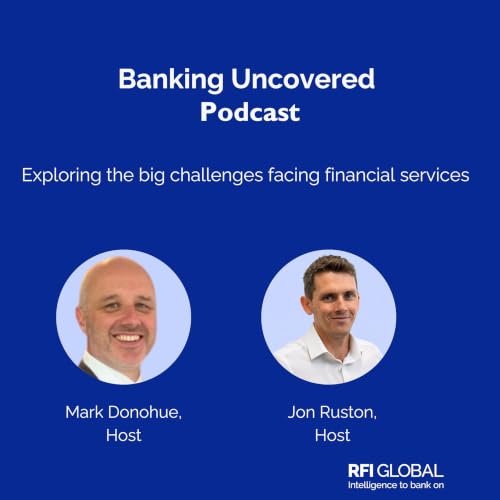
『Banking Uncovered Podcast』のカバーアート

Banking Uncovered Podcast

Banking Uncovered Podcast

著者: RFI Global
無料で聴く

Welcome to RFI Global’s Banking Uncovered - the podcast that goes behind the industry PR, the media spin, the product awards and the investor reports to look at what’s really going on in the industry. Using customer data we focus on how are customers behaving, how behaviour is changing and how institutions are reacting to new customer needs. At the same time as the rapid development and enhancement of data capability, the impact of generative AI and the emergence of stronger fintech propositions, traditional banks have invested heavily in their digital capabilities. As the industry stalwarts, challengers and fintechs continue to compete in this new digital and physical world, we bring together divergent opinions and viewpoints. Talking to CEOs, founders, global experts and leaders in banks, payments, fintechs and challengers spanning the globe, we ask the big questions facing the industry. In depth interviews and panel discussions, combined with RFIs global customer data lake will ask: · What are evolving needs of customers and what are the key trends? · What are the next innovations that will meet these? · Which players are responding to new and emerging customer needs and what propositions are working? · Are new and upcoming regulations going to impact the market and how?Copyright RFI Global. All rights reserved. 経済学
エピソード
  • Banking Uncovered Episode 27: Inside Singapore’s mass affluent: How banks can grow share of wallet
    2026/01/12

    Singapore is a regional hub for banking and wealth, and one of Asia’s most developed and dynamic markets. Its affluent segment is highly attractive and increasingly complex. Affluent customers typically maintain relationships with multiple providers, creating a fragmented landscape where competition for share of wallet is increasingly intense. While domestic leaders like DBS, UOB and OCBC dominate share of wallet, international players like HSBC, Standard Chartered and Citi gain a disproportionate share of affluent consumers’ wallets.

    At the same time, digital is a fast-growing channel. Affluent consumers are asset-rich and time-poor. They expect instant control over their finances through mobile, with high-quality, personalised advice from relationship managers when decisions are complex or cross-jurisdictional.

    In this episode of Banking Uncovered, host Charles Green sits down with Stefano Colombu, Managing Director of Asia at RFI Global, to unpack Singapore’s mass affluent market and what is driving their share of wallet allocations. Drawing on data from RFI Global’s latest share of wallet tracker, they explore where wealth is concentrated, where it is leaking and how banks can compete more effectively across deposits, investments, cross-border flows and non-bank challengers. They explore the growing role of digital channels, AI-enabled services and the evolving balance between human and digital engagement. And much more

    Topics discussed:

    • How banks can convert deposits into investments as interest rates fall with personalised advice, transparent outcomes and frictionless execution.
    • How to capture cross-border flows as Singaporeans increasingly bank offshore and inbound wealth deepens from Asian corridors and global giants.
    • Why domestic banks lead in total wallet share, but international banks outperform among mass affluent segments.
    • How relationship managers and a digital-first experience should interlock – quick, proactive digital moments for everyday tasks, with expert guidance for sophisticated needs.
    • The rise of digital-only providers like MariBank and Trust Bank, and what their growing momentum means for incumbents.

    Key insights:

    • Around 70% of affluent assets in Singapore sit in deposits today, representing a significant opportunity for banks to migrate wealth into investment products as rates ease.
    • About 39% of investment value is held with non-banks, with some domestic players showing notable leakage, underlining the need for integrated investment platforms and innovative features to reclaim AUM.
    • Cross-border wealth is a defining feature of the segment, with around 45% of mass affluent assets held offshore. Singapore benefits from strong inbound flows from Asian markets, while outbound corridors to Malaysia, the US and China remain highly significant.
    • Digital bank usage as a main banking relationship is behind other markets in Singapore (15-16%) in terms of main bank usage, compared to the UK (25%) and the US (30%).
    続きを読む 一部表示
    23 分
  • Banking Uncovered Episode 28: Redefining relationship banking in a digital-first world
    2026/06/02

    As digital adoption accelerates across commercial and business banking, the role of the relationship manager is not diminishing - it is becoming more critical.

    In this episode of Banking Uncovered, Jon Ruston speaks with Claire May, Head of Commercial Clients at Santander UK, to explore how banks are redefining relationship management in a digital-first world. The discussion follows Santander’s recognition at RFI Global’s UK Banking & Finance Awards 2026, where it won awards for Best Relationship Managers (Business Banking) and Best Business Loan Services, based on feedback from over 4,500 UK business banking customers.

    Jon and Claire discuss the evolving role of Relationship Managers (RMs) and, based on Santander’s experience and RFI Global’s data, what small and medium-sized (SMEs and mid-market firms) and commercial businesses expect from their banking partners. They explore how expectations of both digital and human interactions are evolving, and how banks should respond by focusing on where they add the most value. Businesses increasingly expect seamless self-serve for everyday tasks, while placing greater value on human expertise in more complex moments.

    Topics discussed include:

    • How customer expectations are evolving across digital and human channels
    • How customer needs vary by business type, operational complexity and decision-maker
    • Why demand for self-serve is growing, but human expertise is becoming more valuable
    • The role of data and insight in understanding customers and improving delivery
    • How banks can identify and respond to ‘moments that matter’
    • The impact of AI on relationship management and client engagement
    • Why complexity, not size, should define relationship support
    • How banks can better support fast-growing businesses
    • The future of business banking and what will define success.
    続きを読む 一部表示
    36 分
  • Banking Uncovered Episode 26: Inside America’s high net worth households: Understanding the $50 trillion opportunity
    2025/12/18

    High-Net-Worth (HNW) households account for one in 10 US households, yet they control a disproportionate share of the nation’s wealth. According to RFI Global’s MacroMonitor, the largest ongoing study of US household financial behaviour, HNW households hold 69% of all financial assets and 74% of investable assets, amounting to $50.2 trillion.

    So how can financial institutions capture this opportunity?

    In this episode of Banking Uncovered, host Charles Green and Luke Allchin, RFI Global’s US Research Director, explore what the data reveals about America’s high-net-worth households: how their wealth has been built, where it is held, and how their needs and expectations are evolving. They discuss how HNW investors allocate their wealth and the practical implications for banks and wealth providers. Luke explains the growing preference for mutual funds as a risk-diversification tool, alongside the recent surge in certificates of deposit (CDs) as HNW households seek more certainty during periods of elevated rates.

    They focus on the Great Wealth Transfer, with an estimated $45 trillion set to move from US baby boomers over the next decade. Luke and Charles discuss why this transfer is already underway, the multiple inflection points at which assets are at risk of leaving incumbent providers, and why engaging spouses and heirs early is critical to retention.

    They look at how AI is increasingly used as a first stop for financial discovery, offering speed and guideance, but why human advisors remain essential for complex decisions and long-term strategy. The conversation explores how banks and wealth providers should design hybrid advice models that combine the convenience of AI with the assurance of professional guidance.

    Topics discussed include: 

    • How HNW individuals invest, and how this has changed in response to market volatility
    • The Great Wealth Transfer, and the $45 trillion opportunity this represents
    • How and why HNW consumers use AI first as a soundboard, then seek human validation for big moves
    • The role of risk-diversified mutual funds versus CDs as interest rates decline
    • Designing hybrid advice models that marry convenience with compliance, and the need for more female advisors
    • Tax-efficient withdrawals from retirement accounts and the right amount to sustain lifestyle without depleting capital
    • Educating pathways that raise financial literacy for heirs before assets move

     And much more…

    Key insights include: 

    • HNW households hold 69% of all financial assets and 74% of investable assets in the US
    • 88% of HNW households have a formal financial strategy, prioritising retirement, estate planning and tax efficiency
    • As rates fall, CDs lose relative appeal; diversified portfolios regain momentum - especially for older HNW investors focused on preservation
    • $45 trillion is set to move from Boomer households in the US in the next decade; 31% of HNW households will transfer wealth
    • Trusts and estates are rising now, with around 1 in 10 older consumers plan to establish new structures within 12 months

    And much more…

    続きを読む 一部表示
    36 分
adbl_web_anon_alc_button_suppression_t1
まだレビューはありません