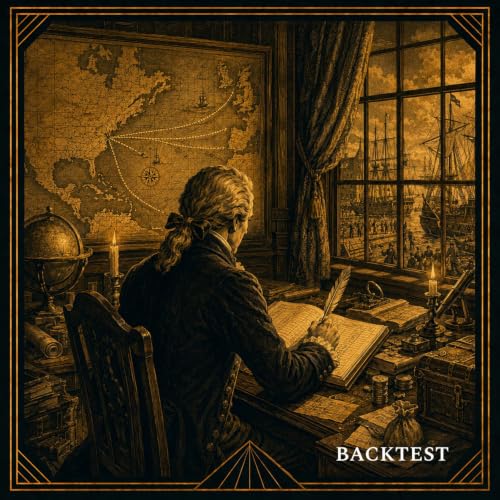
『Backtest』のカバーアート

Backtest

Backtest

著者: Daniel Gamboa Matt Harris
無料で聴く

【Amazonプライム会員限定】今ならプレミアムプランが4か月 月額99円。

10月19日まで。※適用条件あり
Learn from market history

www.backtestpodcast.comBacktest Media
世界 個人ファイナンス 経済学
エピソード
  • The Rail Revolution: Jay Cooke and the Northern Pacific (Part 4)
    2026/09/10

    By 1869, the transcontinental railroad is finished, the Civil War debt is refinanced, and the business that made Jay Cooke reach the pinnacle of private banking in the US is disappearing. He had spent the war building something nobody had built before: a retail distribution machine that sold Union bonds to farmers, mechanics, and merchants. He had created the template for war financing that would inform government playbooks for the next 100 years, and it made him the best known banker in America. But by focusing on that, he had missed the banking business for the major railroads that were booming in financial markets.

    As the government financing business shrinks and excitement builds over the completion of the Union Pacific and Central Pacific linking New York to California, Cooke turns to the Northern Pacific transcontinental railroad. The structure is elegant on paper but the project combines massive capital needs with a speculative vision on an unprecedented scale.

    This is the perfect story to answer the question of what happens when enormous capital funds transformative infrastructure ahead of the demand that must eventually pay for it.

    Chapters

    (05:01) Jay Cooke in Philadelphia, 1839 as a young banker

    (11:51) The retail distribution in Pennsylvania

    (16:38) The financier of the Civil War

    (22:56) Jay Cooke looks for non-government business after the war

    (30:19) The Northern Pacific comes calling

    (36:13) Jay Cook signs a deal with the Northern Pacific

    (45:47) Harris Fahnestock, Cooke’s partner, warns him about funding the Northern Pacific

    (50:36) Jay Cooke & Co. almost fails on October 1872

    (56:10) Fahnestock closes the New York office and triggers the Panic of 1873

    (59:15) The realization of a vision

    References

    Jay Cooke, Private Banker by Henrietta Larson (link)

    1873: The Rothschilds, the First Great Depression, and the Making of the Modern World by Liaquat Ahamed (link)

    Jay Cooke’s Gamble: The Northern Pacific Railroad, The Sioux, and The Panic of 1873 by M. John Lubetkin (link)

    Panic on Wall Street: A History of America’s Financial Disasters by Robert Sobel (link)

    Sponsors

    Big thanks to EQT Corporation for helping us bring you the stories of market history and how they apply today. To learn more and explore the latest data on energy affordability, go to eqt.com/eqt.com/permitting-reform-now.

    Note: this show is for informational purposes only and isn’t investment advice. Backtest hosts and guests may have investments in the companies discussed.


    This is a public episode. If you would like to discuss this with other subscribers or get access to bonus episodes, visit www.backtestpodcast.com
    続きを読む 一部表示
    1 時間 6 分
  • The Rail Revolution: Cornelius Vanderbilt and Market Power (Part 3)
    2026/08/12
    DescriptionIn the 1860s, railroads are rewiring the American economy. The old value chain built around steamboats, canals, and local commerce is coming apart, and nobody knows which parts of the new one will be profitable.Cornelius Vanderbilt is almost 70 years old and one of the wealthiest men in America. He has spent four decades mastering steamboats. He comes to railroads without a master plan for an empire. Instead, he sees a problem he thinks he can fix: the New York and Harlem Railroad, an unprofitable line that Wall Street brokers joke is only good for wrapping paper, and the only railroad running into the heart of Manhattan.What follows is five years of escalating fights, each one set off by a structural problem Vanderbilt discovers as he’s trying to turn railroads from speculative projects to great businesses. Along the way we ask what actually built Vanderbilt’s moat, why he tried diplomacy before waging battles almost every time, and what operating in a fog with enormous amounts of capital, market, and operational risk might teach us about today’s markets.Chapters(02:02) How a technology revolution rewires an entire value chain(06:04) Vanderbilt forcing a boat up the San Juan River in Nicaragua(13:31) Railroads as an accessory and saving the Harlem in the Panic of 1857(16:20) Selling the steamships and buying a railroad nobody wants(20:37) The Harlem Corner(23:21) No market power with the Harlem(27:28) Diplomacy first and taking on the Hudson(38:17) The January 1867 blockade of the Central(47:35) The Erie War against Daniel Drew, Jay Gould and Jim Fisk(1:00:06) The Lake Shore campaign and Black Friday in 1869(1:05:37) The Vanderbilt playbook and what it means for the AI buildoutReferencesThe First Tycoon: The Epic Life of Cornelius Vanderbilt by T.J. Stiles (link)The Invention of the Trillionaire by T.J. Stiles, WSJ Article (link)The Visible Hand: The Managerial Revolution in American Business by Alfred D. Chandler, Jr. (link)History of the New York & Harlem Railroad by E. Clarence HyattIncreasing Returns and the New World of Business by W. Brian Arthur (link)The Innovator’s Dilemma by Clayton Christensen (link)7 Powers: The Foundations of Business Strategy by Hamilton Helmer (link)SponsorsBig thanks to EQT Corporation for helping us bring you the stories of market history and how they apply today. To learn more and explore the latest data on energy affordability, go to eqt.com/energy-affordability.Note: this show is for informational purposes only and isn’t investment advice. Backtest hosts and guests may have investments in the companies discussed. This is a public episode. If you would like to discuss this with other subscribers or get access to bonus episodes, visit www.backtestpodcast.com
    続きを読む 一部表示
    1 時間 11 分
  • Financing the American Revolution: Robert Morris and Independence
    2026/07/01
    You think you know the history of the American Revolution. George Washington crossing the Delaware. Thomas Jefferson writing the Declaration. But there’s one founder you’ve likely never heard of, and he was just as important.The war for independence started and ended on a financial note, and the man at the center of the money problem was someone most of us have never heard of: Robert Morris, the Financier of the American Revolution.Morris was a Liverpool-born merchant who moved to America at thirteen in 1747 and went on to become one of the most important leaders of the American Revolution. He understood shipping, credit, and global trade well enough to keep Washington’s army from collapsing.We trace the arc of the war to understand how a small group of colonies banded together to finance a rebellion against a world superpower. We cover colonial paper money, the fiscal tensions leading up to Lexington and Concord, how the Continental Congress tried to fund everything, and how they ultimately saved the war by handing extraordinary executive powers to Robert Morris.Chapters(05:35) The colonial economy: farming, a chronic trade deficit, and a chronic shortage of gold(08:15) Robert Morris: the Liverpool-born merchant who masters colonial trade(12:50) Money as a flashpoint: the Currency Acts and Morris’s own private currency experiment(17:38) From taxes to revolution: the Stamp Act, the Intolerable Acts, and Lexington and Concord(19:43) Funding a war with no power to tax: Congress invents the Continental Dollar(29:35) Christmas Supplies: Morris helps Washington cross the Delaware(34:02) “Not worth a Continental”: hyperinflation and the collapse of the printing era(44:17) Superintendent of Finance: a desperate Congress hands Morris near-total control(52:13) Yorktown: kegs of French silver and the financing behind the decisive victory(54:47) Newburgh and the Treaty of Paris: the army nearly turns and the war endsReferencesRobert Morris: Financier of the American Revolution by Charles Rappleye (Link)The Continental Dollar: How the American Revolution Was Financed with Paper Money by Fairley Grub (Link)Financial Founding Fathers: The Men Who Made America Rich by by Robert E. Wright and David J. Cowen (Link)Founding Finance: How Debt, Speculation, Foreclosures, Protests, and Crackdowns Made Us a Nation by William Hogeland (Link)One Nation Under Debt by Robert E. Wright (Link)The Power of the Purse by E. James Ferguson (Link)SponsorsBig thanks to EQT Corporation for helping us bring you the stories of market history and how they apply today. To join us in celebrating America’s 250th anniversary, go to https://www.eqt.com/community/america-250.Note: this show is for informational purposes only and isn’t investment advice. Backtest hosts and guests may have investments in the companies discussed. This is a public episode. If you would like to discuss this with other subscribers or get access to bonus episodes, visit www.backtestpodcast.com
    続きを読む 一部表示
    1 時間 6 分
adbl_web_anon_alc_button_suppression_t1
まだレビューはありません