

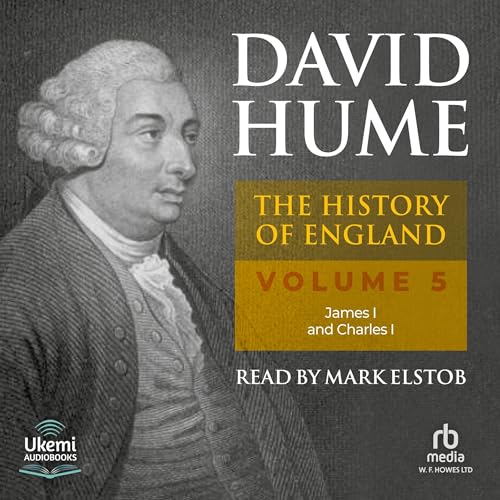
The History of England Volume 5
James I and Charles I
カートのアイテムが多すぎます
ご購入は五十タイトルがカートに入っている場合のみです。
カートに追加できませんでした。
しばらく経ってから再度お試しください。
ウィッシュリストに追加できませんでした。
しばらく経ってから再度お試しください。
ほしい物リストの削除に失敗しました。
しばらく経ってから再度お試しください。
ポッドキャストのフォローに失敗しました
ポッドキャストのフォロー解除に失敗しました
30日間の無料体験を試す
Amazonプライム会員限定
プレミアムプラン4か月 月額99円キャンペーン開催中
期間限定:2026年10月19日(日本時間)に終了
2026年10月19日まで対象者限定でプレミアムプランが4か月 月額99円キャンペーン開催中。詳細はこちら。
オーディオブック・ポッドキャスト・オリジナル作品など数十万以上の対象作品が聴き放題。
オーディオブックをお得な会員価格で購入できます。
会員登録は5か月目以降は月額¥1,500で自動更新します。いつでも退会できます。
オーディオブック・ポッドキャスト・オリジナル作品など数十万以上の対象作品が聴き放題。
オーディオブックをお得な会員価格で購入できます。
30日間の無料体験後は月額¥1500で自動更新します。いつでも退会できます。

The History of England Volume 5
ナレーター:
Mark Elstob
¥3,880 で購入
-
ナレーター:
-
Mark Elstob
-
著者:
-
David Hume
Unsurprisingly, his early distribution of honours benefitted more Scots figures than English, and coloured the nature of his English court, though he prudently left most of the main offices in the hands of Elizabeth’s ministers. Various plots – involving among others Sir Walter Raleigh, and, in 1605 the ‘Gunpower Conspiracy’ – were swiftly dealt with; and though James regarded himself ‘an absolute king’, this was leavened by pragmatism.
Hume considers the continuing activity of learning and the arts in the reign of James, through the work of Shakespeare, Ben, Johnson, John Donne and Francis Bacon; and that James himself was a ‘middling’ writer. He died aged 58 in 1625.
Unlike his father, Charles I (reigned 1625-1649) came to the throne aged 25 ‘unexperienced and impolitic,’ and was further challenged by personal debts and public commitments due to overseas military ventures. This forced him to request Parliament for extra funds, which he expected would be little more than a formality, and, bearing in mind this was a new relationship, Parliament acceded.
But the strengthening of the ‘puritanical’ party in the house of commons set the seeds of future disruption, flames which were fuelled by the king’s increasingly ‘lofty ideas’ of his monarchical authority over constitutional practices in the government of the country.
Hume’s extensive research presents the growing animosity between king and Parliament in detail, culminating Charles ordering the dissolution of Parliament on 10 March 1629. For the next 11 years the king ruled alone.
Hume takes a balanced view of Charles the man and Charles the king. ‘A kind husband, an indulgent father, a gentle master, a steadfast friend; to all these eulogies, his conduct in private life fully entitled him. As a monarch too, in the exterior qualities, he excelled; in the essential, he was not defective…But the high idea of his own authority, which he had imbibed, made him incapable of giving way to the spirit of liberty, which began to prevail among his subjects.’
What’s more, Charles allowed himself, inadvisedly, to be influenced by a few strong personalities which eventually led to his destruction. 1639 finds Charles, ‘in despair of being able to stem the torrent’. With a historian’s care, but with a natural flair for telling the story, Hume relates the descent into civil war, the fluctuating fortunes of both sides, the ascendence of the new model army, and the execution of the king. This, one of the astounding moments in English history, is finely told, with Hume uncovering the conflicting emotions on all sides, adding vivid colour to the facts.©1754 Public Domain (P)2024 W.F. Howes Ltd.
adbl_web_anon_alc_button_suppression_t1
シリーズを続ける
まだレビューはありません