『whistlekick Martial Arts Radio』のカバーアート

whistlekick Martial Arts Radio

whistlekick Martial Arts Radio

著者: whistlekick Martial Arts Radio
無料で聴く

Martial Arts Radio is a bi-weekly show featuring interviews and comments on traditional martial arts topics. From the famous to the not-so, we speak to people from all over the world, in every martial arts discipline. Karate, taekwondo, kung fu, jujutsu, BJJ, HEMA, capoeira, FMA, tai chi, tkd, kungfu, kickboxing, arnis, escrima, tangsoodo,kempo, and everything else you can think of. Brought to you by whistlekick.All episodes are copyright Whistlekick, LLC, All Rights Reserved. エクササイズ・フィットネス フィットネス・食生活・栄養 衛生・健康的な生活
エピソード
  • Episode 1161 - Why Bruce Lee Still Shapes Martial Arts: Even When People Get Him Wrong
    2026/09/10

    SUMMARY

    In this episode, Jeremy and Andrew explore the lasting influence of Bruce Lee on martial arts, discussing his unique contributions, the myths surrounding his legacy, and the misinterpretations of his philosophy. They delve into the significance of Jeet Kune Do, the importance of questioning traditional practices, and how Bruce Lee's approach to martial arts continues to inspire modern practitioners. The conversation highlights the need for a nuanced understanding of Bruce Lee's teachings and the relevance of his ideas in today's martial arts culture.

    TAKEAWAYS

    • Bruce Lee's legacy continues to shape martial arts today.
    • He was a pioneer in bringing martial arts to mainstream cinema.
    • The myth of Bruce Lee often overshadows the reality of his life.
    • Jeet Kune Do emphasizes adaptability and questioning traditional methods.
    • Misquotes of Bruce Lee can lead to misunderstandings of his philosophy.
    • Bruce Lee's influence is evident in modern martial arts training.
    • He rejected rigidity and encouraged a blend of styles.
    • The oversimplification of his teachings is a disservice to his legacy.
    • Bruce Lee would likely advocate for exploration over argument in training.
    • His approach to martial arts was rooted in a philosophy of inquiry and adaptation.

    Join our EXCLUSIVE newsletter to get notified of each episode as it comes out!
    Subscribe — whistlekick Martial Arts Radio

    続きを読む 一部表示
    33 分
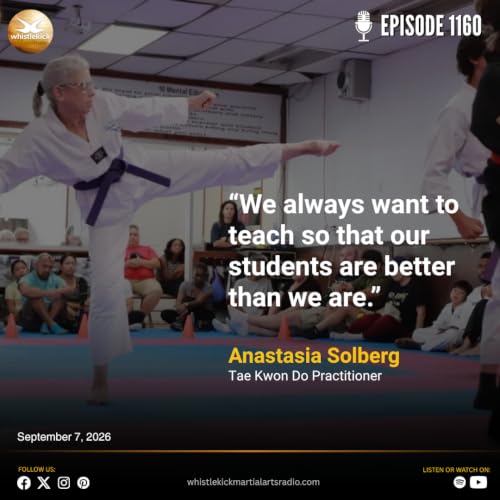
  • Episode 1160 - Anastasia Solberg
    2026/09/07

    SUMMARY

    In this episode, Anastasia Solberg shares her unique journey in martial arts, beginning with her childhood in Korea and her early experiences in Taekwondo. She discusses her return to training as an adult, the challenges she faced, and her passion for forms and sparring. Anastasia also reflects on her competition experiences and her exploration of other martial arts, culminating in her recent training in Korea. Her story highlights the importance of perseverance, cultural connections, and the joy of martial arts at any age. In this conversation, Anastasia shares her experiences training in Taekwondo both in Korea and the U.S., highlighting the differences in class structure, training intensity, and cultural approaches to martial arts. She discusses her love for weapons training, her musical background as a violist, and how music influences her martial arts practice. Anastasia also reflects on her aspirations in martial arts, including competing at the national level and achieving her third dan, while addressing the challenges of aging and injury recovery.

    TAKEAWAYS

    • Anastasia's early exposure to Korean culture influenced her martial arts journey.
    • She trained in Taekwondo for eight months in her twenties before life took over.
    • Returning to Taekwondo as an older adult presented new challenges and opportunities.
    • Anastasia's favorite aspect of training is perfecting her forms.
    • She has competed in martial arts tournaments, often against younger opponents.
    • Anastasia values learning from different martial arts styles.
    • Her recent trip to Korea allowed her to train in Taekwondo again.
    • She emphasizes the importance of cultural connections in martial arts.
    • Anastasia's journey reflects the adaptability of martial arts for all ages.
    • She believes that every experience in martial arts contributes to personal growth.
    • Weapons training varies significantly between schools.
    • Music has a rhythmic influence on martial arts performance.
    • Teaching requires a deep understanding of the art.
    • Future goals include competing at nationals and achieving higher ranks.
    • Cultural differences shape martial arts training styles.
    • Personal growth in martial arts is a lifelong journey.
    • Injuries can impact training but also provide opportunities for growth.
    • Mentorship is a key aspect of martial arts development.

    To connect with Anastasia: anastasiasolberg@gmail.com

    Join our EXCLUSIVE newsletter to get notified of each episode as it comes out!
    Subscribe — whistlekick Martial Arts Radio

    続きを読む 一部表示
    53 分
  • Episode 1159 - Why So Many Martial Arts Conversations Go Nowhere
    2026/09/04

    SUMMARY

    In this episode of Whistlekick Martial Arts Radio, Jeremy and Andrew explore the dynamics of conversations within the martial arts community. They discuss the impact of nostalgia, echo chambers, and ego on discussions, emphasizing the importance of open-mindedness and finding common ground. The conversation highlights the challenges posed by the internet and social media, which often simplify complex topics into binary choices. The hosts encourage listeners to embrace nuance, avoid toxic comparisons, and focus on personal growth in their martial arts journey.

    TAKEAWAYS

    • Nostalgia can hinder progress in martial arts conversations.

    • Echo chambers create rigid identities in martial arts practitioners.

    • Ego often leads to defensive behavior in discussions.

    • Finding common ground is essential for productive conversations.

    • The internet simplifies complex martial arts topics into binary choices.

    • Open-mindedness fosters better understanding and learning.

    • Avoiding toxic comparisons enhances personal growth in martial arts.

    • Conversations should focus on shared experiences rather than differences.

    • Personal growth is more important than defending a specific style.

    • Engaging with differing opinions can lead to valuable insights.

    Join our EXCLUSIVE newsletter to get notified of each episode as it comes out!
    Subscribe — whistlekick Martial Arts Radio

    続きを読む 一部表示
    30 分
adbl_web_anon_alc_button_suppression_t1
まだレビューはありません