『WorkTech Podcast』のカバーアート

WorkTech Podcast

WorkTech Podcast

著者: WRKdefined
無料で聴く

【Amazonプライム会員限定】今ならプレミアムプランが4か月 月額99円。

10月19日まで。※適用条件あり
The WorkTech Podcast explores the critical trends shaping the future of work and HR tech. George LaRocque of WorkTech, drawing from years of advising top innovators, investors, and enterprises, guides you through market deals, issues, opportunities, and trends—all through a strategic, actionable lens.All rights reserved by WRKdefined マネジメント・リーダーシップ リーダーシップ 出世 就職活動 経済学
エピソード
  • Full-Funnel Talent Acquisition: Harver Acquires Symphony Talent to Reengineer Hiring
    2026/09/22
    In this episode of the WorkTech Podcast, host George LaRocque sits down with Sean Barry, CEO of Harver, to explore major M&A news transforming talent acquisition: Harver’s strategic acquisition of Symphony Talent. Backed by Rubicon Technology Partners, Harver is bringing together nearly a century of combined domain expertise. By uniting Harver’s IO psychology, data science, and anti-fraud candidate assessment infrastructure with Symphony Talent’s recruitment marketing, career website, agency (Hodes), and CRM capabilities (SmashFly), this transaction establishes a unified full-funnel recruiting solution. Navigating the AI-Driven Candidate Flood Barry and LaRocque analyze the "best of times, worst of times" paradox currently gripping talent acquisition leaders. Generative AI tools have lowered the barrier to job application, resulting in a massive surge of mass-customized resumes that clog recruiter pipelines and inflate processing costs. At the same time, enterprise HR leaders face immense pressure to reduce software spend, navigate legal mandates around automated decision-making, and protect employer brand reputation when turning away millions of applicants. To solve this deadlock, Harver’s acquisition of Symphony Talent moves skills evaluation "left of the formal application". Rather than waiting for resumes to filter through an Applicant Tracking System (ATS) before conducting scans or interviews, the combined platform allows employers to deliver authentic brand storytelling via career sites, enabling candidates to self-select in or out. Interactive, mobile-first micro-assessments give applicants transparent insight into real job scenarios while verifying hard skills, cognitive traits, and identity fraud-free before submission. Delivering Return on Talent Investment (ROTI) Beyond technical integration, the acquisition addresses the core metrics modern CHROs and Talent Acquisition executives must defend before executive leadership. Barry emphasizes that point solutions are no longer viable in an era requiring strict budget scrutiny. Enterprise HR teams require defensible benchmarks centered on four key pillars: Quality of Hire, Time to Hire, Cost to Hire, and Ease of Hire. By connecting top-of-funnel candidate attraction with post-application skills matching, Harver and Symphony Talent help enterprise clients move beyond transactional "butts in seats" hiring. Employers can measure their true Return on Talent Investment (ROTI) by reducing early candidate turnover—in some cases cutting drop-off by up to 65%—while ensuring that every candidate, whether hired or rejected, leaves with a positive perception of the brand. A Unified Infrastructure for Enterprise Hiring Looking ahead, Barry details a clean integration philosophy centered on "doing no harm" to existing customer workflows. Both platforms will leverage Rubicon-supported tooling to streamline back-end ATS integrations, unified data structures, and global compliance standards (such as GDPR) without requiring clients to undertake painful technical re-plumbing. Serving high-volume verticals like retail, healthcare, financial services, and technology, the combined business provides enterprise HR leaders with the data-driven infrastructure needed to elevate Talent Acquisition from a departmental cost center to a strategic driver of corporate growth. Key Takeaways Full-Funnel TA Consolidation: Harver's acquisition of Symphony Talent pairs top-of-funnel recruitment marketing, CRM, and career websites with scientifically validated skills assessments and reference checks. Moving Evaluation "Left of the Application": Combining brand storytelling with early micro-assessments allows candidates to self-select based on realistic job previews, reducing candidate fallout by up to 65%. Curing AI Resume Fatigue: Fraud-free, anti-cheating assessment tools cut through homogeneous, AI-generated resumes to identify authentic candidate skills before ATS entry. Driving Return on Talent Investment (ROTI): The integrated platform equips HR leaders with defensible metrics across Quality of Hire, Time to Hire, Cost to Hire, and Ease of Hire to justify talent spend to executive leadership. Seamless Back-End Integration: The unified entity focuses on back-end API architecture and standardized ATS integrations, allowing enterprise clients to expand capabilities without disrupting active hiring workflows. On this episode Sean and George discuss Harver Acquires Symphony Talent, Sean Barry Harver CEO, WorkTech Podcast George LaRocque, Pre-apply candidate skills assessment, Recruitment marketing CRM consolidation, Return on Talent Investment ROTI, AI resume flood talent acquisition, Anti-fraud candidate skills verification, Enterprise ATS integration recruitment. Learn more about your ad choices. Visit megaphone.fm/adchoices
    続きを読む 一部表示
    32 分
  • Stadium Acquires Confetti: Eliminating HR Vendor Fragmentation to Unify Employee Recognition and Experiences
    2026/09/14
    In this episode of the WorkTech Podcast, host George LaRocque digs into major M&A news shaping the human resources and talent management ecosystem: Stadium’s acquisition of Confetti. Joining the conversation are Shaunak Amin, co-founder and CEO of Stadium (the platform behind Swag Magic and Snack Magic), and Lee Rubin, founder and CEO of Confetti. Together, they share an exclusive look at why this deal came together, how it solves widespread vendor fragmentation for HR leaders, and why human-first connection is becoming an essential enterprise retention strategy in the age of AI. Eliminating HR Vendor Fragmentation Enterprise talent acquisition and HR teams face growing vendor fatigue. Before this deal, companies managed an average of six separate vendors for employee recognition, swag, snack boxes, corporate gifting, and team experiences. This fragmentation generated administrative overhead, inflated software spend, and prevented leaders from analyzing engagement holistically. As Rubin explains, HR leaders want to end the hassle of managing five separate vendor relationships when a single unified partner can manage the entire engagement lifecycle. Stadium’s acquisition of Confetti solves this market pain point directly. By merging Stadium's global fulfillment infrastructure—which handles international customs, shipping logistics, swag management, and peer recognition—with Confetti's live-hosted virtual and hybrid team experiences, the combined entity gives enterprise clients a unified end-to-end solution. Balancing Background AI with Human Connection A key theme of the episode is balancing AI efficiency with genuine human connection. While artificial intelligence excels at removing operational friction in the background, Amin and Rubin stress that AI cannot build culture. As workplaces become increasingly digitized and remote employees experience isolation, physical touchpoints—such as custom swag, personalized rewards, and live-hosted team events—are vital for building trust and boosting team morale. The combined platform connects digital and physical engagement seamlessy. For instance, a company launching a branded store on Stadium can pair it with a live-hosted Confetti team event and finish by sending global snack boxes to all participants. This integrated approach allows HR teams to deliver memorable moments while keeping centralized financial control alongside decentralized team execution. Building "Global Engagement Infrastructure" Looking ahead, Amin outlines a clear two-year vision: establishing Stadium as the standard "Global Engagement Infrastructure" for the enterprise. Just as companies rely on an HRIS for payroll and a CRM like Salesforce or HubSpot for client tracking, enterprises require a dedicated infrastructure layer to keep remote and hybrid teams connected. With global labor pools shrinking and employee retention superseding traditional skill plays, engagement is no longer an optional perk—it is a core business necessity. By replacing flat SaaS access fees and fragmented point tools with an outcome-driven ecosystem, Stadium and Confetti are positioned to support over 10,000 corporate clients, expanding engagement across both employee and customer bases. Key Takeaways Eliminating Vendor Fragmentation: Enterprise HR teams were previously juggling an average of six separate vendors for swag, rewards, gifting, and team events; Stadium's acquisition of Confetti unifies these points into a single contract and workflow. Global Fulfillment Meets Live Experiences: The acquisition pairs Confetti’s live-hosted team experiences and 10,000+ corporate client network with Stadium’s global fulfillment infrastructure, solving international customs and shipping hurdles for distributed teams. AI Speed vs. Human Meaning: While AI automates workflow friction in the background, physical gifts, swag, and live human interactions are required to build trust, boost retention, and maintain company culture. Centralized Control, Decentralized Execution: The platform provides enterprise leaders with budget guardrails and holistic engagement analytics while allowing individual department heads, event planners, and executive assistants to execute local events. The Rise of "Global Engagement Infrastructure": Stadium’s two-year vision positions engagement software alongside HRIS and CRM platforms as a mandatory, third-bucket enterprise infrastructure layer to combat labor market shrinkage and drive retention. On this episode Rajiv and George discuss Stadium Acquires Confetti, Shaunak Amin Stadium CEO, Lee Rubin Confetti CEO, WorkTech Podcast George LaRocque, HR vendor fragmentation consolidation, Swag Magic Snack Magic global fulfillment, Global engagement infrastructure, Remote team virtual hybrid experiences, Employee recognition rewards platform. Learn more about your ad choices. Visit megaphone.fm/adchoices
    続きを読む 一部表示
    27 分
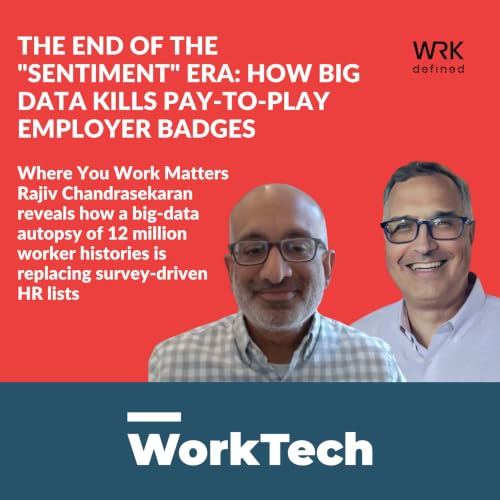
  • The End of the "Sentiment" Era: How Big Data Kills Pay-to-Play Employer Badges
    2026/08/11
    In this episode of the WorkTech Podcast, host George LaRocque sits down with Rajiv Chandrasekaran, Founder and Managing Director of Where You Work Matters and Managing Director at the Schultz Family Foundation, for an unvarnished look at a fundamental paradigm shift in human resources: the death of the "employee sentiment" era. Chandrasekaran, a former senior journalist at The Washington Post who later spent years working alongside Starbucks leader Howard Schultz to scale frontline economic opportunity, brings a pragmatic, data-first perspective to labor market quality. Built as a philanthropic collaboration between the Schultz Family Foundation, Matt Sigelman’s Burning Glass Institute, and Harvard Business School’s Managing the Future of Work project led by Joe Fuller, Where You Work Matters (WYWM) delivers an empirical, big-data autopsy of the American career path. Replacing Survey Guesswork with Hard Outcomes For decades, the HR technology space has relied heavily on annual employee surveys, sentiment analysis, and pay-to-play "Best Place to Work" badges. As LaRocque notes on 1WorkTech, employee sentiment is merely a snapshot of how workers feel on a given day, often masking stagnant wages, lack of promotion, and systemic career paralysis. Where You Work Matters renders these legacy self-reporting mechanisms obsolete by replacing subjective opinion with verified worker outcomes. Instead of asking companies to submit PR surveys or querying small sample groups about their mood, the WYWM engine analyzes the actual career progressions of over 12 million American workers across 1,750 of the country's largest public, private, and non-profit employers over a five-year period. By mining hundreds of millions of data points—including Burning Glass career history data, LinkedIn profiles, online resumes, Lightcast job postings, and Glassdoor compensation sets—the platform uses advanced algorithms to normalize job titles. This allows the index to perform true "apples-to-apples" comparisons at the occupational level rather than treating corporate brands as monoliths. Role-Level Realities and Frontline Mobility EnginesAssessing nearly 55,000 unique occupations across Early Career, Growth Stage, and Stability archetypes, the initiative proves that two workers doing the exact same job can experience radically different career trajectories based purely on employer practices. Comparing workers in platinum-rated occupations against peers in average unrated roles for the same job, workers in platinum roles are 26% more likely to stay past three years, 68% more likely to be promoted internally within five years, and earn 48% more in total compensation. For a standard administrative assistant, working at a platinum-rated firm versus an unrated company translates to an extra $1.2 million in lifetime compensation. The data also reveals that "sector is not destiny". Out of 138 financial services firms evaluated for financial analysts, only six earn platinum ratings across all three archetypes. Meanwhile, 27 non-financial enterprises—such as Nike, General Mills, and Liberty Mutual—rate as platinum for financial analysts, proving that "islands of excellence" exist across non-tech and non-finance companies. Similarly, Platinum employers for Retail Sales Clerks yield a 247% higher likelihood of internal promotion and 91% higher wages, turning frontline entry points into primary internal talent pipelines. Building "Mobility Muscle" for the AI Era For enterprise CHROs and Talent Acquisition executives, Where You Work Matters provides an unbiased, non-commercial yardstick. Free from subscription paywalls or consulting upsells, this public-interest project allows leaders to benchmark internal pay, retention, and mobility against 55,000 occupational standards. As artificial intelligence reshapes job categories, Chandrasekaran emphasizes that resilient companies will be those that build deep "mobility muscle"—the organizational capability to train, retain, and transition staff laterally from within. Key Takeaways The End of the "Sentiment" Era: Where You Work Matters replaces pay-to-play corporate surveys and subjective mood polls with a big-data autopsy of 12 million real worker progressions across 1,750 major U.S. employers. Occupational Precision & "Islands of Excellence": By evaluating 55,000 unique roles across Early Career, Growth, and Stability archetypes, the index proves that specific departments (like financial analysts at CarMax or tech teams at non-tech firms) can outperform traditional industry benchmarks. The $1.2M Compounding Advantage: Workers in Platinum-rated roles earn 48% more on average, are 68% more likely to be promoted internally within five years, and can accumulate up to $1.2 million more in lifetime earnings for roles like administrative assistants. Frontline Mobility Engines: Platinum-rated employers for Retail Sales Clerks offer a 247% higher likelihood of internal promotion and 91% higher ...
    続きを読む 一部表示
    28 分
adbl_web_anon_alc_button_suppression_t1
まだレビューはありません