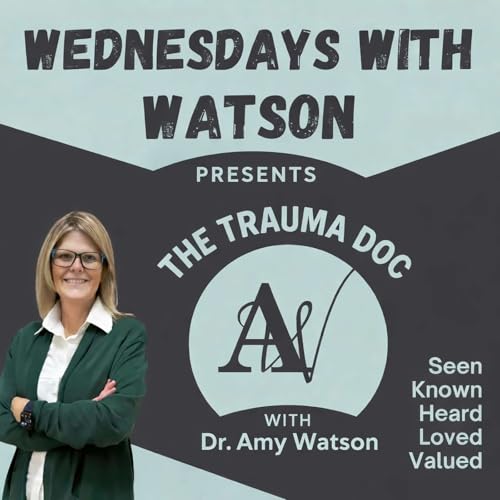
『The Trauma Doc (Wednesdays With Watson)』のカバーアート

The Trauma Doc (Wednesdays With Watson)

The Trauma Doc (Wednesdays With Watson)

著者: Amy Watson: Trauma Survivor Hope Carrier Precious Daughter Of The Most High God
無料で聴く

Welcome to the Trauma Doc, a Wednesdays With Watson Podcast. The Trauma Doc" is a compassionate and insightful podcast dedicated to exploring the complex journey of healing from PTSD, the role of faith in recovery, and the profound impact of trauma on our lives. Hosted by Dr. Amy Watson, a passionate advocate for mental health and a trauma survivor, this podcast aims to provide a safe and empathetic space for listeners to learn, share, and find hope.In each episode, we delve deep into the multifaceted aspects of Post-Traumatic Stress Disorder (PTSD) and its far-reaching effects. We bring you riveting personal stories of resilience, recovery, and transformation and expert interviews with psychologists, therapists, faith leaders, and individuals who have walked the path of healing.Our mission is to break mental health stigma and encourage open dialogue about PTSD and trauma. We explore the profound connection between faith, spirituality, and mental well-being, offering insights into how one's faith can be a powerful source of strength and healing.Whether PTSD, faith, or trauma has touched you or someone you know, "Wednesdays With Watson" is here to inspire, educate, and provide practical tools for navigating the healing journey. Join us on this empowering quest towards reclaiming peace, resilience, and a renewed sense of purpose.Today, subscribe to our community of survivors, advocates, and compassionate listeners. Together, we can heal our hearts and find the path to recovery, one episode at a time.


© 2026 The Trauma Doc (Wednesdays With Watson)
心理学 心理学・心の健康 衛生・健康的な生活
エピソード
  • Family Dysfunction and Boundaries
    2026/08/12

    Send us Fan Mail

    A family fracture can start before you’re even old enough to name it, then follow you for decades like a script you never agreed to read. We sit with the story of Jacob and Esau, not as a distant Bible lesson, but as a painfully current picture of family estrangement, favoritism, deception, and what happens when years of silence stack into missed holidays, missed milestones, and relationships that feel impossible to recover. The question underneath it all is simple and brutal: what do we do with the original wound when we’re still bleeding from it today?

    I talk about trauma and the nervous system, the way hypervigilance trains us to prepare for danger that hasn’t happened yet, and how those survival skills can quietly sabotage relationships with non-offending family members. We dig into Jacob’s wrestling match and the limp he carries afterward, because healing doesn’t mean we walk away untouched. It often means we tell the truth about who we are, take responsibility for our part, and refuse to let the wound determine what happens next.

    Then we name a disturbing trend: being proudly “no contact” without acknowledging the generational trauma and relational fallout it can create. I’m not telling you to give an abuser access to you. I am asking whether you built a wall and called it a boundary, or whether you can build a guarded bridge where it’s safe and right. We define peace as the absence of striving, explore forgiveness and reconciliation with guardrails, and offer simple words that can open a door: “Thank you, I love you, I’m sorry, and please forgive me.”

    If you’re tired of trauma taking a toll on your family relationships, come walk with us. Subscribe, share this with someone who’s living through estrangement, and leave a review so more people can find this conversation.

    You ARE:
    SEEN KNOWN HEARD LOVED VALUED

    続きを読む 一部表示
    40 分
  • Trauma Triggers, Trauma Triage, Seeking Psychological Safety
    2026/07/15

    Send us Fan Mail

    Interested in Trauma 101? Click here. Both live versions with group interaction along with the option to get a recorded link. Don't let trauma continue to steal your life, learn how to navigate triggers and more! Click here.

    Want the trauma detective PDF? Click here.

    Trauma often shows up later as a trigger that makes a safe moment feel like the past is happening again. We break down what trauma is, why your nervous system flips into alarm, and how to ground yourself back in the present with a simple “Trigger Detective” process.
    In this episode we dive deeper into trauma, brain alterations, triggers, and more.
    • Trauma is defined as loss of safety or choice, including witnessing it happen to someone else (Dr. Watson's definition)
    • Big T traumas and the way chronic stress can become traumatic when it overwhelms capacity
    • The window of tolerance and why people respond differently to the same event, this is why we do not compare traumas.
    • Stress versus trauma, plus acute stress disorder (ASD), post traumatic stress disorder (PTSD) and Complex post traumatic stress disorder (CPTSD)
    • What happens when the prefrontal cortex goes offline and the amygdala takes over?
    • Common trigger categories, including sensory, emotional, relational, anniversaries, thoughts and body sensations.
    • Trigger triage steps: ask, remember, name, remain curious
    • “Trigger Detective” grounding questions to orient to time, place, age and safety
    • Trauma 101 options, including a live group and recorded version

    Trauma detective PDF


    You ARE:
    SEEN KNOWN HEARD LOVED VALUED

    続きを読む 一部表示
    24 分
  • What If Burnout Is Surviving Too Long
    2026/07/01

    Send us Fan Mail


    LEARN MORE about Burnout & Stay In Touch with The Trauma Doc


    Join Dr. Watson in a live (or recorded if you prefer) for Burnout 101. A webinar to help you understand all forms of burnout (occupational, caregiver, academic) and be supported by a community of survivors. scholarships are available!

    Learn More

    Burnout isn’t proof you failed, it’s often proof you’ve been surviving for too long. I connect trauma, nervous system survival skills, and the real research-backed signs of burnout so you can replace shame with clarity and start moving toward recovery.
    • survival mode as a powerful teacher that was never meant to be permanent
    • why naps, vacations, and days off may stop working
    • my story of foster care, trauma, and becoming an overachiever
    • the cost of carrying other people’s hardest stories in behavioral health
    • values mismatch and lack of choice as a core burnout driver
    • burnout myths, including the idea it only happens when you hate your job
    • Christina Maslach’s three hallmarks: exhaustion, cynicism, reduced efficacy
    • trauma-linked protective behaviors like perfectionism, people pleasing, and overgiving
    • how to build compassion, boundaries, and nervous system safety over time
    • details on my Burnout 101 live group and upcoming recorded option


    So please click that link in the show notes, which is just nothing more than a contact form, and then I will reach out to you and see how I can support.


    You ARE:
    SEEN KNOWN HEARD LOVED VALUED

    続きを読む 一部表示
    29 分
adbl_web_anon_alc_button_suppression_t1
まだレビューはありません