エピソード

  • BECOMING YOUR OWN BEST FRIEND, WITH JANICE ERLBAUM
    2026/11/10

    "In writing to yourself you really manage to get enough separation that you can have real compassion for yourself and real trust in yourself and you can become your own best friend."
    — Janice Erlbaum

    ABOUT THIS EPISODE

    At 15, Janice Erlbaum gave her mother an ultimatum: take back the violent stepfather, and I'm leaving. Her mother took him back, and Janice walked out that night into New York City's shelter system. Twenty years after the publication of Girlbomb: A Halfway Homeless Memoir, Janice joins Mike to talk about life at Covenant House and in group homes in 1980s Manhattan, and how being told she was a "bad girl" pushed her to become one. She also talks about the teachers who saw something worth saving, and why writing the book honestly meant owning the harm she did, not only the harm done to her. She explains why readers still pass the book from mother to daughter, how the people she wrote about responded, and the one piece of advice she'd whisper to her teenage self and to everyone else: keep writing it down.

    KEY TAKEAWAYS

    1. Leaving can be the healthiest choice a kid makes. Janice's split-second decision to walk out rather than live with violence made her life worse before it got better. She says it has served her well ever since.

    2. Kids live down to the labels adults give them. In the group home, she was treated as homeless because she was "bad," so she set out to be the baddest bad girl there was. Many of the girls around her weren't runaways but "throwaways," including gay and trans kids thrown out by their families.

    3. One adult who sees you can change everything. An overworked drama teacher cast her, unreliable as she was, as the lead in the spring play. She showed up every single day.

    4. Honest memoir means owning your part. She had long told a story in which she was only the victim. To write Girlbomb truthfully, she went back to Covenant House and wrote about the violence and lies she took part in, too.

    5. Catharsis feels terrible while it's happening. Janice compares the drafting process to vomiting: awful in the moment, a relief once it's out. She finally wrote the book once a stable relationship gave her the calm to sit still with it.

    6. The truth can earn forgiveness. Old friends told her the book was hard to read, but "you didn't lie, you were fair." Some of them are glad that time in their lives has been memorialized.

    7. Keep writing it down. Her advice for anyone, at any age: getting your thoughts onto the page creates enough distance to treat yourself with compassion and become your own best friend.

    GET THE BOOK

    Girlbomb: A Halfway Homeless Memoir by Janice Erlbaum
    Villard, March 7, 2006
    ISBN: 9780812974560

    Amazon: https://www.amazon.com/dp/B000FCKPI0?tag=rettocasgra-20
    Bookshop.org: https://bookshop.org/a/54587/9780812974560

    Support your local indie bookstore — if it's not on the shelf, ask them to order it.

    CONNECT WITH JANICE

    Website: https://janiceerlbaum.com/
    Instagram: https://www.instagram.com/janice.erlbaum/
    Facebook: https://www.facebook.com/girlbomb
    Goodreads: https://www.goodreads.com/book/show/82676.Girlbomb

    CONNECT WITH YOUR HOST

    Mike Carlon | Uncorking a Story

    Website: https://uncorkingastory.com
    YouTube: https://www.youtube.com/@uncorkingastory
    Instagram: https://www.instagram.com/uncorkingastory/
    Facebook: https://www.facebook.com/uncorkingastory
    TikTok: https://www.tiktok.com/@uncorkingastory
    Twitter/X: https://twitter.com/uncorkingastory
    LinkedIn: https://www.linkedin.com/company/uncorking-a-story/

    SUBSCRIBE & LEAVE A REVIEW — It helps more readers and writers find the show!

    Apple Podcasts: https://podcasts.apple.com/us/podcast/uncorking-a-story/id563636205
    Spotify: https://open.spotify.com/show/5HZiAEtFlhAzk60Z4eAkhY

    Uncorking a Story is produced by Mike Carlon. New episodes drop every Tuesday.


    Hosted by Simplecast, an AdsWizz company. See pcm.adswizz.com for information about our collection and use of personal data for advertising.

    続きを読む 一部表示
    41 分
  • When Small Towns Censored Hollywood, with Glenn R. Miller
    2026/11/03

    "These people from small towns across the country had the power to go up against Hollywood directors and Hollywood producers, demanding that changes be made to those films."
    — Glenn R. Miller

    ABOUT THIS EPISODE

    Glenn R. Miller started out as a unit manager on NBC soap operas and game shows. He went on to journalism, public television and decades of agency work, and he finally took a swing at fiction with his award-winning comic novel Doorman Wanted. His new novel, Rough Cuts, grew out of a conversation with his mother-in-law, who had found boxes of note cards in her grandfather's files. Her grandfather was a small-town Ohio minister who had served on the state's film censorship board in the 1920s, and the cards ordered Hollywood studios to cut their films. Glenn and Mike talk about how a minister in Marietta could overrule a Hollywood director, why censors started writing their own lines, and how much of that era's comedy was lost. They also discuss why satirizing the 1920s turned out to be as hard as satirizing today, and why censorship is never as simple as it looks.

    KEY TAKEAWAYS

    1. Great stories can be hiding in a family's file boxes. Rough Cuts began with a mother-in-law's offhand discovery of note cards detailing cuts demanded of Hollywood films. Glenn spent a week in the Marietta College archives sorting those cards by what offended the censors: sex, violence, disrespect for authority, and drinking that went unpunished.

    2. Small-town censors held real power over Hollywood. Eight states had censorship boards that could force changes before a film was shown, and neighboring states often followed their lead. That gave local appointees, usually with no film background, leverage over major directors and producers.

    3. Censorship was also a business. Studios paid state boards to review their films and then paid again for every foot of film the boards cut. Glenn argues that those fees gave the commissions every incentive to flag scenes.

    4. Censors stopped cutting and started creating. Censors removed question marks from title cards because they caught the innuendo, and they required declarative sentences instead. Some went further and added lines of their own to improve the films, which became the richest source of satire in the novel.

    5. Comedy took the biggest hit, and much of it is gone. Glenn compared the cards against surviving silent comedy shorts and found punchlines cut again and again, leaving some films that likely made no sense to Ohio audiences. About 75% of films from that era have been lost or are nearly impossible to view.

    6. Censorship is not black and white. Glenn wanted his minister to be a comic antagonist who still scores some real points. The novel draws a line between choosing what your own children see and deciding what everyone else is allowed to watch or read, a distinction that echoes today's book bans.

    7. It's never too late to start the book you keep thinking about. Glenn published his first novel at 64 and Rough Cuts at 66. He credits workshop classes at the Loft Literary Center and the confidence that came with his first sale, and his one piece of advice to his younger self is to start writing sooner.

    GET THE BOOK

    Rough Cuts by Glenn R. Miller
    Publisher: Koehler Books
    Release: September 29, 2026
    ISBN: 9798897470747

    Amazon: https://www.amazon.com/dp/B0GXN4P6BZ?tag=rettocasgra-20
    Bookshop: https://bookshop.org/a/54587/9798897470747

    Support your local indie bookstore — if it's not on the shelf, ask them to order it.

    CONNECT WITH GLENN

    Website: https://glenn-r-miller.com/
    Instagram: https://www.instagram.com/glennrmillerauthor/
    Facebook: https://www.facebook.com/glennmiller1

    CONNECT WITH YOUR HOST

    Mike Carlon | Uncorking a Story

    Website: https://uncorkingastory.com
    YouTube: https://www.youtube.com/@uncorkingastory
    Instagram: https://www.instagram.com/uncorkingastory/
    Facebook: https://www.facebook.com/uncorkingastory
    TikTok: https://www.tiktok.com/@uncorkingastory
    Twitter/X: https://twitter.com/uncorkingastory
    LinkedIn: https://www.linkedin.com/company/uncorking-a-story/

    SUBSCRIBE & LEAVE A REVIEW — It helps more readers and writers find the show!

    Apple Podcasts: https://podcasts.apple.com/us/podcast/uncorking-a-story/id563636205
    Spotify: https://open.spotify.com/show/5HZiAEtFlhAzk60Z4eAkhY

    Uncorking a Story is produced by Mike Carlon. New episodes drop every Tuesday.


    Hosted by Simplecast, an AdsWizz company. See pcm.adswizz.com for information about our collection and use of personal data for advertising.

    続きを読む 一部表示
    42 分
  • Living Your Own Truth, with Machan Taylor
    2026/10/27

    "At the end of the night after you've been performing in front of thousands and thousands of people, you go to your hotel room and you're alone and you have to deal with that."
    — Machan Taylor

    ABOUT THIS EPISODE

    Machan Taylor never meant to write a book. She was born in Japan, uprooted to New Jersey as a child, and spent four decades as a professional singer, touring stadiums with Pink Floyd in the eighties and Sting on the Brand New Day tour in 1999 and 2000. Years of talk therapy for childhood trauma had taken her only so far. When COVID hit, she began psychedelic-assisted therapy with a trained psychologist, and the journaling that came out of that work grew, over about three years, into 60,000 words and her memoir, Naked Out Loud. Machan talks with Mike about what life on the road really looked like behind the private jets and five-star hotels, why holding the finished book finally let her let go of the embarrassment, and how a screen actors' strike pushed her into teaching, back to college in her fifties, and on to a job at NYU's Clive Davis Institute.

    KEY TAKEAWAYS

    1. You don't have to set out to write a book to end up with one. Machan's memoir began as journaling during therapy, with no plan to publish. About three years in, she realized she had 60,000 words, and a friend connected her with a small publisher of music memoirs.
    2. Putting your story on the page gives you distance from it. Once her words were outside her head and on the screen, Machan found she could look at them almost objectively. As she puts it, it's you, but it's not you, and that shift was part of her healing.
    3. The vulnerability is scariest right before you let go. Handing the manuscript to her publisher left her asking whether she really wanted to do this. Holding the printed book changed that: she felt liberated, and the embarrassment she had carried for years simply loosened its grip.
    4. Other people's judgment isn't yours to carry. With her 70th birthday a week away, Machan says she no longer cares how readers judge her stories. There will always be critics; that's on them. She wrote the book for herself, and hopes her honesty helps others tell their own stories.
    5. A glamorous life can hide real struggle. On tour she played to crowds of 20,000 to 100,000 people, but underneath she was fighting imposter syndrome, insecurity and the feeling of not being good enough. After the show, you go back to a hotel room alone, and that loneliness is why so many musicians turn to drugs and alcohol.
    6. Healing can come from places you didn't expect. Traditional talk therapy couldn't get Machan past her childhood trauma. Working with a trained professional, she found that psychedelic-assisted therapy quieted her ego enough to sit with old pain and work through it.
    7. It's never too late to go back to school. Machan started working so young that she never finished college. She earned her bachelor's degree in her fifties, went on to a master's at NYU, and now teaches at the university's Clive Davis Institute.

    GET THE BOOK

    Naked Out Loud: From Yokohama to Pink Floyd and Beyond
    by Machan Taylor
    New Haven Publishing Ltd · December 15, 2025 · ISBN 9781915975287

    Amazon: https://www.amazon.com/dp/B0G675WBR6?tag=rettocasgra-20
    Bookshop.org: https://bookshop.org/a/54587/9781915975287

    Support your local indie bookstore — if it's not on the shelf, ask them to order it.

    CONNECT WITH MACHAN

    Website: https://www.machantaylor.com/
    Instagram: https://www.instagram.com/machantaylorofficial
    Facebook: https://www.facebook.com/machantaylor/
    LinkedIn: https://www.linkedin.com/in/machan-taylor-810196156/

    CONNECT WITH YOUR HOST

    Mike Carlon | Uncorking a Story

    Website: https://uncorkingastory.com
    YouTube: https://www.youtube.com/@uncorkingastory
    Instagram: https://www.instagram.com/uncorkingastory/
    Facebook: https://www.facebook.com/uncorkingastory
    TikTok: https://www.tiktok.com/@uncorkingastory
    Twitter/X: https://twitter.com/uncorkingastory
    LinkedIn: https://www.linkedin.com/company/uncorking-a-story/

    SUBSCRIBE & LEAVE A REVIEW

    It helps more readers and writers find the show!

    Apple Podcasts: https://podcasts.apple.com/us/podcast/uncorking-a-story/id563636205
    Spotify: https://open.spotify.com/show/5HZiAEtFlhAzk60Z4eAkhY

    Uncorking a Story is produced by Mike Carlon. New episodes drop every Tuesday.


    Hosted by Simplecast, an AdsWizz company. See pcm.adswizz.com for information about our collection and use of personal data for advertising.

    続きを読む 一部表示
    38 分
  • From Newsroom to Novelist with Neal Lipschutz
    2026/10/20
    "Even people who have been writing fiction for a long time feel that from book to book they have a lot to learn."— Neal LipschutzAbout This EpisodeNeal Lipschutz grew up in Brooklyn as a big reader with a strong urge to write, and as a teenager he fell in love with the New York newspapers. Practicality won out: he spent more than four decades in journalism, first as a reporter and then mostly as an editor, including a stint as deputy editor-in-chief of The Wall Street Journal. Only after retiring did he take up fiction full-time, treating it as a new job he showed up for every day. Neal talks with Mike about which newsroom habits carried over to fiction and which he had to unlearn, what it felt like to be on the other side of the editor's desk, and why he finished his first novel before looking for a publisher. He also introduces Long Arm of the Past, the sequel to his debut No Write Way to Die. In it, management consultant Scott Morgan investigates the suspicious death of his firm's former chairman, and his partner is the retired NYPD detective who was his antagonist in book one. Along the way, the secrets Scott buried in the first book start working their way back to the surface.Key TakeawaysThe clarity that journalism demands carries straight over to fiction. Decades of making copy clear, precise and accurate gave Neal skills he uses on every page. In his view, even great fiction is often simple and fairly straightforward.Former journalists have to give themselves permission to let go. A clean, clear sentence isn't always enough in a novel. Neal pushes himself to get into his characters' heads and to allow some flourish in key descriptions, without overdoing it.Be the writer you would want to edit. After editing other people's work for a living, Neal went into his own edits determined to be open-minded and cooperative, as a novice with a lot to learn. Even small conventions, like how quotes and paragraphs are set up, work differently in a novel than in a newspaper.Developmental edits are a conversation, not an order. Feedback on plot or character is a free lesson, not an attack. Most editors will hear you out if you disagree, as long as you make your case.Finish the book before you go looking for a publisher. Neal wrote No Write Way to Die in full before approaching anyone. For him, making the manuscript as strong as possible was "job one," and the search for a publisher came after.Every book in a series should stand on its own. Neal wants a reader who starts with book two to understand everything and enjoy it. That means referring to what happened earlier without spoiling book one for anyone who goes back to read it.Place shapes character. Scott Morgan's affluent Westchester suburb is only a few miles from the Brooklyn neighborhood he grew up in, but in Neal's words the psychic distance is huge. New York and its surroundings drive both the crimes and the people in the series.Get the BookLong Arm of the Past by Neal Lipschutz Publisher: Tucker DS Press Release date: August 2026 ISBN: 9781959748502AmazonBookshop.orgSupport your local indie bookstore — if it's not on the shelf, ask them to order it.Connect with NealWebsite: neallipschutz.comInstagram: @nlipschutzTikTok: @neal2841Twitter/X: @NLipschutzLinkedIn: Neal LipschutzConnect with Your HostMike Carlon | Uncorking a StoryWebsite: uncorkingastory.comYouTube: @uncorkingastoryInstagram: @uncorkingastoryFacebook: Uncorking a StoryTikTok: @uncorkingastoryTwitter/X: @uncorkingastorySubscribe & Leave a Review — It helps more readers and writers find the show!Apple PodcastsSpotifyUncorking a Story is produced by Mike Carlon. New episodes drop every Tuesday. Hosted by Simplecast, an AdsWizz company. See pcm.adswizz.com for information about our collection and use of personal data for advertising.
    続きを読む 一部表示
    34 分
  • What I've Learned from 500 Authors
    2026/10/13
    "The show started as a way for me to prove that I can get a stranger to tell me their story. And 500 episodes later, I think strangers have taught me more about mine." — Mike CarlonABOUT THIS EPISODEFor the 500th episode, Mike turns the microphone on himself. He goes back to 2011, when he was a brand-new focus group moderator who started a podcast because he couldn't show clients his proprietary work, and to the publicist who told him to make the show about authors. From there he walks through what 500 conversations have taught him: where writing careers really begin, why there's no such thing as an overnight success, and why it's never too late to start. He also gets personal about losing his brother Greg and his mother a year and a month apart, how writing carried him through it, and the 3 a.m. "download" that became The Waiting Room. And he finally answers the question he's asked every guest: what would you whisper to your younger self?KEY TAKEAWAYS1. Most writing careers start with a grown-up who noticed. When Mike asks guests where their story as an author begins, he expects book deals and hears about childhood instead. April Henry mailed a story to Roald Dahl at nine, and he wrote back. Kara Ruda's school librarian laminated her first little book and put it on the shelf. If you're a parent, teacher or librarian, what you did for a kid decades ago may be chapter one of their career.2. There are no overnight successes. In 500 episodes, Mike has yet to meet a guest who had no turbulence on the road to publication. April Henry's fourth book sold in three days, after nine years of trying. Camille Di Maio's debut took four years, 43 rejections and 17 drafts. And as K Smith Blum put it, better rejections are still progress.3. It's never too late. Some of Mike's most moving conversations are with people who found their voice in their 60s and 70s, after retiring, raising kids or a career that had nothing to do with books. Iris Mittlin Lav decided to write at 72. If you've been sitting on a story because you think the window has closed, 500 episodes say otherwise.4. Everyone is creative. Mike dreaded art class even more than gym, and spent years believing creativity meant crayons and talent he didn't have. Zara Marielle changed that: everyone has something inside them worth nurturing; some people have just been taught it isn't valuable. Nine books later, Mike agrees.5. Write from the scar, not the wound. Memoirists Mike interviews nearly always describe writing their hardest chapter as cathartic. The ones who tell the hardest stories well tend to wait until the wound has scarred over. And not everything has to be published: therapist Lauren Tettenbaum tells clients to write it all down, curse words included, and just not hit send.6. Grief is the price of love, and fiction can heal too. Mike talks openly about losing his brother Greg to lung cancer and his mother a year and a month later. Writing didn't end the grief, but it helped, and he's come to believe that's as true for fiction as for memoir. Stacey Bass gave him the line he still uses: grief is the price of love.7. Sometimes the story comes through you. Sick in a guest bedroom at 3 a.m. one Christmas, Mike started getting "downloads" of a story he had no plan to write. It became The Waiting Room, his most successful book, and only when writing the back cover did he notice his characters were Mary and Joseph, at Holy Family Hospital, on Christmas Eve. Other guests describe the same experience, and it's changed how he thinks of writing: some days it's closer to prayer.GET THE BOOKThe Waiting Room by Mike CarlonPublisher: Uncorking a Story PublishingRelease date: May 27, 2025ISBN: 9781732184695Amazon: https://www.amazon.com/dp/1732184690?tag=rettocasgra-20Bookshop.org: https://bookshop.org/a/54587/9781732184695Support your local indie bookstore — if it's not on the shelf, ask them to order it.CONNECT WITH YOUR HOSTMike Carlon | Uncorking a StoryWebsite: https://uncorkingastory.comYouTube: https://www.youtube.com/@uncorkingastoryInstagram: https://www.instagram.com/uncorkingastory/Facebook: https://www.facebook.com/uncorkingastoryTikTok: https://www.tiktok.com/@uncorkingastoryTwitter/X: https://twitter.com/uncorkingastorySubscribe & Leave a Review — It helps more readers and writers find the show!Apple Podcasts: https://podcasts.apple.com/us/podcast/uncorking-a-story/id563636205Spotify: https://open.spotify.com/show/5HZiAEtFlhAzk60Z4eAkhYUncorking a Story is produced by Mike Carlon. New episodes drop every Tuesday. Hosted by Simplecast, an AdsWizz company. See pcm.adswizz.com for information about our collection and use of personal data for advertising.
    続きを読む 一部表示
    50 分
  • Bouncing Back, with Ellen Holtzman
    2026/10/06
    BOUNCING BACK, WITH ELLEN HOLTZMAN"It's confusing, it's awful, it's terrible, but you can survive it and you could actually have an even better life than you ever imagined."— Ellen HoltzmanABOUT THIS EPISODEEllen Holtzman didn't grow up writing. She was a history graduate student who taught herself to write by working through The Elements of Style page by page. When her husband decided he didn't want children, and then that he didn't want the marriage, her plans for an academic career fell apart along with it. She couldn't find a tenure-track job and had to support herself, so she went back to school for a second doctorate and became a psychotherapist. Years later, after her son left for college, she took writing courses at Grub Street in Boston. There she learned to tell stories instead of making arguments. Bouncing Back weaves her own divorce together with the stories of two of her therapy clients: Lisa, fifty, whose husband of thirty years kept returning to an affair, and Megan, thirty, whose husband told her he didn't want a second child. Ellen tells all three stories twice, once as a memoirist living through it and once as a therapist asking what it all means. In this conversation she talks about why she couldn't have written the book in the first ten years, how women lose themselves in marriage, and the recurring dream that finally stopped once the book was done.KEY TAKEAWAYS1. Writing can be learned, even if you were never a "natural." Ellen says plainly that she wasn't a good writer and didn't always write. As a grad student she sat down with The Elements of Style and a grammar textbook and worked through a paper sentence by sentence, following it like a recipe. Later she learned story structure the same way, one course at a time.2. You can't write the story while you're still in the wound. Ellen believes that if she had tried to write the book within ten years of her divorce, it would have read like a journal: raw venting that no reader wants to sit through. Distance is what turns pain into a story someone else can use.3. Losing yourself in marriage often looks like accommodation, not abuse. Compromise is necessary, but Ellen sees many women become too accommodating, raised to please and unsure it's okay to be assertive. Her ex-husband went silent when he was angry, and she grew afraid to speak up or advocate for herself.4. If a couple can't argue well, the marriage is in trouble. Looking back, Ellen isn't surprised her husband walked out. He never told her what bothered him, so years of anger built up unspoken while she assumed everything was fine. Learning to disagree constructively is a skill most people never get taught.5. Surviving the "unsurvivable" becomes a lasting source of confidence. At the time, Ellen thought her life was over. Getting through it gave her something to look back on whenever something else felt impossible. She also saw many women come out of divorce feeling like a different person, with abilities they didn't know they had.6. Writing can heal what time alone doesn't. For decades Ellen had what she called her "divorce dream," in which someone was leaving her. After she wrote the book, the dream never came back. She believes working through the story in such detail finally dissolved the shock that years alone hadn't touched.7. Recovery is slow, and that's not a failure. Clients often ask Ellen why they aren't better yet. Her answer is that the confusion and pain are normal, grief takes time, and the process has lessons of its own. The book's purpose is to make readers feel understood, and to show them a good life is waiting on the other side.GET THE BOOKBouncing Back: How Women Lose & Find Themselves in Marriage & Divorce by Ellen HoltzmanISBN: 9798989803118Amazon: https://www.amazon.com/dp/B0D6FTLGTJ?tag=returntocasag-20Bookshop.org: https://bookshop.org/a/54587/9798989803118Support your local indie bookstore — if it's not on the shelf, ask them to order it.CONNECT WITH ELLENWebsite: https://www.ellenholtzman.com/Facebook: https://www.facebook.com/profile.php?id=100087660229588LinkedIn: https://www.linkedin.com/in/ellen-holtzman-81b256314/Medium: https://medium.com/@eholtzman00/how-a-psychotherapist-helps-women-bounce-back-from-their-troubled-marriages-458cd1548f4eCONNECT WITH YOUR HOSTMike Carlon | Uncorking a StoryWebsite: https://uncorkingastory.comYouTube: https://www.youtube.com/@uncorkingastoryInstagram: https://www.instagram.com/uncorkingastory/Facebook: https://www.facebook.com/uncorkingastoryTikTok: https://www.tiktok.com/@uncorkingastoryTwitter/X: https://twitter.com/uncorkingastorySubscribe & Leave a Review — It helps more readers and writers find the show!Apple Podcasts: https://podcasts.apple.com/us/podcast/uncorking-a-story/id563636205Spotify: https://open.spotify.com/show/5HZiAEtFlhAzk60Z4eAkhYUncorking a Story is produced by Mike Carlon. New episodes drop every Tuesday. Hosted by Simplecast, an AdsWizz company. See pcm.adswizz.com for ...
    続きを読む 一部表示
    34 分
  • Our Own Worst Enemy, with Sal Amato
    2026/09/29

    "We do more damage to ourselves than any alien species could ever do to us. We kick our own asses every day." — Sal Amato


    ABOUT THIS EPISODE

    Sal Amato has spent almost five decades in entertainment — he started as a kid actor in a 1978 Betty Crocker commercial, became one of the youngest members ever at Chicago's Second City, and has film and TV credits including The Untouchables, My Best Friend's Wedding, Chicago Overcoat, and Chicago Fire. On this episode he talks about his debut novel, Hidden Powers Disclosure from Within, a political sci-fi thriller built around the alleged 1954 Eisenhower UFO meeting. Sal traces his fascination with the unexplained back to childhood — Chariots of the Gods, Bedknobs and Broomsticks, Star Wars — but he's quick to say the book isn't really about aliens. It's about tribalism, the algorithms and bots that keep us divided online, and the fact that people do more damage to each other than any outside force ever could. He also opens up about writing and revising the book while his mother was dying, and how his Second City improv training still shapes the way he writes and edits today.


    KEY TAKEAWAYS

    1. His debut novel uses a real conspiracy theory as its launchpad. Hidden Powers Disclosure from Within imagines what might actually have been discussed at the alleged 1954 Eisenhower meeting with extraterrestrials — and what it would have meant for a Cold War administration deciding whether, and how, to tell the public.

    2. The book isn't really about aliens — it's about us. Sal says the story is ultimately about "the damage we do to ourselves," pointing out that in the book, and in life, people cause each other more harm than any outside force ever could.

    3. He blames the algorithms, not just the people, for our divisions. Sal argues that social platforms are loaded with bots and manufactured engagement built to generate ad revenue, and that this manufactured outrage is what keeps people tribal and unwilling to question their own side.

    4. His Second City training still shapes how he writes. Sal got into Second City at seventeen (with a fake ID) after working on films like Bad Boys and Doctor Detroit, and he says improv's "power of yes" mindset is exactly how he approaches a first draft — keep the door open, keep building, and only later learn when to stop editing.

    5. He wrote through his mother's death. Sal's mom passed away on New Year's Eve without getting to read the finished book. He processed the loss by burying himself in work, including finishing the manuscript, and later realized that stepping away and coming back with fresh eyes made the book stronger.

    6. He beta-tested the book with 70 to 80 friends before finalizing it. Sal asked readers not to hold back, and says the near-universal reaction was surprise that the story isn't really the alien thriller they expected — it's about fanaticism and how hard it is to break free of the "team" you've already picked.


    CONNECT WITH SAL

    Website: salamato.com
    Instagram: @salinchicago
    Twitter/X: @hiddenpowersusa
    Facebook: @salamato711
    TikTok: @backinthedayshow
    YouTube: @hiddenpowersofficial


    CONNECT WITH YOUR HOST

    Mike Carlon | Uncorking a Story

    Website: uncorkingastory.com
    YouTube: @uncorkingastory
    Instagram: @uncorkingastory
    Facebook: Uncorking a Story
    TikTok: @uncorkingastory
    Twitter/X: @uncorkingastory

    Subscribe & Leave a Review — It helps more readers and writers find the show!

    Apple Podcasts: https://podcasts.apple.com/us/podcast/uncorking-a-story/id563636205
    Spotify: https://open.spotify.com/show/5HZiAEtFlhAzk60Z4eAkhY

    Uncorking a Story is produced by Mike Carlon. New episodes drop every Tuesday.


    Hosted by Simplecast, an AdsWizz company. See pcm.adswizz.com for information about our collection and use of personal data for advertising.

    続きを読む 一部表示
    45 分
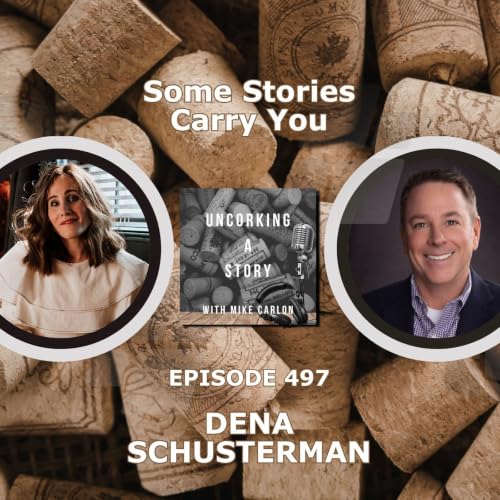
  • Some Stories Carry You, with Dena Shusterman
    2026/09/22
    "I'm about five years old and I'm so tired. I say, Abba, which is what I call my father, can you carry me? I'm so tired. And I remember him saying, Deanch, I can't carry you, but I'll carry you with my stories."— Dena SchustermanABOUT THIS EPISODEDena Schusterman was about five years old, walking a mile and a half to synagogue on Shabbat, too tired to go another step. She asked her father to carry her. He told her he couldn't — but he'd carry her with his stories, and by the time he finished she was at the synagogue door with no memory of the walk. Forty years later, sitting in a room with two thousand women while someone told one of her father's stories without using his name, she decided those stories needed to be reclaimed. What started as a plan to write her father's memoir became something else entirely, because you cannot write someone else's life. In this conversation, Dena and Mike talk about the oral tradition both of them grew up inside, what happens when a writer traces a coping mechanism back four generations and finds it still running in her own kitchen, why rejection never derailed her, and what it costs to look at the people who came before you with compassion instead of judgment.KEY TAKEAWAYS1. You cannot write somebody else's memoir. Dena set out to write her father's story and discovered fairly quickly that the form wouldn't allow it — a memoir has to be told from inside a life, and the only life she could write from inside of was her own. The book that resulted still holds her father's stories, but the person carrying them is her.2. Writing a memoir will crack you open, and you should expect that. Her husband warned her before she started that it would take her places she hadn't gone. She waved him off. It took her places she hadn't gone. Knowing the punchline of a family story turned out to be very different from asking her parents how they felt about what happened.3. Inherited coping mechanisms don't announce themselves. Dena's grandmother survived the Holocaust in part by trading food for slivers of soap to stay clean. Two generations later, Dena found herself raging at her kids about a messy house and realized she was running a script she'd never consciously received: a clean house is how you stay alive. Naming it was what let her stop.4. Bringing something into the light makes it smaller, not bigger. The energy spent keeping a difficult thing stuffed down is what generates the anxiety around it. Put it on the page and it turns out to be survivable — and, in Dena's experience, one sentence on paper pulls the next one out behind it.5. Start at the end and rewind. Dena's process is to know the ending first and then work backwards asking how she got there. The ending, she points out, is rarely the interesting part. The route is.6. A "smooth path" to publication can still include every rejection. She never found an agent. She got the rejections. She was ready to pay a hybrid publisher until a lawyer told her not to sign, which sent her to Mercer University Press — where her editor had been telling her to go for eight years. She kept a reminder in her pocket that The Queen's Gambit was rejected for thirty-two years, and treated every no as proof she was closer to a yes.7. Compassion for the people who came before you is out of fashion, and worth doing anyway. Dena's read on the moment is that we've gotten very good at being kind to ourselves and very quick to judge our parents and grandparents. Her hope for readers is that they look at their own inherited stories the way she learned to look at hers — not to excuse anything, but because every family story eventually becomes a choice about how you show up.GET THE BOOKStories Carry: We All Carry Them. Some Even Carry Us by Dena Schusterman- Publisher: Mercer University Press- Release date: (to confirm)- ISBN: 979-8897360475- Buy on Amazon: https://www.amazon.com/Stories-Carry-Memoir-Dena-Schusterman/dp/B0H4W37YZV?tag=rettocasgra-20&linkCode=ll2&linkId=2b2e63cfbc88a23cfd4a646441b02601&language=en_US&ref_=as_li_ss_tl- Buy on Bookshop.org: https://bookshop.org/a/54587/9798897360475On the episode Dena noted that Amazon was delaying availability, and that the best place to buy right now is the Mercer University Press website, with Barnes & Noble carrying it online as well.Support your local indie bookstore — if it's not on the shelf, ask them to order it.CONNECT WITH DENA- Website: https://www.denaschusterman.com/- Instagram: https://www.instagram.com/denads/ (@denads)CONNECT WITH YOUR HOSTMike Carlon | Uncorking a Story- Website: https://uncorkingastory.com- YouTube: https://www.youtube.com/@uncorkingastory- Instagram: https://www.instagram.com/uncorkingastory/- Facebook: https://www.facebook.com/uncorkingastory- TikTok: https://www.tiktok.com/@uncorkingastory- Twitter/X: https://twitter.com/uncorkingastorySubscribe & Leave a Review — It helps more readers and writers find the show!- Apple Podcasts: https://podcasts.apple.com...
    続きを読む 一部表示
    33 分