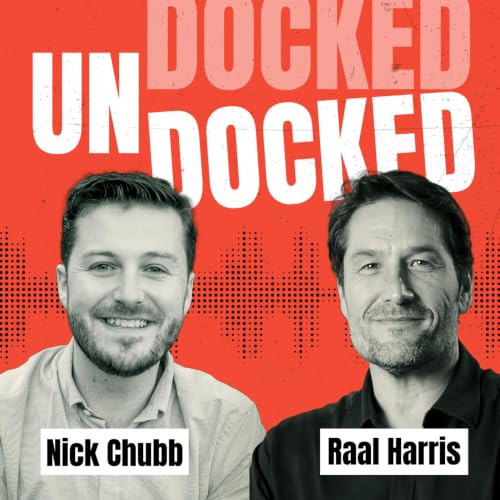
『UnDocked: The Maritime Transformation Show』のカバーアート

UnDocked: The Maritime Transformation Show

UnDocked: The Maritime Transformation Show

著者: Raal Harris and Nick Chubb
無料で聴く

【Amazonプライム会員限定】今ならプレミアムプランが4か月 月額99円。

10月19日まで。※適用条件あり
Undocked is a weekly podcast where Nick Chubb and Raal Harris explore what’s changing in maritime and technology. Through candid conversations and guest interviews, the show unpacks emerging trends, overlooked stories, and strategic insights, offering a fresh, unfiltered perspective on the evolving future of one of the world’s oldest industries.2026 Raal Harris and Nick Chubb
エピソード
  • Could Crew Welfare Decide Who Gets Fuel, South Korea's Public AI Bet, and Armageddon
    2026/09/17

    This week, Nick and Raal ask whether bunker suppliers could become an unlikely force for crew welfare, examine why the world map may finally change, and explore South Korea’s bet on sovereign AI. They also unpack mounting AI safety concerns before ending with shipping’s newest minimal-techno artist: Handysize.

    CHAPTERS

    • 01:32 Could bad crew welfare cost shipowners their bunkers?
    • 07:22 Why maritime suppliers may have more leverage than we think
    • 11:36 Connecting crew performance, maintenance and procurement data
    • 14:57 Why doesn’t better training affect insurance premiums?
    • 19:25 Can maritime risk data drive prevention, not just pricing?
    • 21:33 The end of the Mercator map?
    • 30:42 South Korea’s plan to make AI a public utility
    • 43:20 AI insiders sound the alarm over the race to superintelligence
    • 52:01 Would AI regulation protect incumbents?
    • 01:01:17 Shipping gets a techno artist: Handysize and 14 Knots

    The episode opens with an unusual proposal for tackling one of shipping’s most persistent welfare problems: what if suppliers simply refused to do business with operators that mistreat or fail to pay their crews?

    Raal highlights Suzun Marine Fuels’ move to include crew-welfare provisions in bunker contracts, allowing it to refuse or cancel supply where operators have been reported over issues including unpaid wages, poor conditions, forced labour or modern slavery.

    That leads to a wider discussion about the overlooked influence of maritime suppliers and how unpaid wages can be used as a signal for financial distress at the organisation-level.

    From there, they turn to P&I and loss prevention, asking why investment in crew competency and training is still so weakly connected to the way maritime risk is priced.

    From there, Nick gives a brief history of the Mercator map and its proposed replacement: The Equal Earth projection.

    The second half moves into AI. South Korea’s plans for a sovereign, widely available generative-AI capability prompt a discussion about what happens when AI starts to look less like a software subscription and more like national infrastructure.

    That optimism is followed by the darker side of the AI race. Raal tracks a rapid sequence of resignations, safety warnings and calls for greater oversight from researchers and industry leaders.

    They finish on a less apocalyptic note with former Shipfix co-founder Antoine Grisset’s return to electronic music as Handysize, including his debut track 14 Knots, dedicated to women at sea.

    You can support Handysize and women in maritime here:

    EPISODE PARTNER

    This episode is sponsored by OneOcean

    Weather has always shaped shipping. But what happens when conditions become more extreme, less predictable, and the consequences start reaching far beyond the voyage plan?

    On 29 September, Digital Ship Media and OneOcean are bringing together senior maritime leaders to explore what that means in practice - from vessel performance, cargo and fuel consumption to schedules, crew wellbeing and commercial decisions.

    You’ll hear from Capt. Harpreet Singh, COO of Suisse Atlantique, and Peter Turner from OneOcean, in a discussion moderated by Nick.

    Register here and join the discussion on 29 September.

    続きを読む 一部表示
    58 分
  • What SMM 2026 Signals for Shipping, the Rise of the Meat Proxy, and the Return of the Spreadsheet
    2026/09/10

    Nick returns from SMM Hamburg with a read on where maritime innovation is actually moving: wind propulsion, nuclear, AI, class and new technology hubs. Raal then digs into digital judgement, conflicting data sources and the return of spreadsheets thanks to AI, before the episode ends with a reminder of shipping’s extraordinary role in everyday abundance.

    CHAPTERS

    • 01:07 How SMM is changing
    • 03:21 The Thetius Top 150
    • 07:52 Wind propulsion goes mainstream
    • 12:39 Maritime AI before the AI boom
    • 16:27 Meet the “meat proxy”
    • 17:39 Class as an innovation enabler
    • 28:25 What people at SMM really think comes next
    • 32:03 Shipping’s messy, contextual data problem
    • 35:12 Who owns the authoritative version of reality?
    • 37:03 Moving decisions closer to the frontline
    • 41:32 Critical thinking becomes digital judgement
    • 43:16 Are spreadsheets making a comeback?
    • 47:22 Ordinary abundance
    • 50:13 Pineapples, spices and what shipping lets us take for granted

    Nick is back from SMM Hamburg, where the exhibition increasingly looks less like a showcase for engines and heavy equipment alone and more like a cross-section of shipping’s technological transition. Using the newly launched Thetius Top 150 as a lens, he picks out several signals from the week: nuclear propulsion moving towards a credible adoption pathway, wind-assisted propulsion shifting decisively from demonstration to commercial scale, and classification societies becoming important enablers rather than inadvertent bottlenecks for new technology.

    Although maritime has been applying machine learning, computer vision and predictive systems for years, much of the industry remains cautious about the current generative AI boom. Nick’s conversations at SMM underline the contradiction nicely: almost everyone thinks AI matters, but nobody wants to be the person predicting AI.

    That leads into a broader discussion about shipping’s increasingly connected data environment. As vessel, port, customs and operational systems exchange more information, the challenge is no longer simply collecting data. It is deciding which source deserves authority when those systems disagree.

    This has one unexpected consequence of generative AI: the possible return of the spreadsheet. Tools that once required specialist software or analyst support can increasingly be built and interrogated quickly, although data governance and validation remain significant constraints.

    The episode closes with a reminder of the once-extraordinary luxuries that shipping now enables us to take for granted as everyday essentials.

    EPISODE PARTNER

    This episode of UnDocked is brought to you by GTT Marine.

    Every integration RFP in shipping asks for "a single source of truth". Almost no fleet actually wants one in practice. Why? Because, as one operator told the team at Thetius, the moment you force everything onto one platform you risk sacrificing best-in-class functionality.

    The Great Integration, the new Thetius and GTT Marine report, makes the case for something more achievable — a consistent view across the systems your teams already trust. Recommended listening for anyone running an integration RFP.

    Download it today.

    続きを読む 一部表示
    54 分
  • Shipping’s Digital Ambition Is Outpacing Its IT Maturity, with Steven Hemmings
    2026/09/03

    Steve Hemmings joins Nick and Raal to examine why maritime IT maturity still lags other sectors, what shipping can learn from cruise and banking, and why cyber resilience, asset visibility, data architecture and change management matter. They also explore AI, legacy systems and the organisational foundations needed for meaningful digital transformation.

    CHAPTERS

    • 00:27 Introducing Steve Hemmings
    • 02:05 Why maritime needs to take IT more seriously
    • 03:45 Insight’s evolution from hardware to transformation
    • 10:34 Lessons from banking and open standards
    • 18:38 What a mature maritime IT organisation looks like
    • 22:52 Building an accurate vessel IT asset inventory
    • 27:58 Turning maritime data into business value
    • 32:58 What cargo shipping can learn from cruise
    • 43:17 AI adoption and building a culture of innovation
    • 45:51 The human side of technology transformation
    • 50:40 Legacy platforms, AI and the future architecture

    The episode opens with a fundamental question: why does maritime still struggle to treat IT as a strategic capability rather than a support function? Steven Hemmings, Client CTO for Insight’s EMEA maritime team, explains how Insight moved from supplying technology into transformation and integration work, including its experience supporting the AROYA project with Columbia Group.

    The conversation then turns to what maritime can learn from other sectors. Drawing on his early career at the Bank of England, Steve argues that banking’s progress on standards depended as much on relationships, behaviour and sustained dialogue as it did on technology.

    Cruise provides a useful reference point.

    Better onboard infrastructure, stronger connectivity and clear revenue incentives have pushed cruise operators towards more mature digital environments. Those foundations matter increasingly for cargo shipping too, particularly as IT and operational technology converge and cyber exposure grows.

    The discussion closes on two closely related challenges: AI and people. Legacy platforms may constrain what shipping companies can do next, but replacing everything at once is rarely realistic. Building around existing systems, creating stronger data foundations and introducing new capabilities incrementally may offer a more practical route.

    EPISODE PARTNER

    This episode is partnered with Insight, in partnership with SmartSea.

    The most resilient fleets don't wait for a cyber incident to start thinking about security — they design it from day one.

    Under NIS2, maritime is classed as essential infrastructure, and IMO's cyber risk rules already require security to be built into a vessel's Safety Management System.

    Insight and SmartSea help operators meet both by embedding cyber resilience directly into everyday operational workflows — so compliance isn't a separate project, it's how the fleet already works.

    Because the strongest fleets are resilient by design, not by reaction.

    Future-proof your digital defences with Insight and SmartSea.

    続きを読む 一部表示
    56 分
adbl_web_anon_alc_button_suppression_t1
まだレビューはありません