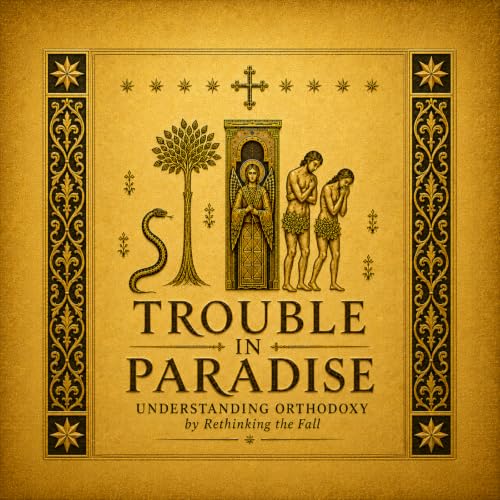
『Trouble in Paradise - Understanding Orthodoxy by Rethinking the Fall』のカバーアート

Trouble in Paradise - Understanding Orthodoxy by Rethinking the Fall

Trouble in Paradise - Understanding Orthodoxy by Rethinking the Fall

著者: Matthew Lyon
無料で聴く

【Amazonプライム会員限定】今ならプレミアムプランが4か月 月額99円。

10月19日まで。※適用条件あり

Trouble in Paradise: Understanding Orthodoxy by Rethinking the Fall is a Christian theology podcast exploring Eastern Orthodoxy, Orthodox Christianity, Original Sin, Genesis, the Fall, and the beliefs of the early Church.

Trouble in Paradise isn't just about the trouble in Eden. It's about the trouble that begins when we import foreign ideas into the biblical text—ideas that shape how we understand sin, human nature, salvation, and the Christian life in ways the biblical authors never intended. Through Scripture, biblical theology, historical theology, the Church Fathers, and personal experience, each episode examines how rethinking the Fall reshapes the entire Christian story.

Whether you're Protestant, Catholic, Orthodox, or simply curious about the history of Christian doctrine, this podcast offers thoughtful conversations about Scripture, the Church Fathers, salvation, grace, free will, theosis, and the Orthodox understanding of the Christian faith. Its goal is to help Christians understand Eastern Orthodoxy by revisiting the assumptions that have shaped Western Christianity and returning to the world of the inspired biblical authors and the early Church.

Matthew Lyon 2026
キリスト教 スピリチュアリティ 哲学 社会科学 聖職・福音主義
エピソード
  • Put to Death? What Is Earthly? What Does That Mean?
    2026/09/03

    Episode 24 —

    Put to Death? What Is Earthly? What Does That Mean?

    What does Paul mean when he tells us to “put to death what is earthly”?

    After becoming Orthodox, I found that one of the hardest things to communicate to my Protestant friends was the Orthodox understanding of the Fall. It isn't simply a matter of learning a different doctrine. You have to begin imagining the human condition from a different starting point.

    In this episode, I explore a central question:

    What if death is not merely the consequence of human sin, but one of the great forces driving human sin?

    We are mortal creatures. Our bodies are designed to preserve our lives in a world where we die. Hunger, sexuality, fear, the desire for security, the accumulation of resources, and our instinct to protect ourselves are not inherently evil. They are part of embodied human life.

    But what happens when these legitimate bodily systems become our masters?

    Paul's language about the mortal body, its desires, the flesh, sin reigning, and obedience gives us a way to understand this. The problem isn't that the body has desires. The problem is when the mind takes those desires and decides that they tell us what we ought to do.

    And Paul says:

    “For the mindset of the flesh is death, but the mindset of the Spirit is life and peace.” —Romans 8:6, LEB

    We also look at Hebrews' startling claim that Christ came to free humanity from slavery caused by the fear of death, and what this tells us about Satan's role in human depravity.

    From there, we explore:

    • What Paul means by “what is earthly”
    • The meaning of Paul's language of “members” and the mortal body
    • The relationship between bodily systems and moral deliberation
    • Why hunger, sexual desire, and the desire for security aren't inherently sinful
    • Blameless and blameworthy passions in St. Maximus the Confessor
    • St. John Chrysostom's understanding of marriage and sexual desire
    • Augustine's different trajectory regarding concupiscence and inherited guilt
    • Why death → life is such a dominant pattern in Paul's theology
    • Baptism as participation in Christ's death and Resurrection
    • Why Paul repeatedly connects Resurrection with Christian holiness
    • How monasticism and marriage can both be understood within the horizon of Resurrection
    • Why Orthodox fasting, almsgiving, and prayer train us to subordinate bodily desires rather than simply eliminate them
    • The Didache and its two ways: the way of life and the way of death
    • Why Satan's great weapon is not the creation of our natural desires, but the exploitation of our fear of death
    • Why Christ being our Life changes the entire moral calculation

    The central question of the episode is ultimately very simple:

    If we have died with Christ and been raised with Him, why would we continue living as though death were our master?

    The Christian life is not about becoming less human, less embodied, or less alive.

    It is about learning to live according to a new reality:

    The appetite is not your lord. Fear is not your lord. Security is not your lord. Survival is not your lord. Death is not your lord. Christ is your Life.

    And because Christ has risen, we can finally learn how to live rather than merely how to survive.

    続きを読む 一部表示
    46 分
  • Dark Matter Season 2: Before All Worlds - Leibniz, the Multiverse, and Original Sin
    2026/08/19

    Episode 23 —

    Dark Matter Season 2: Before All Worlds

    Leibniz, the Multiverse, and Original Sin

    What if the multiverse isn't really about other universes—but about finding another version of ourselves?

    With Season 2 of Dark Matter approaching, Matthew revisits the first season and follows its central ideas into an unexpected theological territory: Original Sin, the Fall, Leibniz's “possible worlds,” the problem of evil, repentance, guilt, grief, and the fear of death.

    Why this world?

    Leibniz's attempt to answer that question helped give us the concept of theodicy and his famous argument that God chose the best of all possible worlds. But what happens when that philosophical idea is transformed into the modern multiverse?

    Instead of asking why this world contains suffering, we can imagine countless worlds where things happened differently.

    A world where Adam didn't fall.

    A world where Eve made another choice.

    A world where you never made the decision you regret.

    A world where you never experienced the loss that changed your life.

    And perhaps, somewhere, a version of you got everything right.

    But is that salvation?

    Matthew explores the possibility that the modern multiverse functions as a kind of secularized return to Eden—a way of imagining another world in which repentance isn't necessary because another version of ourselves already made the right choices.

    The episode also draws a surprising parallel with the multiverse response to the argument from design: rather than answering why this particular universe appears ordered or fine-tuned, multiplying universes can make the question of design seem unnecessary. Likewise, multiplying possible worlds can make the problem of why this fallen history exists appear to disappear.

    But perhaps the deeper problem isn't theodicy at all.

    Perhaps it is death.

    Because in Dark Matter, Jason isn't really searching for another universe. He's searching for the life he lost.

    And that's something much more familiar than quantum physics.

    It's grief.

    It's the human desire to undo what cannot be undone—to find the version of ourselves that existed before the fall, before the mistake, before the loss.

    Hebrews gives Christianity a radically different diagnosis: humanity is held in “slavery” through the fear of death.

    And Christianity's answer isn't another universe.

    It isn't another version of yourself.

    It isn't finding the Adam who never fell.

    It is resurrection.

    続きを読む 一部表示
    23 分
  • Adam, the Fall, and Assurance of Salvation
    2026/08/12

    Episode 22 —

    Orthodoxy and Assurance of Salvation

    What happens to assurance of salvation when you become Orthodox?

    For many Protestants, this is one of the biggest obstacles to considering Orthodoxy. In this episode, I share why it was one of my biggest questions as well—and why I eventually realized that Orthodoxy isn't simply giving a different answer to assurance. It's asking a different question altogether.

    We'll explore:

    • Why assurance is the logical conclusion of a particular understanding of the Fall.
    • How Calvinism and the Wesleyan tradition, despite their disagreements, share many of the same assumptions about original sin, the human will, and salvation.
    • Why the Orthodox Church begins with union with Christ rather than guaranteed perseverance.
    • The role of Baptism as an objective union with Christ—not merely a symbol of a prior experience.
    • Why Christ's command to "abide in Me" becomes central to the Orthodox understanding of the Christian life.
    • How the early Church Fathers, especially St. Cyril of Jerusalem, describe God's gracious initiative and man's genuine response.
    • Why Ephesians 2 may be emphasizing humanity's bondage to sin, death, and the devil more than constructing a doctrine of total inability.
    • Why assurance ultimately depends on where we place our confidence.

    Rather than grounding assurance in ourselves, Orthodoxy directs our eyes to Christ—the One who united us to Himself, continually calls us to repentance, feeds us with His own Body and Blood, and remains faithful.

    Scripture Discussed

    • Genesis 1:31
    • Matthew 16:24
    • John 15:1–10
    • Acts 2:38
    • Romans 6:3–5
    • Romans 11:22
    • 1 Corinthians 10:12
    • Galatians 3:27
    • Colossians 1:21–23
    • Ephesians 2:1–5

    Historical Figures Mentioned

    • St. Cyril of Jerusalem
    • St. Augustine
    • Martin Luther
    • John Calvin
    • John Wesley
    • George Whitefield
    • Charles H. Spurgeon
    • Paul Washer
    • James H. Brookes
    • St. John Chrysostom

    Mentioned Resources

    • R.C. Sproul, The Pelagian Captivity of the Church
    • The Westminster Confession of Faith (1646)
    • The 1689 London Baptist Confession
    • St. John Chrysostom's Paschal Homily

    If this episode was helpful, please consider subscribing and sharing it with someone exploring Orthodoxy. If you have questions or topics you'd like me to cover in future episodes, I'd love to hear from you.

    Christ is risen!

    続きを読む 一部表示
    35 分
adbl_web_anon_alc_button_suppression_t1
まだレビューはありません