エピソード

  • The direct deposit lesson: why HR survives every automation wave
    2026/08/11

    Summary
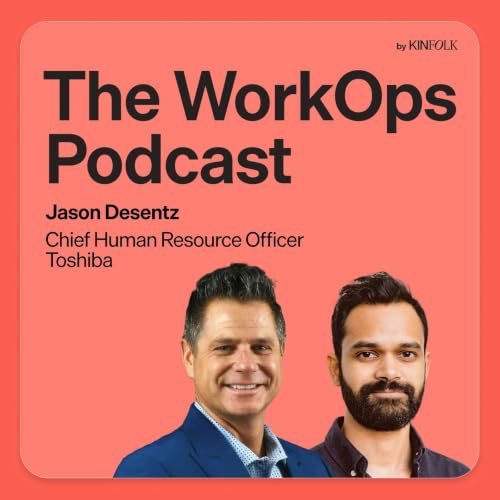
    What happens when a CHRO treats AI like a brainstorming wall instead of a threat? In this episode of The WorkOps Podcast, host Jeet Mukherjee sits down with Jason Desentz, Chief Human Resource Officer at Toshiba America, to unpack why AI is an enhancement story, not a replacement story. Jason shares the history lesson behind his optimism, from direct deposit to factory robots to Ford's reversed AI layoffs, then goes inside Toshiba's HR Shark Tank, where cross functional teams built working Copilot agents like Payroll Princess and Time Tamer in 60 days. He also lays out his two goalpost framework for every AI decision and warns about the integration trap that could fragment HR tech stacks all over again. A practical conversation for HR and operations leaders who want to experiment with AI without disrupting the business.

    Chapters
    00:00 Introduction
    01:45 From police academy to CHRO
    05:50 Why AI will deepen HR expertise instead of replacing it
    08:50 The direct deposit lesson
    13:55 Starting small with proof of concept
    16:35 Inside Toshiba's HR Shark Tank
    20:00 Build, borrow, or bot
    21:30 The two goalposts and the integration trap
    28:55 FOBO and getting people AI ready
    32:55 From curious to cautious

    Takeaways

    -AI will change how HR work looks, not whether it exists. Like computers, direct deposit, and factory robots before it, it enhances the function and creates new work.

    -Start small instead of trying to do everything at once. Pick one proof of concept and give it a full cycle, a year to 18 months, before judging whether it worked.

    -Cross functional experimentation multiplies value. Toshiba's HR Shark Tank mixed payroll, field HR, business partners, and L&D to build real -Copilot agents on top of their day jobs.

    -Every AI decision has to pass two goalposts: little to zero disruption to the business and a genuine improvement to the employee experience.

    -Watch the integration trap. HR spent 15 years consolidating eight systems down to three, and bolting on AI point solutions risks recreating the same fragmentation.

    Connect with the Guest
    LinkedIn: https://www.linkedin.com/in/jason-desentz/
    Website: https://www.toshiba.com/


    Sponsor
    This episode is brought to you by Kinfolk, the AI service desk built for HR.

    See more at kinfolkhq.com

    続きを読む 一部表示
    36 分
  • Why SurveyMonkey moved payroll into HR
    2026/08/04

    Summary

    Payroll problems were blowing up Slack channels at SurveyMonkey, and employees weren't taking them to finance. In this episode of The WorkOps Podcast, host Jeet Mukerji talks with Becky Cantieri, Chief People Officer at SurveyMonkey, about the decision to hit the blow-up button and move payroll out of finance and into HR, how a willing CFO and one simple question (who is willing to talk to the employee?) made the handoff a slam dunk, and why the defining skill for HR leaders right now is metabolizing change: finding signal in noise fast enough to prioritize, pivot, and keep up in the AI era. A practical listen for people leaders, HR operations teams, and anyone rethinking who should own the employee experience.

    Chapters

    00:00 Cold open

    01:16 From the Nordstrom sales floor to CPO

    06:37 Fifteen years of reinvention

    09:26 Metabolizing change

    14:22 The payroll problem

    18:31 Winning over the CFO

    21:44 Rebuilding the team

    28:03 The AI champion at SurveyMonkey

    32:51 Refusing to wait in the AI queue

    35:21 Permission, capability, agency

    Takeaways

    -Employees don't think in org charts. When something breaks, they go to whoever usually answers, so design ownership around the employee experience, not department history.

    -The team willing to talk to employees should own the employee-facing function. SurveyMonkey moved payroll into HR when it became clear finance didn't want those conversations.

    -Make handoffs safe with data: SurveyMonkey's HR team committed to SLAs and email volume reporting while banking controls stayed with finance.

    -The defining HR skill right now is metabolizing change: finding signal in noise fast enough to prioritize, pivot, and keep up with AI.

    -Metabolizing is teachable. It starts with curiosity, a growth mindset, and the willingness to throw out a process you built and are proud of.

    Connect with the Guest

    LinkedIn: https://www.linkedin.com/in/rebecca-cantieri-85654a/

    Website: https://www.surveymonkey.com


    Sponsor

    続きを読む 一部表示
    37 分
  • The three levels of work: Where AI belongs, and where it never will
    2026/07/28

    Summary

    What happens when a CEO hands unlimited AI access to every employee, and adoption still stalls? In this episode of The WorkOps Podcast, host Jeet Mukerji sits down with Kimberly Nerpouni, Global VP of People & International Operations at Pearl, the parent company of JustAnswer. Kimberly shares why AI transformation is a human enablement problem rather than a technology problem, how her People Ops team built Pearl's AI accelerator and a 1 to 10 adoption scale with no bad scores, and her three levels of work framework for deciding what AI should absorb first. She also explains the feedback facilitator agent her team is building, the hard line she draws (AI never gives feedback, it helps managers facilitate it), and why PIPs don't exist at Pearl. This conversation is for people leaders, HR teams, and anyone navigating AI adoption inside their organization.

    Chapters

    00:00 Introduction

    00:45 From IT manager to people operations

    04:25 JustAnswer, Pearl, and human plus AI

    06:15 Inside Pearl's AI accelerator

    10:55 Build, buy, or borrow

    13:15 The three levels of work

    17:05 AI that facilitates feedback instead of giving it

    19:50 The AI agent hub and transparency

    23:35 Why PIPs don't work and what replaces them

    35:05 Don't wait, just do

    Takeaways

    -AI adoption is a human enablement problem, not a technology problem, and people ops is uniquely positioned to lead it.

    -Move AI into level one work first, the tasks that don't require your expertise, so your team can focus on level two and level three work.

    -Build, buy, or borrow: piloting with AI startups can reveal exactly what's worth building bespoke in-house.

    -AI should facilitate feedback conversations by scanning context and prompting managers, but it should never give the feedback itself.

    -Front-load clarity with job descriptions, career ladders, and employee-owned development plans so PIPs are never needed.

    Connect with the Guest

    LinkedIn: https://www.linkedin.com/in/kimberlypignolet/

    Website: https://www.pearl.com


    Sponsor
    This episode is brought to you by Kinfolk, the AI service desk built for HR.

    See more at kinfolkhq.com

    続きを読む 一部表示
    35 分
  • When Your HR AI Pilot Works Too Well to Stay a Pilot
    2026/07/23

    Summary

    What happens when your AI pilot works too well to stay a pilot? In this episode of The WorkOps Podcast, host Jeet Mukerji talks with Ivan Nosov, Head of HR Tech and Global Total Rewards Director at Campari Group, about taking AI in HR from proof of concept to production. Ivan shares why he started with Copilot Studio knowing it wouldn't last, where RAG breaks down at enterprise scale, and how his team built a digital twin router app on Claude that loads only the context each question needs. He also lays out the adoption playbook that made it stick: winning over regional directors and COE champions first, running hackathons for awareness, and addressing the work people hate instead of the work they love. A practical conversation for HR, people ops, and workplace technology leaders navigating AI transformation.

    Chapters

    00:00 Introduction

    01:30 From IT engineer to HR leader

    03:45 Should AI transformation sit in HR or IT

    05:55 How non technical HR can get started

    07:20 Copilot Studio as a proof of concept tool

    09:30 Harness, routing, and the limits of RAG

    15:00 Building the digital twin router app on Claude

    17:40 Context engineering and distilling tacit knowledge

    19:30 Winning adoption through champions

    29:55 The future of junior roles and build versus buy

    Takeaways

    • Start with the accessible tool to prove the concept, then move on. Copilot Studio validated Campari Group's AI ideas, but production required control over the harness that abstracted platforms can't offer.
    • Routing beats RAG at scale. Loading only the relevant context for each question makes AI more targeted, more efficient, and far less likely to hallucinate.
    • Campari Group's digital twin runs on Claude with deliberate model selection: Sonnet for efficiency, Haiku for helper queries, and Opus for final artifacts because of its design taste.
    • Adoption spreads through champions. Win over regional directors and COE heads first, stay with them until the outputs click, and they will share it further than any rollout plan.
    • Context engineering is the real work. Distill tacit knowledge into a compact, unambiguous knowledge base: 250,000 tokens in total, with no session loading more than 50,000.


    Connect with the Guest

    LinkedIn: https://www.linkedin.com/in/ivan-nosov/

    Website: https://www.camparigroup.com/

    Sponsor
    This episode is brought to you by Kinfolk, the AI service desk built for HR.

    See more at kinfolkhq.com

    続きを読む 一部表示
    36 分
  • Job Security, Not Role Security: How to Future-Proof a Workforce
    2026/07/21

    Summary

    What happens to careers when AI makes more than half of all roles look fundamentally different within two years? In this episode of The WorkOps Podcast, host Jeet Mukergi sits down with Lisa Sherwell, Chief People Officer at SUSE, to unpack her answer: strive for job security, not role security. Lisa shares how SUSE's Future Selves program transformed engagement for its over 50 workforce, why internal gigs are the new engine of career growth, and why performance management fails not because of broken processes but because leaders avoid honest conversations. A practical, candid conversation for HR leaders, people operations professionals, and executives navigating the AI era.

    Chapters

    00:00 Introduction

    01:15 From sales and call centers to chief people officer

    02:30 Building commercial curiosity in HR

    04:15 Future Selves: investing in the over 50 workforce

    07:00 Job security vs role security

    08:55 Hiring for AI potential, not expertise

    10:30 How SUSE rolled out AI across the business

    16:45 Running HR for 8% less while delivering more

    24:30 Performance is a clarity problem, not a process problem

    33:00 A new playbook for the AI era

    Takeaways

    -Strive for job security, not role security: broad competencies and internal mobility protect people as AI reshapes their roles.

    -More than half of all roles could look fundamentally different within two years, so career agility is now a core business responsibility.

    -SUSE's Future Selves program proved that investing in the over 50 workforce lifts engagement, internal mobility, and community, while preserving invaluable business context.

    -Performance is a clarity problem, not a process problem: honest meets, fails, exceeds conversations beat new ratings scales and OKR frameworks.

    -Ownership of performance belongs with the individual contributor, because nobody cares more about your career growth than you do.

    Connect with the Guest

    LinkedIn: https://www.linkedin.com/in/lisasherwell/

    Website: https://www.suse.com


    Sponsor
    This episode is brought to you by Kinfolk, the AI service desk built for HR.

    See more at kinfolkhq.com

    続きを読む 一部表示
    35 分
  • High agency, low ego, and the future of HR at Tubi
    2026/07/17

    Summary

    On this episode of The WorkOps Podcast, host Jeet Mukergi sits down with Natasha Valani, Chief People Officer at Tubi, the number one free ad-supported streaming service in the US. Natasha shares how her people team built a live calibration tool in Replit in just two days, connecting it back to Workday and saving roughly two weeks during year end review season. The conversation goes well beyond one tool: Natasha unpacks how she hires for high agency and low ego, why subtraction is her favorite leadership discipline, and how she sees junior and people roles evolving as AI takes on more of the routine work. It's a practical, candid look at running a lean, builder-minded HR function, ideal for people leaders, HR practitioners, and anyone rethinking how their team operates in the AI age.

    Chapters

    0:45 Welcome and Natasha's story

    1:45 From 26 schools to belonging and the people space

    3:45 Building a culture where everyone builds

    6:45 Hiring for high agency and low ego

    9:45 The year end calibration problem

    10:45 The two day tool built in Replit

    15:45 Why build instead of buy

    19:45 Trade-offs and the power of subtraction

    21:45 The honest gap, headcount management

    26:45 The future of junior roles in the AI age

    Takeaways

    -You don't need a vendor RFP to solve an HR problem. Someone who knows the guts of the process built a live calibration tool in Replit in two days and connected it to Workday, saving roughly two weeks.

    -High agency is the differentiator in the AI age. Natasha screens for it with one question: tell me about a time you built a solution nobody asked you to.

    -Pair high agency with low ego. Stay curious and ask questions, but don't assume nothing good existed before you.

    -Subtraction is a strategy. Force-rank priorities, openly showcase what you removed, and protect your team's bandwidth by refusing to do everything.

    -Junior roles won't disappear, they'll shift. The people closest to the guts of a workflow become operational advisors and orchestrators, and AI still needs a human eye to catch the slop.

    Connect with the Guest

    LinkedIn: https://www.linkedin.com/in/natasha-valani-1758a418/

    Website: https://tubitv.com


    Sponsor
    This episode is brought to you by Kinfolk, the AI service desk built for HR.

    See more at kinfolkhq.com

    続きを読む 一部表示
    30 分
  • This Isn't an AI Revolution. It's a Human Revolution.
    2026/07/16

    Summary

    Carmel Smith, Director of People Operations and Programs at Tenstorrent, joins host Jeet Mukerji on The WorkOps Podcast to make the case that the AI moment is really a human one. Fresh off building people operations inside a company that grew headcount 43% past 1,300 employees, Carmel explains why she's rebranding her team from "people operations" to system architects and experience creators, why she refuses to mandate AI or track tokens and agents, and what she means when she says she's leading a human revolution rather than an AI one. It's a refreshingly optimistic, practical conversation for HR and people leaders, operations teams, and anyone trying to bring humans along through rapid change.


    Chapters

    00:00 Cold open, the scary part of getting AI right

    00:45 Meet Carmel Smith and Tenstorrent

    03:45 From people operations to system architects

    06:45 Why she never mandates AI

    07:45 The painting lesson and psychological safety

    11:45 Leading a human revolution

    12:45 People data as an open source foundation

    20:45 Redefining productivity beyond AI ROI

    30:45 The monthly hackathon her leader defends


    Takeaways

    -HR's real identity shift is internal: help your team see themselves as system architects and experience creators, not process executors, and their confidence follows.

    -Mandating AI backfires. Counting tokens, hours, and agents produces box checking, not rethinking. Curiosity, safety, and a genuinely excited leader scale far better.

    -AI rewards the most human skills. Having strong opinions and articulating them clearly matters more than technical knowledge, because the systems part is the easy part.

    -Don't track ROI on AI directly. If it's implemented well it bleeds into everything, so measure faster processes, redesigned workflows, and reduced fear instead.

    -Protect creative time on purpose. A defended monthly hackathon, even when the output fails, changes how a team works by redefining what productivity means.


    Connect with the Guest

    LinkedIn: https://www.linkedin.com/in/carmelmoyal/

    Website: https://tenstorrent.com

    Disclaimer: The views and opinions expressed here are my own and do not reflect the official policy or position of Tenstorrent.

    Sponsor
    This episode is brought to you by Kinfolk, the AI service desk built for HR.

    See more at kinfolkhq.com

    続きを読む 一部表示
    33 分
  • Kate Stewart reveals the trade secrets on building AI for HR tasks
    2026/07/07

    Summary

    On this episode of the WorkOps Podcast, host Jeet Mukergi talks with Kate Stewart, Staff People Operations, AI and Automations Lead at Horizon3.ai, about what really happens when you put an AI agent into a live people-operations workflow. Kate shares the story of the offer-validation agent she built in Slack to check every job offer against approved comp bands and job architecture, how a Slack update broke it after two months, and the two weeks she spent secretly becoming the agent herself to keep the quality bar from slipping. Along the way she unpacks why a hallucinating agent is more dangerous than a silent one, why automation raises the bar instead of lowering it, and how to ship, break, and maintain automations without burning out. It's a candid, practical listen for anyone in people ops, HR tech, or operations moving from curiosity about AI to actually running it in production.

    Chapters

    00:00 From the retail floor to people ops

    06:30 Staying curious without a second job

    07:45 The broken process behind every offer

    09:45 Building the offer validator in slack

    11:45 Two months in, the agent breaks

    12:45 Becoming the human agent

    13:45 Why a hallucinating agent is a liability

    14:55 Automation raises the bar

    15:45 From perfectionism to shipping V1

    28:45 Build it, let it break, protect the time

    Takeaways

    -When an automation breaks, you don't fall back to your old baseline, you fall below it, because automation raises the bar for what your team considers acceptable

    -A silent agent is confusing, but a hallucinating agent is a liability, a confident wrong answer is far more dangerous than no answer at all

    -Job architecture is not a data hygiene problem, it is an IT provisioning problem, the wrong title in the HRIS means the wrong system access on day one

    -Build one agent to do one job at the right moment, rather than spreading the same check across three people and three separate touchpoints

    -Ship V1, let it break, and protect the time to maintain it, the build teaches you the problem and the break teaches you what you actually built

    Connect with the Guest

    LinkedIn: https://www.linkedin.com/in/kate-stewart00/
    Website: https://www.horizon3.ai


    Sponsor
    This episode is brought to you by Kinfolk, the AI service desk built for HR.

    See more at kinfolkhq.com

    続きを読む 一部表示
    31 分