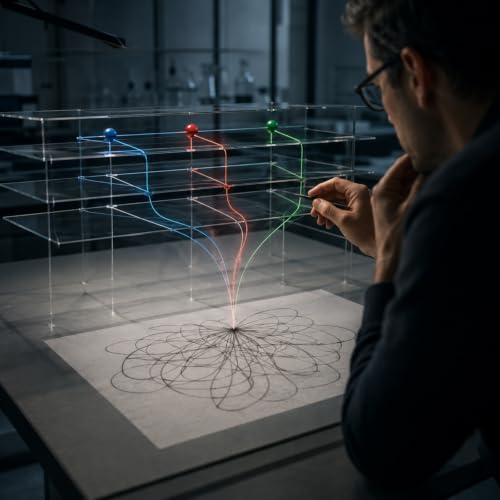
『The Void Dynamics Model Podcast』のカバーアート

The Void Dynamics Model Podcast

The Void Dynamics Model Podcast

著者: Justin Lietz
無料で聴く

What if physics could audit its own ideas in code?

Void Dynamics Model Podcast is an approachable audio series about building a testable physics-and-cognition framework in public. Each episode is a solo talk or fireside chat that walks one idea, then ties it to a measurable check. The problem: big theories often stay vague, so it is hard to know what would falsify them. VDM focuses on “gated” work, meaning pre-set pass/fail tests with saved logs. You will hear how models are turned into small experiments, how results get documented, and where the open questions still are. If you like sharp thinking without heavy math, this is low-commitment and high signal.

Email — justin@neuroca.ai

Zenodo Community — https://zenodo.org/communities/void-dynamics-model/records?q=&l=list&p=1&s=10&sort=newest

Zenodo Phase Calculus — https://zenodo.org/communities/vdm-phase-calculus/records?q=&l=list&p=1&s=10&sort=newest

Zenodo Cognitive Runtime — https://zenodo.org/communities/vdm-cognitive-runtime/records?q=&l=list&p=1&s=10&sort=newest

Academia.edu — https://independent.academia.edu/justinlietz

YouTube — https://www.youtube.com/@NeurocaAI

Medium — https://medium.com/@jlietz93

X — https://x.com/quantumjunk

LinkedIn — https://www.linkedin.com/in/justinlietz1993/

Active VDM Repo — https://github.com/justinlietz93/Prometheus_VDM.git

Neuroca, Inc 2026
科学
エピソード
  • 77. Cortex: The Mathematical Engine That Never Forgets
    2026/07/26

    Modern computing survives by forgetting.

    Files are overwritten, simulation states are discarded, and precision slowly erodes as systems advance.

    This episode explores a radically different possibility: a mathematical engine that preserves its history without drowning in memory, accumulating rounding error, or relying on an external clock. At its center is the QBL recurrence and the Orthad, a self-determining geometric architecture in which each state selects its own next operation, completed layers remain permanently embedded, and new complexity grows without erasing what came before.

    We trace the engine from its first primitive steps through Fibonacci growth, dual overlapping charts, exact billion-tick execution, compact wordless state, and the emergence of complex behavior from only three internal operations. Along the way, the discussion reaches beyond software into physics, engineering, biological memory, and a deeper question:

    What would computation look like if the past did not need to be destroyed to create the future?

    Cover Art Credits: Hajdú Gábor https://www.facebook.com/photo.php?fbid=10232942602619671&set=pb.1604049865.-2207520000&type=3

    続きを読む 一部表示
    48 分
  • 76. Mathematics: Phase Calculus and the Jacobian Paradox
    2026/07/26

    What looks like chaos may actually be the shadow of a system whose history has been discarded.

    This episode explores Phase Calculus, projection-loss accounting, and the surprising connection between deterministic physical systems and the 2026 Jacobian counterexample. It follows a single structural idea across physics and pure mathematics: distinct realities can collapse into the same visible state when orientation, branch history, completed turns, or sheet identity are removed from the record.

    The discussion moves from apparently unpredictable motion to lifted states, retained coordinates, reconstruction ladders, and the difference between local regularity and global recoverability. Three distinct mathematical inputs can produce the same visible output, just as orderly higher-dimensional paths can appear tangled and ambiguous when flattened onto a lower-dimensional surface.

    The central lesson is simple but far-reaching: unpredictability does not always indicate randomness. Sometimes the system remains exact, while the observer has thrown away the information required to reconstruct it.

    A deep dive into hidden structure, mathematical memory, formal verification, and the possibility that many forms of “chaos” are failures of bookkeeping rather than failures of order.

    続きを読む 一部表示
    36 分
  • 75. Cortex: When Mathematics Became the Universe
    2026/07/21

    What if reality did not begin with particles, space, or even time?

    This episode follows a single retained mathematical object governed by three primitive operations as it builds increasingly complex structure from its own internal recurrence. Beginning with a flat line of exact relations, the system reaches a decisive transition where two-dimensional geometry opens, phase curvature propagates as light, and persistent topological defects form the first matter-like structures.

    From there, the same underlying geometry develops the symmetry patterns associated with the weak and strong forces, fractional charge structure, and confinement. Nothing is placed inside a pre-existing universe. The relations become space, their causal succession becomes time, their phase motion becomes radiation, and their retained knots become matter.

    It is a step-by-step exploration of a remarkable possibility: that the physical world may be the visible consequence of pure mathematics repeatedly acting on itself.

    続きを読む 一部表示
    46 分
adbl_web_anon_alc_button_suppression_t1
まだレビューはありません