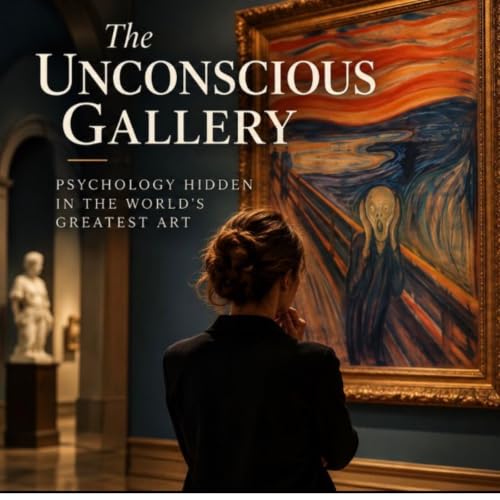
エピソード

  • Salvador Dalí: The Man Who Painted His Dreams
    2026/10/11
    Why did Salvador Dalí paint melting clocks, distorted bodies, and landscapes that seem to exist somewhere between dreams and reality? Fascinated by Sigmund Freud and the unconscious mind, Dalí believed that irrational images could reveal psychological truths hidden beneath ordinary awareness. In this episode of The Unconscious Gallery, we explore the psychology of surrealism, the meaning of Dalí’s most famous paintings, and how dreams became the foundation of his extraordinary artistic vision.
    続きを読む 一部表示
    4 分
  • The Kiss — Where Do I End and You Begin?
    2026/10/04
    Gustav Klimt’s The Kiss appears to capture the perfect moment of romantic surrender, but psychologically, intimacy is rarely that simple. The painting raises a deeper question about love: how close can we become to another person without losing our own identity? Through a psychodynamic lens, The Kiss becomes a study of intimacy, fusion, boundaries, and our unconscious desire to become completely known by another person.
    続きを読む 一部表示
    3 分
  • Nighthawks: The Loneliness of Being Together
    2026/09/28
    Edward Hopper’s Nighthawks shows four people sharing a brightly lit diner, yet somehow each appears profoundly alone. The painting captures a psychological paradox: physical proximity does not necessarily produce emotional connection. Through a psychodynamic lens, Nighthawks becomes a portrait of isolation, guardedness, and the human longing to be known without risking the vulnerability of being known.
    続きを読む 一部表示
    4 分
  • “Saturn Devouring His Son: The Terror of Being Replaced”
    2026/09/24
    Francisco Goya’s Saturn Devouring His Son is one of Western art’s most disturbing images, but its psychological power extends far beyond its violence. The painting transforms an ancient myth into something intimately recognizable: the fear that what comes after us may eventually replace us. Through a psychodynamic lens, Goya’s Saturn becomes an unsettling exploration of possession, envy, aging, aggression, and the destructive side of attachment.
    続きを読む 一部表示
    5 分
  • Uncontained: Why The Scream Isn’t Just Anxiety
    2026/09/24
    Edvard Munch’s The Scream is usually described as an image of anxiety, but that explanation barely begins to account for its disturbing power. The painting captures something more psychologically complicated: the moment when an emotion no longer seems to exist inside us but appears to have overtaken the world around us. Through a psychodynamic lens, The Scream becomes an exploration of anxiety, psychological boundaries, and what happens when the mind can no longer comfortably contain what it feels.
    続きを読む 一部表示
    5 分
  • Imposter Syndrome in Stay-at-Home Fathers: Societal and Internal Barriers to Perceived Parental Competence
    5 分