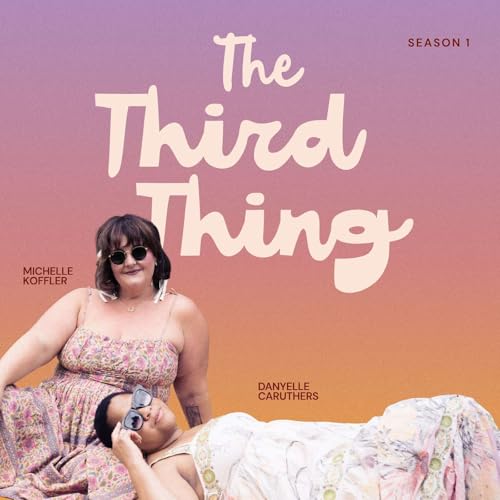
『The Third Thing』のカバーアート

The Third Thing

The Third Thing

著者: Michelle Koffler & Danyelle Caruthers
無料で聴く

【Amazonプライム会員限定】今ならプレミアムプランが4か月 月額99円。

10月19日まで。※適用条件あり

A podcast Hosted by Michelle & Danyelle: a coach and a therapist, an interracial and queer best friend pair of 26 years. The Third Thing is where we are naming and confronting the topics that challenge us in platonic relationships. On friendship and race, money, sobriety, politics, when we drift or breakup, and the jealousy nobody admits to. Each week we spill the tea from our hurdles, and offer up the tools we’ve learned along the way.


© 2026 The Third Thing
人間関係 社会科学
エピソード
  • S2E17: What to Do When You Don't Like Your Friend's Partner
    2026/09/24

    Every relationship or friend group has had this moment: your favorite person is dating someone you can't stand. Maybe it's just a values mismatch, or maybe it's something heavier from controlling behavior to verbal abuse, or worse. Either way, the question is the same: what's actually your job here, and where's the line between being a good friend and trying to run someone else's relationship?

    This week Danyelle and Michelle share the times they got this wrong, one who stayed quiet, one who rallied a full "intervention" campaign, and spoiler alert - neither ended up well. From there, they map out what actually helps: leading with curiosity instead of judgment, naming impact instead of verdicts, and knowing when "I don't love your partner" needs to become a real safety conversation.

    In This Episode

    • Why "I don't click with your partner" usually isn't yours to fix or fully voice
    • The therapist line, "They're the unit now", that uno-reversed Michelle's plan
    • Leading with impact on you ("I feel uncomfortable when...") instead of judgment of them
    • Why you're allowed to set limits on time together without trying to end the relationship
    • The psychology of why we're drawn to familiar, sometimes unhealthy, relationship patterns
    • How to name concerning behavior without ultimatums or forcing a choice
    • Setting up a code word or safety check-in
    • National Domestic Violence Hotline: 1-800-799-7233, text START to 88788, or chat at thehotline.org

    Reflection Questions

    • Is my discomfort about their safety, or about my own values and preferences?
    • Am I trying to help my friend, or trying to be right?
    • Have I made it safe for my friend to come to me if things get worse?
    • Where's a boundary I could set for myself instead of trying to change their relationship?

    Resources Mentioned

    • Our Boundaries workbook — available at thethirdthingpod.com
    • National Domestic Violence Hotline — 1-800-799-7233 / text START to 88788 / thehotline.org

    Connect With Us
    📸 Instagram: @thethirdthingpod
    🌐 Website: TheThirdThingPod.com
    🎧 Join our Patreon community for monthly events, deeper conversations, early access, workbooks, and more.

    If this episode resonated with you, share it with a friend and leave a rating or review. It helps more people find the show and keeps the conversation about friendship, growth, and what it means to show up for each other going.

    Support the show

    続きを読む 一部表示
    41 分
  • S2E16: Are You a Good Friend to Yourself? On Self-Abandonment and People-Pleasing
    2026/09/17

    You already know how to show up for a friend: feed them a home cooked meal, celebrate their wins or birthdays, meet their tears with grace. Now flip it around and look at how you treat yourself when no one's watching.

    This episode moves from the external work of friendship into the internal: what's actually happening in your nervous system when you people-please, fawn, or go quiet to keep the peace. Danyelle and Michelle break down people-pleasing as a form of self-abandonment, trace it back to IFS "parts" and protector instincts, and get honest about where they still do it from bridesmaid budgets to bracing for a partner walking through the door.

    In This Episode

    • Why people-pleasing in friendship is often self-abandonment in disguise
    • IFS parts work: how protective parts formed to keep you safe, and why they can outlive their usefulness
    • Fight, flight, freeze, and fawn: naming fawning as a nervous system response, not a personality trait
    • Real stories: avoidance as a people-pleasing pattern, the maid-of-honor budget squeeze, and the "jolt off the couch" reflex
    • Choosing a restaurant as a low-stakes place to practice saying what you actually want
    • The pause-and-reframe tool for catching yourself mid-pattern
    • How secure, "I got you" friendship still leaves room to say what isn't working
    • Tarot pull: Knight of Wands — charging forward while staying in communication with yourself

    Reflection Questions

    • Where in your life does people-pleasing show up as avoidance rather than agreement?
    • What's one relationship where you'd benefit from naming a feeling out loud instead of letting it build?
    • If your best friend heard your internal dialogue about yourself, would they recognize it as kind?
    • Where do you already have a boundary you haven't set yet?

    Resources Mentioned

    • "No Bad Parts" by Richard C. Schwartz
    • TTT workbooks on attachment style, non-violent communication, and boundaries — available at thethirdthingpod.com

    Connect With Us
    📸 Instagram: @thethirdthingpod
    🌐 Website: TheThirdThingPod.com
    🎧 Join our Patreon community for monthly events, deeper conversations, early access, workbooks, and more.

    If this episode resonated with you, share it with a friend and leave a rating or review. It helps more people find the show and keeps the conversation about friendship, growth, and what it means to show up for each other going.

    Support the show

    続きを読む 一部表示
    40 分
  • S2E15: "I Give More Than I Get" - On One Sided Friendship
    2026/09/10

    Everybody has that friend who remembers the birthdays, plans the trips, sends the text first or the friendship where they're the one always reaching out (which one are you?). Naming that out loud feels uncomfortable no matter which side you're on. But what if the imbalance you're keeping score of isn't actually about being cared for less?

    Michelle and Danyelle get into one-sided friendships and offer up a unique framework: over-functioning invites under-functioning, and neither role is good or bad. Rather, they're often trauma responses playing out in real time. Danyelle traces her under-functioning back to staying small and not taking up space; Michelle traces her over-functioning back to her mom's constant giving and a lifelong need to prove she's worthy of love. They connect this to attachment styles from Season 1, talk honestly about a friend who went quiet on Michelle for two months, and dig into capacity...how illness, parenthood, and life stage all shape what each person can actually show up with, and why that's not the same as how much they care. They close on delegation, love languages (and why Michelle can't stand that term), and a Tower-and-Sun pull about what has to fall apart before things get lighter.

    In This Episode:

    • The framework: over-functioning invites under-functioning, and both are often nervous system responses
    • Tracing over/under-functioning back to childhood and family patterns
    • Connecting this to attachment styles — anxious and over-functioning, avoidant and under-functioning
    • A real-time story: reaching out to a friend six times over two months with no response, and choosing not to take it personally
    • Capacity as a spectrum, and why it's not a measure of love
    • Chronic illness, capacity, and living in a world that assumes able-bodiedness
    • Learning to ask for what you need instead of resenting what isn't given
    • Closing tarot pull: The Tower and The Sun

    Reflection Questions:

    • Are you the over-functioner or the under-functioner in most of your friendships and does that shift depending on who you're with?
    • Is there a friendship where you've been keeping score without saying so out loud?
    • Where in your life is capacity, not love, the real limiting factor?

    Resources Mentioned:

    • Lena Dunham's Fame Sick
    • The Third Thing workbooks: thethirdthingpod.com

    Connect With Us:
    📍 Instagram: @thethirdthingpod
    🌐 Website + workbooks: thethirdthingpod.com
    💛 Join the community on Patreon

    Support the show

    続きを読む 一部表示
    41 分
adbl_web_anon_alc_button_suppression_t1
まだレビューはありません