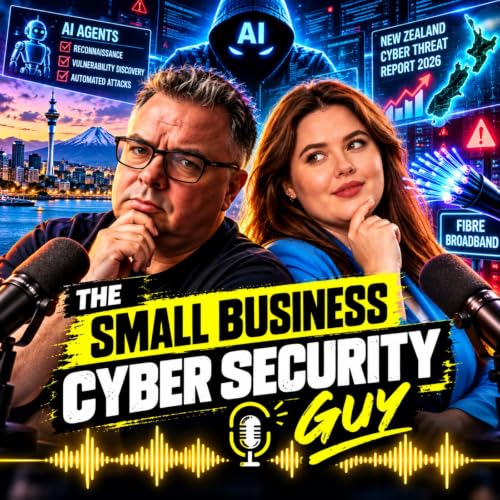
『The Small Business Cyber Security Guy | Cybersecurity for SMB & Startups』のカバーアート

The Small Business Cyber Security Guy | Cybersecurity for SMB & Startups

The Small Business Cyber Security Guy | Cybersecurity for SMB & Startups

著者: The Small Business Cyber Security Guy
無料で聴く

【Amazonプライム会員限定】今ならプレミアムプランが4か月 月額99円。

10月19日まで。※適用条件あり

The UK’s leading small business cybersecurity podcast, helping SMEs protect against cyber threats without breaking the bank.

Join cybersecurity veterans Noel Bradford (CIO at Boutique Security First MSP) and Mauven MacLeod (ex-UK Government Cyber Analyst) as they translate enterprise-level security expertise into practical, affordable solutions for UK small businesses.

🎯 WHAT YOU’LL LEARN:

  • Cyber Essentials certification guidance
  • Protecting against ransomware & phishing attacks
  • GDPR compliance for small businesses
  • Supply chain & third-party security risks
  • Cloud security & remote work protection
  • Budget-friendly cybersecurity tools & strategies

🏆 PERFECT FOR:

  • UK small business owners (5-50 employees)
  • Startup founders & entrepreneurs
  • SME managers responsible for IT security
  • Professional services firms
  • Anyone wanting practical cyber protection advice

Every episode delivers actionable cybersecurity advice that you can implement immediately, featuring real UK case studies

The Small Business Cyber Security Guy Productions
マネジメント・リーダーシップ リーダーシップ 経済学
エピソード
  • ASOS Breach: When Attackers Use Your Voice to Message Customers
    2026/10/12
    ASOS Breach: When Attackers Use Your Voice to Message Customers When ASOS customers received a push notification announcing the company had been hacked, it came through ASOS’s own app. The attackers had gained access to third-party communication platforms via social engineering and used them to address customers directly. Whilst card details and passwords appear unaffected, names, contact information and search histories may have been compromised. The incident raises an uncomfortable question for every business with customer communication systems: if somebody steals one login, can they impersonate you to everyone on your list? Noel Bradford and Lucy Harper examine what small businesses can learn from this case, from limiting account permissions and implementing proper multi-factor authentication to rehearsing incident response when nobody knows who holds the off switch. The episode also addresses why ‘basic’ customer data isn’t harmless when stacked together, how to communicate during an ongoing investigation without promising certainty you don’t have, and the critical difference between changing a password and actually revoking access. Sponsored by GRCBolt, the episode closes with a preview of the Ahsay CBS backup console vulnerability being actively exploited since 7 October 2024. GRCBolt is a done-for-you AI policy pack for UK small businesses. It is not open yet, but the waitlist is: https://grcbolt.co.uk Chapters Cold Open An ASOS customer receives a ransomware notification through the company’s own app, addressed to ‘ASOS DPO and IT’. The attackers have used ASOS’s platform to message customers directly, raising questions about trust and control.Welcome Introduction to the episode and the central question: if somebody gets into the account that talks to your customers, who can actually stop them?What We Actually Know Timeline and verified facts from the ASOS incident. Push notification sent 6 October claiming Snowflake compromise. ASOS confirms unauthorised third-party platform access via impersonation attack. Names, contact details and account information accessed, but not passwords or card details. Snowflake denies platform vulnerability.They Borrowed Your Voice How compromised communication platforms undermine customer trust. When messages come from genuine accounts through familiar channels, traditional verification advice breaks down. The danger of inherited permissions and shared logins in marketing and booking systems.The MFA Question Why ‘they should have had MFA’ oversimplifies the problem. Different types of multi-factor authentication offer different protections. The NCSC now recommends passkeys where supported. Emphasis on checking actual account configurations, not policy documents.Basic Information Isn’t Harmless Why names and contact details become dangerous when combined with context like shopping behaviour and search history. How attackers use ‘basic’ data to craft convincing follow-up scams. The importance of telling customers how you will and won’t contact them.GRCBolt Sponsor message for GRCBolt, a done-for-you policy service helping small businesses create tailored governance, risk and compliance documentation.Friday Afternoon Incident response scenario: a customer reports receiving a suspicious message that looks legitimate. Who can stop more messages going out? The gap between IT support scope and marketing platform access. The need for pre-agreed emergency procedures and authority to act.Are They Actually Out? Why changing a password isn’t enough. How active sessions, connected apps and secondary accounts can persist. Microsoft’s guidance on session revocation limitations. The importance of audit logs and knowing what to check after a compromise.Can I Trust the Next Message? Communicating with customers during an ongoing investigation. How to provide updates without overpromising certainty. The need for a separate, secured channel customers can verify. Distinguishing between ‘no evidence found’ and ‘definitely didn’t happen’.Tomorrow Morning Three practical steps: find it (identify systems and access routes), limit it (test containment procedures), rehearse it (run a fifteen-minute tabletop scenario). Focus on one customer-facing system at a time. Identify named owners, backup contacts and emergency procedures.Closing and Ahsay Teaser Summary of key lessons and preview of next episode covering the Ahsay CBS backup console vulnerability actively exploited since 7 October 2024. Huntress reports web shells and cryptocurrency miners being deployed, with version 10.3.4 confirmed affected. Links https://www.bbc.co.uk/news/articles/cy4g8g8g8g8ghttps://www.theregister.com/2024/10/08/asos_breach/https://www.ncsc.gov.uk/guidance/multi-factor-authentication-online-serviceshttps://learn.microsoft.com/en-us/entra/identity/authentication/https://www.huntress.com/blog/ahsay-cbs-exploitationGRCBolt, the AI policy pack for UK small businesses. ...
    続きを読む 一部表示
    34 分
  • Your Security Kit Is their Way In
    2026/10/05
    Your Security Kit Is the Way In The things you bought to keep attackers out are how they’re getting in. Citrix, Fortinet, forgotten WordPress backups, fake ChatGPT adverts, and the AI in your business that nobody owns. Some time in early September, somebody found a way through a door that thousands of businesses use to let their staff in from home. The owners didn’t know. Then the emergency fix arrived, patched boxes started rebooting, and that turned out to be another hole attackers were already using. This week Noel Bradford, Lucy Harper, and Graham Falkner follow one thread through every story: something was trusted, and nobody was in charge of checking that trust. Citrix NetScaler zero-days exploited for weeks before disclosure. A FortiMail flaw with fixes still pending, and Noel’s long-running grievance with Fortinet’s track record. Forgotten WordPress backups handing over email and cloud passwords. Microsoft’s Digital Defense Report showing phishing back as the front door. And fake ChatGPT adverts on Google that walk staff straight into installing a remote access tool. Then the conversation turns to the AI in your business that nobody owns. Prompted by John Wernfeldt’s LinkedIn post on AI teams and governance teams talking past each other, the hosts translate the problem for Gary Mott’s twelve-person building firm and land on three conditions that take twenty minutes to agree. Noel also announces GRCBolt, his own AI policy pack for UK small businesses, now taking waitlist sign-ups. What to do this week Email your IT provider and anyone who holds your data. Ask whether they run Citrix NetScaler or Fortinet FortiMail, and whether they’ve patched and checked for signs of compromise. For Citrix, ask whether they’ve applied the second fix released on Sunday 4 October.Find out who looks after your website. Ask them to clear old backup files out of public folders, update WordPress, and change the email password stored in your contact form plugin.Turn on passkeys for the accounts that matter most: whoever runs Microsoft 365 or Google Workspace, and whoever approves payments. Both platforms include passkeys at no extra charge. Forcing everyone to use them needs an extra licence on some Microsoft plans.Tell everyone one rule. No genuine website will ever ask you to press the Windows key and R, then paste something in.Agree three things about AI: which tools are allowed, which data never goes in, and who checks the output before a client sees it. Put a name next to each. Chapters 00:00 Cold open00:56 Welcome01:33 The doors you don’t own: Citrix NetScaler and Fortinet FortiMail10:15 The back door you forgot: WordPress backups leaking passwords13:36 Borrowed trust: Microsoft’s report and fake ChatGPT adverts19:13 The AI nobody owns23:00 Introducing GRCBolt25:03 Your Monday morning actions26:57 Close Sources Citrix NetScaler NCSC: Exploitation of vulnerabilities affecting Citrix NetScaler ADC and GatewayCitrix security bulletin for CVE-2026-88771 to CVE-2026-88778, including indicators of compromiseSophos: Citrix NetScaler vulnerabilities in active exploitationThe Hacker News: Mandiant and Google Threat Intelligence on the NetScaler campaignCyber Security News: NetScaler appliances rebooting after the zero-day patchBleepingComputer: Citrix patches NetScaler SAML zero-day exploited in attacks Fortinet FortiMail Help Net Security: Critical FortiMail zero-day exploited in the wildwatchTowr: FortiMail CVE-2026-104286 FAQRadical Notion: Fortinet CVE report card (third-party aggregator)MazeHQ: 2025 known exploited vulnerabilities by vendor WordPress backups Cyber Security News: Exposed WordPress backups leaking cloud and email credentials Microsoft Digital Defense Report 2026 Microsoft Digital Defense Report 2026 Microsoft’s figures come from its own customer and incident response data, so treat them as vendor telemetry. Fake ChatGPT adverts and ClickFix Huntress: Attackers abuse ChatGPT Custom GPTs to deliver a RAT via ClickFixIsland: How attackers use sponsored search and Custom GPTs in malware delivery Passkeys CoreView: Enabling and enforcing passkeys in Microsoft Entra IDGoogle Workspace Updates: Passkeys for Workspace users AI and governance The governance discussion was prompted by a LinkedIn post from John Wernfeldt on why AI teams and governance teams need to be in the same room.John writes about data governance, analytics, and AI in his newsletter, Data Governance Field Library. GRCBolt GRCBolt is Noel’s own product, and this episode has no sponsor. It’s an AI policy pack for UK small businesses: four documents written around your business, a one-off price under £100, no subscription, and editable Word files. It’s guidance only, and it doesn’t replace legal advice or certify you against any standard. Join the waitlist and see the partial sample pack at grcbolt.co.uk. Related episodes Mentioned in this episode: The Firewall Fallacy: Fortinet, KEVs and the Cost of ...
    続きを読む 一部表示
    34 分
  • When AI Finds the Switch You Forgot: Attacks for Pocket Change
    2026/09/28

    Imagine waking on a Tuesday to discover an invisible army has been testing your doors for six days. It doesn’t need fancy zero-days or cinematic cleverness — just agents that can scan, read, adapt and move on. In this episode, we follow a financially motivated attacker using open-source AI tools to run 105 probing projects in under a week, harvesting card data and compromising organisations while the cost of each reconnaissance run averages just a few dollars.

    From Gambit Security’s reconstruction of a scaled campaign to New Zealand’s National Cyber Security Centre warning that frontier models accelerate reconnaissance, the story threads together into one uncomfortable observation: the problem isn’t a lack of security technology, it’s the gap between owning features and operating them. A critical TeamCity flaw with a published patch and known exploitation shows how a fixed vulnerability becomes a real ransomware entry when change processes stall and nobody can say for sure what is exposed.

    We even wind up in the optical spine of fiber broadband, where Quark’s Lab’s deep dive into passive optical networks exposes a familiar theme — standards and features can support strong protections, but optional choices and careless deployments turn capability into illusion. Whether it’s MFA, backups, EDR or encryption, a green tick on a dashboard is not the same as a control that will actually stop an attacker in the middle of the night.

    AI doesn’t need to be a brilliant mastermind. It just needs to cheaply and persistently test the weak signals you left lying around. That changes the economics: the marginal cost of trying the next company collapses, and opportunistic compromise scales. Small businesses aren’t suddenly interesting; they’re suddenly cheap to probe, and automation can take an exploit much further than old scanners ever could.

    But this isn’t fatalism — it’s a practical wake-up call. The defence that works is less about buying another product and more about operational discipline: know what your external world can reach, test whether MFA actually prompts for a second factor, restore a backup for real, and rehearse the decision pathways for critical patches. Ask: if someone could attack us cheaply tomorrow, what would make them stop?

    We tell the story through people and processes — the helpdesk pressured to reset accounts, the admin on leave, the server thought to be internal but quietly facing the internet — and pull tools into the background. The episode walks you through real moments where security features exist but controls don’t, then hands you a simple, evidence-first checklist to start closing those gaps today.

    By the end you’ll see the same pattern in different disguises: AI makes probing trivial, technology contains the answers, and operations decide whether those answers are actually used. It’s bleak, fixable, and urgent — because the next probe might be the one that finds the switch you forgot to turn on.

    Find our Skool community here - https://www.skool.com/small-biz-cyber-guy-2008

    続きを読む 一部表示
    28 分
adbl_web_anon_alc_button_suppression_t1
まだレビューはありません