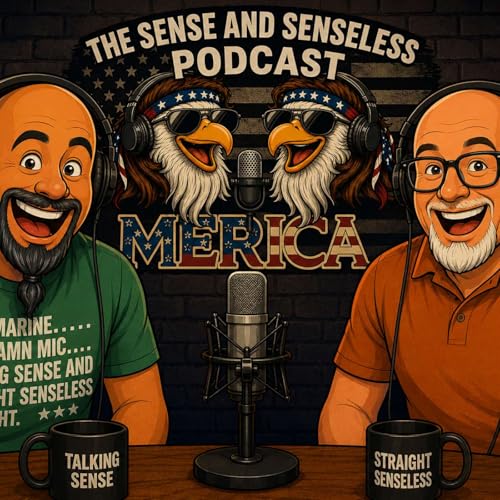
『The Sense and Senseless Podcast』のカバーアート

The Sense and Senseless Podcast

The Sense and Senseless Podcast

著者: Bryan Mayon Jason Hedrick
無料で聴く

Just two average guys making below average sense of the world. Fun and informative.2026 Bryan Mayon, Jason Hedrick 政治・政府 政治学
エピソード
  • EP: 72 Cheap Labor to $770 Car Notes and Why We’re All Still Underwater
    2026/09/01

    In this episode of The Sense and Senseless Podcast, Bryan and Jason start with a dirty vacation condo and end up tracing 400 years of American cheap labor.Bryan noticed the cleaning crew did a mediocre job even though a cleaning fee was paid. That observation launched a discussion about how cheap labor pools change over generations. New immigrant groups typically arrive desperate, work extremely hard, accept low pay and bad conditions, then gradually realize they are being overloaded and underpaid. Quality drops. They organize or move into better jobs, and employers simply replace them with the next group that has even less bargaining power.The episode walks through a simplified historical chain: indentured servants, Irish canal and railroad workers, Chinese railroad laborers, Italians in urban trades, successive waves in the garment industry, Eastern Europeans in steel and meatpacking, the Bracero Program, and today’s undocumented agricultural and construction labor. The pattern is consistent — shortage or walkout by the previous group, wage suppression, eventual replacement. Workers often turn their anger on the new arrivals instead of the employers who benefit.The conversation then turns to the modern welfare state. Government assistance is supposed to be a temporary ladder. Instead, the benefit cliff means earning a little more can leave a family worse off. Meanwhile, large corporations in the “Low-Wage 20” (Walmart, Amazon, Target, Dollar stores, restaurant chains, etc.) pay median wages so low that many of their 6.7 million U.S. workers qualify for SNAP and Medicaid. Taxpayers effectively subsidize corporate payrolls while CEO-to-worker pay ratios average 899-to-1.The episode closes with personal-finance reality checks: most Americans cannot cover a $1,000 emergency from savings, credit-card balances average $6,500–$7,700, and new-car payments have climbed to $770 a month with 70-month (sometimes 84-month) terms. Many buyers are rolling thousands of dollars of negative equity into the next loan.Bryan and Jason argue the cheap-labor cycle never really ended — it just changed costumes. The real fight isn’t between ethnic groups; it’s over whether wages and conditions will ever be allowed to rise enough that ordinary people can stay above water. #SenseAndSenseless #CheapLabor #WageGap #WelfareCliff #LowWage20 #CorporateWelfare #EmergencySavings #CarPayments #AmericanHistory #ImmigrationLabor #Podcast

    続きを読む 一部表示
    1 時間 4 分
  • EP: 71 Everyone Has an Angle: China, Israel, and Who Recruits Your Kids
    2026/08/31

    On this episode of The Sense and Senseless Podcast, Bryan and Jason start with documented claims that China-linked accounts used AI to seed anti-U.S. data-center messaging—then ask why that story gets amplified when most local opposition is grassroots over power prices, land, and environment. They use that as a lens for media bias: hosts rarely invent everything, but they spin hard, and listeners have to check the other side instead of only hunting for flaws. The conversation then turns to Israel and the United States. They walk through the Christian Zionist media tradition (Robertson, Falwell, and later Levin, Hannity, Shapiro, Beck, Huckabee) that framed Israel as indispensable to American survival, and they ask whether that is evidence-based conviction or institutional interest. Clips cover alleged influence on U.S. elections and policy. From there they go to college campuses: why every major faction recruits there (AIPAC-aligned groups included), why they want loud advocates rather than independent thinkers, and why TPUSA mattered. Charlie Kirk’s organization was the biggest conservative campus machine and an early Israel supporter; later comments from Candace Owens, Megyn Kelly, Tucker Carlson and others claimed he cooled on that support at the same time youth polling showed collapsing backing for Israel. Bryan offers his own (clearly labeled) speculation about Kirk’s death and the message it sent. They also play clips of officials praising Netanyahu, Trump on U.S. weapons in Gaza, and a historical segment on nuclear and political leverage. The through-line: agendas, recruitment of the young, media spin, and why uncritical “holy land” loyalty is getting harder to sell as images and numbers change. Listener caution: this is two hosts connecting public reporting, clips, and opinion—not a legal brief.

    #SenseAndSenseless #IsraelUS #TPUSA #CampusPolitics #MediaBias #AIPAC #DataCenters #FreeSpeech #CharlieKirk #ForeignInfluence #ChristianZionism #YouthVote

    続きを読む 一部表示
    1 時間 7 分
  • Ep: 70 $40 Trillion_$3 Billion a Day in interest_and loss faith in the Dollar
    2026/08/30

    Six months into the U.S.–Iran war, Bryan and Jason walk through the money first and the strait second.

    Iran’s population is widely reported to be short on fuel and food. The hosts stress they do not support Iran and love the United States; the target is government policy and an unpopular war.

    The federal books: national debt already in the $40 trillion range and rising. Interest runs about $3–3.2 billion a day. Collections are roughly $14.4 billion a day ($5.26 trillion a year). Spending is about $19.3 billion a day (~$7 trillion a year), so the government borrows on the order of $4.9 billion every day. Ten-year sketches put debt near $64 trillion and annual interest near $2.1 trillion; twenty-year sketches run $80–120 trillion.The dollar’s value still rests on two pillars: oil priced in dollars (the petro-dollar) and global faith that the United States will stand behind the currency. The war strains the first. Growing debt, talk of large Treasury buybacks, and weak foreign appetite for bonds strain the second. Clips cover collapsing confidence, a “Treasury Ponzi” framing of buybacks, and Bessent telling countries to cut ties with Iran, warning that no country is above the rules, and floating an “economic D-Day.” The world’s reported response is to hang up. If sanctions fail, military intervention is on the table.

    JD Vance compares reserve-currency status to the Appalachian resource curse—extracting value while hollowing out the place that produces it. The hosts ask whether the current dollar system is doing that to American workers.

    They analogize federal finance to revolving credit and to the wealthy “Buy, Borrow, Die” strategy: hold assets, borrow against them, never sell, never settle up in one lifetime. Washington holds a growing tax base, rolls Treasuries forever, and bets that reserve status, bond buyers, growth, and inflation keep the burden from exploding. That is selling tomorrow to fund today.On Hormuz, officials say the U.S. controls the waterway and sees every inch. Traffic graphs and tracker data (including Kpler, Aug 1–19, 2026) show a sharp drop and a majority of ships—especially oil and gas carriers—going dark or using unknown routes. Oil still moves via night shuttles and ship-to-ship transfers. Whether the strait is “open” depends on the definition: pre-war volumes of 15–20 million barrels a day have not returned; some flow continues at lower averages. CENTCOM cites tens of millions of barrels blocked or stranded (figures from ~69 million on 41 tankers up to 100 million-plus). The U.S. has also seized millions of barrels.

    Energy importers blame the war that started in late February 2026 for higher oil, food, and shipping costs. Trump told them in March to get their own oil. U.S. producers have gained volume while the Strategic Petroleum Reserve has been used to cushion domestic prices. The hosts support selling American energy but argue celebrating a broken world market makes the country look like a tyrant—and tyrants eventually stand alone. A fight, if it comes, will be paid for by ordinary people, not the loudest voices. With only about 30% public support, they argue Washington should pause and fix conditions at home.

    #SenseAndSenseless #USDebt #NationalDebt #PetroDollar #StraitOfHormuz #IranWar #Treasury #ScottBessent #JDVance #BuyBorrowDie #Dollar #Oil #Sanctions #Podcast #Geopolitics #Economy

    続きを読む 一部表示
    1 時間 28 分
adbl_web_anon_alc_button_suppression_t1
まだレビューはありません