• Legacy Is Built in Moments | Rabbi Daniel Cohen
    2026/11/11

    What does a rabbi know about building a profitable Christian business? More than you might think.

    Rabbi Daniel Cohen served for over 20 years as a senior rabbi in Stamford, Connecticut. He is the author of "What Will They Say About You When You Are Gone? Creating a Life of Legacy" and his newest book, "The Secret of the Light". He joins Doug to talk about what legacy really means for a business owner of faith, and why it is built in ordinary moments, not milestones.

    In this episode:

    • Why a good name is worth more than wealth, and what King Solomon said about it
    • "Destination disease": the trap of postponing your life for the next milestone
    • How to reverse engineer your life before a crisis forces you to
    • The 3-minute daily practice: one minute of gratitude, one minute of prayer, one minute to make somebody's day
    • The 3.5 seconds that can change a life, and the Sloan Kettering doorman who proved it
    • Why growth happens in the valley, not on the mountaintop
    • The 94-year-old COVID survivor who finally learned what one day's breath is worth

    Connect with Rabbi Daniel Cohen:

    Website: https://www.rabbidanielcohen.com
    Books: "What Will They Say About You When You Are Gone? Creating a Life of Legacy" and "The Secret of the Light": https://www.rabbidanielcohen.com/books
    The Legacy Academy: https://thelegacyacademy.getlearnworlds.com/
    Verse he prays with, Isaiah 40:31: https://www.biblegateway.com/passage/?search=Isaiah+40%3A31&version=NIV

    Mentioned on the show: Zig Ziglar on "destination disease"; King Solomon on a good name (Proverbs); Psalm 30:1: https://www.biblegateway.com/passage/?search=Psalm+30%3A1&version=NIV

    Ready to turn good intentions into daily execution? Get clarity, set your 90-day goal and track your needle movers with Goal Getting: https://goalgetting.app

    Subscribe for weekly conversations with Christian business owners building businesses that honor God.

    続きを読む 一部表示
    24 分
  • You Might Be Chasing the Wrong Goal | Amanda VanDerHeiden
    2026/10/22

    Are you working hard toward a goal you do not actually want? Amanda VanDerHeiden joins Doug Greathouse to talk about finding your real why, turning it into daily action, and getting back on track when life interrupts. Amanda brings a secular goals-and-habits framework; Doug brings his perspective as a Christian business owner. They explore common ground without pretending their foundations are the same.

    They discuss the five-whys exercise, accountability partners, the value of being both a mentor and a mentee, and why consistency only helps when you practice the right thing. Amanda also shares a free workbook to help listeners put the ideas into action.

    Guest workbook: https://gogtds.com

    Turn your next step into action with Goal Getting: https://goalgetting.app

    続きを読む 一部表示
    47 分
  • Curative Culture: How Christian Leaders Build Workplaces People Want to Stay In | Douglas Shaw
    2026/09/23

    What does it actually feel like to work for you?

    You can put Christian values on your website.

    You can talk about servant leadership.

    You can say people come first.

    But your employees experience your culture every single day—and their experience may tell a very different story.

    In this episode of the Profitable Christian Business Podcast, Doug Greathouse sits down with Douglas Shaw, author of Curative Culture: Stepping Away from a Toxic Workplace, to explore how leaders can build healthy, high-performing workplaces rooted in dignity, trust, accountability, purpose, and Christian values.

    Douglas says employees are constantly evaluating three things when they enter a workplace:

    Am I safe?

    Can I trust your intentions?

    Can I respect you?

    Those questions reveal far more about your real culture than a mission statement hanging on the wall.

    Douglas also challenges the idea that healthy culture means soft leadership.

    A curative culture still demands excellence.

    It still requires accountability.

    It still requires difficult conversations.

    And sometimes it requires removing someone—even a high performer—to protect the rest of the organization.

    In one of the strongest stories from the episode, Douglas explains why he hesitated to deal with two highly productive but toxic employees. A consultant finally challenged him: if leadership continued tolerating their behavior, the rest of the company would assume leadership approved of it.

    Douglas acted.

    The employees left.

    And something unexpected happened:

    Other people began to flourish.

    In this episode:
    • What Douglas means by Curative Culture
    • How nature helped inspire the idea behind the book
    • How quickly you can sense whether a workplace feels healthy
    • The three questions employees silently ask
    • Why leadership owns culture
    • How Christian leaders should think about the Imago Dei
    • Why treating employees with dignity does not eliminate accountability
    • How Douglas handled an employee he initially wanted to fire
    • Why understanding context can change a difficult personnel decision
    • How a firing can sometimes become a blessing
    • Why healthy culture isn't "soft"
    • How culture affects retention and profitability
    • Why toxic high performers can damage the entire organization
    • Why what leaders tolerate becomes part of the culture
    • How to improve culture starting with leadership self-awareness
    • Why leaders should ask, "How do I want it to feel to work here?"
    • Why values must be embodied instead of simply written down
    • How servant leadership changes the use of power
    • Why great leaders ask questions instead of always making pronouncements
    • How leaders can stay connected to employees
    • How Douglas maintained culture after his company went remote
    • Why remote teams still need intentional in-person connection
    • Why asking employees for their opinions builds confidence
    • Why purpose can keep employees engaged longer than compensation alone

    Douglas ends with a powerful leadership challenge:

    Help employees understand what they are actually accomplishing through their work.

    Don't simply give people a job.

    Help them understand the mission they're part of.

    Connect with Douglas Shaw

    Doug Shaw Perspective:
    DougShawPerspective.com

    Douglas Shaw & Associates:
    DouglasShaw.com

    Book:
    Curative Culture: Stepping Away from a Toxic Workplace

    Turn Clarity Into Execution

    Knowing your culture needs to change isn't enough.

    The Goal Getting App helps entrepreneurs turn one important outcome into a focused 90-day goal, identify the needle-moving actions that matter, and consistently execute.

    Start Your Next 90 Days with Goal Getting

    続きを読む 一部表示
    1 時間 1 分
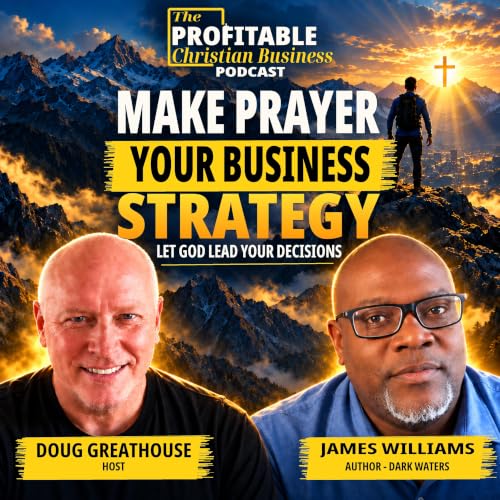
  • Partnering with God in Business: Prayer, Discernment and Spiritual Warfare with James Williams
    2026/09/30

    What does it look like to make prayer part of the way you run your business, rather than something you fit in after everything else?

    Doug Greathouse talks with James Williams, author, podcaster, speaker and creator of Dark Waters, about what James calls partnering with God in business. James shares how he organizes his day around prayer, learns to discern the Holy Spirit's direction, and makes room for faith when work feels overwhelming.

    The conversation moves into James's views on spiritual warfare, repentance, generational patterns, and the relationship between priesthood and kingship. Doug and James also discuss business setbacks, sacrifice, removing distractions, and praying for protection over a business and home.

    In this episode:
    - Making time for prayer when business feels overwhelming
    - Hearing God's voice through prayer, scripture and experience
    - James's perspective on repentance and generational patterns
    - Why James connects spiritual life with business leadership
    - Learning from business setbacks and trusting God
    - Removing distractions to make room for spiritual growth
    - The "gates of prayer" and James's biblical explanation
    - Praying for protection over your business and home

    CHAPTERS
    00:00 Introduction and welcome to James Williams
    01:40 Organizing the business day around prayer
    06:06 Overwhelm, sacrifice and partnering with God
    12:08 Hearing God's voice and discerning His direction
    21:37 Repentance and spiritual communication
    26:38 Generational patterns and the bloodline
    32:55 Priesthood, kingship and business leadership
    44:18 Removing distractions for spiritual growth
    49:17 The gates of prayer and their biblical basis
    54:35 Praying for protection over business and home
    01:06:32 Where to follow James and a possible part two
    01:08:22 Final challenge: make time to pray

    続きを読む 一部表示
    1 時間 10 分
  • AI Agents Doing the Work of a Hire
    2026/10/07

    What would it cost you each month to hire someone to build your software tools, run your research, and take your meeting notes? Doug Greathouse tells you what he pays for the same work: $135 a month.

    In this solo episode, Doug walks through what AI has actually done inside his business, with real costs and no hype. He shares the three jobs his AI tools handle today: building SEO, ads and social agents with Codex, a funding research agent built for a client, and an AI meeting notes pipeline. He is also honest about what AI does not do, and what it still takes from him: setup time and checking the work.

    Then the faith side. Using the Parable of the Talents in Matthew 25, Doug asks whether we are being faithful with the tools we have been handed, and why faithful means both putting tools to work and cutting the ones that do not earn their place.

    You will leave with a six-step assignment to find one repeatable task, price your own hour, test one AI tool for a month, and decide with real numbers.

    In this episode:

    • What $135 a month of AI buys in a real business
    • Three AI jobs: building agents, client funding research, meeting notes
    • Why a hire is not the same as a tool
    • Matthew 25 and stewardship of AI
    • A six-step weekly assignment

    Get clear on your next 90 days with Goal Getting: https://goalgetting.app
    More episodes: https://profitablechristianbusiness.com/profitable-christian-business-podcast

    続きを読む 一部表示
    5 分
  • Your 2027 Starts Now: One 90-Day Goal to Carry Into the New Year
    2026/10/28

    Your next year does not have to start from zero.

    In this solo episode of The Profitable Christian Business Podcast, Doug Greathouse challenges the idea that the year is already over. A 90-day goal started now can carry you through the holidays and into the new year with momentum.

    The framework is simple:

    • Get clear on one specific goal.
    • Make it uncomfortable but finishable in 90 days.
    • Choose two or three weekly needle movers.
    • Review honestly every week and adjust around the holidays.

    Doug also reflects on Psalm 90:12 and the difference between biblical rest and drift. The challenge: take 30 minutes before this week ends, write one goal in one sentence, put a finish date on it and do your first needle mover tomorrow.

    Explore Goal Getting: https://goalgetting.app

    If this helps, share it with one business owner who is already coasting toward January.

    続きを読む 一部表示
    3 分
  • Stop Blaming Your People: Fix the Systems That Are Breaking Your Business with Adam Ward
    2026/09/16

    What if the biggest problem inside your business isn't your people?

    What if it's the system you've asked them to work inside?

    In this episode of the Profitable Christian Business Podcast, Doug Greathouse sits down with organizational architect, executive coach, best-selling author, and transformation expert Adam M. Ward to explore organizational friction, systems thinking, sustainable growth, burnout, aggressive goal setting, and faith-driven leadership.

    Adam has spent more than 20 years diagnosing broken systems across multiple industries. He tells Doug that after doing this long enough, he can often spot organizational problems in about 30 seconds.

    One thing he looks for?

    Stacks.

    Stacks of inventory.

    Stacks of emails.

    Stacks of meetings.

    Stacks of projects.

    Anywhere work continually piles up can signal that part of the organization isn't flowing properly.

    But Adam makes an even stronger argument:

    "If you're blaming people, you have a system problem."

    Most employees don't come to work intending to fail. When capable people repeatedly depend on heroics, workarounds, phone-a-friend solutions, or constant firefighting just to get through the day, leadership needs to examine the environment those people have been given.

    In this episode:
    • What completing an Ultraman taught Adam about business transformation
    • Why you shouldn't ask a "couch potato" organization to immediately run an Ironman
    • How Adam defines organizational friction
    • Why different business problems require different improvement frameworks
    • How to recognize a system problem versus a people problem
    • Why Adam looks for "stacks" when diagnosing a company
    • How to prioritize when multiple systems are broken
    • Why revenue and profit are outputs—not the underlying processes
    • Why Adam says "money masks everything"
    • Why leadership humility determines whether transformation can happen
    • How to perform a simple internal systems audit
    • Why every company has more good ideas than it can execute
    • Why repetitive processes need documentation and continuous improvement
    • The difference between the entrepreneur who dreams and the operator who scales
    • Why startups need to transition from startup mentality to production mentality
    • Why broken systems—not simply workload—can cause burnout
    • Why leaders should ask frontline employees how to improve their own work
    • Adam's approach to aggressive but realistic goals
    • Why leaders underestimate what's possible long-term while overestimating what's possible short-term
    • Why progress should still be celebrated when a stretch goal isn't fully achieved
    • How Adam's Christian faith shapes the way he works with clients
    • Why character matters more than getting ahead
    • What it means to trust God when business outcomes aren't controllable
    • Why a friend once told Adam to put down the whiteboard and fast and pray
    • Adam's candid story about self-reliance, burnout, and eventually needing intensive recovery and pastoral care
    • Why successful leaders need accountability and Christian community
    • Adam's final challenge around integrity, vision, direction, and trusting God
    Free Organizational Diagnostic

    Adam offers a free 30-question organizational diagnostic on his website that provides immediate results.

    Adam M. Ward — Website & Free Diagnostic

    Stop Drifting. Start Executing.

    Once you know what needs to change, you still need to execute.

    The Goal Getting App helps entrepreneurs turn clarity into a focused 90-day goal, identify the needle-moving actions that matter most, and consistently execute.

    Start Your Next 90 Days with Goal Getting

    続きを読む 一部表示
    51 分