エピソード

  • In Memory of Ira Rutkow, author of Empire of the Scalpel: The History of Surgery
    2026/09/25
    Season 3 episode nine: Our September book was Empire of the Scalpel: The History of Surgery by the late Dr. Ira Rutkow.From his obituary: Ira Rutkow, age 77, beloved husband, father, and grandfather, passed away on January 16, 2026, two months after being diagnosed with advanced bile duct cancer. Born on October 13, 1948, in Newark, New Jersey, Ira dedicated his life to the practice of surgery and the study of medical and surgical history. After graduating from Union College (New York) he earned his medical degree from St. Louis University and trained as a general surgeon at Johns Hopkins. He went on to receive an MPH and doctorate from the Johns Hopkins Bloomberg School of Public Health, setting the stage for a remarkable career that blended clinical expertise with a passion for historical scholarship.Ira was an entrepreneur and innovator. In the mid-1980s, he established the Hernia Center, a novel approach to patient care that would serve as a model for countless practitioners. He built and oversaw a free-standing medical complex containing a full-service operating room. While running the Hernia Center, he developed and patented a mesh plug that became a standard approach for modern hernia repair. Surgeons from around the world trained with him at the Hernia Center to learn and adopt his method.In addition, Ira authored eight influential books, including his latest, Empire of the Scalpel: The History of Surgery (2022), which was an Editor's Choice in the New York Times Book Review. His other notable works include Seeking the Cure: A History of Medicine in America (2010); James A. Garfield (2006), part of Times Books' American Presidents series edited by Arthur M. Schlesinger, Jr; Bleeding Blue and Gray: Civil War Surgery and the Evolution of American Medicine (2005); American Surgery: An Illustrated History (1998); Surgery: An Illustrated History (1993), named a New York Times Notable Book of the Year; and a two-volume bibliography, The History of Surgery in the United States (1992 and 1988). He was not only a prolific author but also served as an editor for multiple surgical textbooks and contributed numerous articles to professional journals. Ira's achievements earned him several prestigious awards, including the American Medical Writers Association Medical Book Award (1998) and the Fletcher Pratt Literary Award of the Civil War Roundtable of New York (2005). He was inducted into the Johns Hopkins University Society of Scholars (2003) and awarded Union College's Founders' Medal (2007) as well as St. Louis University School of Medicine's Alumni Merit Award (2015). His passion for history and medicine will live on through his writings and the many lives he touched throughout his career.Ira was an avid collector of rare and unique surgical and hernia texts as well as nineteenth-century surgical instrument sets.Ira's warmth, humor, and wisdom will be remembered by his friends, colleagues, and his cherished family, including his wife of 54 years, Beth; children, Lainie and Eric; son-in-law, Adam Spira; daughter-in-law, Elizabeth Herman; and his beloved grandsons, Alex Spira and Benjamin Rutkow.With his wife Beth, Ira loved splitting his time between New York City and a farm in the Hudson Valley and spending time with friends and family. He will be dearly missed by all who knew him.Contributions in Ira's memory may be made to the hospice that cared for him in his final days, Gilchrist Center Towson (Maryland), or a charity of your choice.Some charities I found:Doctors without Borders - Provides emergency and surgical care in conflict zones and disaster areas.Lifebox - Works on making surgery safer worldwide, including getting pulse oximeters and safety training into operating rooms that lack them.American College of Surgeons - "Improving access to optimal surgical care for medically underserved communities through surgical service and education."Cholangiocarcinoma Foundation - "Providing hope for improved treatments and outcomes, for those affected by cholangiocarcinoma, also known as bile duct cancer."Gilchrist Center Towson - Hospice center from his obituary where Ira spent his final days.Hospice Foundation of America - "HFA supports individuals and families facing life-limiting illness, educates hospice and grief professionals, and conducts programs and research to improve care and empower informed medical decision making."Also, his alma maters, Union College, St. Louis University School of Medicine, and Johns Hopkins, all take gifts in someone's name.Advertising Inquiries: https://redcircle.com/brandsPrivacy & Opt-Out: https://redcircle.com/privacy
    続きを読む 一部表示
    5 分
  • It's Not Hysteria: Everything You Need to Know About Your Reproductive Health (But Were Never Told) with the author Dr. Karen Tang (BONUS)
    2026/09/22

    Welcome to a special BONUS episode, where I chat with an author about their nonfiction book that is morbidly curious book club adjacent, but it hasn't been a pick. Thus, a bonus episode!

    Did you know the book club is now an online indie bookstore?! Your one-stop shop for nonfiction. Grab a book club pick, subscribe to our book box, books featured on the podcast (like this one that you're listening to), YA/kids section, morbid cookbooks, and more! Check it out here: https://morbidlycuriousbookclub.myshopify.com/

    Join the book club here: https://www.morbidlycuriousbookclub.com/

    I sat down with the one and only Dr. Karen Tang to discuss her book, It's Not Hysteria: Everything You Need to Know About Your Reproductive Health (But Were Never Told)

    An inclusive and essential new resource for reproductive health--including period problems, pelvic pain, menopause, fertility, sexual health, vaginal and urinary conditions, and overall wellbeing--from leading expert and fierce advocate Dr. Karen Tang

    "Dr. Karen Tang is a literal godsend to women in a time still filled with great ignorance in medical research and financing of women's health initiatives. Please read her book, follow her on Instagram as I have, and feel blessed as I do to have an advocate for our body, our health, and our human rights." ―Sharon Stone

    Did you know that up to 90% of women experience menstrual abnormalities or pelvic issues in their lifetime? Yet these conditions are overwhelmingly misunderstood, misdiagnosed, or dismissed. The root causes for these issues, such as PCOS, endometriosis, fibroids, ovarian cysts, PMDD, or pelvic floor dysfunction, don't receive the stream of funding for research and new treatments that other conditions do, despite affecting up to half the population. Dr. Karen Tang is on a mission to transform how we engage with our bodies and our healthcare. It's Not Hysteria is a comprehensive guide to common conditions and potential treatment options, with practical tools such as symptom prompts and sample questions for your provider, to equip readers to take control of their gynecologic health. Reproductive healthcare, from abortion to gender-affirming care, is under siege. The onus continues to fall on patients to find and advocate for the care they need. In the face of uncertainty and misinformation, It's Not Hysteria is destined to become a new classic that educates and empowers women and those assigned female at birth.

    KAREN TANG, MD, MPH, is a board-certified gynecologist and minimally invasive gynecologic surgeon who is an internationally recognized leader in reproductive health. She received her medical degree and masters in public health at Columbia University, and trained in obstetrics and gynecology at Beth Israel Deaconess Medical Center / Harvard Medical School. As @KarenTangMD, she reaches millions of viewers with her educational videos about period health, pelvic pain, and reproductive rights. Dr. Tang has been featured in the New York Times, the Washington Post, NPR, Forbes, NBC News, and Oprah Daily, among other media outlets. She lives in the Philadelphia area with her husband and three children.


    Advertising Inquiries: https://redcircle.com/brands

    Privacy & Opt-Out: https://redcircle.com/privacy
    続きを読む 一部表示
    1 時間 11 分
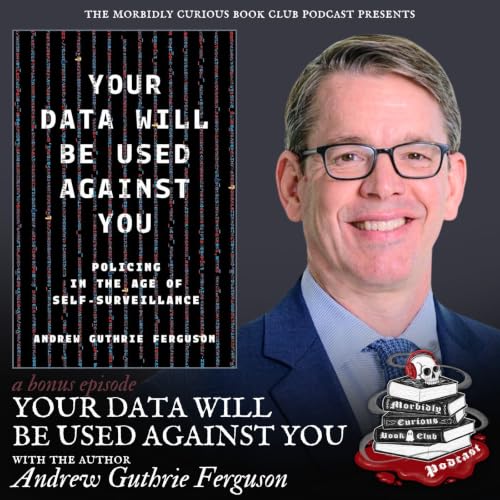
  • Your Data Will Be Used Against You: Policing in the Age of Self-Surveillance with the author Andrew Guthrie Ferguson (BONUS)
    2026/09/17

    Welcome to a special BONUS episode, where I chat with an author about their nonfiction book that is morbidly curious book club adjacent, but it hasn't been a pick. Thus, a bonus episode!

    Did you know the book club is now an online indie bookstore?! Your one-stop shop for nonfiction. Grab a book club pick, subscribe to our book box, books featured on the podcast (like this one that you're listening to), YA/kids section, morbid cookbooks, and more! Check it out here: https://morbidlycuriousbookclub.myshopify.com/

    Join the book club here: https://www.morbidlycuriousbookclub.com/

    I sat down with Andrew Guthrie Ferguson to discuss his latest book, and release it on Constitution Day: Your Data Will Be Used Against You: Policing in the Age of Self-Surveillance.

    For consumers living in a digitally connected world, smart technologies have built an inescapable trap of digital self-surveillance. Smart cars, smart homes, smart watches, and smart medical devices track our most private activities and intimate patterns. While these devices allow users to receive personal insights by monitoring their every move, that data can be accessed by police and prosecutors looking to find incriminating clues. Digital technology exposes everyone, everywhere, all at once, and we have few laws to regulate it.

    In Your Data Will Be Used Against You, Andrew Guthrie Ferguson warns us of how the rise of sensor-driven technology, social media monitoring, and artificial intelligence can be weaponized against democratic values and personal freedoms. At the same time, that data will solve crimes, radically transforming how criminal cases are prosecuted. Ferguson explores how this proliferation of private data in combination with public surveillance networks promises new ways to solve previously unsolvable crimes, but also leaves us vulnerable to governmental overreach and abuse. He argues for legal interventions that address the threat of digital self-surveillance and provides concrete suggestions about how legislators, judges, and communities should respond.

    As consumers, citizens, and potential subjects of surveillance, the questions in this book must be confronted now, before the trap of surveillance captures us completely. Providing a stark warning of the dangers of digital self-surveillance, Your Data Will be Used Against You is a defense of civil liberties against the growing threat of data-driven policing.

    Andrew Guthrie Ferguson is Professor of Law at George Washington University Law School. He is a national expert on new surveillance technologies, policing, and criminal justice. He is the author of the 2018 PROSE Award winning book, The Rise of Big Data Policing. He is an elected member of the American Law Institute.


    Advertising Inquiries: https://redcircle.com/brands

    Privacy & Opt-Out: https://redcircle.com/privacy
    続きを読む 一部表示
    49 分
  • The Museum of Lost Things: True Tales of Fabled Treasures, Legendary Cities, and Mythical Creatures That Vanished From History with the author Sam Kean (BONUS)
    2026/09/15

    Welcome to a special BONUS episode, where I chat with an author about their nonfiction book that is morbidly curious book club adjacent, but it hasn't been a pick. Thus, a bonus episode!

    Did you know the book club is now an online indie bookstore?! Your one-stop shop for nonfiction. Grab a book club pick, subscribe to our book box, books featured on the podcast (like this one), YA/kids section, morbid cookbooks, and more! Check it out here: https://morbidlycuriousbookclub.myshopify.com/

    Join the book club here: https://www.morbidlycuriousbookclub.com/

    I sat down with one of the best science writers out there, Sam Kean, with his new book, The Museum of Lost Things: True Tales of Fabled Treasures, Legendary Cities, and Mythical Creatures That Vanished From History

    Spanning a million years of history, the mysteries in these pages include fabled relics, legendary cities, mythical species, and undeciphered languages that have bedeviled seekers for centuries.

    Perhaps the single most common theme across all of history is loss. The loss of lands, loss of sacred objects, loss of languages, of rights, of life—the past groans with disappearances of all kinds. This enthralling narrative collects the most spellbinding tales of these experiences and weaves them into a thoughtful meditation on what it all means across the sweep of human history and the scope of human lives, including:

    • The long-lost city of Troy
    • The hidden tomb of Genghis Khan
    • The destruction of the fabled library of Alexandria
    • The near-destruction of the Mona Lisa and other art
    • The decipherment of ancient Egyptian hieroglyphs
    • The extinction—and potential resurrection—of dodos, mammoths, and other iconic species

    Provocative, surprising, and above all entertaining, this globe-trotting narrative acknowledges the sheer scale of humanity’s losses, celebrates the treasures we have managed to retain, and reveals why they continue to captivate us centuries later.

    Enjoy the episode, friends!


    Advertising Inquiries: https://redcircle.com/brands

    Privacy & Opt-Out: https://redcircle.com/privacy
    続きを読む 一部表示
    26 分
  • The Martians: The True Story of an Alien Craze that Captured Turn-of-the-Century America with the author David Baron (BONUS)
    2026/09/01

    Welcome to a special BONUS episode, where I chat with an author about their nonfiction book that is morbidly curious book club adjacent, but it hasn't been a pick. Thus, a bonus episode!

    Join the book club here: https://www.morbidlycuriousbookclub.com/

    You can purchase the book, out TODAY is paperback, on the MCBC Online Bookstore. Comes with a signed bookplate!

    I sat down with the one and only David Baron to discuss his book The Martians: The True Story of an Alien Craze that Captured Turn-of-the-Century America.

    About the book: Long before NASA began contemplating a visit to our neighboring world, a turn-of-the-century Mars craze invaded the public’s imagination, here thrillingly retold in David Baron’s The Martians.

    “There is Life on the Planet Mars” —New York Times, December 9, 1906.

    This New York Times headline was no joke.

    In the early 1900s, many Americans actually believed we had discovered intelligent life on Mars, as best-selling science writer David Baron chronicles in The Martians, his truly bizarre tale of a nation swept up in Mars mania.

    At the center of Baron’s historical drama is Percival Lowell, the Boston Brahmin and Harvard scion, who observed “canals” etched into the surface of Mars. Lowell devised a grand theory that the red planet was home to a utopian society that had built gargantuan ditches to funnel precious meltwater from the polar icecaps to desert farms and oasis cities. The public fell in love with the ambitious amateur astronomer who shared his findings in speeches and wildly popular books.

    While at first people treated the Martians whimsically—Martians headlining Broadway shows, biologists speculating whether they were winged or gilled—the discussion quickly became serious. Inventor Nikola Tesla announced he had received radio signals from Mars; Alexander Graham Bell agreed there was “no escape from the conviction” that intelligent beings inhabited the planet. Martian excitement reached its zenith when Lowell financed an expedition to photograph Mars from Chile’s Atacama Desert, resulting in what newspapers hailed as proof of the Martian canals’ existence.

    Triumph quickly yielded to tragedy. Those wild claims and highly speculative photographs emboldened Lowell’s critics, whose withering attacks gathered steam and eventually wrecked the man and his theory—but not the fervor he had started. Although Lowell would die discredited and delusional in 1916, the Mars frenzy spurred a nascent literary genre called science fiction, and the world’s sense of its place in the universe would never be the same.

    Today, the red planet maintains its grip on the public’s imagination. Many see Mars as civilization’s destiny—the first step toward our becoming an interplanetary species—but, as David Baron demonstrates, this tendency to project our hopes onto the world next door is hardly new. The Martians is a scintillating and necessary reminder that while we look to Mars for answers, what we often find are mirrors of ourselves.


    Advertising Inquiries: https://redcircle.com/brands

    Privacy & Opt-Out: https://redcircle.com/privacy
    続きを読む 一部表示
    57 分
  • American Afterlives: Reinventing Death in the Twenty-First Century with the author Shannon Lee Dawdy (August 2026 Selection)
    2026/08/28

    Season 3, Episode 8!

    Join the Book Club, subscribe to our book box, and support our small business here: https://www.morbidlycuriousbookclub.com/

    This episode is available ad-free for our Patreon members and releases slightly early! Become a Patreon Pal today and check out other episodes, along with bonus bits not available to the general public... https://patreon.com/TheMorbidlyCuriousBookClub?

    In August, the Morbidly Curious Book Club read "American Afterlives: Reinventing Death in the Twenty-First Century" by Shannon Lee Dawdy!

    Death in the United States is undergoing a quiet revolution. You can have your body frozen, dissected, composted, dissolved, or tanned. Your family can incorporate your remains into jewelry, shotgun shells, paperweights, and artwork. Cremations have more than doubled, and DIY home funerals and green burials are on the rise. American Afterlives is Shannon Lee Dawdy’s lyrical and compassionate account of changing death practices in America as people face their own mortality and search for a different kind of afterlife. As an anthropologist and archaeologist, Dawdy knows that how a society treats its dead yields powerful clues about its beliefs and values. As someone who has experienced loss herself, she knows there is no way to tell this story without also reexamining her own views about death and dying. In this meditative and gently humorous book, Dawdy embarks on a transformative journey across the United States, talking to funeral directors, death-care entrepreneurs, designers, cemetery owners, death doulas, and ordinary people from all walks of life. What she discovers is that, by reinventing death, Americans are reworking their ideas about personhood, ritual, and connection across generations. She also confronts the seeming contradiction that American death is becoming at the same time more materialistic and more spiritual. Written in conjunction with a documentary film project, American Afterlives features images by cinematographer Daniel Zox that provide their own testament to our rapidly changing attitudes toward death and the afterlife.

    Watch the doc here: https://ilikedirtfilm.com/

    About the author: Shannon Lee Dawdy is a professor of anthropology at the University of Chicago. Her fieldwork combines archival, ethnographic, and archaeological methods to understand how objects and landscapes mediate human life.

    Check out her Substack here: https://substack.com/@shannonleedawdy

    TW for the book: https://app.thestorygraph.com/books/58d3fe4f-c3cb-482f-a7a4-3b1dacfd9e34


    Advertising Inquiries: https://redcircle.com/brands

    Privacy & Opt-Out: https://redcircle.com/privacy
    続きを読む 一部表示
    1 時間 5 分
  • 99 Ways to Die: And How to Avoid Them with the author Ashely Alker, MD (BONUS)
    2026/08/18

    Welcome to a special BONUS episode, where I chat with an author about their nonfiction book that is morbidly curious book club adjacent, but it hasn't been a pick. Thus, a bonus episode!

    Join the book club here: https://www.morbidlycuriousbookclub.com/

    I sat down with the one and only Dr Ashely Alker to discuss her book 99 Ways to Die: And How to Avoid Them.

    Buy it with a signed bookplate here! https://morbidlycuriousbookclub.myshopify.com/products/99-ways-to-die-and-how-to-avoid-them

    An illuminating, hilarious, and practical guide to 99 of the most terrifying ways to die and how to avoid them from an emergency medicine doctor. Dr. Ashely Alker is a self-described death escapologist—or, in more familiar terms, an emergency medicine doctor. She has seen it all, from flesh-eating bacteria to the work of a serial killer to the more mundane but no less deadly, and her work outwitting the end has uniquely prepared her to write this book. Dr. Alker manages to shock listeners while making them laugh, educating them on how to outsmart a wide range of deadly situations and conditions. Many of the chapters include stories from her experiences in life and medicine, at times heartwarming, others heartbreaking. Sections include explorations of sex, poison, drugs, biological warfare, disease, animals, crime, the elements, and much more. An Anthony Bourdain-style greatest hits tour of death, 99 Ways to Die is entertaining while it informs. Full of valuable advice and wild stories, this riveting listen might just save your life.

    Ashely Alker, M.D., M.Sc., is an emergency medicine physician on a mission to improve public health. While completing her master’s degree, Dr. Alker studied at Harvard School of Public Health’s multinational institute in Cyprus, where she lived near the United Nations Green Zone and worked in humanitarian affairs at the Unit for the Rehabilitation of Victims of Torture. After graduating from the George Washington University School of Medicine, Dr. Alker served as a healthcare advisor for a member of the US Congress. During her residency in emergency medicine at the University of California, San Diego, Dr. Alker became a technical consultant and medical screenwriter, improving medical accuracy on over twenty shows, including TV and film for Netflix, Hulu, HBO, and Disney. Her nonprofit, Meaningful Media, connects writers, artists, and reporters with certified public health experts to develop scientifically accurate messaging.

    TW: https://app.thestorygraph.com/books/cb65259b-b36c-4c43-af51-5fe0a22431d9


    Advertising Inquiries: https://redcircle.com/brands

    Privacy & Opt-Out: https://redcircle.com/privacy
    続きを読む 一部表示
    1 時間 4 分
  • How to Kill a Language: Power, Resistance, and the Race to Save Our Words with the author Sophia Smith Galer (BONUS)
    2026/08/14

    Welcome to a special BONUS episode, where I chat with an author about their nonfiction book that is morbidly curious book club adjacent, but it hasn't been a pick. Thus, a bonus episode!

    Buy the book here: https://morbidlycuriousbookclub.myshopify.com/products/how-to-kill-a-language-power-resistance-and-the-race-to-save-our-words?_pos=1&_psq=how+to+kill&_psid=da80de954&_ss=e

    Join the book club here: https://www.morbidlycuriousbookclub.com/

    I sat down with the incredible Sophia Smith Galer to discuss her book How to Kill A Language: Power, Resistance, and the Race to Save Our Words.

    Languages can be killed in many ways: war, the climate crisis, nationalism, and even quiet choices made at the dinner table. Around the world, an unprecedented shift is drawing speakers toward national and global lingua francas. For some, that means losing the language of parents or grandparents; for many, it is a permanent farewell to systems that carry knowledge, culture, and belonging. With half of our 7,000 languages due to disappear this century, linguicide is one of the most pressing cultural emergencies of our age. In How to Kill a Language, journalist Sophia Smith Galer travels across continents and generations to chart this phenomenon. In Ecuador, she sees firsthand how shame deters parents from passing Kichwa onto their children. In Oman, she learns about languages with roots older than Arabic but never officially recognized. And in Italy, she searches for her Nonna’s dialët, which is vanishing from diaspora communities and Italy itself. But languages can also be reclaimed: We meet the Karuk tribe of California, pioneering a grassroots language immersion program, and the storytellers challenging the criminalization of Kurdish. And in her discussion of Hebrew, Smith Galer reckons with the unintended consequences of raising a language seemingly from the grave. Part investigation, part travelogue from a disappearing world, How to Kill a Language exposes the true costs of this mass extinction event. Brought to life by vivid storytelling and Smith Galer’s own experience with language loss, it’s a fierce rallying cry for a multilingual future.

    Sophia Smith Galer is an award-winning journalist who has reported for the BBC and VICE News around the world. She studied Spanish and Arabic at Durham University, and in 2022 British Vogue selected her as one of the 25 most influential women in the UK.

    TW: https://app.thestorygraph.com/books/cfbcfc43-253d-4b65-9b29-9f3969874fb8


    Advertising Inquiries: https://redcircle.com/brands

    Privacy & Opt-Out: https://redcircle.com/privacy
    続きを読む 一部表示
    52 分