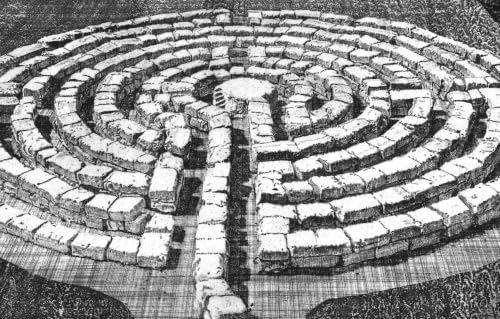
『The Labyrinth』のカバーアート

The Labyrinth

The Labyrinth

著者: Lisa Carley Rich Grego Ph. D.
無料で聴く

【Amazonプライム会員限定】今ならプレミアムプランが4か月 月額99円。

10月19日まで。※適用条件あり
An intentional space to navigate life's paradox in the same way that an arrow is shot from the bow where our aim is true but the destination is not known. You are invited into this community as an intrepid explorer of purpose, meaning, and service regarding the open terrain of spirituality, psychology, motherhood, relationships, The Arts, human potential, awareness, education, science and technology as a springboard to societal innovation and evolution. In a cross-collaboration with both Henry Crettela's Alchemical Dialogues podcast, and Joel Lesses' Unraveling Religion podcast, The Labyrinth seeks to further and promote conversations evolving our understanding of the vital topics of spirituality, the humanities, psychology, and The Arts, and we find deepening community in our mutual support. We have begun posting 'Selected, Best of Alchemical Dialogues' and 'Selected, Best of Unraveling Religion' episodes on 'The Labyrinth.'© 2024 アート スピリチュアリティ 哲学 社会科学
エピソード
  • 'Words From The Heart Penetrate The Heart,' Required Revolution In Education As A Response To AI
    2026/08/19

    In this episode of The Labyrinth, co-hosts Rich Grego and Lisa Carley welcome Joel David Lesses for a conversation about artificial intelligence, education, critical thinking, ethics, creativity, and the future of learning. At the center of the discussion is a fundamental question: what happens to education when artificial intelligence can perform many of the tasks students have traditionally been expected to learn?

    The conversation begins with the growing reality that students are already using AI, even when schools prohibit or restrict its use. Students increasingly describe themselves as overwhelmed and exhausted by academic demands. Rather than responding primarily through punishment or moral judgment, the speakers consider whether educators should first understand why students are turning to AI. While AI can certainly be used to avoid intellectual work, it can also help students manage pressure, access information, explore ideas, and develop their understanding.

    Lisa describes how AI has challenged her to make classroom learning more meaningful and intrinsically engaging. Through literary study, including an examination of Lord of the Flies using psychological concepts such as Maslow’s hierarchy of needs, students can move beyond completing an assignment and begin exploring motivation, human behavior, relationships, and the world around them.

    This leads to a deeper question about the boundary between using AI as a tool and allowing it to replace the thinking process itself. The speakers recognize that technology has always changed how people conduct intellectual work. Research that once required thousands of handwritten index cards can now be organized and explored digitally. AI dramatically expands that capacity, but the important distinction is whether technology supports human thought or substitutes for it.

    The conversation also recognizes AI’s potential to democratize access to knowledge and creative capability. Lisa describes using AI to help develop an application despite not having formal training in business, data analysis, or computer science. Through that process, AI became not simply a means of obtaining answers, but a resource through which he could learn, experiment, and transform ideas into possibilities that might otherwise have remained inaccessible.

    Ultimately, the conversation returns to the human heart.

    AI can provide information, organize knowledge, assist with writing, and generate ideas, but meaningful education involves much more: curiosity, passion, wisdom, compassion, emotional intelligence, ethical judgment, and human relationship. A teacher can make an idea come alive through enthusiasm and genuine connection in ways that technology cannot simply reproduce.

    The speakers therefore move beyond the question of whether AI is good or bad. The deeper question is how we can teach people to use AI without surrendering the human capacities that make learning meaningful. AI may generate information and perform increasingly sophisticated tasks, but education has a deeper responsibility: to help human beings understand, question, create, connect, and develop wisdom.

    The Labyrinth invites us to see AI not simply as a technological disruption, but as an opportunity to reimagine education and place the human heart back at the center of learning.

    続きを読む 一部表示
    43 分
  • Introducing The Labyrinth's New Co-host, Rich Grego, Ph.D.; Wading The Cosmic River Together with Lisa Carley, A Talk
    2026/08/11

    The Labyrinth, hosted by Lisa Carley, introduces Rich Grego, Ph.D., as Lisa’s new co-host and longtime intellectual, spiritual, and personal companion.

    Lisa first knew Rich as her philosophy professor when she was an undergraduate, and their relationship developed into a deep resonance that has continued throughout their lives.

    Lisa describes the purpose of The Labyrinth as entering a space of genuine presence with another person, allowing dialogue to unfold naturally and discovering what emerges rather than beginning with predetermined conclusions.

    Together, Lisa and Rich describe the complementary perspectives they bring to the podcast.

    • Rich approaches contemporary questions through philosophy, history, and spirituality, while Lisa begins with current cultural issues and explores their psychological, existential, and spiritual implications.
    • Their discussions may range from artificial intelligence and education to deeper questions about what it means to be human and spiritually alive.

    Lisa reflects on her intellectual development, particularly her early attraction to philosophers such as Kierkegaard and Krishnamurti. She explains that she once approached these thinkers primarily through intellectual frameworks, eventually recognizing that intellectualization could become a way of avoiding the deeper emotional experiences that initially drew her to philosophy. Her training in existential therapy helped her move away from intellectual abstraction and toward the lived experience of being present with another human being during moments of crisis, revelation, and transformation.

    The central conversation unfolds through ten chronological themes:

    • Intellectualization and emotional experience

    • Lisa’s early encounter with Kierkegaard

    • The limitations of Western philosophical traditions

    • Gender, knowledge, and lived experience

    • Love as experience rather than object

    • Naming versus directly experiencing reality

    • The emergence of the manosphere

    • Objectification, fear, and pornography

    • Masculinity, work, and the loss of identity

    • Humanity’s movement toward greater wholeness

    The discussion ultimately returns to the fundamental purpose of The Labyrinth: creating a space where Lisa and Rich can remain fully present without an agenda and allow the conversation itself to become a practice of exploration. Rather than offering definitive answers, they move through philosophy, psychology, gender, evolution, technology, economics, relationships, masculinity, and spirituality as interconnected dimensions of human experience.

    Lisa emphasizes that her intention is to 'show up' with another person and see where the dialogue leads.

    Rich’s philosophical and historical perspective complements Lisa’s experiential and existential orientation, creating a partnership grounded in curiosity, reflection, affection, and openness.

    Their discussion of gender and philosophy leads naturally into contemporary questions about young men, changing cultural expectations, economic instability, relationships, and the search for identity and purpose.

    They consider whether some contemporary behaviors are symptoms of deeper cultural disorientation and whether society is moving toward a more integrated understanding of human experience.

    Lisa and Rich invite listeners into a conversation where intellectual inquiry and lived experience meet, where difficult cultural questions can be approached without immediate judgment, and where meaning is allowed to emerge through sustained dialogue. The labyrinth is not presented as a problem to solve, but as a space to enter—with curiosity, presence, and a willingness to discover where the path leads.

    続きを読む 一部表示
    59 分
  • 'What Are We In Service To: The Intrinsic Nature of The Universe as Discordant or Meaningful?' Examining Our Phenomenology and Inner Landscape; Pointers, Roadmaps, and Signs
    2026/07/18

    In this episode of The Labyrinth, Lisa Carley introduces Joel Lesses and Rich Grego and engage in a deeply personal narrative exploring purpose, spirituality, identity, and the role of solitude in living an authentic life.

    Lisa begins by reflecting on a question that has become central to her life: how can she use her time in ways that are meaningful not only in the present moment but also in service of a larger purpose? She explains that while she values mindfulness and presence, she is equally interested in understanding how everyday choices contribute to a deeper calling. As an educator, she extends this question to modern education, asking whether schools prepare students simply for careers or whether they help people discover lives of meaning, purpose, and authentic contribution.

    The conversation turns to Lisa's recent experience with an Akashic Record reading, which confirmed intuitions she already held about her life direction. Rather than predicting the future, the reading encouraged her to trust an emerging sense of purpose as she considers moving into a larger artist community. She describes feeling called to become a gathering place for ideas—a person who brings together diverse perspectives, synthesizes them, and shares them in ways that serve others.

    Joel reflects on his own philosophical journey from a worldview that questioned whether life possessed any inherent meaning to one shaped by years of Buddhist practice and the Dharma. He explains that purpose is not something imposed upon life but something discovered through careful attention to one's inner landscape. As people recognize their natural gifts, passions, and values, they begin to understand how they are uniquely called to contribute. Echoing the familiar saying often attributed to Picasso, Joel reminds listeners that the meaning of life is to discover one's gift, while the purpose of life is to give that gift away in service to others.

    Lisa also shares how her understanding of identity has changed. Much of her life had been shaped by defining herself through close relationships, particularly romantic partnerships. Increasingly, however, she is discovering who she is independent of those roles. This deeper relationship with herself has brought greater clarity to her vocation and a stronger sense of alignment with her own path.

    The conversation explores the value of solitude within spiritual traditions, particularly Buddhism, and questions whether time alone can become an essential part of personal transformation. Rather than viewing solitude as isolation, the speakers suggest it offers space for creativity, self-discovery, and deeper listening. Lisa proposes expanding the idea of relationship itself, suggesting that we can learn to be in relationship not only with other people but with life, the universe, and reality itself. Asking what life is calling us toward becomes just as important as asking what others expect from us.

    Throughout the discussion, the speakers emphasize that purpose is rarely discovered through dramatic moments of revelation. More often, it emerges gradually through self-reflection, meaningful work, community, creativity, and service. Authentic living is less about arriving at certainty than about remaining attentive to the patterns that unfold throughout one's life and choosing actions that increasingly align with one's deepest values.

    Ultimately, this episode invites listeners to reconsider conventional ideas of success and fulfillment. Rather than measuring life solely through achievement or external recognition, Joel, Lisa, and Rich encourage a lifelong exploration of calling, authenticity, and service. Purpose is not simply a destination waiting in the future—it is something revealed through the choices we make, the lives we touch, and the willingness to remain open to the unfolding mystery of our own experience.

    続きを読む 一部表示
    17 分
adbl_web_anon_alc_button_suppression_t1
まだレビューはありません